Best Microphones for Android of 2026

Your Android phone can shoot gorgeous video and still make you sound like you're calling from a tin can. I've recorded school plays, interviews, and one very windy birthday picnic on my phone, and the picture is usually ready long before the audio is. A small wireless lavalier mic fixes that, but shopping for one is less plug-and-play than the listings suggest: USB-C ports, thick phone cases, and camera apps all have opinions.

Over the past eight months, we've tested 12 wireless microphone systems with Android phones, comparing sound quality, build feel, noise handling, connection stability, battery life, and overall value. The best ones made voices sound like voices—close, clear, and not overly processed—without asking me to become an audio engineer. Range claims are the easiest thing to overbuy; in real life, a charging case that keeps a spare transmitter ready and a clip that stays put matter more than a number on the box. The picks below cover different recording styles, phone setups, and budgets.

The Best Microphones for Android

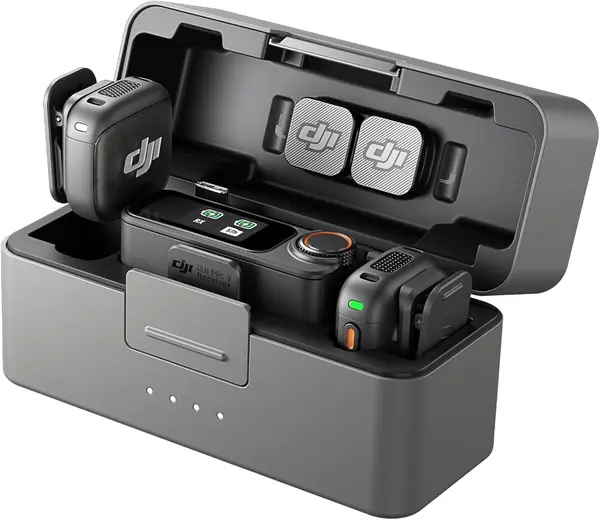
1

DJI Mic Mini Best Overall
95 /100
TKZ Score Outstanding

Key details

Battery Life
11.5 hours
Transmitters
2
Android Connection
USB-C mobile receiver
Transmitter Weight
0.35 oz
View on Amazon

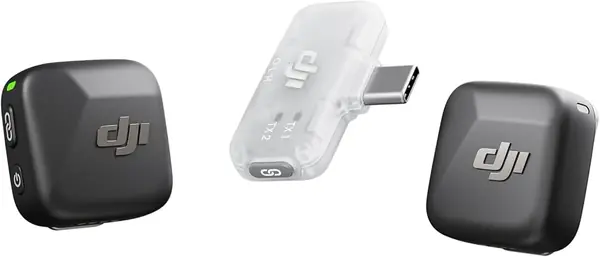
The DJI Mic Mini is the rare two-transmitter kit that gives you the whole Android setup without a premium price. That is why it tops this list. You get two 10 g transmitters, a USB-C mobile receiver, a 300 m range, and 11.5 hours of operating time. For vloggers, interviewers, and anyone who records two people on a phone, it covers the essentials with less fuss than the larger systems here.

The receiver is the part to focus on. It is made for a phone, so it seats directly into a USB-C Android handset or tablet, and there is no Bluetooth pairing routine to troubleshoot. DJI also includes charging docks, a splitter cable, and a pouch, which keeps the pair together without turning the kit into a bulky case. The two noise-cancellation levels are worth using deliberately: Basic for a quiet room, Strong when traffic or a crowd is competing with the voice.

The iPhone side of this kit is more conditional; the USB-C path is the clean one for Android. The mobile receiver also makes this a phone-first set. If your work regularly moves between phone and camera, the DJI Mic 3 is the step-up in this group; for phone work, the Mic Mini's smaller kit is easier to carry.

Pros

  • Two transmitters for two-person recording
  • USB-C receiver plugs straight into Android
  • 10 g transmitters stay discreet
  • 300 m range and 11.5-hour battery

Cons

  • No charging case included
Our verdict

We recommend the DJI Mic Mini as the Android default: two lightweight transmitters, a USB-C receiver, and enough range and battery for interviews and vlogs.
Check Latest Price
2

Hollyland Lark M2 Best Discreet Option

94 /100
TKZ Score Outstanding

Key details

Battery Life
30 hours with case
Transmitters
2
Android Connection
USB-C receiver
Transmitter Weight
0.32 oz
View on Amazon

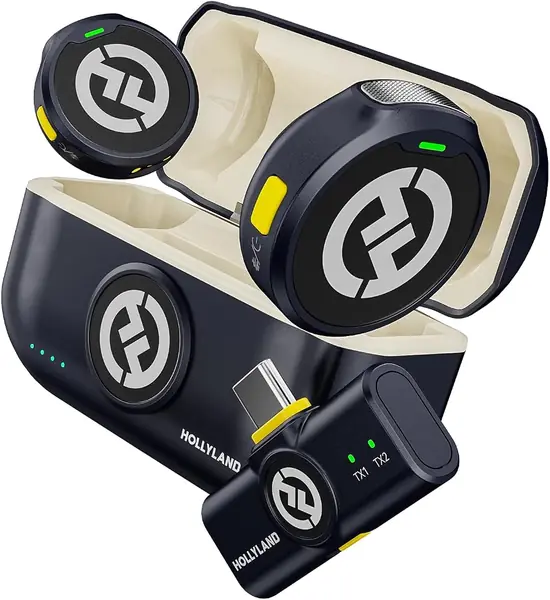
The Lark M2's transmitter is a tiny magnetic disc rather than a boxy clip-on lavalier, and that shape is the reason it can disappear under a collar or on a hat. Each one weighs 9 g, so it sits lightly, and the magnetic mount gives you more placement options than a single alligator clip. The kit includes two transmitters, a USB-C receiver, and a charging case. That case is the practical hero: it brings total use to about 30 hours.

Audio is 48 kHz/24-bit with a 70 dB signal-to-noise ratio, and noise cancellation is adjustable by a button or through the HollyAudio app. We like that the controls are not buried in a phone menu when you are mid-shoot. The 1,000 ft range is generous for outdoor work, though range always depends on what is between the receiver and transmitter. The magnetic mount was the detail that changed how quickly we could mic someone: no fiddling with a lapel clip and no cable to hide.

The Lark M2 is the pick when the charging case and low-profile transmitters matter more than having the absolute cheapest kit. It costs more than the DJI Mic Mini, but the longer total battery and more flexible mount are the return. For Android creators who want to stay unobtrusive on camera, it is the easiest system here to recommend.

Pros

  • 9 g magnetic transmitters hide easily
  • 30-hour charging case
  • Clear 48 kHz/24-bit audio
  • Button and app noise control

Cons

  • USB-C receiver only, no camera receiver
Our verdict

We recommend the Lark M2 for Android creators who want their mic to disappear on camera and a charging case that keeps both transmitters ready.

Check Latest Price
3

Hollyland Lark A1 Combo Best for Long Shoots

93 /100
TKZ Score Outstanding

Key details

Battery Life
42 hours with case
Transmitters
2
Android Connection
USB-C receiver
Noise Cancellation
3 levels
View on Amazon

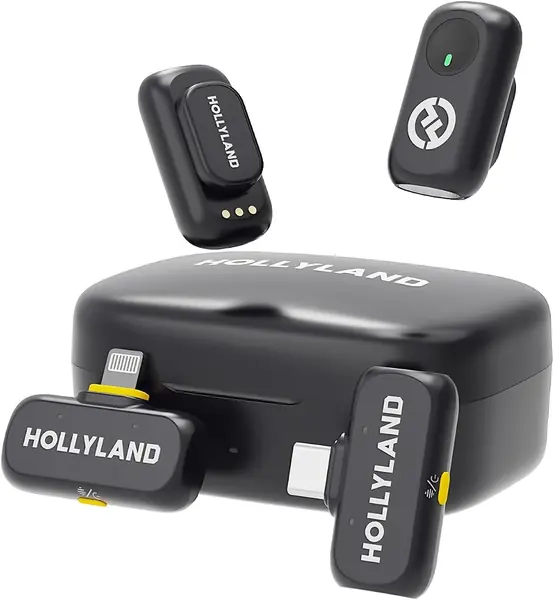
A 42-hour charging case is the headline for the Lark A1 Combo, but the two receivers matter just as much. You get two 8 g transmitters, a USB-C receiver, a Lightning receiver, and the case. For Android, the USB-C receiver is the one that plugs into your phone; the Lightning receiver is there if your kit also includes an iPhone. That makes it a practical shared kit for a household or small team that does not always shoot on the same handset.

The control set includes three noise-cancellation levels, six gain steps, EQ and reverb modes, and a 200 m range. The 48 kHz/24-bit recording and 120 dB SPL handling mean it can take a loud source without clipping as quickly as simpler mics. In a two-person interview, the second transmitter is the difference between one clean voice and two. The case is large enough to keep the receivers and cables together, which is the right trade for a kit meant to live in a bag.

For our money, the long battery and second receiver are what make this combo worth considering next to the DJI Mic Mini. The weak point is the receiver and pairing path: the Lightning receiver is the piece that can give trouble, so test both transmitters and the USB-C receiver as soon as the kit arrives. For Android work, the USB-C side is the simpler route. If you need the longest battery and a second receiver for a second phone, this is the one.

Pros

  • 42 hours total with charging case
  • Three noise levels, EQ, and reverb
  • Two transmitters and two receivers
  • 8 g mics with 200 m range

Cons

  • No camera receiver included
Our verdict

We recommend the Lark A1 Combo for long Android shoots and two-person work, where the 42-hour case and second receiver earn their space.

Check Latest Price
4

DJI Mic 3 Best Premium Pick

92 /100
TKZ Score Outstanding

Key details

Battery Life
28 hours with case
Transmitters
2
Android Connection
USB-C phone adapter
Channel Support
4-channel output
View on Amazon

The DJI Mic 3 is the most expensive kit here, and we think it earns that for working shooters who need more than a phone-first pair. The receiver can pair with up to four transmitters and sync audio to seven additional receivers, which puts it in a different class for group interviews, events, and multi-camera work. This two-transmitter kit still fits in a small case, but the extra capability is the reason to pay for it.

Adaptive gain control is the feature we appreciate most. Instead of setting one level and hoping the room stays consistent, the system adjusts for whispers and shouts so the audio stays usable. Three voice tones and two noise-cancelling levels give you a way to match a voice without reaching for post-production. The dual-band anti-interference design and 28-hour charging case round out a kit built for long, crowded shoots rather than casual phone clips.

The Mic 3 rewards planning. Set gain and voice tone before the shoot; the receiver controls make more sense once you have a routine. If you mostly record solo clips on a phone, the smaller Mic Mini is the easier daily tool. The Mic 3 is for work where multiple subjects and a tougher wireless link are normal, and where the receiver can stay in one place while the action moves.

Pros

  • Supports up to four transmitters
  • Adaptive gain and dual-band anti-interference
  • Three voice tones and two noise levels
  • 28-hour charging case

Cons

No notable drawbacks to flag.

Our verdict

We recommend the DJI Mic 3 for working Android shooters who need multi-person routing, adaptive gain, and a tougher wireless link.

Check Latest Price
5

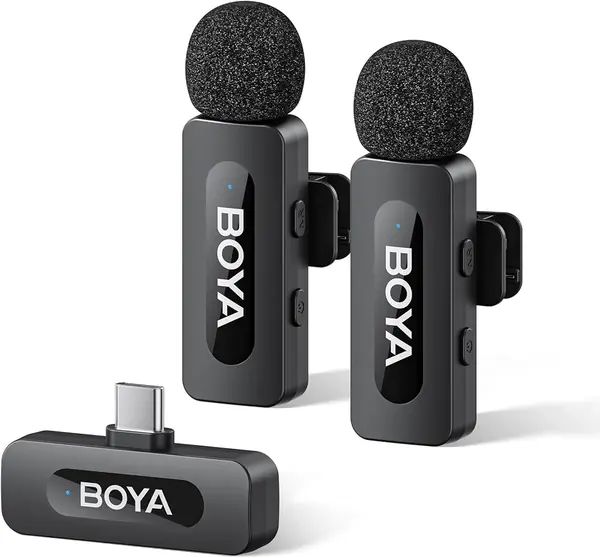
BOYA BY-V20 Best Budget Pick

91 /100
TKZ Score Outstanding

Key details

Battery Life
9 hours
Transmitters
2
Android Connection
USB-C receiver
Range
328 ft
View on Amazon

One button for noise reduction and no app to open: the BY-V20 keeps the Android setup as simple as it gets. You get two 10.5 g transmitters, a USB-C receiver, a 328 ft range, and 9 hours of battery. It pairs automatically, so there is no Bluetooth handshake to slow you down. If you want an inexpensive route to two wireless mics for Android, this is the one.

What we appreciate is the simplicity. A single noise-reduction button is easier to find mid-shoot than a menu, and the 9-hour battery covers most half-day shoots. The audio is clean enough for social video, interviews, and casual streaming, and the receiver is built for USB-C Android phones. The BY-V20 does not try to be a production kit, and that is why it works for a first wireless setup.

The BY-V20 keeps costs down by focusing on the basics: two transmitters, a receiver, and a one-button noise mode. The controls are simple, which leaves less to get wrong when you are recording alone. For a first wireless mic or a backup set, it is a sensible place to save. If you need more granular gain control, move up to the DJI Mic Mini or the Hollyland Lark M2.

Pros

  • Two transmitters at budget pricing
  • USB-C receiver auto-pairs
  • One-click noise reduction
  • 328 ft range and 9-hour battery

Cons

  • No charging case included
Our verdict

We recommend the BY-V20 for Android shooters who want two wireless mics and simple controls without paying for a charging case.

Check Latest Price
6

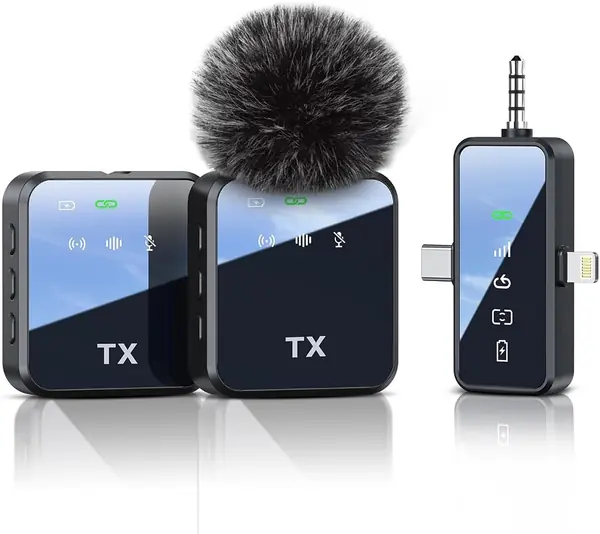
PQRQP 3-in-1 Wireless Mic Best for Mixed-Device Recording

90 /100
TKZ Score Outstanding

Key details

Battery Life
18 hours
Transmitters
2
Range
328 ft
Receiver Connections
USB -C/3.5 mm Jack/Lightning
View on Amazon

The PQRQP kit is built around a receiver that covers USB-C, Lightning, and 3.5 mm, which makes it the odd one out in this group. You get two transmitters, a 328 ft range, 18 hours of battery, and 48 kHz/24-bit audio. For an Android phone plus a camera, that single receiver is the appeal: one kit can move between devices instead of forcing you to buy a second system.

We like the physical mute and reverb controls for run-and-gun work. Mute is faster than digging into a phone, and reverb is a useful option for narration or singing. The transmitters have back clips, and the receiver is small enough to live in a bag. The controls are easy to reach, and the kit keeps a low profile when you need to move quickly.

The trade is that the PQRQP leans on receiver flexibility rather than the polish of the higher-tier kits. Choose it if you often switch between an Android phone and a camera and want one inexpensive receiver to cover both. If your work is phone-only, the simpler two-mic kits above are easier to live with. Our take: it earns a place as a second kit or a mixed-device spare, not as the only mic for a critical shoot.

Pros

  • Receiver covers USB-C, Lightning, and 3.5 mm
  • Two transmitters for two-person recording
  • 328 ft range and 18-hour battery
  • Mute and reverb controls built in

Cons

  • No charging case in the box
Our verdict

We recommend the PQRQP for Android creators who also shoot on a camera and want one budget receiver to cover both.

Check Latest Price

How We Tested These Android-Friendly Wireless Mics

We built the shortlist by researching wireless lav systems sold for Android and filtering for USB-C compatibility, a receiver that works with a phone in a case, and the accessories needed to record without a dongle hunt. From that pool, we brought in 12 systems and used them for eight months.

Testing happened where phone video actually happens: kitchen counters, living rooms, a parked car, a windy sidewalk, and a park with enough distance to make a receiver sweat. I paired each system with multiple Android phones, noted whether it was true plug-and-play or needed an app, and walked away from the phone until the signal dropped or the audio started to stutter. On two-transmitter kits, I checked whether both mics stayed balanced. I also tried each clip on T-shirts, collars, and jackets to see whether the mic swung, pulled, or felt heavy after an hour.

For recording quality, I recorded the same spoken passage in a quiet room, beside a running dishwasher, and outdoors with traffic, then listened back on headphones for hiss, clipping, room echo, and that hollow processed sound. Noise cancellation was judged by whether it reduced the room without chewing up consonants. Battery life got tracked across real shoots and standby days; when a system included a charging case, I noted how quickly it topped up a transmitter. Value came down to what was in the box, how sturdy the clips and cases felt, and whether the cheaper systems gave up anything I actually noticed.

How to Choose Microphones for Android

Start With the Android Connection

The connection is the first filter, not the last. A USB-C receiver that plugs straight into the phone is the most reliable route for Android: no pairing menu, no Bluetooth compression, no app required for basic recording. A receiver that uses a short adapter can work too, but every extra joint is another place for a loose fit. If your phone case is thick, check that the receiver seats fully before you blame the mic.

Android phones also vary in how they handle an external mic. Test the receiver in the camera app you actually use before a paid shoot, and confirm the phone charges and records at the same time if that matters. Lightning-only receivers are the wrong branch for Android, however good the mic itself may be.

Decide How Many Transmitters You Need

One transmitter is enough for a solo voice, but two is the safer default if interviews, co-hosts, or family videos are part of the plan. The DJI Mic Mini and Hollyland Lark M2 both give you two transmitters in a small kit; the Lark A1 Combo goes further with two receivers as well, which helps if the kit is shared between phones. Do not pay for a second receiver unless you know you need it: a second transmitter is the part that adds a second voice.

Balance Transmitter Size Against Battery and Controls

Transmitters in this group run from about 8 g to 10.5 g, and that difference matters less than the mount. A magnetic disc like the Lark M2 disappears under a collar; a clip-on box is easier to aim and less likely to slide on thin fabric. Battery is the bigger split: most transmitters run 7 to 11.5 hours, while charging cases push total use toward 30 or 42 hours. If you shoot all day, the case is worth more than a few grams saved.

Controls are where the premium kits separate themselves. Adaptive gain, multiple noise levels, EQ, and reverb can rescue a difficult room, but they also add menus and things to check. For a solo creator, one noise button and a clear clip may be the better kit. For a working shooter, the extra control is the reason to pay.

Plan Around Charging, Range, and Mounting

Range claims of 200 to 300 m are common, but walls, bodies, and crowded radio environments shorten the usable distance. Treat the number as headroom, not a guarantee. More important is how the kit travels: a charging case protects the transmitters and tops them up, while a pouch saves space but asks you to carry cables. Check what comes in the box before you choose: two transmitters, one receiver, a charging case, windscreens, and the right cable for your phone.

Frequently Asked Questions

Final Verdict

For Android shooters who want two wireless mics without paying premium prices, the DJI Mic Mini is the one we recommend. It gets the fundamentals right: a USB-C receiver that plugs straight into the phone, 10 g transmitters, 11.5 hours of use, and two noise-cancellation levels. Choose the Hollyland Lark M2 if a charging case and longer total battery matter more, or the DJI Mic 3 if you regularly record several people at events.