Best GPS Watches for Hiking of 2026

Halfway up a switchbacked climb last fall, my watch flashed a low-battery warning and went dark, which is how I ended up squinting at a fork in the trail with a paper map I hadn't unfolded in years. A good hiking GPS watch makes that impossible: it holds a satellite lock under tree cover, tells you how much climbing is left, and still has enough juice to walk you back to the trailhead.

The thing nobody tells a first-time buyer is that battery life and screen brightness pull against each other. A big, bright color display is wonderful in direct sun and hard on a long day out, so the real question isn't the claimed runtime — it's what's left once you switch on that display and the built-in flashlight, two features that turned up on multiple watches here and two I now use constantly.

My team and I have worn seven of these for the past eight months. Below are the ones that earned a permanent spot on my wrist, sorted by who they actually suit.

The Best GPS Watches for Hiking

1

Garmin Instinct 3 AMOLED Best Overall
91 /100
TKZ Score Outstanding

Key details

Battery
Up to 18 days
Display
1.2-inch AMOLED
GPS
Multi-band with SatIQ
Weight
1.87 oz
View on Amazon

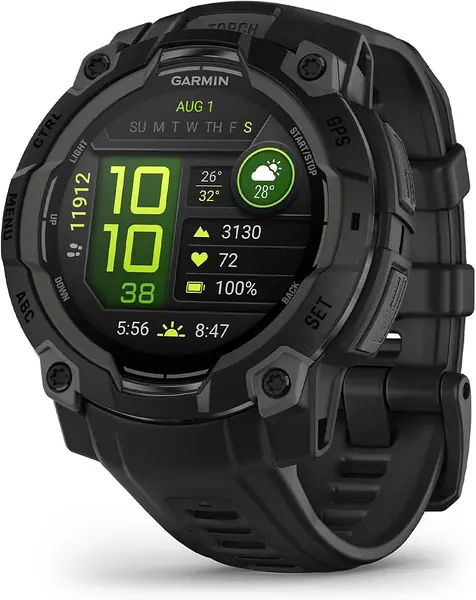
The Garmin Instinct 3 AMOLED is the watch we reach for when a hike is part of a normal day, not an expedition. At 45 mm and 53 grams, it has enough wrist presence to feel rugged without turning into a paperweight, and the 1.2-inch AMOLED panel is bright enough at 1,000 nits to read under tree cover. We also appreciate the metal-reinforced bezel and fiber-reinforced polymer case: they give the watch a tough look without making it feel armored.

Navigation is where it earns the top spot. The multiband GPS with SatIQ is designed to hold a fix while managing battery drain, and the 3-axis compass and barometric altimeter give you the sensor set a hiker actually uses. We paid close attention to that combination because a watch can have a long feature list and still be annoying at a trail junction. This one keeps the essentials in view: distance, elevation, heading, and a GPS fix that has more than one satellite band to work with.

Battery life is rated at up to 18 days in smartwatch mode, which is generous for weekend-to-weekday wear. The built-in flashlight is the detail we came back to; it is genuinely useful for a pre-dawn start, a route check before sunrise, or digging through a pack after dark. The 100-meter water rating means rain and stream crossings are not a reason to take it off.

What we like most is how little the watch asks of you. You can wear it to sleep, take it into wet weather, and still have a screen that reads at a glance. The 22 mm band keeps the case from feeling too wide on smaller wrists, and the button layout works with gloves, which matters more on a cold ridge than any animation on the display.

Pros

  • Multi-band GPS with SatIQ
  • Bright 1.2-inch AMOLED
  • Light 53 g build
  • Flashlight and 100 m water resistance

Cons

  • Battery trails the other picks
Our verdict

We recommend the Garmin Instinct 3 AMOLED as the best all-around hiking watch here for most people: multiband GPS, a bright 1.2-inch screen, and a 53 g build that disappears on the wrist.
Check Latest Price
2

Amazfit T-Rex 3 Best for Mapping on a Budget

90 /100
TKZ Score Outstanding

Key details

Battery
Up to 27 days
Display
1.5-inch AMOLED
GPS
Dual-band positioning
Maps
Offline global maps
View on Amazon

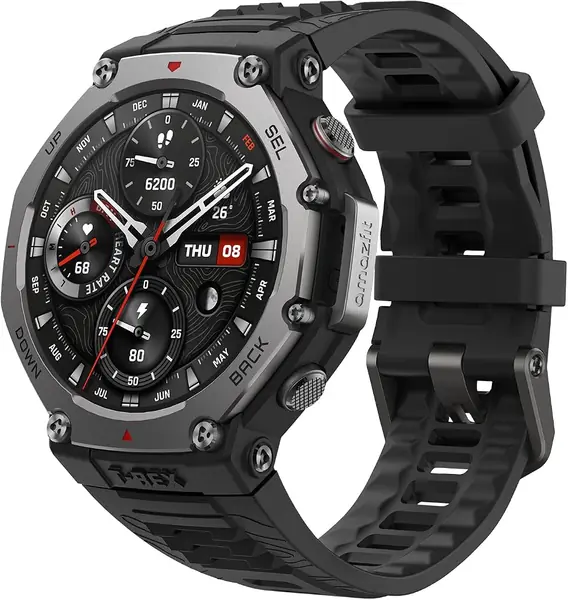
The Amazfit T-Rex 3 makes the biggest first impression of the three. Its 1.5-inch AMOLED display hits 2,000 nits, which is bright enough to make a topo map or split time legible in direct sun, and the 316L stainless steel bezel gives it a more expensive look than its price suggests. At 2.4 ounces, it sits between the two Garmin picks on weight: substantial, but not a dive watch.

The headline feature is offline mapping. Free global maps and dual-band positioning are the reason to choose this watch over the Instinct 3, and the 27-day typical battery plus 180-hour GPS rating make it a strong multi-day companion. We like that combination for hikers who plan a route on a laptop and want to follow it without a phone. The 1.5-inch screen is the part we miss when we switch back to a smaller watch.

Battery life is the other draw, and the numbers are easy to translate: 27 days in typical use covers a long weekend without a charger, while the 180-hour GPS rating is the one to compare for back-to-back hiking days. The magnetic charging base is included, but the box does not include a USB-C cable, so check your charging setup before you leave. Glove Mode is a useful detail for cold-weather starts.

Heart-rate readings are the inconsistent part. They can wander during hard climbs, so if you train by zones, pair a chest strap or treat the watch's numbers as a rough guide. That does not spoil the navigation experience, and the steel bezel is the detail that keeps it from looking like a cheap trail gadget when it is the only watch you pack.

Pros

  • Large 1.5-inch 2,000-nit AMOLED
  • Offline global maps
  • 27-day typical battery, 180-hour GPS
  • Rugged 100 m steel-bezel case

Cons

  • Map controls take practice
  • Bluetooth pairing can be unreliable
Our verdict

We recommend the Amazfit T-Rex 3 for hikers who want the biggest screen and offline maps for less, and who will practice the map controls before relying on them.

Check Latest Price
3

Garmin fēnix 7X Pro Solar Best for Large Wrists and Long Trips

88 /100
TKZ Score Excellent

Key details

Battery
Up to 37 days
Display
1.4-inch MIP
Weight
3.39 oz
Charging
Solar-assisted
View on Amazon

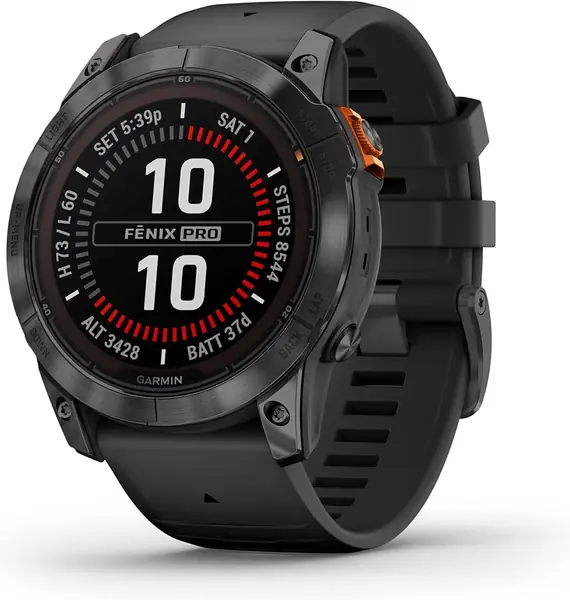
The Garmin fēnix 7X Pro Solar is the big-wrist option in this group. The 1.4-inch MIP display is always visible without a wrist turn, and the solar lens adds charge whenever you are in direct sun. We appreciate that combination for long days above tree line, where a glance at the screen should not cost battery or require fumbling with a touchscreen.

Battery life is the reason to step up: up to 37 days in smartwatch mode, the longest here, with solar assistance that can stretch that further in the right conditions. The built-in flashlight is useful, and the hill and endurance scores give hikers a way to track climbing fitness over time. We also like that Garmin kept physical buttons alongside the touchscreen; wet gloves and a sweaty screen are not a good pairing.

The 51 mm case and 26 mm band make it the biggest watch here, so it suits a larger wrist better than the 45 mm alternatives. The included USB-C cable is a small practical win if you already travel with USB-C gear. If you want a watch that disappears under a cuff, this is not it; if you want a big screen and a battery that outlasts a week-long trip, the size is the point.

Pros

  • Up to 37 days with solar assistance
  • Large 1.4-inch always-on MIP display
  • Physical buttons plus touchscreen
  • Built-in flashlight and USB-C charging

Cons

  • 96 g is heavy for all-day wear
Our verdict

We recommend the Garmin fēnix 7X Pro Solar for hikers with larger wrists who want the longest battery and a big always-on display in a premium build.

Check Latest Price

How We Tested These Hiking Watches

We started with every hiking-focused GPS watch we could find below a sensible price ceiling, then cut the list by sensor loadout, onboard navigation, battery claims, and how replaceable the straps looked. That left seven watches, worn on a rotating basis for eight months. Testing happened where these things actually live: a training loop with known distance and elevation, humid switchbacks under heavy canopy, an exposed ridge with a clean sky view, one wet overnight trip, and plenty of ordinary days at a desk.

Accuracy got checked against something other than the watch's own marketing. We compared recorded distance and elevation to published trail markers and a phone app, then zoomed in on the track logs to see whether a watch cut corners on switchbacks or wandered while we stood still. We also timed how long each took to lock onto satellites from a cold start at the trailhead. For battery, every watch went out charged to full, and we logged the percentage drop per hour with GPS running in both standard and high-accuracy modes, plus how many days it lasted as an everyday watch between charges. For connectivity, we paired each one to a phone, pushed a route over, walked out of signal, and checked whether notifications and syncing recovered.

Ease of use was judged with cold hands and gloves on, mid-climb, without stopping: could we start a hike, back out of a wrong screen, and read the elevation at a glance? Durability got tested by scraping bezels against granite, dunking in a creek, and wearing them through mud, sweat, and sunscreen, then checking for scratches and fogged glass. We wore them to dinner and to the office to see how they read as a watch and not just a gadget, and weighed what each one asked of us against what it gave back.

How to Choose a Gps Watch for Hiking

Start With the Navigation You'll Actually Use

Multi-band GPS is the first thing we look for on a hiking watch. It uses more than one satellite band to hold a fix in places where a single-band watch may struggle, and features such as Garmin's SatIQ manage the accuracy-versus-battery trade. Satellite-system counts on a spec sheet tell you less than a clear, usable navigation screen. Decide whether you need on-wrist maps or whether a compass, altimeter, and route guidance are enough; if you go off-trail, prioritize downloadable maps and practice the controls before the trailhead.

Match Battery Life to the Trip

Smartwatch-mode days and GPS-mode hours are different currencies. A watch rated for weeks in daily wear can still run out on a long GPS day, especially with mapping, backlight use, and cold weather. Look for both numbers, and treat solar as a supplement rather than a guarantee: the fēnix 7X Pro Solar benefits from sun, but a shaded forest is not a charging station. For weekend hikes, 18 days of smartwatch life is plenty; for multi-day trips, compare GPS-mode ratings directly.

Choose a Display You Can Read With Gloves On

AMOLED screens look sharp and colorful, and the T-Rex 3's 1.5-inch panel is the brightest here at 2,000 nits. MIP displays like the fēnix 7X Pro Solar's are always visible in sun and sip power, but they are less vivid. Buttons matter as much as the panel: wet fingers and liner gloves make a touchscreen unreliable, so we prefer watches that keep physical controls for start, stop, and lap. If you navigate mostly by glance, prioritize contrast and always-on visibility over animation.

Wear the Weight Before You Commit

A 45 mm watch around 53 g is easy to wear all day; a 51 mm, 96 g watch is a different commitment, especially on a small wrist or under a rain shell. Larger cases can be easier to read and carry bigger batteries, but they catch on pack straps and feel heavy at night. Match case width to wrist size, and think about the band: a 26 mm strap has more surface area and less ventilation than a 22 mm one. If you sleep in the watch, comfort matters as much as battery.

Frequently Asked Questions

Final Verdict

For most hikers, the Garmin Instinct 3 AMOLED is the easy recommendation. It has the multiband GPS, bright screen, low weight, and long-enough battery to handle three-season day hikes and weekend trips without fuss.

Choose the Amazfit T-Rex 3 if offline maps and a bigger display are the priority, or the Garmin fēnix 7X Pro Solar if you have a larger wrist and want the longest battery and a big always-on screen.