Best Multisport GPS Watches of 2026

A multisport watch is a negotiation between two things that don't get along: a screen bright enough to read at noon on an exposed ridge, and a battery that still has something left for the ride home. Get the balance wrong and you're either squinting at your wrist or plugging in every night. Get it right and the watch disappears into your training.

I've spent the past six months wearing seven of these on trail runs, pool laps, and a slow daily bike commute, with my team logging the same sessions beside me. The one I reached for on race morning was rarely the one with the biggest spec sheet.

Here's what nobody tells a first-time buyer: quoted battery life assumes smartwatch mode with the screen mostly off. Turn on an always-on AMOLED and multi-band GPS and you can watch that estimate fall. Case size is the other thing to settle early — a 51mm watch on a small wrist is a genuine nuisance. The picks below are sorted by what you'll actually ask of one.

The Best Multisport GPS Watches

1

Garmin Instinct 3 AMOLED Best Overall
93 /100
TKZ Score Outstanding

Key details

Battery Life
Up to 18 days
Display
1.2 in AMOLED
GPS
Multi-band with SatIQ
Weight
1.87 oz
View on Amazon

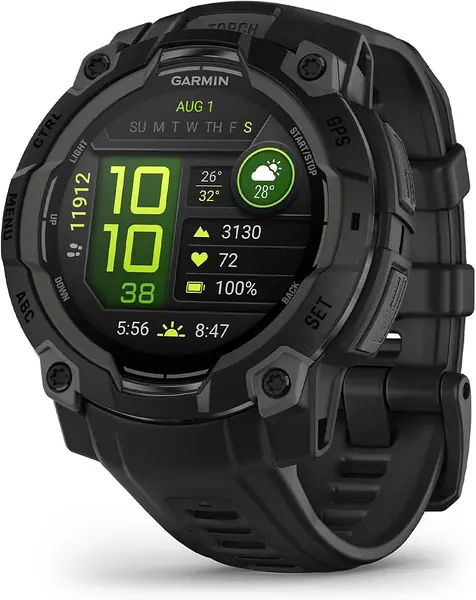
Multi-band GPS, eighteen days of battery, a bright AMOLED screen, and a built-in flashlight is a fair description of a flagship watch. Here it describes the midrange one. The Instinct 3 AMOLED covers the parts of multisport training that actually get used — solid positioning, a screen you can read at noon, battery that outlasts a training block — without charging you for titanium, and that is why it is our top pick.

Positioning is where the money goes. Multi-band GPS with SatIQ means the watch pulls from more than one satellite frequency and switches modes on its own, so a route through tree cover or a city canyon doesn't wander the way single-band tracks do, and the battery cost stays contained. We also came to appreciate the button-only controls: with gloves on or hands wet, physical buttons beat stabbing at glass.

The 1.2-inch panel is the smallest screen in this group, which you notice at a glance — two or three data fields read fine, and you set it up accordingly. The fiber-reinforced polymer case is the other trade: light, happy to be knocked against a door frame, and plainly a tool rather than a dress watch. Neither slows a workout down, and at 53 grams the watch disappears overnight, which is what makes the sleep and recovery numbers worth reading at all.

Pros

  • Multi-band GPS with SatIQ at midrange money
  • Up to 18 days in smartwatch mode
  • 53 g

Cons

  • 1.2-inch display is the smallest here
  • Polymer case looks more tool than jewelry
Our verdict

We recommend the Instinct 3 AMOLED to anyone who wants multi-band GPS, real battery life, and a readable screen without paying flagship money.
Check Latest Price
2

Garmin epix Pro (Gen 2) Sapphire Best Big-Screen Training Watch

92 /100
TKZ Score Outstanding

Key details

Battery Life
Up to 58 hours
Display
1.4 in always-on AMOLED
Case
51 mm titanium
Weight
3.1 oz
View on Amazon

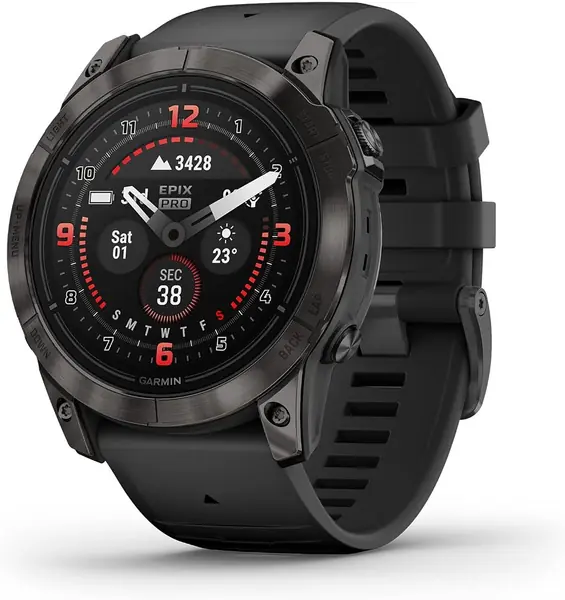
Fifty-one millimeters across and 88 grams on the scale: the epix Pro is the biggest watch here, and the size question comes before anything else. If your wrist can carry it, the payoff is the nicest screen-and-glass pairing in this group — a 1.4-inch always-on AMOLED under a sapphire lens, set in a titanium bezel, rated at 1,200 nits and not the least bit bothered by door frames.

The training side is where this watch earns its keep for anyone chasing fitness rather than logging miles. Hill score and endurance score turn a season of climbing and long rides into two numbers you can watch move, HRV status and Pulse Ox feed the recovery picture, and the built-in flashlight is the feature we came back to most — a strobe on a night run or a light over a tent stake beats another data field. This is the deepest training package in the group.

Two things to know before you commit. The weight is real: 88 grams is fine for a workout and noticeable at 2 a.m., so if overnight recovery tracking is the reason you are buying, the lighter Instinct 3 is the better bet. And the failure to watch for is a watch that quits outright rather than one that drifts, so buy from a seller with an easy return window and put it through a hard week early. Garmin's published 58-hour battery figure also doesn't line up neatly with the day counts the other watches quote, so don't read it as a week.

Pros

  • Always-on 1.4-inch AMOLED, bright at 1,200 nits
  • Sapphire lens and titanium bezel resist scratches
  • Hill score, endurance score, and HRV status

Cons

  • 88 g is heavy for overnight wear
  • Premium price against the midrange picks
Our verdict

We point big-wristed, data-hungry athletes to the epix Pro for its always-on AMOLED and training scores, as long as they can live with the weight.

Check Latest Price
3

Apple Watch Ultra 3 Best for iPhone Users

91 /100
TKZ Score Outstanding

Key details

Battery Life
Up to 42 hours
Case
49 mm titanium
Connectivity
GPS, cellular, satellite
View on Amazon

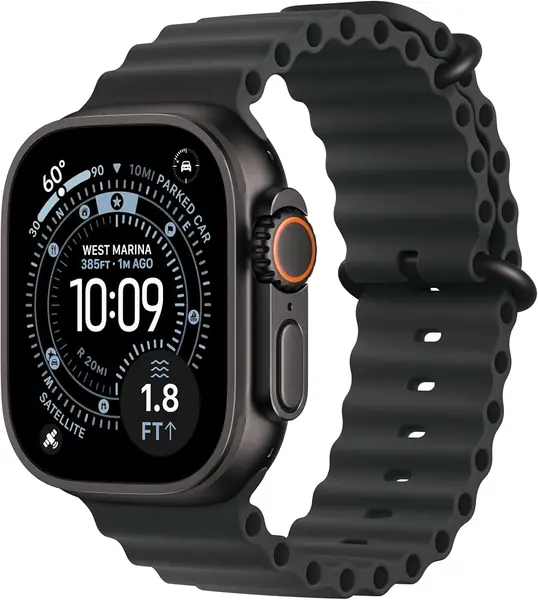
Forty-two hours is the number that decides this watch. Against the weeks-long Garmins it looks small; against every Apple Watch that came before it, it is a different animal — up to 72 hours in low power mode means a weekend of trail runs and a night in a tent without hunting for a charger, and that is the whole argument in one figure.

Everything else is the best version of an Apple Watch. The 49 mm titanium case and sapphire crystal take hits that would mark aluminum, the display is the brightest in this group by a wide margin, and cellular plus satellite messaging means the phone can stay in the car. Add ECG and heart-rhythm checks, hypertension alerts, and fall and crash detection, and it is the deepest set of health safeguards here — no other watch in this roundup lists an ECG.

The costs are the same two that have always followed the Ultra. It is a chunky slab that catches on long sleeves, and it pairs with an iPhone only, so the Android half of the audience is out before the battery conversation starts. Charge it every second or third night and it never becomes a problem; head out for a long weekend without a cable and it will.

Pros

  • Brightest, toughest display in this group
  • ECG, rhythm checks, and hypertension alerts
  • Cellular and satellite messaging without a phone

Cons

  • Needs charging every two to three days
  • Pairs with iPhone only
Our verdict

The Ultra 3 is the pick for iPhone owners who want a serious training watch that is also the best smartwatch here, and who can live with two-day charging.

Check Latest Price
4

KOSPET Tank T4 Special Edition Best for Rugged Budget GPS

84 /100
TKZ Score Excellent

Key details

Battery Life
Up to 15 days heavy use
Display
1.43 in AMOLED
GPS
Dual-band, offline maps
Water Rating
10 ATM / IP69K
View on Amazon

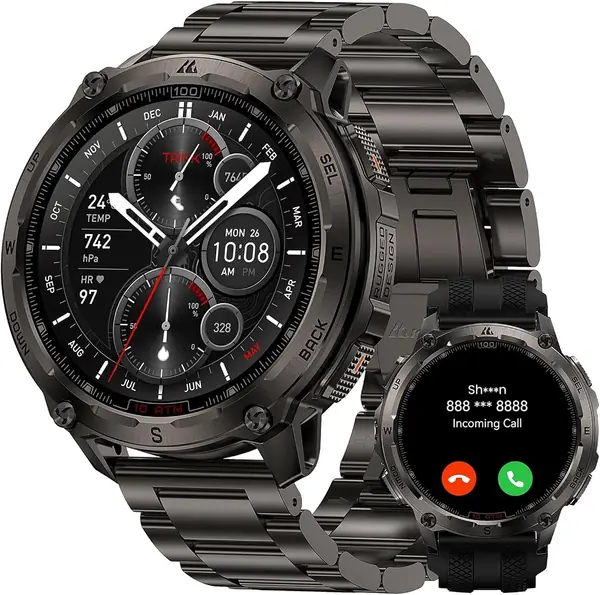
IP69K, 10 ATM, a stainless steel case, and two straps in the box: the Tank T4 Special Edition is built like something you take offshore, and it costs less than either Garmin here. That is an unusual combination at the low end of this group, and it is the reason the watch earned a place in a roundup of serious training tools.

The surprises are the display and the navigation. A 1.43-inch AMOLED at 1,000 nits is bigger and brighter than the Instinct's panel, and dual-band GNSS with offline maps means you can load a route and follow it with the phone left at home — genuinely useful for hiking and diving, where the watch is often the only screen you have. The 180 sport modes are the least interesting part of that pitch, but they are there.

Then the compromises. The 320 x 320 resolution is the softest here, and text and map tiles look coarse beside the others. The app and on-watch menus also take more patience than Garmin's or Apple's, which stings when you sit down to review a week of workouts. For a swimmer, hiker, or diver who wants tracks, a rugged body, and a strap swap, neither is disqualifying. The steel bracelet in the box is the detail that surprised us — it turns a rugged GPS watch into something you can wear to work.

Pros

  • 10 ATM and IP69K in a stainless case
  • Dual-band GPS with offline maps
  • Two bands included, metal and silicone

Cons

  • 320 x 320 screen is the softest here
  • App and menus are the least polished here
Our verdict

We recommend the Tank T4 to rugged-outdoor buyers on a budget who want dual-band GPS and offline maps and can accept a coarser screen and app.

Check Latest Price

How We Tested Seven Watches Over Six Months

We built the shortlist by pulling every multisport watch with multi-band GPS, an always-on color display, and genuine water resistance, then filtering by case size and price band so the group covered different wrists and budgets rather than a lineup of flagships. Anything that couldn't record a swim, a ride, and a run without a phone nearby didn't make the cut.

Each watch then went onto a wrist for six months on a fixed rotation: Tuesday track intervals, a Wednesday pool session, a long Saturday trail run, and weekend hikes through the kind of tree cover that wrecks a GPS trace. One tester wore his through a 50-mile charity ride; another wore hers through a week of nothing but treadmill runs, because a watch still has to survive the boring weeks.

For accuracy, we ran the same measured 10K loop and compared each trace against a calibrated foot pod, noting where lines cut switchbacks or drifted into the trees. We read pace and heart rate outdoors at noon with sunglasses on to judge displays, then drained every battery twice — once in full multi-band mode with the screen always on, once in a stripped-down daily setup — to see how far the real number fell from the claim.

Features got tested the way they actually get used: loading an offline map mid-hike, hitting lap with cold wet fingers, finding the built-in flashlight in the dark of a tent. Overnight we compared sleep and recovery scores with how we actually felt, and cross-checked heart rate against a chest strap during intervals. By month five we were looking for wear — loose bezels, mushy buttons, fraying bands — and for what each watch demanded in return: nightly charging, a screen too small to read mid-effort, or a subscription that quietly changes the value math.

How to Choose a Multisport Gps Watch

Satellite Support Before Sport Counts

Every pick here logs a run, a ride, and a swim; the number of modes is the least interesting thing about any of them. What separates a clean track from a messy one is the receiver. Multi-band or dual-band positioning listens on more than one frequency and holds a line under tree cover and between buildings, where single-band watches tend to wander. Two picks here list it, and if you train on trails or in a city, it is worth more than any extra sport profile.

Offline maps are the other navigation upgrade worth paying for, because they let you leave the phone at home and still follow a route. If you never go anywhere unfamiliar, skip both and spend the difference on battery.

Read Battery Numbers in the Right Units

An 18-day figure describes smartwatch mode: notifications, step counts, and a short GPS session now and then. The moment you start a long activity, the number that matters is hours. The Tank T4 publishes both — 15 days of heavy use against 22 hours of continuous GPS — and that ratio is normal rather than a flaw.

When you compare watches, put day counts against day counts and GPS hours against GPS hours. If your long day is a four-hour trail run, GPS hours are the only figure that decides whether you finish with a watch that still works.

AMOLED or MIP: Pick Your Compromise

AMOLED panels are bright, saturated, and readable at a glance, and they cost battery — three of the picks here use them. Transflective MIP screens look flat indoors but stay visible in full sun and sip power. Our preference for most people is AMOLED, because a screen you can read mid-interval beats one you have to angle into the light.

If you go weeks between charges off-grid, the calculation flips, and a solar-assisted MIP model starts to make sense.

Size and Weight Decide Whether You Sleep in It

Recovery metrics only work if the watch stays on overnight, and that is a comfort question rather than a software one. A 53-gram Instinct disappears on the wrist; an 88-gram epix is a commitment. Case width matters too: 51 mm on a narrow wrist leaves the lugs hanging past the wrist bone, and no strap fixes that.

Try the size on, or buy somewhere with an easy return window. A big screen you take off at bedtime is worth less than a small one you forget about.

What the Extra Money Actually Buys

Sapphire glass, titanium, a built-in flashlight, a bigger AMOLED, hill and endurance scores, cellular and satellite messaging — the premium picks buy durability, analysis, and connectivity, not better positioning. Our rule is to pay for the one or two features you will use every week and skip the rest.

If you want a watch that survives rocks and a battery that survives a week, the midrange Instinct covers both. If hill scores and a 1.4-inch always-on screen are what get you out the door, that is what the epix is for.

Frequently Asked Questions

Final Verdict

The Garmin Instinct 3 AMOLED is the watch we recommend to most multisport buyers: multi-band positioning that holds under cover, a bright 1.2-inch AMOLED, and up to 18 days of battery, with nothing spent on jewelry. It covers the training that actually happens.

Step up to the epix Pro only if a 1.4-inch always-on screen and hill and endurance scores are worth 88 grams and a premium price. iPhone owners who want one device for workouts and everything else should take the Ultra 3 and its two-day charging — and buyers who need a rugged body with offline maps at the low end of the group still get real dual-band navigation from the Tank T4.