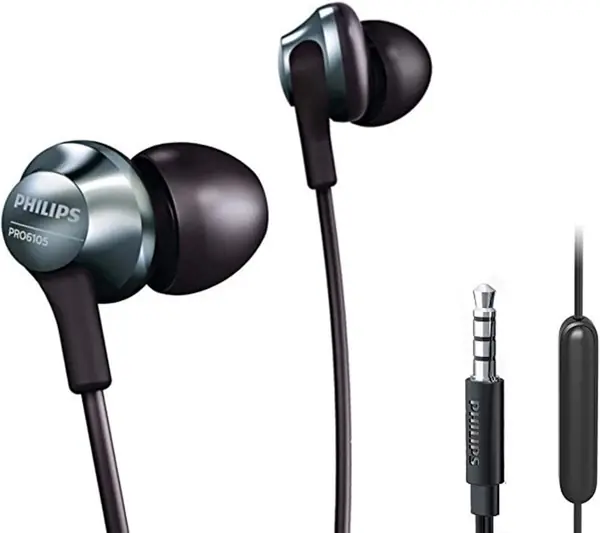
Best Wired Earbuds for Calls of 2026

Nobody reaches for wired earbuds hoping for magic. They reach for them because the wireless pair died at 12 percent right as the call connected, or because one tiny bud is lost somewhere under a car seat. A wire doesn't need charging, and that matters most when you're the one doing the talking.

What a good pair actually fixes is specific: a microphone that doesn't make you sound like you're calling from a stairwell, and a seal that keeps the room out so you aren't shouting into a meeting. I've owned a drawerful of these over the years, and over the past four months my team and I worked through 14 pairs to see which ones hold up.

First-time buyers tend to shop on driver size, which is not the number that matters here. Where the mic sits on the cable and whether the eartips actually fit your ears do far more for call quality, and a bad seal sounds bad to the person on the other end, not just to you. The picks below are the ones that held up.

The Best Wired Earbuds for Calls

1

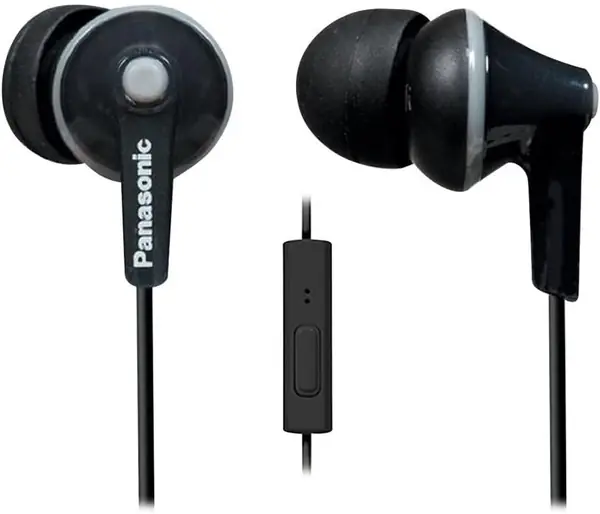
Panasonic ErgoFit RP-TCM125-K Best Overall
91 /100
TKZ Score Outstanding

Key details

Connection
3.5 mm jack
Ear Tips
S/M/L included
In-line Control
Mic and call button
View on Amazon

The little module on the ErgoFit's cord is why this pair earns the top spot: a microphone and a single call button sit within thumb reach, so you can answer, talk, and hang up without touching the phone. Panasonic ships three silicone tip sizes, and the rounded housings angle into the canal instead of pressing against the opening.

That combination makes it the pair we recommend to almost anyone who wants calls handled without fuss. In our testing it stayed seated through a full day of back-to-back calls, and the microphone did its best work indoors or in a car — the button answered and ended cleanly, and nobody on the other end asked us to repeat ourselves in a quiet room. It is not a noise-cancelling headset, though, and a windy street is audible to your caller.

Fit is the strongest argument for it. Of the pairs here, this is the one we had the least trouble keeping seated, and the soft tips seal without the pressure ache that harder housings leave after an hour-long call. If your canals are small, the housing is still on the larger side — the EP05 further down is the better bet.

What you accept is a thin cable. It is the first part to give out and the reason we treat a pair like this as a couple-of-years purchase rather than a decade one. For the money, no other pair here balances call controls, comfort, and device compatibility this well, and the 3.5mm plug works with laptops, tablets, and older phones with nothing in between.

Pros

  • Mic and call button within thumb reach
  • Secure, comfortable fit over long calls
  • 3.5mm plug works with most devices

Cons

  • Thin cable is likely to fail first
  • Callers hear street noise outdoors
Our verdict

We recommend the ErgoFit to anyone who wants clear calls without fuss: it fits, it has a real call button, and it plugs into almost anything.
Check Latest Price
2

Apple EarPods (Lightning) Best for iPhone

90 /100
TKZ Score Outstanding

Key details

Connector
Lightning
Compatibility
Lightning devices, iOS 10 or later
In-line Remote
Volume, music, calls
View on Amazon

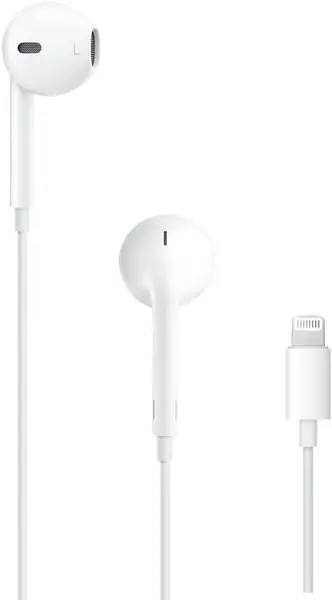
Every 3.5mm pair here needs a dongle on a modern iPhone, and a dongle is a small thing that disappears. EarPods plug straight into the Lightning port, which makes them the pair we point iPhone owners to first — no adapter to lose, nothing to charge, and a remote that handles volume as well as calls.

That remote is the underrated part. Several pairs here give you one button that answers and hangs up and nothing else; EarPods put volume, play/pause, and call control in the same little strip, which is exactly what you want when the phone is in a pocket and you are mid-sentence. The microphone holds up too — our calls came through clearly at normal speaking volume.

The open, tip-less shape divides people. It rests in the bowl of the ear rather than sealing the canal, so some wearers forget it is there after an hour and others feel it shift on the first walk. The cable is the bigger worry — the same soft jacket Apple has used for years — and it is where these fail, often early. Buy them for the connector, not for longevity.

Pros

  • No adapter needed on Lightning iPhones
  • Remote controls volume, music, and calls
  • Open shape stays comfortable for hours

Cons

  • Lightning only, no 3.5mm devices
  • Cable frays and fails early
Our verdict

For a Lightning iPhone, these are the pair to buy — no dongle, a full remote, and the most comfortable open fit here if your ears accept it.

Check Latest Price
3

Betron BS10 Best Build

89 /100
TKZ Score Excellent

Key details

Connection
3.5 mm jack
Warranty
12 months
In-line Control
Mic and volume
Housing
Metal
View on Amazon

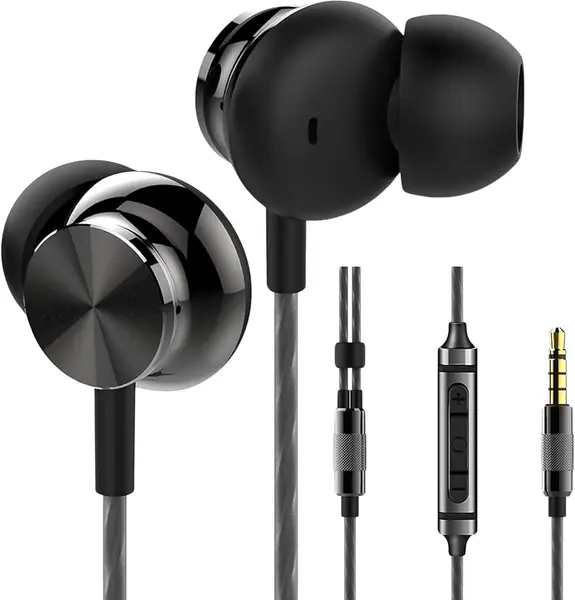
Pick up the BS10 and the first thing you notice is the cable: thicker than almost anything else in this group, with metal housings at the ends and a weight that makes the cheaper pairs feel like toys. For a wired earphone that lives in a jacket pocket and gets wound around a phone, that heft is the point.

Sound leans bassy. The 12mm drivers put real weight behind music, and voices stay clear enough that we never struggled to follow a call. The in-line control gives you volume as well as a microphone, which is more than a lot of budget designs bother with.

Build is where the BS10 wins. It is the sturdiest pair here, and it was the one that showed the least wear over our testing — no fraying at the plug, no crackle when the cord moved. That matters in a category where the failures are almost always mechanical: a channel going quiet, a plug turning intermittent, a wire giving out at the bend.

The trade-off is fit. The tips are oval rather than round and sit snugly — sometimes too snugly — in smaller canals, so plan on a break-in period or a swap to the smallest tip. Get past that and this is the pair here most likely to still be in your bag next year.

Pros

  • Heaviest cable and metal housings here
  • In-line volume control as well as a mic
  • 12mm drivers give a fuller low end

Cons

  • Oval tips run snug in small canals
Our verdict

We hand the BS10 to people who kill a pair every six months: heavier cable, metal housings, and the best odds of surviving a year.

Check Latest Price
4

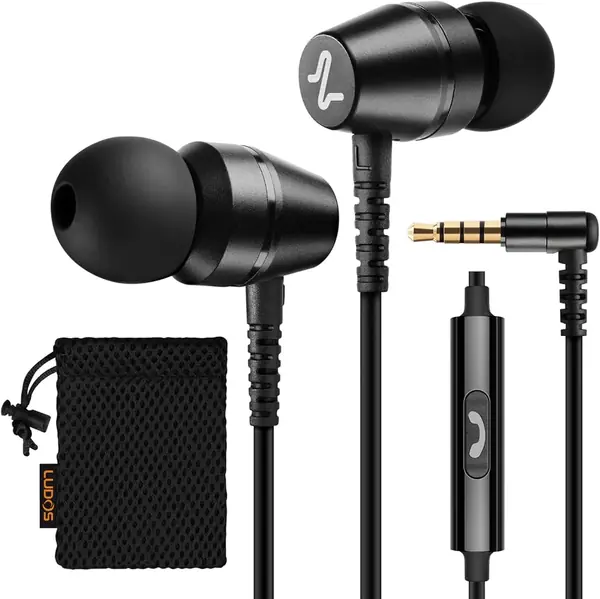
LUDOS OMNITONE Best for Work Calls

88 /100
TKZ Score Excellent

Key details

Connection
3.5 mm jack
Warranty
5 years
In-line Control
Mic and call button
View on Amazon

Five years is the longest warranty on this page by a wide margin, and LUDOS pairs it with a metal case and a drawstring pouch in the box. For an inexpensive set of earbuds, that is an unusual amount of after-sale cover, and it changes how you use the thing — a pair with five years on it is one you stop handling like it is fragile.

We like it best as a desk pair. The microphone is what earns its keep in meetings: it holds up on video calls, and the cord is long enough that you can stand and pace while you talk. Sound is warm and clear enough for speech, with the bass kept in check so voices stay intelligible. The call button sits on the module where your hand already is, and at 40 grams you stop noticing them somewhere in the second hour.

Fit is the caveat. The housings are larger than the ErgoFit's, and in smaller ears they work loose — worth knowing if buds have migrated on you mid-call before. When they do seat, that warranty turns a dead channel into an inconvenience rather than a loss, which is more than most pairs here can promise.

Pros

  • Five-year warranty, the longest here
  • Metal case and pouch included
  • Holds up on video meetings

Cons

  • Housings run large for small canals
Our verdict

We keep the OMNITONE for desk work: clear video calls, a case in the box, and five-year cover against a dead channel.

Check Latest Price
5

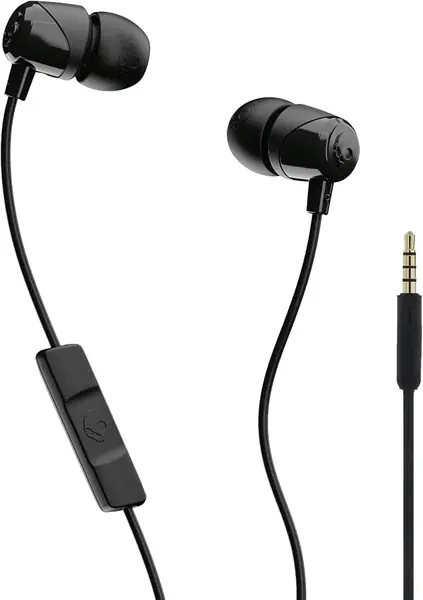
Skullcandy Jib Best Budget

87 /100
TKZ Score Excellent

Key details

Connection
3.5 mm jack
Warranty
1 year
Cable
48 in
Ear Gels
Two sizes
View on Amazon

The Jib is the cheapest pair we are recommending, and it is the one we treat as a consumable: buy a couple, keep one in the laptop bag and one in the car, and stop worrying about where they ended up. At this price the question is not whether it lasts years; it is whether it handles today's call, and it does.

Comfort is the surprise. The small ear gels genuinely suit small canals, the buds sit shallow enough to wear for a long stretch, and the sound is fuller than the price suggests — Skullcandy did not strip the low end out to hit a number. The microphone is fine in a quiet room and out of its depth on a busy street.

Two details are worth knowing. The 48-inch cable reaches across a desk without looping around a chair, and the cable itself is thin enough that one hard yank will finish it. Treat them as spares, buy two, and the arithmetic works in your favor.

Pros

  • Comfortable, small ear gels
  • Full sound for the money
  • Cheap enough to keep as a spare

Cons

  • Cable is thin and fails under hard use
  • Mic struggles on a busy street
Our verdict

We buy the Jib by the pair and leave one wherever a call might find us — cheap, comfortable, and good enough in a quiet room.

Check Latest Price
6

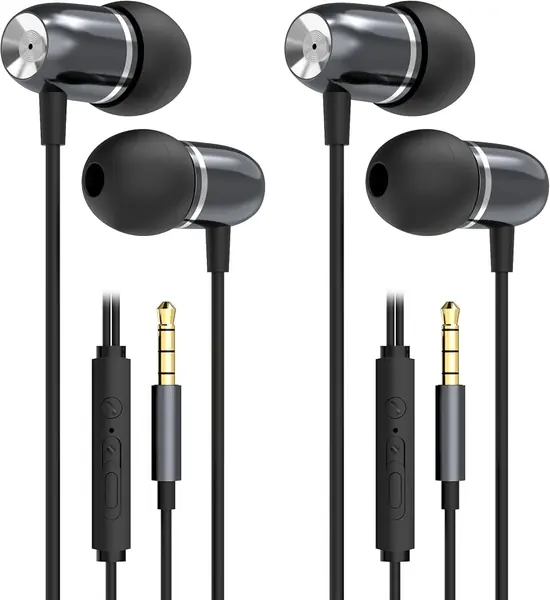
MORMOQUE EP05 Best for Small Ears

86 /100
TKZ Score Excellent

Key details

Connection
3.5 mm jack
Warranty
1 year
Ear Tips
XS/S/M included
Pack
Two pairs
View on Amazon

If most earbuds leave your ears sore, the EP05 is built for you: a smaller housing, XS tips alongside S and M, and a shape meant to sit inside a petite canal instead of wedging against it. Two pairs come in the box, which matters more than it sounds — small-tip pairs get lost and are hard to replace.

The rest is ordinary in a good way. Sound is clear with a modest bass lift, the button handles call pickup and hangup, and the cable resists tangling. Pressure is where the design shows: the tips are soft, the body is shallow, and the whole thing weighs about 12 grams, so nothing presses on the outer ear the way larger buds do.

We recommend it for one job: ears that other buds do not fit. On that count it is the most thoughtful design here, and the low price makes trying it a low-risk experiment. What it is not is an upgrade in sound or call handling — the driver is smaller, the controls are simpler, and the ErgoFit still does more for a long call.

Pros

  • XS tips fit small ear canals
  • Two pairs in the box
  • Low-pressure housing for long wear

Cons

  • Small housing will not seal larger canals
Our verdict

We recommend the EP05 for small ears, where its XS tips and compact housings solve a problem the other pairs here do not.

Check Latest Price
7

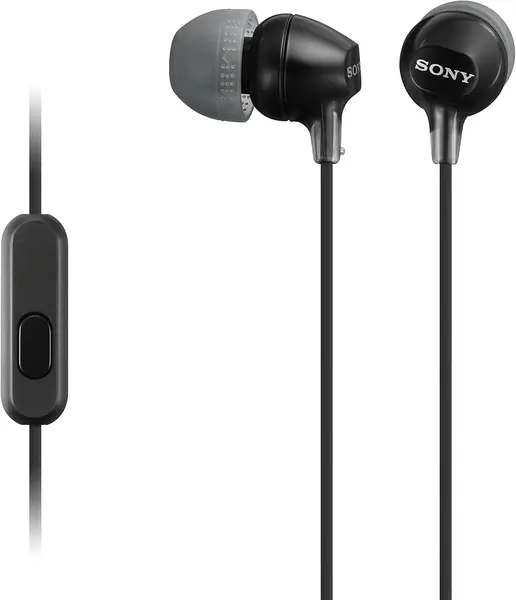
Sony MDREX15AP A Backup Pair That Packs Flat

85 /100
TKZ Score Excellent

Key details

Connection
3.5 mm jack
Warranty
90 days
Ear Tips
Three sizes
Cable
Y-cord with slider
View on Amazon

The 90-day warranty is the shortest on this page, and it sets expectations: this is a pair you buy knowing it may not see a second year. What you get in exchange is the smallest, lightest earbud here — 9mm drivers, a housing that sits nearly flush, and a cord slider that cinches the two sides together so nothing tangles in a pocket.

Sound is midrange-forward rather than bass-heavy, which suits speech better than music. On calls, voices came through clearly at our end; in a noisy room, the lack of isolation lets the room in on both sides of the conversation.

The slider is the detail we appreciate most. Most cords here loop and snag when you pull them out of a pocket, and the Sony's cinch keeps the two halves together until you need them apart. It is a small thing that makes the pair easier to carry than anything else in this group.

Where we hesitate is longevity. The wire is thin, the warranty is short, and when these go, they go at the cable. Buy it for a glovebox or a gym bag and it is excellent value; make it your only pair and its thin cable is doing a lot of work.

Pros

  • Tiny housings sit nearly flush
  • Cord slider keeps the cable tidy
  • Midrange-forward sound suits voices

Cons

  • 90-day warranty is the shortest here
  • Thin cable wears out with daily use
Our verdict

We treat the MDREX15AP as a glovebox spare: tiny, tangle-resistant, and inexpensive enough that its short warranty is a fair trade.

Check Latest Price
8

Philips Pro 6305 Best for Blocking Out a Noisy Office

84 /100
TKZ Score Excellent

Key details

Connection
3.5 mm jack
Warranty
1 year
Ear Tips
Three extra sizes
Housing
Aluminum
View on Amazon

The Philips Pro is the priciest pair we are recommending, and it sits a class above the plastic budget picks on materials: an aluminum housing, a tangle-resistant cable, and three extra tip sizes in the box. Pick it up and it feels like a piece of hardware rather than a consumable.

You hear the difference first in isolation. The aluminum body and deep-seated tips seal the canal well, so a noisy office or a train car gets quieter before any music plays — and on a call that means you speak at a normal level instead of shouting to hear yourself.

Where it gives ground is consistency. The microphone works well and then, on some units, stops; volume can vary from pair to pair; and the cable is the same wear item as everything else here. None of that is unusual in this range, but it is why the Philips sits behind the ErgoFit rather than ahead of it.

If the problem you are solving is a loud room rather than a long warranty, this is the one to buy. The seal does more for how your call sounds at the other end than any microphone upgrade at this price, and it is the only pair here whose housing will still feel solid when the wire inside it gives out.

Pros

  • Aluminum housing feels substantial
  • Seals the ear against office noise
  • Three extra tip sizes for fit

Cons

  • Mic and volume can vary between units
  • Priciest pair here with a one-year warranty
Our verdict

We recommend the Philips when a loud room is the problem — its seal does more for call quality than a better microphone would.

Check Latest Price

How We Chose and Tested Wired Earbuds for Calls

We built the shortlist by reading spec sheets and the fine print on every wired pair we could find, sorting them by which jack they used, how many eartip sizes came in the box, and whether the in-line remote offered real volume control or a single multi-click button. From that pool we bought 14 pairs and made them our daily drivers for four months.

Calls were the point, so most of the testing happened where calls happen: at a desk during weekday meetings, on a sidewalk with traffic going past, and in a kitchen with the range hood and dishwasher both running. With each pair I recorded the same short script as a voice memo, then listened back to hear whether my voice came through clean or thin and echoey. In the kitchen I also noted how much I had to raise my voice, since a loose seal makes you shout without noticing.

Fit and comfort got separate passes. I wore each pair for a two-hour stretch and logged where they started to ache, and I handed the smallest eartips to smaller-eared colleagues, because a bad seal wrecks call clarity as fast as it wrecks music. Build quality got a rougher test: each pair lived loose in a bag pocket, had its cable wrapped and unwrapped daily, and got yanked out by the cord more often than it should have.

Toward the end I re-checked every pair for a channel that had gone quiet, a remote button that had stopped responding, or a plug that started cutting out when the cord moved — the reliability problems that surface after the honeymoon. We also compared what was actually in each box against what the listing promised, eartip counts included, and weighed what each pair cost against how well it was holding up. The eight that made the list are the ones still sounding like themselves.

How to Choose Wired Earbuds for Calls

Judge the Microphone Before the Driver

A 12mm driver tells you about bass; it says nothing about how you sound on a call. What matters is where the microphone sits on the cord, whether the module gives you a button you can find without looking, and how well the tips seal — a sealed ear lets you speak at a normal volume instead of projecting into the room.

The ErgoFit's dedicated call remote and the EarPods' full remote are the two best arrangements in this group. A single multi-function button answers and ends calls, but that is the whole vocabulary.

Match the Plug to the Phone You Own

Apple dropped the headphone jack with the iPhone 7, so a 3.5mm pair needs a Lightning adapter on any newer iPhone, and a Lightning pair like the EarPods works on nothing else. Count your devices before you choose: a 3.5mm pair plus one adapter covers a laptop, a tablet, and an older phone, while Lightning covers one ecosystem only.

If you go the adapter route, confirm it passes microphone and remote signals. An adapter built only for charging leaves you holding the phone to talk.

Fit Is the Whole Ballgame

An earbud that migrates out of your ear ruins a call faster than a mediocre microphone. Three tip sizes should be the minimum, and the housing matters as much as the tip: the BS10's oval tips and the OMNITONE's larger bodies suit bigger canals, while the ErgoFit's rounded housings and the EP05's XS tips treat small ears better.

If you have never found a pair that stays put, start with the smallest housing you can get and work up through the tips from there.

Treat the Cable as a Wear Part

Every pair here eventually fails at the wire — a channel goes quiet, or the plug turns crackly — so judge the cable and the warranty together. Length matters more than you think: 48 inches is fine at a desk and short for pacing a room.

Then check the cover, which runs from 90 days to five years in this group. On an inexpensive pair, the longest warranty is the cheapest insurance available, and it is the single best tiebreaker between two similar designs.

Frequently Asked Questions

Final Verdict

Our default recommendation is the Panasonic ErgoFit RP-TCM125-K. It handles the whole job: a mic and call button where your thumb already rests, a fit that holds through a long call, and a 3.5mm plug that works with everything except a jackless iPhone.

For that phone, buy the EarPods — no adapter, and a remote with volume. And if you want a pair in every bag rather than one good pair, the Jib costs little enough that losing one is a shrug.