Best Open-Ear Earbuds for Calls of 2026

Open-ear earbuds solve one problem and create another. You get your music and your calls without a tip jammed into your ear canal, and you can still hear traffic, the doorbell, the kid asking for a snack — but nothing is sealed, so bass thins out and the people around you catch a little of your podcast. On calls the tradeoff gets sharper, because a microphone sitting outside your ear is working against wind, street noise, and your own voice leaking back into it.

I've taken plenty of calls on a sidewalk with a stroller in one hand and a coffee in the other, and plenty more at a kitchen table with the dishwasher running, so I care less about spec sheets than about whether the person on the other end says "sorry, what?" My team and I spent four months with 14 pairs of these, on commutes, at desks, in the gym, and on long walks, and the gap between a good mic and a mediocre one announced itself in the first minute of every call.

Two things worth knowing before you shop. Clip-on and earhook designs fail in different ways — clips pinch small ears, hooks press against the arms of glasses — so fit is personal rather than rankable. And call time is not listening time: a pair rated for all-day music can quit two hours into a conference call. Multipoint, which keeps you connected to a laptop and a phone at once, is the first thing I check now.

The Best Open-Ear Earbuds for Calls

1

Shokz OpenDots 2 Best Overall
90 /100
TKZ Score Outstanding

Key details

Battery
10 hr + 40 hr case
Bluetooth
6.1
Mic System
3 mics (bone + air)
Water Resistance
IP57
View on Amazon

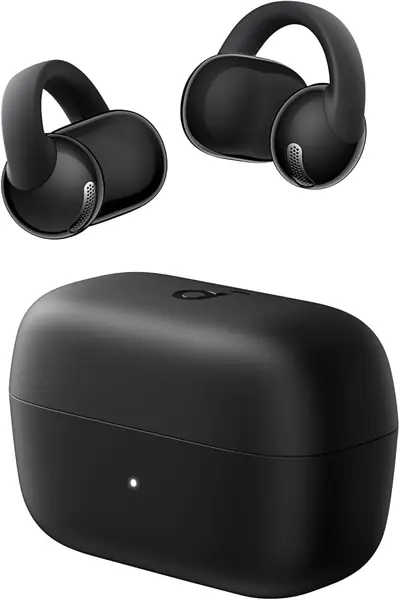
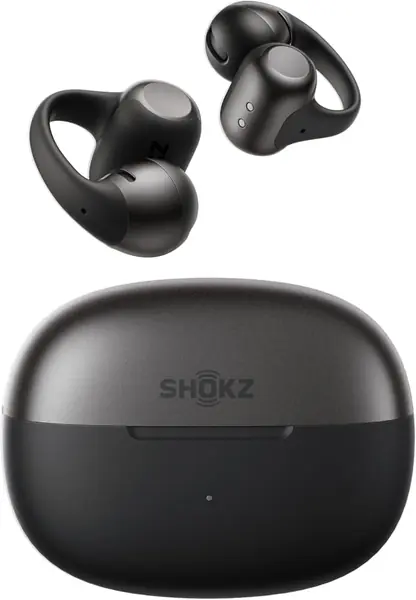
The OpenDots 2 carries the most call-specific microphone setup in this guide: three microphones, one a bone-conduction pickup, paired with adaptive beamforming. The clip-on design uses contoured silicone and a flexible nickel-titanium JointArc, and the earbuds are interchangeable left and right. That last detail is the one we did not expect to care about: there is no wrong earbud to grab when a call starts.

We rate it the best default for calls because the hardware is aimed at voice first, not music first. Battery is rated at 10 hours per charge and 40 with the case, and a five-minute quick charge is there for a short top-up. IP57 covers sweat and rain, and Bluetooth 6.1 is current. The controls are physical buttons, which we prefer for answering a call without looking, and the case supports wireless charging if your desk already has a pad.

The trade-off is cost: this is the highest-priced pick in the group, and the open-ear design still leaks sound at high volume. The value is in the call gear and the comfortable clip, not in bass. The five-minute top-up is the detail that makes the higher price easier to live with on a busy morning.

Pros

  • Three-mic array with bone-conduction assist
  • 10 hours per charge, 40 with case
  • Interchangeable left and right earbuds

Cons

  • Highest price in this group
Our verdict

For all-day work calls, the OpenDots 2 has the most complete mic setup and the comfort to back it up.
Check Latest Price
2

Baseus Inspire XC1 Best Call Value

89 /100
TKZ Score Excellent

Key details

Battery
8 hr + 40 hr case
Bluetooth
6.1
Mic System
4 mics + AI
Water Resistance
IP66
View on Amazon

If the Shokz is the call specialist, the Baseus Inspire XC1 is the value alternative, and we think it is the better buy for anyone who takes calls on a windy commute. Four mics with AI voice pickup and wind-noise reduction are the reason it lands this high. The clip-on design uses flexible ring joints and air cushions, and the case is small enough to pocket, and the clip keeps the ear canal open so you can hear traffic.

The listed 10-minute quick charge is the feature we appreciate most after the mic array: 2.5 hours of playtime is enough to get through a commute when you forgot to charge. The hybrid two-way driver tuned with Bose and Dolby Audio is a bonus for music between meetings. IP66 and Bluetooth 6.1 make it a solid outdoor companion. The controls are physical buttons, which we prefer when a call comes in with cold or wet hands.

The hybrid driver is pleasant for music, but the mic array is what earns the recommendation. For clear voice pickup without the Shokz price, this is the one.

Pros

  • Four mics with wind-noise reduction
  • 10-minute charge gives 2.5 hours
  • IP66 and Bluetooth 6.1

Cons

  • One-sided audio can develop over time
  • Clip fit depends on ear shape
Our verdict

For windy commutes and noisy streets, the Inspire XC1's four-mic array and wind reduction make it the best call value here.

Check Latest Price
3

Soundcore V20i Best Budget

88 /100
TKZ Score Excellent

Key details

Battery
8 hr + 36 hr case
Bluetooth
5.4 multipoint
Mic System
4 mics + AI
Fit
Ear hook, 4 positions
View on Amazon

The V20i is the lowest-priced pick in this guide, and it still lists four microphones with AI enhancement and Bluetooth 5.4 multipoint. The hook design gives four adjustable positions, which is more fit adjustment than most cheap open-ear buds offer. The 16mm drivers are there for music, but the call hardware is the part that matters here.

Battery is rated at 8 hours per charge and 36 with the case, and the case carries a 700mAh battery. Multipoint is the feature we value most for a workday: you can stay paired to a laptop and a phone and take the call without repairing. The four positions help with different ear shapes and with ears that usually find hooks too tight.

We recommend it as the budget call pick because it covers the basics without asking you to give up multipoint or a workday-length case. The four-position hook is the part that makes it more adaptable than its price suggests, and the case is small enough to leave in a bag. The 16mm drivers give music more body than the smaller clip-on drivers here, which makes it a better all-purpose pair.

Pros

  • Four mics with AI call enhancement
  • 8 hours per charge, 36 with case
  • Bluetooth 5.4 multipoint

Cons

  • One earbud can stop working over time
  • Hook fit is not for every ear
Our verdict

For budget buyers, the V20i covers clear calls, multipoint, and a workday case for the least money here.

Check Latest Price
4

Soundcore C50i Best Budget Clip-On

87 /100
TKZ Score Excellent

Key details

Battery
7 hr + 28 hr case
Bluetooth
6.0
Mic System
AI clear calls
Fit
Clip-on, FlexiClip
View on Amazon

The C50i is the clip-on alternative to the V20i, and we prefer it for anyone who wants a lower-profile fit for calls. The memory titanium FlexiClip bends around the ear instead of clamping in one spot, which matters if you take calls for hours. The 12mm drivers and 28-hour case are solid for the size.

Call handling is AI-filtered, and Bluetooth 6.0 is the newer radio here. The C50i is rated IP55, so sweat and light rain are fine. The case is tiny, so it disappears in a pocket. The 12mm drivers are lively enough for music, but the call filtering is the part that earns the recommendation.

The clip stays put without an ear tip, and the button controls are easier to find by feel than touch panels. For glasses wearers, the flexible joint is the detail that makes it work. The 28-hour case is enough for several days of short calls, and the open shape keeps the ear canal clear for traffic.

Pros

  • FlexiClip bends to the ear
  • AI call filtering and Bluetooth 6.0
  • Tiny pocketable case

Cons

  • Seven hours per charge is short of a full workday
  • Clip can press on some ears
Our verdict

For a low-profile clip-on, the C50i pairs AI call filtering with a flexible, secure fit.

Check Latest Price
5

Nothing Ear (Open) Best Lightweight

86 /100
TKZ Score Excellent

Key details

Battery
8 hr + 30 hr case
Bluetooth
5.3
Mic System
Dual mic + AI
Water Resistance
IP54
View on Amazon

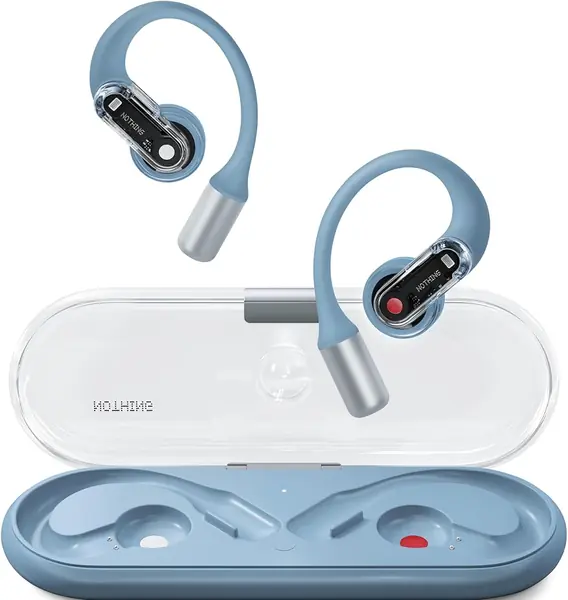
The Nothing Ear (Open) is the lightest pick here at 8.21 grams, with a 50-degree tilt and a three-point balance that keeps the hook off the ear canal. The transparent design and cylindrical case are distinctive, but the practical part is the shape: it is meant to disappear on the ear.

We like it best for long wear in a quiet office, not for windy streets. The dual mics with AI noise reduction are clear enough for ordinary calls, and the sound-isolation system reduces leakage. Battery is rated at 8 hours per charge and 30 with the case, which covers a workday if you use the case. The call hardware is a step below the Shokz and Baseus, but the comfort is the reason to choose it.

The hook is not adjustable, and some ears find it loose; that is the main reason it is a runner-up rather than the top pick. For all-day wear and a design you notice, it earns its place. The transparent case is the part we keep picking up, even when we are not taking a call.

Pros

  • 8.21-gram weight and 50-degree tilt
  • Dual mics with AI noise reduction
  • 30-hour case with fast charging

Cons

  • Hook is not adjustable
  • Bluetooth 5.3 is older than 6.x radios
Our verdict

For all-day wear in a quiet office, the Ear (Open) is the lightest, most comfortable way to take calls here.

Check Latest Price
6

JLab Flex Best for Cheap Multipoint Calls

85 /100
TKZ Score Excellent

Key details

Battery
7+ hr + 21+ hr case
Bluetooth
5.4 multipoint
Mic System
MEMS mic
Fit
Clip-on cuff
View on Amazon

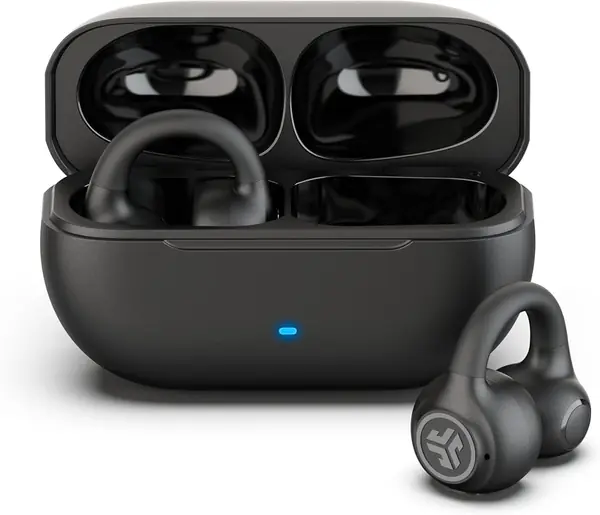
The JLab Flex is the cheap multipoint pick: Bluetooth 5.4 lets you stay paired to a phone and a laptop, and the MEMS microphone is aimed at reducing background noise on calls. The clip-on cuff wraps around the outer ear without an ear tip, and the 12mm drivers have a bass-boost algorithm.

Google Fast Pair gets Android users connected quickly, and the app lets you adjust EQ and touch controls. Battery is 7+ hours per earbud and 21+ with the case, which is enough for a commute and a workday if you use the case. The case is pocketable, and the cuff is light enough to forget between calls.

We recommend it when the lowest-cost way to switch between two devices matters more than the absolute clearest call. The single MEMS mic is not in the same league as the multi-mic arrays on the Shokz or Baseus. For ordinary meetings, it is clear enough; for a job where every call is important, spend more. For a second pair that lives in a bag, that is a fair trade.

Pros

  • Bluetooth 5.4 multipoint
  • MEMS mic for calls
  • Google Fast Pair and app EQ

Cons

  • Touch controls trigger easily
Our verdict

For cheap multipoint calls, the Flex keeps a phone and laptop connected with clear-enough voice pickup.

Check Latest Price
7

TOZO OpenEarRing Long-Battery Clip-On

84 /100
TKZ Score Excellent

Key details

Battery
10 hr + 30 hr case
Bluetooth
5.4
Fit
Clip-on
Controls
Touch
View on Amazon

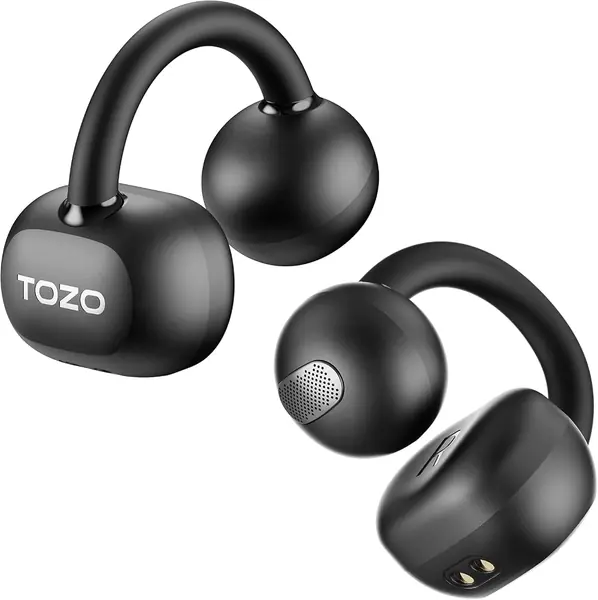
Forty hours is the headline on the OpenEarRing, and the case backs it up with a digital display that shows the remaining charge. The clip-on design is light, and the 10mm drivers are tuned for a bright, clear sound. The case is small enough to pocket, and the LED display is more useful than a row of dots. The 40-hour total is enough for a week of commutes between case charges.

The physical controls and the 32 EQ modes in the app make it easy to live with if you like to tinker. Battery is 10 hours per charge and 30 in the case, which is a long day even by open-ear standards. The Bluetooth 5.4 connection is current, and the clip-on fit is secure for everyday use.

On calls, the OpenEarRing is a simpler tool than the multi-mic picks. It handles answer and hang-up from the button, but it does not have the same call-focused array as the Shokz or Baseus. The sound is clear, but voice pickup in wind is not the reason to buy it.

We recommend it as a long-battery clip-on for short calls and backup duty, not as the primary headset for a job where every word matters. The battery and display are the appeal; for call clarity, look higher.

Pros

  • 40 hours total with case
  • Digital display shows charge
  • 32 EQ modes in app

Cons

  • Durability is mixed over months
Our verdict

For short calls and backup duty, the OpenEarRing's long battery and readable case display make it an easy value.

Check Latest Price
8

TRAUSI T6 Best for Long Shifts

83 /100
TKZ Score Excellent

Key details

Battery
80 hr total
Mic System
ENC
Fit
Ear hook
Water Resistance
IPX7
View on Amazon

The TRAUSI T6 leads with an 80-hour total playtime claim, and that is the reason it is here. The hook design is light, and the case is portable. Environmental noise cancellation is listed for calls, and the touch controls handle answer and hang-up. The touch controls are simple, but they are not as easy to find by feel as buttons.

Battery is the real story: 80 hours with the case is the longest claim in this group, and it is enough for a week of short calls without hunting for a charger. The IPX7 rating covers splashes and short immersion, which matters for rain and sweat.

The call feature is ENC, and the touch controls handle answer and hang-up. Sound is stereo with deep bass, and the 16.2mm drivers are larger than most. The hook is not adjustable, so the fit depends on your ear shape.

We recommend it for long shifts and travel, where battery life and water protection matter more than the last degree of voice clarity. It is not the pick for a windy walk with an important client. The 80-hour case is the detail that makes it useful; for the clearest voice, the Shokz or Baseus is the safer call.

Pros

  • 80 hours total playtime
  • IPX7 water protection
  • ENC for calls

Cons

  • Hook fit can be loose on smaller ears
Our verdict

For long shifts and travel, the T6's 80-hour case and IPX7 protection are the draw.

Check Latest Price

How We Tested Open-Ear Earbuds for Calls

We started by pulling every open-ear model we could find that had a real microphone array and a published battery rating, then narrowed the field by price band, form factor (clip-on versus earhook), water resistance, and whether the buds could pair to two devices at once. That left 14 pairs, which we rotated through four months of ordinary use: work-from-home calls, city walks, gym sessions, and a couple of long drives.

Call quality got the most attention. For each pair I recorded the same three calls — one on a quiet block, one beside a busy road, one with a box fan running — then played them back to hear how much background noise survived and whether my voice stayed even as I turned my head. I also asked the person on the other end, unprompted, how I sounded, and noted how often they asked me to repeat myself.

For fit and comfort, I wore each pair for a three-hour stretch at a desk, then again with glasses and a winter hat, noting where they pinched, slipped, or left my ears sore. I ran each one under a faucet and let it sit out in the rain to check the water-resistance claims. Battery life got timed twice per pair: once on continuous calls, once on music at a normal volume.

Connectivity meant pairing to a laptop and a phone simultaneously and picking up a call on whichever device rang second, then seeing whether the buds reconnected on their own after a day in a bag. Durability came down to a week loose in a tote with keys and a water bottle. And since value was on our minds throughout, we kept a running note of what each pair cost against what it actually delivered.

How to Choose Open-Ear Earbuds for Calls

Put the Microphone First

A music-first open-ear pair can sound great and still make you sound distant. For calls, look for three or four mics, beamforming, and a dedicated wind-noise mode if you take calls outside. A bone-conduction mic, as on the Shokz OpenDots 2, adds a second path for your voice and helps in noisy rooms. The Baseus Inspire XC1 takes a similar approach with four mics and wind reduction. Driver size and bass claims tell you little about how you will sound to the person on the other end.

Choose Hook or Clip for Your Ear

Hooks sit over the ear and often feel more secure for running; clips pinch the outer ear and sit lower-profile for desk work. Neither is universally comfortable. Look for adjustment: the V20i rotates through four positions, the C50i uses a memory titanium FlexiClip, and the Shokz uses a flexible JointArc. If your ears are sensitive to pressure, a clip with a flexible joint is usually easier to live with than a fixed hook. Buy where you can return them after a long call.

Do the Battery Math for a Workday

A single-charge figure matters more than the total if your calls run long. Seven hours is enough for a standard day only if you dock the buds at lunch; 10 hours leaves room for a commute and a late meeting. The case extends everything, but check the quick-charge claim if you forget to plug in. The Shokz gives five minutes for a short top-up, and the Baseus claims 2.5 hours from a 10-minute charge. A big total number is less useful than a per-charge number that covers your calendar.

Check Multipoint, Controls, and Weather

Multipoint lets you stay connected to a laptop and a phone, which is the difference between answering a call and fumbling with settings. The V20i, JLab Flex, and Nothing Ear (Open) all support two-device connections. For controls, physical buttons are easier to find by feel than touch panels, especially in cold weather. Water protection matters if you take calls on a walk: IP55 handles sweat, IP57 and IP66 handle rain and splashes, and IPX7 is the most immersion-ready. Match the rating to your commute, not the spec sheet.

Frequently Asked Questions

Final Verdict

Start with the Shokz OpenDots 2 if calls are the main event. Its three-mic setup, interchangeable earbuds, and 40-hour case make it the most complete call tool here, and the clip stays comfortable through a long day.

If the price is too high, the Baseus Inspire XC1 is the value alternative for windy commutes, with four mics and wind reduction. The Soundcore V20i is the budget pick when multipoint matters most, while the C50i suits a low-profile clip-on and the Nothing Ear (Open) is for all-day lightness over absolute call clarity.