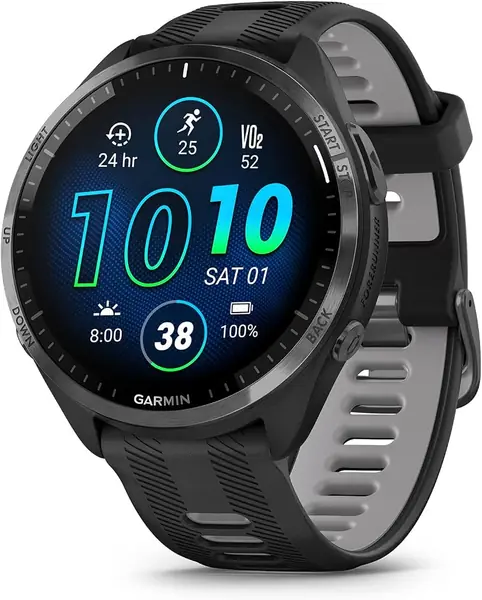
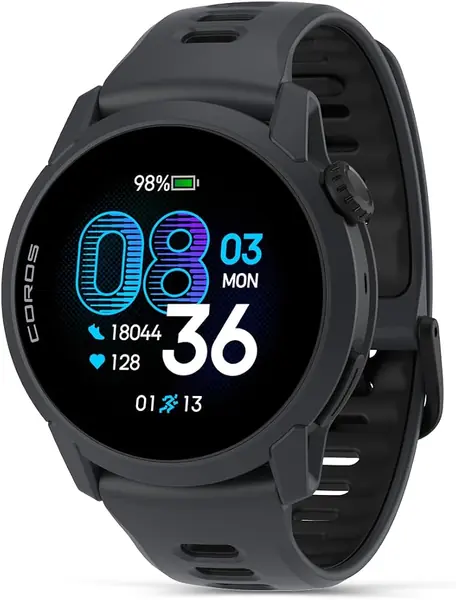
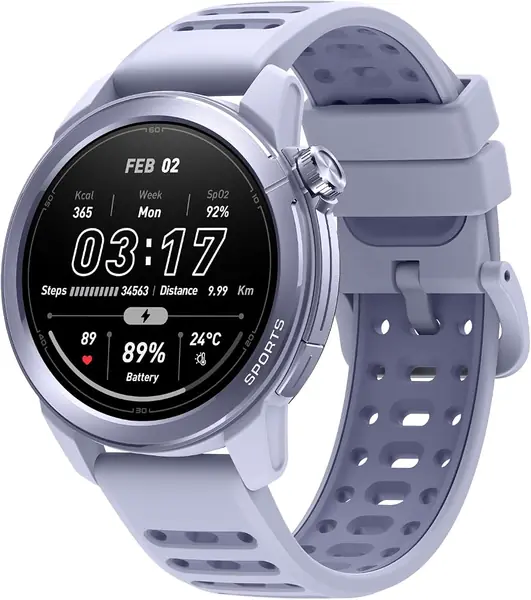
Garmin Forerunner 165 Best Overall
Key details
- Battery
- Up to 11 days smartwatch, 19 hours GPS
- Weight
- 1.38 oz
- Display
- 1.2 in AMOLED
- Case Size
- 43 mm
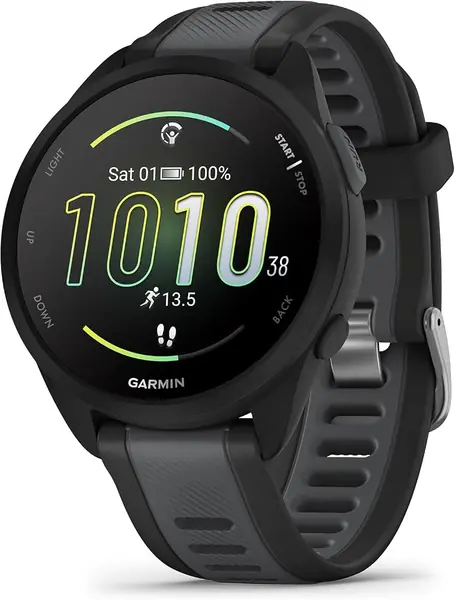
When a friend asks which running watch to buy, this is the one we point to, and the reason is not a single spec. The Forerunner 165 gets the fundamentals right: built-in GPS for pace and distance, a wrist heart-rate sensor, and a 1.2-inch AMOLED screen that stays legible in direct sun. At 43 mm and 1.38 ounces it disappears on the wrist, which matters more than any line on a spec sheet once you are wearing it to bed for sleep and recovery data. And it runs the same training software as Garmin's expensive models, so the daily suggested workout adjusts to how hard you went yesterday instead of handing you a fixed plan.
That coaching is the part we kept coming back to. Wake up and the morning report puts sleep, recovery, and HRV status on one screen; the watch then proposes a session and lets you take it or leave it. Garmin Coach race plans for a 5K, 10K, or half marathon come free with the watch, and 25+ activity profiles cover the bike and gym days in between. Buttons alongside the touchscreen turn out to matter more than we expected, because a sweaty finger on a touchscreen mid-run is a nuisance.
Battery is where the marketing runs ahead of reality. The 11-day figure assumes light GPS use; run most days and you are charging roughly weekly, which is still far better than a smartwatch. If long, unfamiliar routes are part of your training, that is the 965's job. For road runners chasing a 5K or a first marathon, this is the amount of watch most men actually need.
Pros
- Bright AMOLED screen readable in sunlight
- Daily suggested workouts that adapt to recovery
- Light 1.38 oz case, comfortable overnight
Cons
- Phone pairing can take a couple of tries
We recommend the Forerunner 165 to nearly every man who asks about a first serious running watch: it tracks pace and distance reliably, suggests your workouts daily, and stays light enough to sleep in.