Best Running Watches of 2026

A running watch is only as good as the two numbers it promises to get right. Heart rate that locks onto your cadence instead of your pulse, or GPS that cuts a corner downtown, will quietly wreck a training block — you'll run too hard on easy days and then wonder why race pace feels impossible.

I've worn a GPS watch on nearly every run since 2019, and I'm picky about the unglamorous parts: whether the screen is readable in flat noon sun, whether the buttons work through winter gloves. Over the past six months, my team and I put 12 running watches through real training, from stripped-down models to ones with maps and music on board. Battery life separated them faster than any other spec — a few went more than a week between charges with daily runs, and one needed the cable every third day.

The spec sheet oversells workout-mode counts. What mattered more was whether the interface made sense with cold hands, whether the watch held its connection through an ordinary week, and whether the extras justified the step up in cost. The picks below are the ones I kept reaching for.

The Best Running Watches

1

Garmin Forerunner 165 Best Overall
93 /100
TKZ Score Outstanding

Key details

Display
1.2 in. AMOLED
Battery (GPS)
Up to 19 hours
Battery (watch)
Up to 11 days
Weight
1.38 oz
View on Amazon

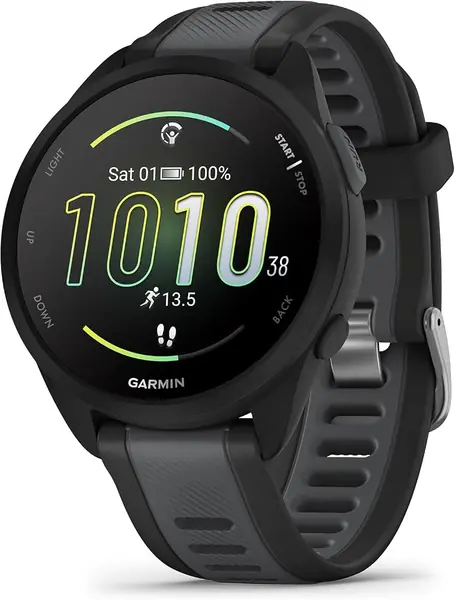
At 43mm and 1.38 ounces, the Forerunner 165 is the running watch that disappears on the wrist. The 1.2-inch AMOLED screen is bright enough for sunny runs, and the button-plus-touch controls mean you can start a workout without peeling off a glove. We also like the 11-day smartwatch rating for the days you forget the charger; the 19-hour GPS rating is the number that matters on race day.

This is the watch we recommend to most runners because it covers the daily essentials without making you learn a pro-level menu. Garmin's daily suggested workouts and Coach plans give you structure, and the 25+ activity profiles handle cycling, strength, and HIIT when you are not running. The 265 adds multi-band GPS, training readiness, and music, but the 165 has enough for a first marathon or a steady 5K habit.

The 11-day battery figure is smartwatch mode, and daily GPS runs will bring you back to the charger sooner. Phone pairing is the one place to be patient; the connection can take a few tries. Those are small annoyances in a watch that otherwise makes the daily run feel easy to start.

Pros

  • Light 43mm case works for all-day wear
  • Daily suggested workouts and Garmin Coach built in
  • Up to 11 days smartwatch, 19 hours GPS
  • Bright 1.2-inch AMOLED with buttons

Cons

  • GPS runs shorten the 11-day estimate
  • Phone pairing can take a few tries
Our verdict

The Forerunner 165 is the running watch we point most people toward: light, bright, and coached enough for daily miles without a premium price.
Check Latest Price
2

Garmin Forerunner 265 Best for Advanced Training

92 /100
TKZ Score Outstanding

Key details

Display
1.3 in. AMOLED
Battery (GPS)
Up to 20 hours
GPS
Multi-band with SatIQ
Battery (watch)
Up to 13 days
View on Amazon

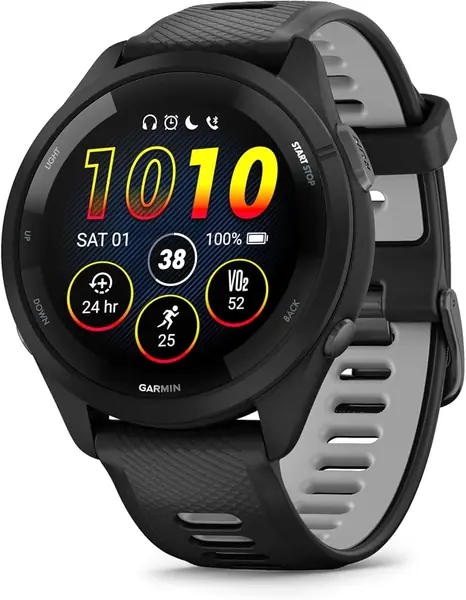
The Forerunner 265 is the step-up for runners who want the watch to coach the workout, not just record it. Multi-band GPS with SatIQ is the headline for anyone who runs downtown or under tree cover, and training readiness turns sleep, recovery, and training load into a daily go-hard-or-back-off signal. We like that the 1.3-inch AMOLED screen is easy to read at a glance, and the 13-day smartwatch rating means it can live on your wrist between charges.

The 265 also brings music on the wrist and a morning report that pulls sleep, HRV, and weather into one screen. Those extras make it a better race-training companion than the 165, especially if you follow a plan and want feedback on whether you are absorbing the work. The 20-hour GPS rating is enough for a marathon and most long training days, though ultra runners should look at the COROS.

The 46mm case and 47-gram weight are a full size up from the 165, so smaller wrists should try it on before committing. The button-and-touch interface is deep, and it takes a few runs to feel automatic. Neither issue undoes the training package, but they are the reasons the 165 remains the easier default.

Pros

  • Multi-band GPS for tough routes
  • Training readiness and morning report
  • Music on the wrist and 13-day battery
  • 1.3-inch AMOLED screen

Cons

  • 46mm case and 47g feel large
  • Button-and-touch menus take time to learn
Our verdict

We like the Forerunner 265 for racers who want multi-band GPS, deeper recovery data, and music on the wrist.

Check Latest Price
3

COROS PACE 4 Best Battery Life

89 /100
TKZ Score Excellent

Key details

Display
1.2 in. AMOLED
Battery (GPS)
Up to 41 hours
Battery (daily)
Up to 19 days
Case Thickness
11.8 mm
View on Amazon

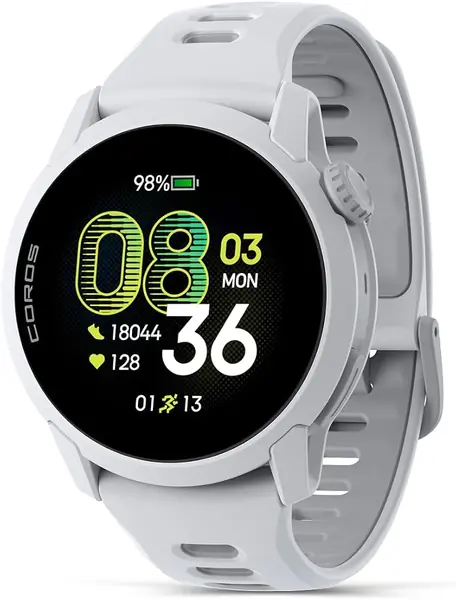
The PACE 4's 41-hour GPS rating is the reason to look here first. That is enough for a hundred-mile race with hours to spare, and the 19-day daily rating means a training week does not end at the charger. We like that COROS puts that battery in an 11.8mm case; it sits closer to the wrist than the 47-gram Forerunner 265 and is easier to sleep in.

The 1.2-inch AMOLED screen is sharp, and the digital crown plus two buttons give you a tactile way to start and stop without stabbing at a touchscreen with sweaty hands. Voice notes are a nice extra for capturing how a workout felt while it is still fresh. This is a training tool first, so do not expect the app-and-music experience of the Garmin.

We give the PACE 4 the nod for ultra runners and high-mileage weeks because the battery and slim case solve the two things that make a watch annoying over time. The heart-rate sensor is the weak spot: readings can miss on tattooed skin, so use a chest strap for intervals and zone work. The band keeper is also worth watching, since it can work loose with daily wear.

Pros

  • 41 hours of GPS battery for ultra races
  • 19-day daily battery
  • Slim 11.8mm case
  • Digital crown and two easy-reach buttons

Cons

  • Heart-rate sensor can miss on tattooed skin
  • Band keeper can work loose
Our verdict

We give the PACE 4 the nod for ultra runners who want 41 hours of GPS battery and a slim, light case.

Check Latest Price
4

Amazfit Active 3 Best Value

88 /100
TKZ Score Excellent

Key details

Display
1.32 in. AMOLED
Battery (GPS)
Up to 24 hours
Battery (daily)
Up to 12 days
Case
Stainless steel, sapphire glass
View on Amazon

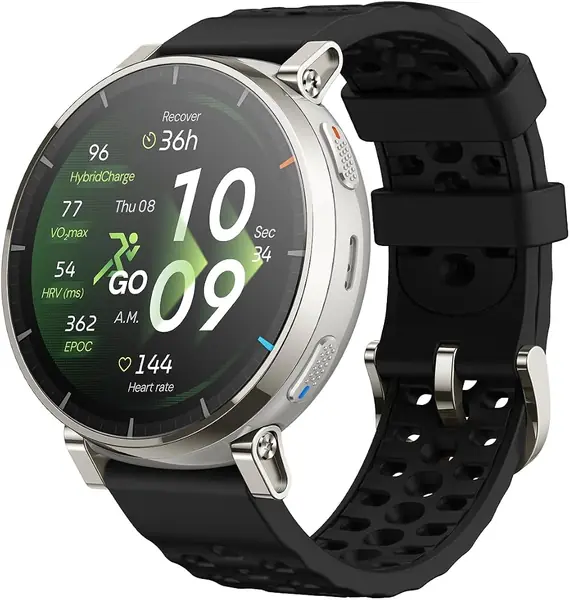
The Active 3 is the watch that looks more expensive than its budget tier. The stainless steel case and sapphire glass are the kind of materials we usually see on premium watches, and the 1.32-inch AMOLED screen is rated at 3,000 nits, the brightest figure in this group. Four buttons give you a physical way to start a run, which we prefer when your fingers are wet or cold.

The 12-day daily battery and 24-hour GPS mode are enough for daily training, and the Zepp app is free with no subscription. We think this is the value pick because it also includes 5K-to-marathon training plans, running power, lactate threshold, and ground contact data, so you are not giving up structured guidance to save money. The 170 workout modes cover far more than running, too.

The heart-rate sensor is the caveat: high-intensity efforts can come back inaccurate, so a chest strap is worth adding for intervals. The 24-hour GPS rating also puts ultra-distance racing out of reach compared with the COROS. For everyday runs, though, the Active 3 gives you a bright, tough-feeling watch and useful coaching for a budget price.

Pros

  • Sapphire glass and stainless case
  • 3,000-nit AMOLED display
  • 12-day battery and 24-hour GPS
  • Free Zepp app with no subscription

Cons

  • High-intensity heart-rate readings can drift
  • 24-hour GPS limits ultra racing
Our verdict

Budget-minded runners should look at the Active 3: we like its sapphire glass, bright screen, and free training app.

Check Latest Price
5

Amazfit Bip 6 Best for Casual Runners

86 /100
TKZ Score Excellent

Key details

Display
1.97 in. AMOLED
GPS
Five satellite systems
Battery
Up to 14 days
Workout Modes
140+
View on Amazon

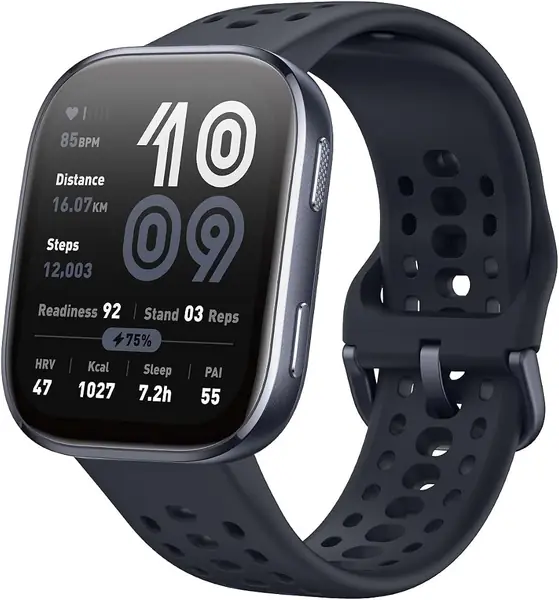
The Bip 6 puts a 1.97-inch AMOLED screen on your wrist for less than the dedicated running watches here, and that is the whole pitch. The display is rated at 2,000 nits, so it stays readable in direct sun, and the 14-day battery means you can treat it like a watch rather than a nightly chore. We recommend it for casual runners who want a big, bright screen and long battery, not for structured race training.

It has built-in GPS with five satellite systems, free downloadable maps, and 140+ workout modes, which is a lot for a budget fitness smartwatch. The catch is that the training guidance is broader than it is running-specific; if you want daily suggested workouts or race pacing, the Forerunner 165 is the better tool. The 46mm case and 1.97-inch display are also a lot of watch for a small wrist, so check the size before you commit.

Pros

  • Huge 1.97-inch AMOLED display
  • Up to 14 days of battery
  • Five satellite systems and free maps
  • 140+ workout modes

Cons

  • 46mm case may overwhelm small wrists
  • Training guidance is broad, not running-specific
Our verdict

The Bip 6 is our pick for casual runners who want a huge screen and long battery for less, not a dedicated race-training tool.

Check Latest Price

How We Tested 12 Running Watches

We started with the current crop of GPS watches and narrowed by hardware: optical heart rate, built-in GPS, and a screen we could actually read outdoors. The final 12 spanned stripped-down training watches and models with maps, music, and guided workouts built in. Each one was worn by at least two testers so a single wrist couldn't skew the results.

Testing ran six months and followed a real training week rather than a lab protocol. Every watch went on predawn five-milers, a long weekend run on roads and a rail trail, treadmill intervals, and at least one overnight wear per week so we could see how sleep and recovery data looked the next morning. We charged only when the watch asked and wrote down the day. We also paired and unpaired each one from both an iPhone and an Android phone, noting every dropped connection and failed sync.

For accuracy, we carried a phone in a pocket as a control on the same loop and compared distance and pace traces afterward, and we wore a chest strap on three runs per watch — including a set of 400-meter repeats — to see where optical heart rate lagged or latched onto cadence. We read each screen at noon and again at dusk, pressed buttons with gloves on, and counted how many taps it took to start a workout from the watch face.

Durability got the ugly treatment: each watch collected at least 100 miles, was rinsed in the shower, and was checked for scratches on the bezel and glass, band stretching, and corrosion around the charging pins. At the end we asked whether the extra features on the pricier models were things we used mid-run or things we set up once and forgot.

How to Choose a Running Watch

Match the training tools to your goals

A running watch can be a simple pace-and-distance logger or a coach that tells you to back off. The Forerunner 165 sits in the sweet spot for most runners: daily suggested workouts and Garmin Coach plans give structure without a pro-level dashboard. The Forerunner 265 adds training readiness and multi-band GPS for race-focused runners. If you just want to log miles, you can save money and ignore the recovery data. We prioritize a watch that makes your normal week easier, not one that buries you in metrics you will not use.

Read battery ratings in two modes

Every battery claim here has two numbers: smartwatch mode and GPS mode. The GPS figure is the one that decides whether a watch can cover your long run or race. A 19- or 20-hour rating handles a marathon and most training weeks; the COROS PACE 4's 41-hour rating is the one for hundred-milers and long adventure days. Add up your weekly GPS hours before you choose. If you run an hour a day, a 20-hour watch needs charging more often than the 11-day headline suggests.

Fit and weight decide whether you wear it

The best running watch is the one you forget you have on. A 43mm case and 1.38-ounce weight, like the Forerunner 165, suit most wrists and make sleep tracking less annoying. The 46mm Forerunner 265 and the 1.97-inch Bip 6 are full-size watches; if you have a small wrist, try them on before you buy. A watch that feels bulky comes off at night, and that costs you the recovery data you paid for. We start with fit, then add features.

Trust GPS and heart rate differently

Multi-band GPS is the feature to pay for if you run in cities, forests, or deep valleys where a single-band signal can wander. The Forerunner 265 has it; the 165 lists standard GPS. Heart rate is a separate question: wrist sensors can lag during intervals, and tattoos can block the optical signal. For easy runs, the wrist reading is usually fine. For structured workouts, a chest strap is the more reliable choice. We treat GPS and heart rate as tools with different limits, not one overall accuracy score.

Screens and materials are about daily use

AMOLED screens are bright and colorful, but the nit rating matters more than the label. The Active 3's 3,000-nit screen is the brightest here, while the 165 is rated at 1,000 nits; more nits give you more headroom in direct sun. Sapphire glass, like the Active 3's, resists scratches better than standard glass. Buttons matter, too: physical controls are easier than touch alone when your hands are wet. Choose the screen and case you will not baby.

Frequently Asked Questions

Final Verdict

The Garmin Forerunner 165 is the running watch we recommend first because it gets the daily essentials right: a light 43mm case, a bright AMOLED screen, useful coaching, and enough battery for a week of runs. Step up to the Forerunner 265 if you race and want multi-band GPS, training readiness, and music on your wrist. Choose the COROS PACE 4 for ultra-distance battery, or the Amazfit Active 3 if you want sapphire glass and a bright screen on a tighter budget.