Best On-Ear Wired Headphones of 2026

Every pair of wireless headphones I've owned has died at the worst possible moment — mid-flight, mid-commute, mid-call. Wired on-ears sidestep that entirely: plug them in and they play, no charging, no pairing, and at this price often better sound than Bluetooth models costing twice as much. What they don't fix is fit — the wrong pair clamps your ears after twenty minutes — or the cable, which is usually the first part to fail.

Over the past four months my team and I have worn 14 pairs through workdays, commutes, and flights, and the gaps between them showed up quickly. You also give up a couple of things: most of these have no microphone, so calls go through your laptop's own mic, and plenty of newer phones need a dongle for the 3.5mm plug.

A replaceable cable is worth more than any number printed on the box, and passive isolation — how much the pads physically block — does more for you on a noisy train than the spec sheet suggests. The picks below are the ones we kept reaching for after the testing period ended.

The Best On-Ear Wired Headphones

1

Sony MDR-ZX110 Best Overall
92 /100
TKZ Score Outstanding

Key details

Impedance
24 ohm
Weight
4.76 oz
Frequency Range
12 Hz–22 kHz
Cord Length
3.94 ft
View on Amazon

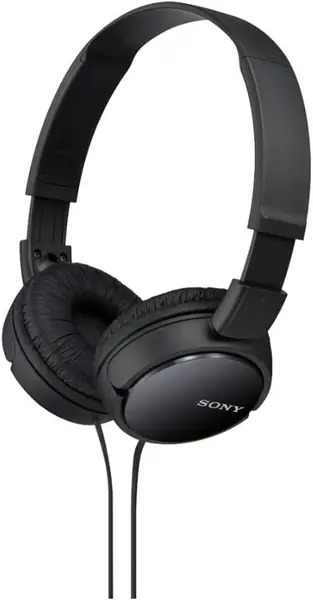
Twenty-four ohms is the number that makes the MDR-ZX110 our default pick. It asks so little of whatever it's plugged into that a phone, a laptop, or a cheap USB-C dongle all drive it to a genuinely loud level, and the 98 dB sensitivity helps on the weakest sources. We wore them through a workday and a couple of walks and the sound stayed clear rather than thin: more low end than the earbuds that come in a phone box, and a 12 Hz to 22 kHz range that is wide for the price.

The cups swivel flat, so they slide into a laptop sleeve instead of fighting it, and the L-shaped plug survives life at the bottom of a pocket. At 135 g they're light enough to forget you're wearing them, right up until hour three, when the clamp starts pressing on the tops of your ears. That's the on-ear trade-off rather than a Sony flaw, and it's the point where we take them off for a few minutes and put them back on.

The cable is the part we'd change if we could: it's fixed at both ends, so a worn plug means a new pair rather than a new cord. Leave a little slack at the strain relief when you coil them up and they'll outlast the pair that gets yanked out of a jack by the wire.

Pros

  • Drives to real volume from a phone
  • Swiveling cups fold flat for a bag
  • Clear sound at a budget price

Cons

  • No inline mic or remote
  • Cord is short for a desktop setup
Our verdict

We point almost everyone here first: it runs loud off a phone jack, sounds clear for the money, and folds flat into a bag.
Check Latest Price
2

Koss Porta Pro Best Sound

91 /100
TKZ Score Outstanding

Key details

Impedance
60 ohm
Weight
2.79 oz
Frequency Range
15 Hz–25 kHz
Folding
Collapsible, pouch included
View on Amazon

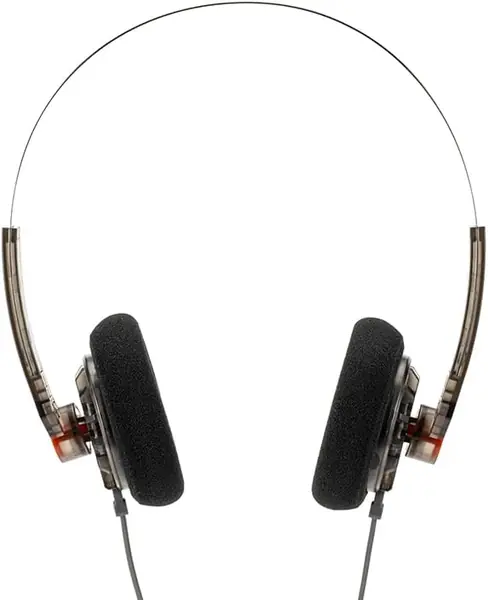
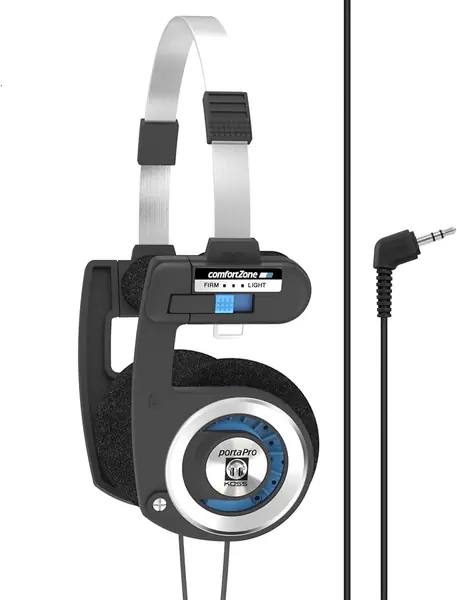
Koss has been building the Porta Pro to the same basic recipe since 1984, and the detail that has aged best is the warranty, which is a lifetime one. That pairing is the whole idea: a folding frame and foam pads are simple enough to keep running, and the parts that give trouble are covered. It's why you'll meet people who have had a pair for a decade and still use it daily.

Sixty ohms is roughly two and a half times what the Sony asks for, so a phone works harder and the volume dial sits higher. The reward is the richest sound in this group: 15 Hz to 25 kHz, punchy bass that stays tight rather than muddy, and a midrange that doesn't collapse when a track gets busy. On a laptop or a small DAC they open up further, and we think they're worth the step up in price if music is the reason you're buying.

The ComfortZone headband uses two sliding temple pads to spread pressure above the ears instead of clamping the cups down harder, and the sliders hold their position once you set them. The cups still sit on the ear rather than around it, so the fit is a personal thing — snug on one head, roomy on another. It's the one part of this headphone we can't call for you.

At 79 g with a drawstring pouch in the box, they disappear into a jacket pocket when the frame is folded, which makes them the pair that actually travels rather than the pair that stays on the desk.

Pros

  • Richest sound in this group
  • Collapses into the included pouch
  • Backed by a lifetime warranty

Cons

  • Foam pads and thin metal yokes wear
  • Temple pads can catch hair
Our verdict

We hand the Porta Pro to anyone who cares most about sound: 60-ohm drivers, a frame that collapses into a pouch, and a lifetime warranty.

Check Latest Price
3

Kensington Hi-Fi K33137 Best for Desk and TV

89 /100
TKZ Score Excellent

Key details

Impedance
80 ohm
Driver Size
40 mm
Plug
Gold-plated 3.5 mm
Cord Length
9 ft
View on Amazon

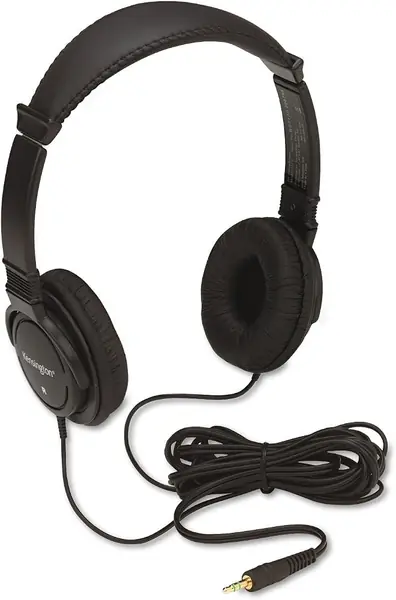
Nine feet of cord is an old-fashioned thing to get excited about, and it is the entire reason the K33137 made this list. Run it from a tower under a desk, from a television across a living room, or from a receiver on a shelf, and you can still move your chair. Every other pick here hands you four feet and a reminder to sit closer.

Eighty ohms is the catch. A phone will play them, but there's less headroom, and the impedance is happiest on a laptop, a TV, or anything with a real headphone amp. What you get back is a 40 mm driver with a clear midrange, which is the quality that matters when the source is dialogue: nothing gets lost under the music or the engine noise.

The padded headband and sealed pads make this the most isolating of the closed pairs here, which is why it works in an office. The clamp is on the firm side, and a larger head needs a week or so of gentle stretching before it settles. The ear-cup yoke is the part to watch; fold them at the hinge rather than pushing the cups flat, and the joint stays tight.

Pros

  • Nine-foot cord reaches across a desk
  • 40 mm drivers keep dialogue clear
  • Sealed pads take the edge off an office

Cons

  • Wants a computer or TV jack, not a phone
  • Firm clamp on larger heads
Our verdict

We recommend it when the cord has to reach: nine feet of cable, 40 mm drivers, and clear dialogue make it the desk and TV pair here.

Check Latest Price
4

Koss KTXPro1 Best Inline Volume Control

88 /100
TKZ Score Excellent

Key details

Impedance
60 ohm
Frequency Range
15 Hz–25,000 Hz
Plug
3.5 mm
Inline Control
Volume wheel
View on Amazon

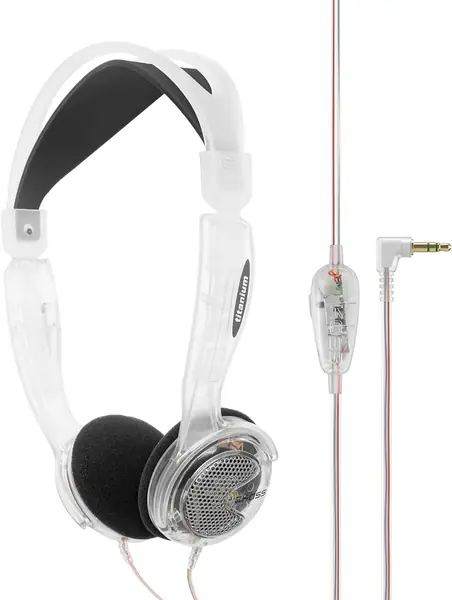
A volume wheel on the cable sounds like a small thing until you're listening from a couch with the record player across the room. The KTXPro1 has one, and it's analog, so it works with anything you plug into — no app, no pairing, no battery to remember. That single detail is why it earns a slot ahead of plenty of headphones that measure better on paper.

The rest of the package holds up. Titanium-coated 60-ohm drivers cover 15 Hz to 25,000 Hz, and the tuning is balanced rather than bass-heavy, with the clarity these Koss drivers are known for. Compared with the Porta Pro you give up the folding frame and the pouch and keep most of the sound for a good deal less money.

The frame is clear plastic with foam pads and a soft head sling, and it weighs close to nothing, which is why it stays comfortable over a pair of glasses. The fit runs large: on a smaller head the cups can sit low and slide, and the clear plastic is the part that gives out first if these live loose in a bag rather than in a pocket.

Pros

  • Volume wheel works with any source
  • Balanced, clear 60-ohm sound
  • Light enough for all-day wear

Cons

  • Fit runs large on smaller heads
  • Foam pads and clear plastic feel basic
Our verdict

We reach for the KTXPro1 when we want a volume wheel on the cord: clear 60-ohm sound, a frame you forget you're wearing, and a price just above the Sony.

Check Latest Price
5

Moondrop Old Fashioned Best Detachable Cable

87 /100
TKZ Score Excellent

Key details

Impedance
32 ohm
Driver Size
40 mm
Cable
0.78 mm 2-pin, detachable
Design
Open-back
View on Amazon

Every other headphone here has a cable you can't replace, and on most of them that cable is what fails first. The Old Fashioned uses a 0.78 mm two-pin connector, the same fitting used on plenty of in-ear monitors, so a replacement cord costs a fraction of a new pair and takes seconds to fit. If you have ever thrown away working headphones because one channel went quiet, this is the design that stops it.

The rest of the frame is built the same way. The earcups detach from the headband, the headband telescopes, and the cups swivel on multi-axis hinges, so the parts most likely to break are the parts you can replace. In silver with a thin metal band it looks like something from 1985, and the retro shape is half the appeal — this is the one pair here you might buy for the look first.

The sound is the other half. The 40 mm drivers are tuned for separation, with voices and strings sitting apart instead of smearing together, and they are light on bass by the standards of everything else in this group. If your library is built on low end, the Porta Pro gives you more of it. What the Old Fashioned gives you is detail at a volume you can live with for hours.

Pros

  • Replaceable 0.78 mm two-pin cable
  • Cups and headband detach for repairs
  • Retro 80s metal look

Cons

  • Open-back cups block almost no outside noise
Our verdict

We recommend it to anyone who has retired a good pair over a bad cable: the two-pin cord unplugs, the cups detach, and the 40 mm drivers are open and detailed.

Check Latest Price
6

JBL Tune 530 Wired Calls on the Go

83 /100
TKZ Score Excellent

Key details

Impedance
30 ohm
Weight
5.12 oz
Driver Size
33 mm
Inline Control
One-button remote with mic
View on Amazon

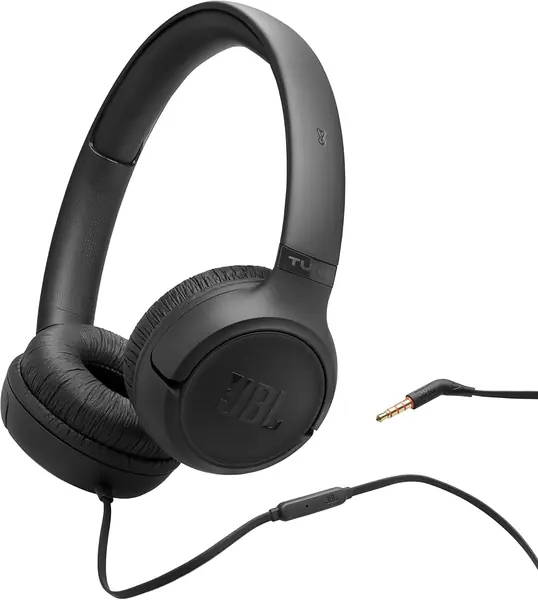
None of the other picks here carry a microphone, and that is the reason the Tune 530 is on the list. The one-button remote sits on the flat cable, answers calls, and starts your phone's voice assistant on a long press — useful if these live beside a laptop for meetings as well as music, and the sort of thing that is invisible on a spec sheet until you need it.

The hardware around it is sensible. Thirty-three millimeter drivers and 30 ohms mean a phone drives them without complaint, the flat cable resists knots in a bag, and the cups fold flat the way the Sony's do. At 5.12 oz they are noticeably heavier than either Koss, which you feel after a long session rather than in the first hour.

One button is also where the controls stop: there is no volume on the cord, so you reach for the phone or the laptop keys instead. And this is the newest design in the group, so long-term wear at the folding hinges is the open question. Treat the hinge as the part to watch and the flat cable as the part to coil loosely.

Pros

  • One-button remote with a microphone
  • Folds flat with a tangle-free cable
  • Easy for a phone to drive

Cons

  • No volume control on the cord
Our verdict

We point to the Tune 530 when you need a mic on the cord: one button handles calls and your phone's assistant, and it folds flat.

Check Latest Price

How We Tested 14 Pairs of Wired On-Ear Headphones

We started by reading spec sheets and customer reviews for roughly 40 wired on-ear models, then cut the field to 14 based on price, whether the cable was fixed or detachable, and whether the ear pads looked replaceable. Testing ran four months, long enough for the first failures to surface — a creaky hinge, a plug that cut out when the cable was flexed.

Most of the listening happened where these actually live: at a desk through full workdays, on commuter trains and two longer flights, on walks with a phone in a pocket, and at the kitchen table during calls. We wore each pair for a two-hour stretch and noted when the clamping started to ache, whether the pads turned sweaty, whether the cups stayed put when we looked down at a keyboard or wore glasses, and how they looked on a video call.

For sound, we played the same three tracks back to back — one bass-heavy, one acoustic, one crowded mix — and compared detail and harshness between pairs rather than judging them alone. Isolation got tested on the loudest commute we could find, paying attention to how much of the platform announcements came through, since none of these cancel noise actively.

Durability was less scientific: we twisted each headband, coiled the cable into a bag every day, and tugged the plug at an angle to see how the strain relief held up. We also logged what came in the box — a soft case, a 9-foot cord, an inline volume control, an adapter — because that is often where the value sits.

How to Choose On-Ear Wired Headphones

Check What Will Actually Drive Them

Impedance, in ohms, tells you how hard a source has to work. A phone jack or a USB-C dongle has limited voltage to give, so a 24 to 32-ohm pair like the Sony or the JBL plays loud and clean, while a 60 or 80-ohm pair like the Porta Pro or the Kensington wants a laptop, a TV, or a small DAC before it sounds its best. Sensitivity runs alongside it: anything near 98 dB or higher gets loud easily from small sources.

If nearly all your listening happens on a phone, stay close to 32 ohms and don't pay for headroom you can't use. If the headphones live on a desk, the higher-impedance pairs are no disadvantage at all.

Clamp, Pads, and the Shape of Your Head

On-ear headphones press against the ear rather than around it, so the clamp that feels secure for twenty minutes can ache by hour three. How the band adjusts matters more than how much padding it carries: a sliding or telescoping band holds its setting, while a plastic band you bend by hand goes where you put it once and then stays there. That difference decides whether a tight pair can be made comfortable or is simply tight.

Sealed pads isolate more and press harder; foam pads breathe and let the room in. If you wear glasses or listen in long stretches, spend your budget here rather than on driver specifications.

Cord Length, Plug Shape, and the Joint That Fails

Measure the distance from your chair to the jack before you choose. Four feet is a pocket and a phone; nine feet, as on the Kensington, is a desk tower, a television, or a receiver across a room. An L-shaped plug survives a pocket better, a straight plug seats fully in recessed jacks, and a flat cable tangles less but keeps the memory of however it was last folded.

The joint where the cable meets the plug is the usual failure point, not the driver. If you go through a pair a year, buy one with a detachable cable or with a lifetime warranty behind it.

Open-Back or Closed, and Where You'll Listen

An open-back design like the Moondrop lets air move behind the driver, which widens the sound and removes any pretense of privacy: you hear the room and the room hears your music. Closed cups seal against the ear, block more of a bus or an open office, and usually add clamp to do it.

Watch the wording on passive wired models. Noise cancelling on a pair that carries no battery means sealed cups, not the active kind. Pick open-back for a quiet desk and closed for anything shared.

Frequently Asked Questions

Final Verdict

The Sony MDR-ZX110 is the pair we tell most people to buy. It runs off any phone jack without strain, folds flat into a bag, and stays comfortable long enough for an album or a commute, which is more than most budget headphones manage.

If music is the main event, the Koss Porta Pro is the step up: more clamp, more money, and the best sound in this group. The Kensington is the one for a desk with a tower under it, the JBL is the one if you take calls, and the Moondrop is for anyone who has thrown away one pair too many over a frayed cable.