Best Lightweight Tripods for Travel and Phones of 2026

A tripod only helps if you have it with you, and that's the quiet problem with the heavy ones: they're rock steady, and they live in the closet. Lightweight models flip the tradeoff. They're easy to carry, but a thin-legged stand on a breezy afternoon can blur a shot, and a weak ball head can sag the moment you let go. What you want is the middle ground — something that disappears into a daypack and still holds a phone or a mirrorless camera steady while you step away.

My team and I spent six months setting up 12 of them — phone-first stands, aluminum travel legs, carbon fiber, selfie-stick hybrids with wireless remotes and magnetic mounts — in parks, on gravel, on a windy rooftop, and in hotel rooms. The spec printed largest on the box, max load capacity, mattered least. What separated the keepers was how the leg locks held after a hundred setups, whether the ball head locked down tight, and whether the remote was genuinely useful.

The Best Lightweight Tripods for Travel and Phones

1

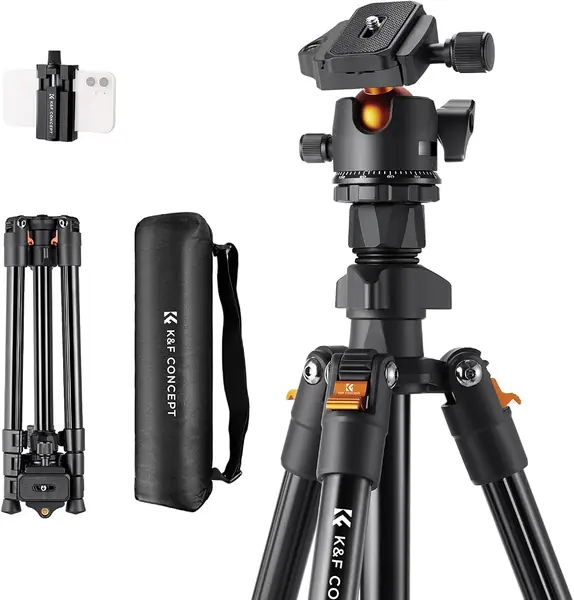
K&F Concept 64-Inch Travel Tripod Best Overall
93 /100
TKZ Score Outstanding

Key details

Weight
2.54 lb
Max Height
64.1 in
Folded Length
15.5 in
Load Capacity
17.6 lb
View on Amazon

A 17.6-pound load rating is unusual on a tripod this light, and that is the first thing we check on the K&F Concept 64-inch. The body weighs 1.15 kg and folds to 15.5 inches, yet the 36 mm ball head and four-section legs reach 64.1 inches. That is enough for a mirrorless camera with a zoom, or a phone in the included holder, without the tripod becoming a piece of luggage.

We think that balance is what makes it the best default here. The flip locks open with one hand, the center column inverts with the short column for low angles, and the 1/4-inch screw and Arca-style plate accept the accessories most travelers already own. The ball head moves smoothly for stills, and the flip locks are easy to use with cold hands. It is a working travel tripod rather than a phone stand with extra legs.

The 64.1-inch top height is tall enough for eye-level portraits, and the four leg sections collapse small enough to strap to a daypack. We did not mind the extra setup step because the locks are quick, but the 1.15 kg weight is the reason this one stays in a pack rather than a pocket. For a trip that mixes phone clips and camera stills, that is the right compromise.

Pros

  • Carries a real camera kit at 1.15 kg
  • Folds to 15.5 inches for travel
  • One-hand flip locks and 64-inch reach

Cons

  • No panhandle for smooth video pans
Our verdict

We recommend the K&F Concept 64-inch as the default lightweight travel tripod for anyone carrying both a phone and a real camera.
Check Latest Price
2

RISEOFLE 71-Inch Phone Tripod Best for Phone Creators

91 /100
TKZ Score Outstanding

Key details

Weight
9.31 oz
Max Height
70.86 in
Folded Length
12.2 in
Remote
Wireless
View on Amazon

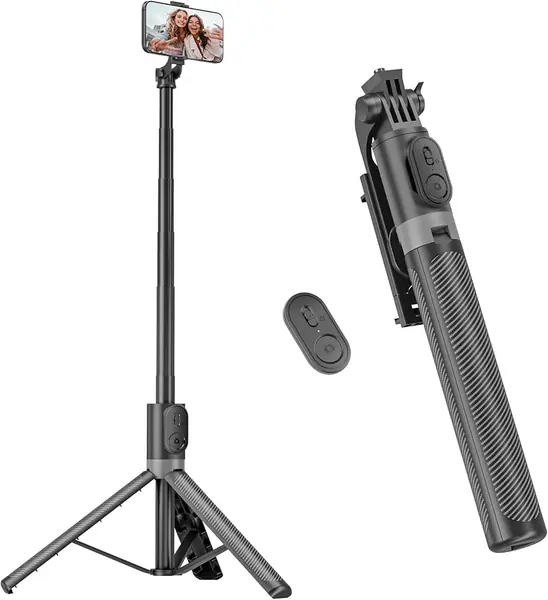
At 264 grams and 12.2 inches folded, the RISEOFLE is the lightest full-height tripod in this group. It extends to 70.86 inches, so it can lift a phone above a crowd or frame a solo shot without a second person. The same pole works as a selfie stick, and the wireless remote is removable, which means you can pocket it and step back for the shot.

The 360-degree phone holder switches between portrait and landscape without unscrewing anything, and the aluminum telescoping pole has seven sections. That is a lot of extension, and the clamp is stiff enough that you will want to seat the phone before you raise the pole. The remote handles the shutter, and the whole package folds into a bag smaller than a water bottle.

We think this is the best phone-first pick here. The 2 kg load rating is honest about its job: a phone, a small action camera, or a lightweight compact, not a DSLR with a zoom. For selfies, travel video, and hands-free calls, the weight saving is worth carrying it everywhere.

Pros

  • Weighs just 264 grams
  • Reaches 70.86 inches for group shots
  • Wireless remote and 360-degree holder

Cons

  • Top-heavy at full 71-inch height
Our verdict

We recommend the RISEOFLE for phone-first travelers who want the lightest full-height selfie stick and tripod in this set.

Check Latest Price
3

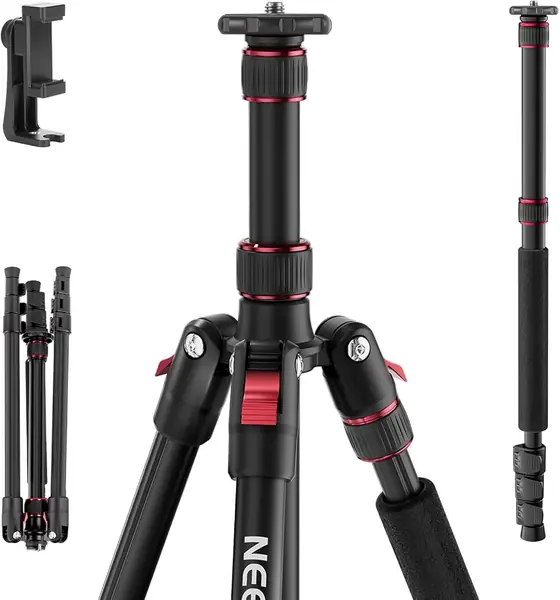
NEEWER TP53 Travel Tripod Best Budget Camera Tripod

90 /100
TKZ Score Outstanding

Key details

Weight
1.25 lb
Max Height
57.5 in
Folded Length
16.9 in
Load Capacity
3.3 lb
View on Amazon

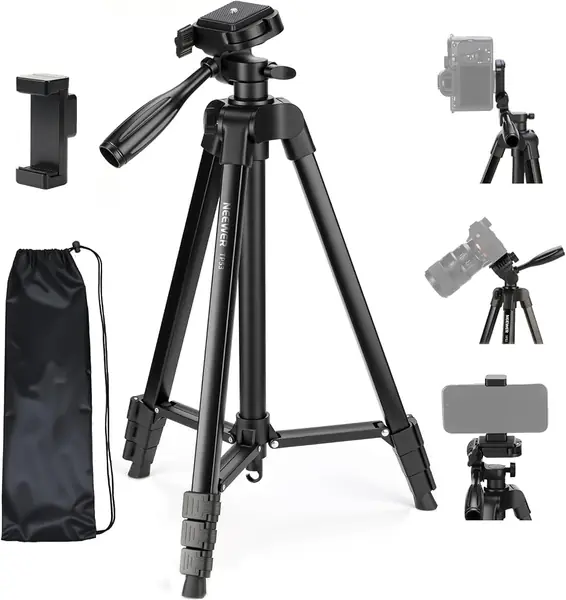
The 3.3-pound load ceiling is the first thing to understand about the NEEWER TP53, and we think it is a sensible trade. For a phone, action camera, or small mirrorless body, 3.3 pounds is enough; for a DSLR with a zoom, it is not. At 568 grams and 16.9 inches folded, the TP53 stays a true lightweight instead of pretending to be a full camera support.

The 57.5-inch top height is shorter than the other camera tripods here, but it still clears a tabletop and puts a phone at a useful interview height. The four-section flip locks are quick, and the ball head has a quick-release plate that rotates from horizontal to vertical without unscrewing the camera, a small feature that makes vertical video much less annoying.

The phone holder clamps from 2.2 to 3.4 inches, which covers most phones with a case, and the cold shoe gives you a place to mount a small light or microphone. We also appreciate the included carry bag at this weight, because loose accessories are the first thing to go missing. It is a simple tripod, and that simplicity is the point.

Pros

  • 568-gram body for light travel
  • Plate flips from horizontal to vertical
  • Cold shoe for a light or mic

Cons

  • No panhandle for smooth video pans
Our verdict

We recommend the NEEWER TP53 as the budget pick for phone shooters and compact mirrorless kits that stay under its 3.3-pound limit.

Check Latest Price
4

NEEWER TP14B Travel Tripod Best Tall Travel Tripod

89 /100
TKZ Score Excellent

Key details

Weight
3.2 lb
Max Height
72 in
Folded Length
17 in
Load Capacity
13 lb
View on Amazon

The 72-inch top height and monopod conversion are the reasons the NEEWER TP14B exists in this set. It folds to 17 inches and carries 13 pounds, so it can hold a camera with a zoom and still go in a carry-on. The two-section center column does most of the height work, which means you can raise the camera without extending every leg to its thinnest section.

We think it is the best tall option here for camera work that needs elevation. The 360-degree ball head has an Arca-type plate, the leg locks are quick flip tabs, and the phone holder means you can leave the camera at home for a phone shoot. The 3.2-pound weight is the price of that height and capacity; this is a pack tripod, not a pocket one.

The monopod is a real second tool, not a spec-sheet afterthought. Remove one leg and you have a stabilizer for a crowded space or a hiking aid. The metal legs and ball head feel sturdy in hand, and the folded package is short enough to live under a airplane seat with a backpack.

Pros

  • 72-inch reach with a 13-pound load
  • Converts to a monopod
  • Two-section center column raises quickly

Cons

  • Plastic leg-lock tabs may wear faster
Our verdict

We recommend the NEEWER TP14B for camera users who need 72-inch reach and a monopod in one travel tripod.

Check Latest Price
5

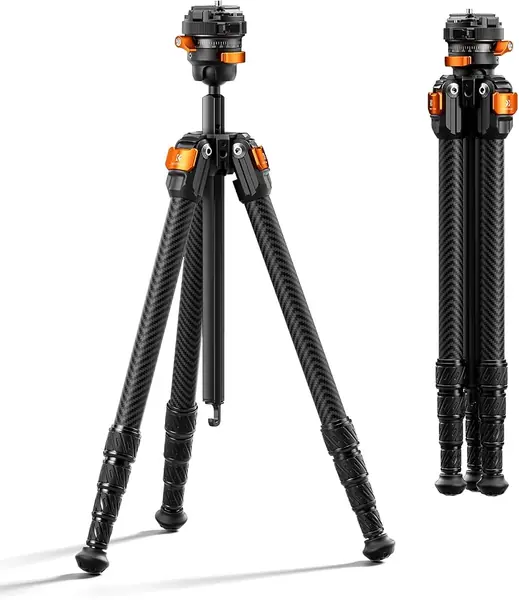
K&F Concept 60-Inch Carbon Tripod Best Ultralight Carbon

88 /100
TKZ Score Excellent

Key details

Weight
2 lb body
Max Height
60 in
Folded Length
16 in
Load Capacity
13.2 lb
View on Amazon

A 2-pound body is the headline on the K&F Concept carbon tripod, but the 22 mm legs are the number that decides whether it suits you. They keep the weight down and make the 60-inch tripod easy to carry, yet they are not built for a 70-200 mm f/2.8. We think of this as a compact mirrorless tripod first, and the 13.2-pound ball-head rating as a ceiling rather than a target.

Folded to 16 inches, it disappears into a backpack next to a laptop. The 28 mm ball head has a smooth pan base, the legs use twist locks rather than flip clamps, and the short center column gets the camera down to 15.6 inches for low angles. The hook under the center column is a useful detail: hang a bag on it when the wind picks up and the tripod settles down.

We were also impressed by the little things: two quick-release plates come in the box, so you can leave one on a camera and one on a cage. The catch is the plate width. The included plate is 37 mm wide, and the clamp is built around that Arca-style fit, so measure any wider L-bracket before you assume it will seat fully.

Pros

  • 2-pound carbon body
  • Folds to 16 inches
  • Hook under the column for ballast

Cons

  • Twist locks are slower than flip locks
Our verdict

We recommend the K&F Concept carbon tripod for compact mirrorless travelers who will pay for a 2-pound body and a 16-inch fold.

Check Latest Price
6

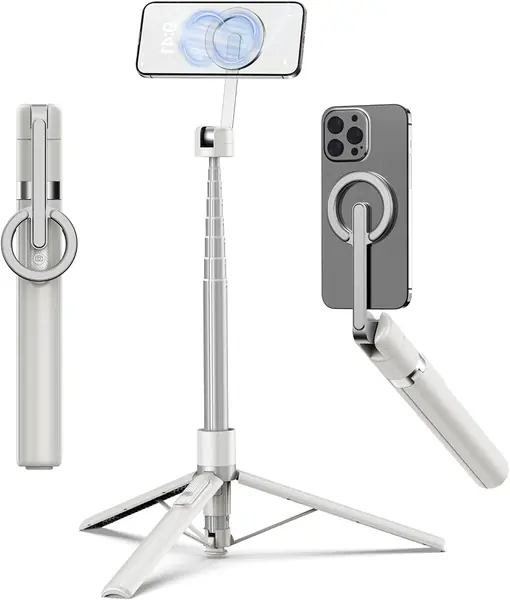
TONEOF 68-Inch Magnetic Tripod Best for MagSafe iPhones

87 /100
TKZ Score Excellent

Key details

Weight
11.3 oz
Max Height
68 in
Folded Length
11 in
Remote
Rechargeable
View on Amazon

The magnetic mount is the reason to pick the TONEOF over the other phone tripods here. An iPhone with MagSafe snaps onto the aluminum plate and stays put without a clamp, which makes setup feel instantaneous. At 320 grams and 11 inches folded, it is short enough for a jacket pocket, yet it extends to 68 inches for group shots and hands-free video.

The built-in remote detaches and charges, so you are not hunting for a coin cell before a shoot. The mount rotates 360 degrees horizontally and tilts 200 degrees vertically, and the whole thing folds into a compact stick. For a non-MagSafe phone, the included metal ring makes it work, but you have to commit to sticking the ring on the phone or case.

We think it is the best iPhone-first pick here when you shoot alone. The magnet is strong enough to hold a Pro Max in a MagSafe case, and the remote makes framing a solo shot much easier than stretching for the shutter. It is a phone-first tool, and the 320-gram build is the reason it goes everywhere.

Pros

  • Magnetic mount snaps on instantly
  • Folds to 11 inches and weighs 320 g
  • Rechargeable detachable remote

Cons

  • Top-heavy at full 68-inch height
Our verdict

We recommend the TONEOF for MagSafe iPhone shooters who want a pocketable tripod with a rechargeable remote and no phone clamp.

Check Latest Price
7

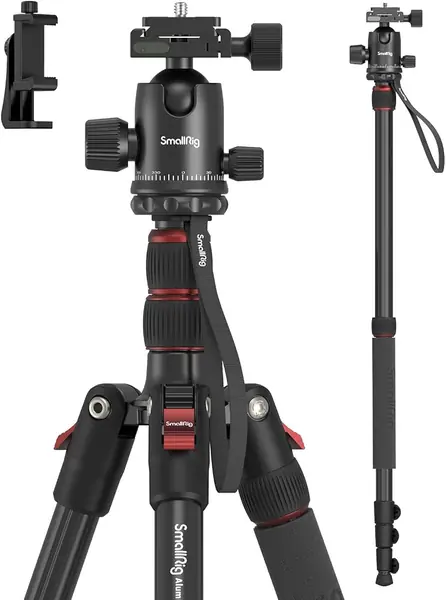
SmallRig CT-10 Tripod Best for Heavy Camera Rigs

86 /100
TKZ Score Excellent

Key details

Weight
3.4 lb
Max Height
71 in
Folded Length
43 cm
Load Capacity
33 lb
View on Amazon

A 33-pound payload is the number that separates the SmallRig CT-10 from the rest of this set. It weighs 3.4 pounds, folds to 43 cm, and extends to 71 inches, so it can hold a heavier camera and still travel in a car or a large pack. The 36 mm ball head has a 360-degree pan, and the legs convert to a monopod when you need to move fast.

The leg locks are quick-release flip tabs, and the red leg-angle buttons are easy to find by feel. We like that the center column can be reversed for low shots, and the 33-pound rating gives you margin with a normal camera and lens. It is not an ultralight tripod, but it is a serious support for the size.

The monopod is a real second tool, not a spec-sheet afterthought. Remove one leg and you have a stabilizer for a crowded space or a hiking aid. The red leg-angle buttons and flip locks are easy to work with cold hands, which is more than we can say for some twist-lock tripods.

For a heavy rig that still needs to fold into a car trunk, the CT-10 earns its place. It is the high-payload choice here, not the ultralight one, and that is the right way to read the 33-pound number. If you are packing for a long hike, the K&F Concept 64-inch is the easier carry.

Pros

  • 33-pound payload for heavy rigs
  • Converts to a monopod
  • Quick flip locks and red angle buttons

Cons

  • 3.4 pounds is heavy for long hikes
  • Ball-head clamp can loosen under heavy lenses
Our verdict

We recommend the SmallRig CT-10 when a heavy camera rig needs a 33-pound payload and a monopod more than it needs the lowest weight.

Check Latest Price
8

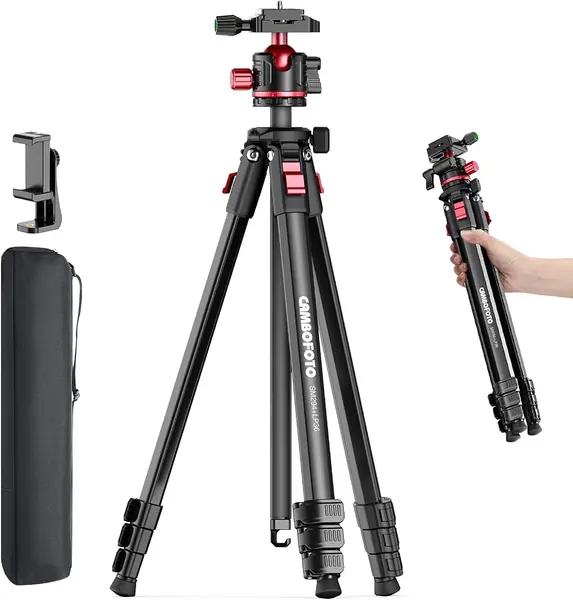
CAMBOFOTO 68-Inch Travel Tripod Best for Value Camera Travel

85 /100
TKZ Score Excellent

Key details

Weight
2.6 lb
Max Height
68 in
Folded Length
21.2 in
Load Capacity
8 lb
View on Amazon

The 21.2-inch folded length is the first compromise in the CAMBOFOTO, and it is a visible one. This is a 68-inch tripod that does not disappear into a small daypack; it rides in a larger bag or straps to the outside. In exchange, you get a 2.6-pound camera tripod with an 8-pound load rating and a 360-degree ball head for not much money.

The three-section legs use flip locks, which are quicker to set than twist locks, and the ball head has dual knobs for pan and tilt. The quick-release plate uses a standard 1/4-inch screw, and a phone holder is included, so the same tripod can handle a mirrorless camera or an iPhone. The 18.5-inch minimum height is low enough for tabletop work.

At 2.6 pounds, it is light enough to carry on a day trip, and the 8-pound rating covers a mirrorless body with a standard zoom. The ball head is basic but smooth enough for stills, and the included bag keeps the phone holder and plate together. It is a simple camera tripod that happens to be tall for the money.

We think the CAMBOFOTO is a good value for a tall camera tripod when you pack by car rather than by backpack. It is the one for a trunk, a checked bag, or a roomy daypack, not for a minimalist carry-on. If your bag is small, the K&F Concept 64-inch is the better fit.

Pros

  • 68-inch reach at 2.6 pounds
  • 8-pound load for mirrorless kits
  • Includes phone holder and quick-release plate

Cons

  • 8-pound load limits big telephoto lenses
Our verdict

We recommend the CAMBOFOTO when you want a tall camera tripod at a low price and pack by car rather than by backpack.

Check Latest Price

How We Chose and Tested the Best Lightweight Tripods

We built the shortlist by reading listings and customer reviews, then filtering on folded length, weight, mount type, and price. The 12 that made the cut spanned aluminum and carbon fiber, flip and twist locks, phone-first designs, and camera-first models with quick-release plates.

Testing ran six months, and very little of it happened on a bench. These tripods rode in daypacks and side pockets, went up to a rooftop on a gusty afternoon for timelapse attempts, sat on gravel and uneven trailside dirt, got set up one-handed in a hotel room at midnight, and stood in for a desk stand during video calls. We timed how long each took to go from bag to shooting height solo, then packed it back down in a hurry.

At each setup we extended to full height and pressed on the apex to see if any leg slipped or flexed, then nudged a leg with a knuckle to watch how the whole tripod recovered. With a camera mounted, we tightened the ball head and checked for droop over ten minutes. We ran every wireless remote from across a room and through a doorway, mounted a cased phone on each magnetic ring and shook it, and converted the 2-in-1 models to monopods to see how much of a hassle the switch really was.

Back indoors, we weighed each one on a kitchen scale, confirmed the folded length actually fit a backpack side pocket, cycled every leg lock far more times than a normal shoot would require, and checked the plate clamp for security after each pack-down. By the end we looked for scratches, wobble at the joints, and whether the extra money for carbon fiber bought measurably steadier footage or just fewer ounces.

How to Choose a Lightweight Tripod

Match the tripod to the device first

Phone tripods and camera tripods look similar, but they are built around different loads. A phone-first model such as the RISEOFLE can weigh 264 grams because it only has to steady a phone; a camera tripod such as the K&F Concept 64-inch carries a 17.6-pound rating and a larger head. If you shoot both, start with the camera tripod and add the phone holder rather than asking a selfie stick to hold a DSLR. The phone holder's clamp range and the tripod's 1/4-inch screw are the two specs to check.

Treat load ratings as ceilings

A 13.2-pound ball-head rating does not mean the legs can handle 13.2 pounds of camera. The K&F Concept carbon model is the clearest example: the head is rated to 6 kg, but the 22 mm carbon legs are intended for mirrorless and entry DSLR kits up to about 3.3 pounds. Read the lower of the two limits, count the lens and quick-release plate, and leave a margin for wind and panning. If you are near the limit, go up a leg size.

Weight and height trade against stability

Every gram you save comes from somewhere: thinner legs, more leg sections, or a lighter center column. A 3.2-pound tripod at 72 inches, like the NEEWER TP14B, is a different tool from a 264-gram phone tripod at 71 inches. The phone tripod is easier to carry, but the camera tripod has more mass and leg diameter to resist a bump. Use the lowest height that frames the shot, and hang a bag on the center-column hook when the wind picks up.

Folded length decides whether it travels

The difference between a 15.5-inch fold and a 21.2-inch fold is the difference between a daypack and a trunk. The K&F Concept 64-inch and NEEWER TP14B are short enough to live in a carry-on; the CAMBOFOTO is a 68-inch tripod with a 21.2-inch folded length, so it takes a larger bag or a strap on the outside. Measure your pack before you buy, and remember that a four-section leg usually folds shorter than a three-section leg at the same height.

The head, plate, and remote are what you touch every day

A ball head is fast for stills and awkward for smooth pans; a pan head is the opposite. Plate compatibility matters just as much: the K&F Concept carbon tripod uses a 37 mm Arca-style plate, and a wider L-bracket may not seat. For phone work, check the clamp range and whether the remote is included or sold separately. The NEEWER TP53's plate flips from horizontal to vertical without removing the camera, which is a small convenience you will notice every time you shoot vertical video.

Frequently Asked Questions

Final Verdict

For most travelers, the K&F Concept 64-inch is the lightweight tripod to buy. It folds to 15.5 inches, carries a real camera kit, and still weighs close to a liter of water. If your phone is the only camera, the RISEOFLE saves a lot of weight and reaches higher; if you shoot compact mirrorless and count grams, the K&F Concept carbon model is the premium alternative.