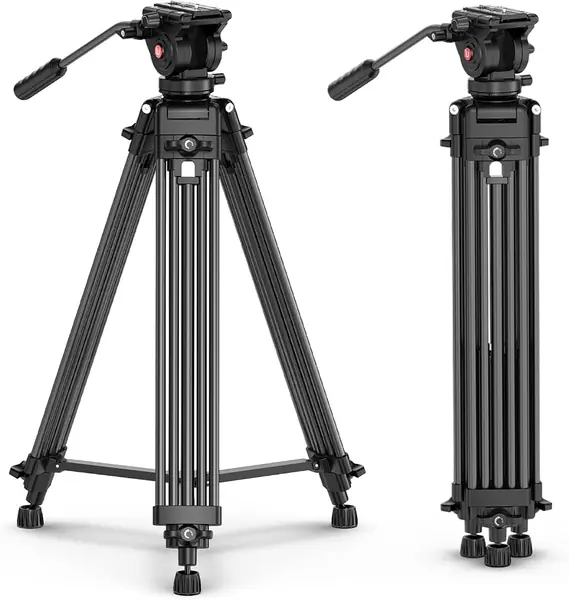
Best Heavy-Duty Video Tripods of 2026

A slow pan is where cheap tripods give themselves away. The head grabs, then lurches, and a take you spent twenty minutes lighting is suddenly unusable — which is why I stopped trusting flimsy legs for anything with movement in it. A heavy-duty video tripod fixes that specific problem: a fluid head with real drag, legs that don't shiver when a truck rolls past, and enough mass that your camera stays where you put it.

Over the past six months, my team and I have run eight of these tripods through real shoots — interviews, product footage, a few windy afternoons on a rooftop deck. The differences live mostly in the head, not the legs. One thing I'd tell a first-time buyer: don't trust the max load number on the box, since a head that feels silky with a bare camera turns sticky once you add a cage and a monitor, and a tripod so heavy you leave it in the car is one you won't use. The picks below earned their space.

The Best Heavy-Duty Video Tripods

1

K&F Concept VA3+BV70 Best Overall
92 /100
TKZ Score Outstanding

Key details

Head Payload
17.6 lb
Maximum Height
79.5 in
Tripod Weight
12.3 lb (5.6 kg)
Folded Length
36.2 in
View on Amazon

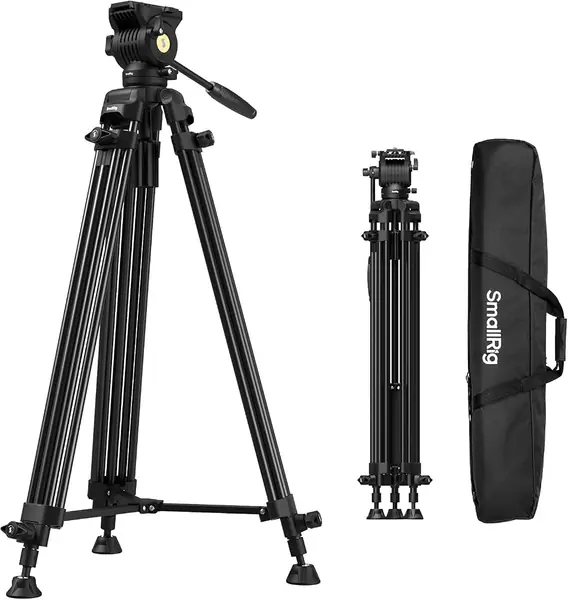
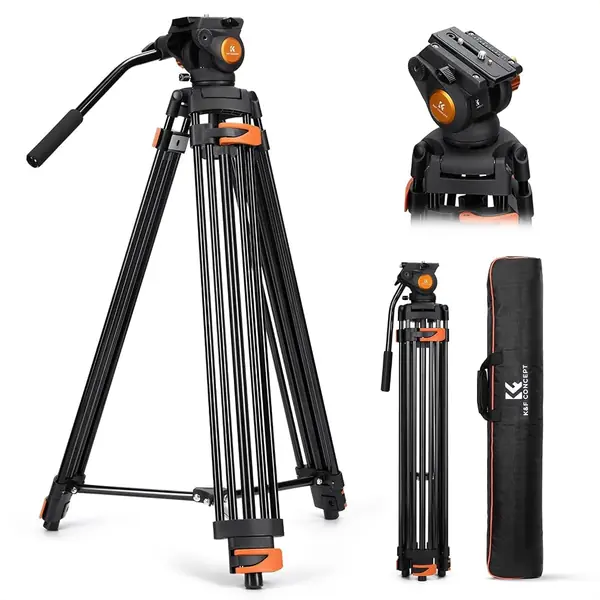
Seventy-nine and a half inches of maximum height is the number that separates the K&F Concept VA3+BV70 from almost everything else here. That is eye level with a standing presenter, a clean high angle over a table, and a shot over a crowd at an event, all without a ladder or a center column you do not have. Three flip-lock sections get you up there quickly, and the whole tripod collapses to 36 inches.

What earns it the top spot is what comes with the height: a 17.6-pound fluid head that starts and stops a pan evenly, a tension knob big enough to find by feel in a dark room, and a pan handle that mounts on either side. The motion stays smooth through a slow tilt, and the drag holds a zoom lens where you leave it. Underneath, twin-tube aluminum legs stay planted at full extension, and the mass is where that stability comes from.

The bill arrives at carrying time. At 5.6 kg (about 12.3 pounds) it is the heaviest tripod on this list, and a 36-inch folded package lives in a trunk rather than on your shoulder. Shorten the walk and the SmallRig AD-14 is the better call; keep the tripod on a cart or in a studio and the weight buys you legs that do not flex with 17.6 pounds on the plate.

Pros

  • 79.5-inch reach for over-crowd shots
  • 17.6 lb payload with even, damped pans
  • Flip locks extend fast at full height

Cons

  • Heavy at 12.3 lb to carry
  • 36-inch folded length needs a trunk
Our verdict

Our top pick: 79.5 inches of reach, a 17.6-pound head that pans smoothly, and stiff legs that stay planted, at the cost of a 12-pound carry.
Check Latest Price
2

Cayer BV30L Best for Mirrorless Rigs

91 /100
TKZ Score Outstanding

Key details

Head Payload
13.2 lb
Maximum Height
72.5 in
Tripod Weight
8.8 lb
Head Base
75mm flat base
View on Amazon

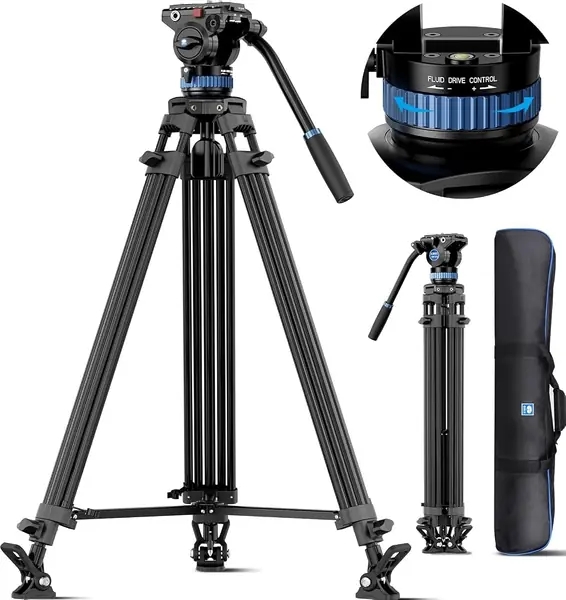
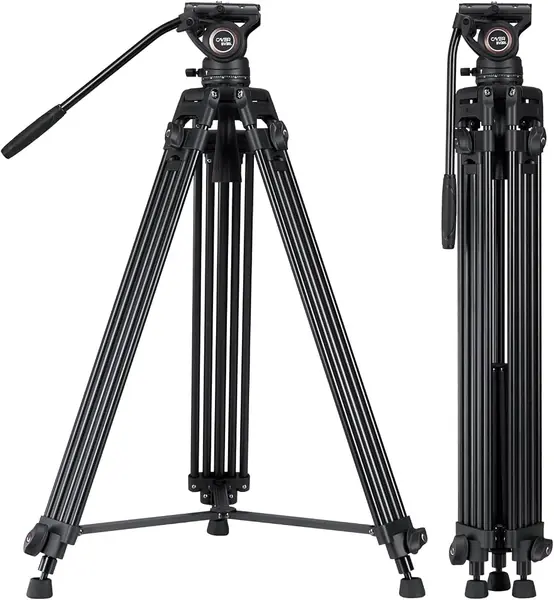
The Cayer BV30L sits one rung below our top pick on paper, 72.5 inches instead of 79.5, and it is the tripod most people will be happier carrying. At 8.8 pounds it is nearly four pounds lighter than the K&F, and it still has the two things that matter on a normal shoot: a 75mm leveling bowl and a head that starts a pan without a lurch.

The K3 head is the reason it earns a place. Pans come out slow and even, the tilt friction holds a zoom lens without drooping, and the side-clamp plate locks a camera down without the guesswork of a slide-in mount. Add the pair of quick-release plates in the box, one for the camera and one for a second body, and a two-camera setup stops being a screwdriver job.

Twin-tube legs and a mid-level spreader make it stable and quick on a hard floor, and the bowl levels without you touching a leg. One habit worth forming: check each leg section before a long take, because height can creep at the clamps after a season of service.

Pros

  • Even, well-damped pans from the K3 head
  • 75mm bowl levels without touching the legs
  • Two quick-release plates included

Cons

  • Payload tops out at 13.2 lb
Our verdict

The pick for a mirrorless or DSLR rig: 8.8 pounds, a 75mm bowl, two quick-release plates, and a K3 head that pans evenly.

Check Latest Price
3

NEEWER TP-M200 Best for Fast Setup

90 /100
TKZ Score Outstanding

Key details

Head Payload
17.6 lb (8 kg)
Maximum Height
79 in (200 cm)
Bowl Size
70mm
Folded Length
35.8 in
View on Amazon

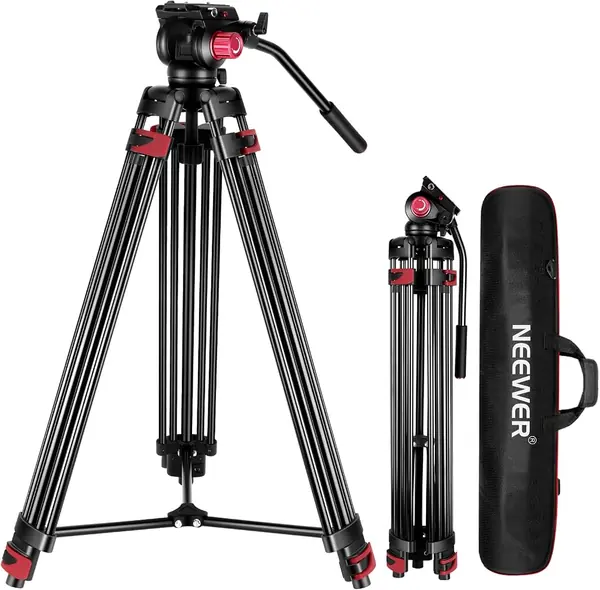
Three flip locks per leg and a paddle-style release you can pop with a thumb make the NEEWER TP-M200 the fastest tripod here to get from bag to leveled. Seventy-nine inches of top height and a 70mm bowl do the rest: stand it up, level it, and you are shooting while someone else is still working down a twist lock.

The head is the surprise. Pans are steady through a full 360 degrees, the tilt has a spring-assisted feel that keeps a long lens from running away, and the drag holds a mid-weight rig without a fight. It is plain, heavy aluminum at 5.64 kg, and that mass is exactly why a tall setup with a big lens sits still on it.

So why is it not our top pick? Because the joint where the head meets the bowl can work loose on a hard-used tripod, and a head that shifts on its base will wreck a locked-off shot. Check it and re-tighten at the start of a shoot day and the problem never reaches the footage. For a two-camera interview where both tripods come out of the van and have to be standing in five minutes, that extra check is cheap.

Pros

  • Flip locks and thumb release set up fast
  • Smooth 360 pan with spring-assisted tilt
  • 79 inches of height with a 70mm bowl

Cons

  • Head can work loose from the bowl
  • Heavy at 12.4 lb to move around
Our verdict

Built for crews working fast at full height: flip locks, a 70mm bowl, and a drag head that behaves, with a joint worth checking before each shoot.

Check Latest Price
4

SmallRig AD-14 Best Lightweight

88 /100
TKZ Score Excellent

Key details

Head Payload
18 lb (8 kg)
Maximum Height
73 in (186 cm)
Tripod Weight
6.8 lb (3.1 kg)
Bowl Size
65mm
View on Amazon

The AD-14 is the one that rides in the back seat instead of the trunk. At 6.8 pounds it is the lightest tripod in this group, and it still carries an 18-pound head rating, which is why it is the tripod we reach for when the shoot is somewhere a cart cannot go.

The 65mm bowl is the compromise that makes the weight possible. It levels the head the same way a 75mm bowl does, with less metal around it, and on a mirrorless rig you will not notice the difference. The 2-2-1 leg layout extends to 73 inches, folds to 34.6 inches, and comes with a two-year warranty.

Fold it down and it disappears behind a seat or into a pannier, which is the point: this is a video tripod for people who do not have a van. Pair it with a mirrorless camera and a zoom and you have a full fluid-head setup you can walk with. Load a built cinema camera onto it and you are close to the 18-pound rating before the monitor goes on.

Pros

  • 6.8 lb with an 18 lb head rating
  • Levels on a 65mm bowl
  • Folds to 34.6 inches

Cons

  • Spreader is the least durable part
Our verdict

The one to carry: 6.8 pounds with an 18-pound head rating, a 65mm bowl, and 73 inches of height.

Check Latest Price
5

Sirui AM-25S Best for Uneven Ground

87 /100
TKZ Score Excellent

Key details

Head Payload
17 lb (8 kg)
Maximum Height
74.8 in (190 cm)
Tripod Weight
8.8 lb (4 kg)
Bowl Size
75mm
View on Amazon

Retractable spikes under rubber feet, plus a mid-level spreader, are the pair that makes the Sirui AM-25S the pick for ground that is not level. Spike it into grass or gravel, set the spreader to fix the leg splay, and the platform stops rocking in a way the flat-footed tripods here cannot match on a slope.

A tension ring at the base of the 75mm bowl lets you dial pan and tilt from nearly free to nearly locked instead of choosing between two settings. The twin legs are stiff, the 17-pound rating covers a camcorder or a DSLR with a zoom, and the 74.8-inch top height is within an inch of the Cayer.

Nothing here pretends to be a premium head, and that is the appeal: it does the plain job of being a level platform about as well as anything in this group. Set it on a bank, spike it down, level the bowl, and a locked-off shot holds as long as you need it.

Folded, it is 96 cm, about 38 inches, so this is a car tripod rather than a backpack one, which is the price of twin tubes this stiff. For a run-and-gun day on rough ground, the spikes and the spreader earn that back.

Pros

  • Spikes and spreader hold on rough ground
  • 75mm bowl with tension-ring drag
  • Stiff twin legs with a 17 lb rating

Cons

  • No separate tilt lock, only drag tension
Our verdict

The uneven-ground answer: spikes, a mid-spreader, and a 75mm bowl that levels properly, with tilt held by drag rather than a lock.

Check Latest Price
6

Sirui SQ75+VHS10 Best Premium

86 /100
TKZ Score Excellent

Key details

Head Payload
22 lb (10 kg)
Maximum Height
71.7 in
Drag Control
4 steps
Counterbalance
7 steps
View on Amazon

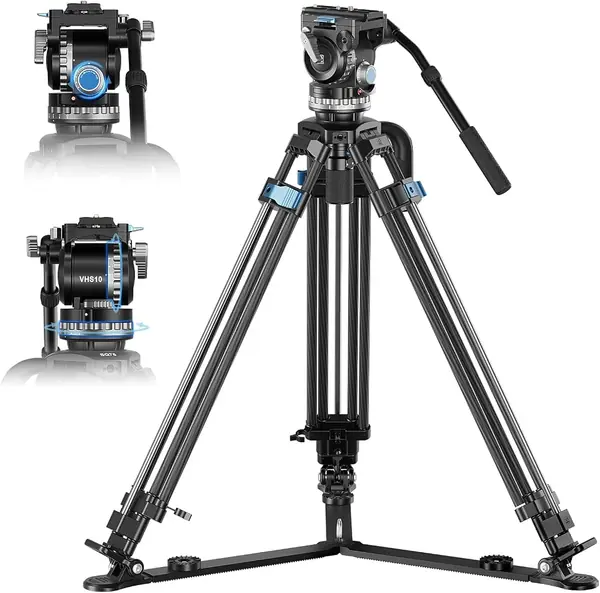
Seven counterbalance steps and four drag steps on a fluid head is the kind of control that normally lives on a rental shelf. What the numbers buy is a heavy rig that stays where you leave it: set the counterbalance to match the camera and the head holds a tilt with your hand off the handle.

The carbon legs matter as much as the head. This is a 22-pound-capacity system that weighs 5.9 kg, and the one-step flip locks drop all three legs at once instead of working down each section. The 75mm half ball levels on the same principle as the aluminum picks, and 71.7 inches is an inch below the Cayer: enough for most work, short for a shot over a crowd.

The ground spreader is the part to think about before you buy. Fixing leg splay at floor level is exactly right on a stage or a studio floor and less happy on gravel or a bank, where a mid-spreader or no spreader at all does better.

None of that matters if your camera is a mirrorless body and a kit lens, and you are paying for headroom you never use. It matters a lot when the camera is built up, the shot is locked off for twenty minutes, and there is one operator. That is the case this system is designed for, and it is the only tripod here that handles it without a second pair of hands.

Pros

  • 7-step counterbalance holds a heavy rig
  • 4-step pan and tilt drag
  • 22 lb capacity on carbon legs at 13 lb
  • One-step leg locks

Cons

  • Ground spreader wants a flat, level floor
Our verdict

For built-up rigs on flat floors: seven-step counterbalance, four-step drag, and carbon legs that carry 22 pounds without a second operator.

Check Latest Price
7

Cambofoto TA60 Best for Stage and Studio

85 /100
TKZ Score Excellent

Key details

Head Payload
20 lb
Maximum Height
74 in
Tripod Weight
11.4 lb (5.17 kg)
Quick Release Plates
2 included
View on Amazon

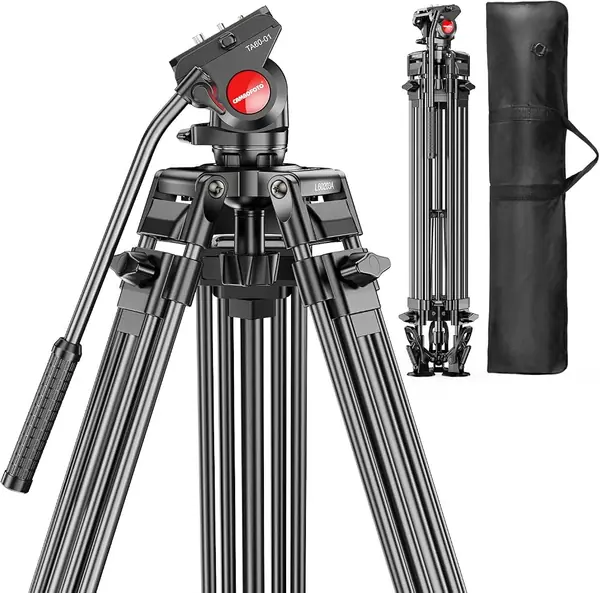
The horizontal joint on the Cambofoto TA60 is oil-filled, and the aim is a pan that eases into motion instead of jumping the first few degrees, which is exactly where inexpensive heads give themselves away. On a tripod with 20 pounds of payload and a 74-inch top height, that smooth start is what makes it worth a look: the first second of a pan is the part an audience notices.

Two quick-release plates come in the bag, both with 1/4-inch and 3/8-inch screws, so a second camera or a slider is a swap rather than a rebuild. Each leg has two clamps instead of three, which sounds minor until you are setting up in the dark: fewer joints to check, fewer places to fumble.

The money was saved in the fittings. The material list names engineering plastics alongside the aluminum, and the bowl is where you feel it. At 11.4 pounds it is a two-hand lift, and neither of those is a problem for a tripod that lives on a stage. Treat the plastic as the thing that bought you 20 pounds of payload for modest money.

Pros

  • 20 lb payload near the top of the set
  • Two quick-release plates included
  • Oil-filled pan joint for smooth starts

Cons

  • Folded length of 38 inches is the longest here
  • Plastic bowl and fittings
Our verdict

Capacity for the money: 20 pounds of payload, two quick-release plates, and 74 inches of height, with plastic in the bowl and fittings.

Check Latest Price
8

Ulanzi MT-81 Best for Seated Interviews

84 /100
TKZ Score Excellent

Key details

Head Payload
17.6 lb (8 kg)
Maximum Height
61 in (155 cm)
Leg Sections
4
Minimum Height
29.5 in
View on Amazon

If your work happens in a studio, a low-lit event room, or a seated interview, 61 inches is enough, and the Ulanzi MT-81 puts a 17.6-pound fluid head on a leveling bowl for less than most of this group. It is not the tripod for shooting over a crowd.

The bowl seat adjusts at the base, so leveling works the way it does on the taller picks, and four leg sections fold it into a small package for the walk between rooms. The head itself runs a 360-degree pan and a -70 to +90 tilt range, the same motion envelope as everything else here.

The interesting part is where the money went. This is the only pick under 70 inches, yet the head is rated for the same 17.6 pounds as our top choice, which makes it a serious option for a two-camera interview where both tripods stay locked off at seated height.

We keep it on the list for one reason: it buys head capacity instead of height, and that is the right trade for a fixed setup where the camera never goes above chest height. It is the simplest way into a fluid head and a leveling bowl without paying for height you do not need.

Pros

  • 17.6 lb fluid head at the low end of the set
  • Adjustable bowl seat for leveling
  • Four sections pack small

Cons

  • No carry bag in the box
Our verdict

For studio and seated work: a 17.6-pound fluid head on a leveling bowl in a small package, with 61 inches as the ceiling.

Check Latest Price

How We Tested Heavy-Duty Video Tripods

We built the shortlist from specs and retailer listings, filtering for fluid heads with adjustable drag, leg locks rated for the load, and standard quick release plates you can actually buy spares for. Price mattered, but a cheap head that won't hold a tilt is a false economy. Eight tripods made the cut, and we used them for six months.

Each one went to work rather than onto a bench: interviews in living rooms, product footage on a backyard deck, a dusk timelapse on a windy rooftop. We timed the first solo setup of each — bag to leveled with a camera mounted — then repeated it in low light to see how the leg locks and the leveling bowl behaved when we couldn't see them well.

For smoothness, we loaded each head with a rig near its claimed capacity and made slow pans and tilts, noting whether motion started cleanly or with a jolt and whether the camera held its tilt when we let go. A loaded rig sat for twenty minutes to check for sag. For stability, we locked the legs, leaned on the apex, and watched for shiver when someone walked past on a wooden deck.

Build quality and safety we judged by handling — how much play the leg locks had after a dozen setups, whether the plate release needed two hands, whether the whole thing felt tippy with a long lens at full height. Every tripod got packed back into its bag, carried up stairs and across a park, and weighed on a luggage scale, since portability decides whether it ever leaves the house.

How to Choose a Heavy-Duty Video Tripod

Match the Head's Payload to the Rig You Actually Build

Every heavy-duty video tripod here is rated by what its head can carry, and the range across our picks runs from 13.2 to 22 pounds. Weigh your rig with the cage, monitor, batteries, and lens hood attached, then leave room: a head at its limit loses the slow, even start that made it worth buying in the first place.

Most mirrorless and DSLR video rigs land between six and ten pounds, which is why the 17-to-18-pound heads cover the widest range of buyers. A built cinema camera or a long telephoto is what pushes you up to the 20- and 22-pound picks.

Drag and Counterbalance: Where the Money Goes

Cheap heads give you one drag setting; better ones let you change it. Stepless damping adjusts continuously and is hard to match between two cameras, while stepped drag, four steps on the Sirui VHS10 head, is repeatable. Counterbalance is the other half: a spring that holds the tilt angle with your hand off the handle.

Seven counterbalance steps, as on the Sirui SQ75+VHS10, are what let a heavy rig sit at any angle for a locked-off shot. On a three-pound mirrorless setup you will not feel much difference; on a twelve-pound rig you will feel all of it.

Bowl Size, Spreaders, and Leveling

Video tripods level at the bowl rather than at the legs: loosen the bowl, tilt the head until the bubble centers, retighten. A 75mm bowl is the common size and takes the widest range of heads; 65mm and 70mm bowls appear on lighter models and work the same way.

Then pick your spreader. Mid-level spreaders, as on the Cayer BV30L and Sirui AM-25S, fix leg splay above the floor and cope with rough ground. A ground spreader, as on the Sirui SQ75+VHS10, is rock solid on a flat stage and awkward on gravel. Spikes for grass and dirt, rubber feet for hardwood.

Height, Folded Length, and Where the Tripod Lives

Height across our picks runs from 61 to 79.5 inches. The low end is fine for seated interviews, tabletop work, and studio setups; 74 to 80 inches is what you want for a standing presenter, an event, or any shot over a crowd.

Folded length is the number people check last and regret first. These tripods pack down to between about 34 and 38 inches, which is a trunk-or-back-seat decision rather than a backpack one. Measure the space in the car or the gear closet before ordering, not after.

Leg Locks, Weight, and Setup Speed

Three-section legs with flip locks are the workhorse arrangement: fast, usable in gloves, and fewer joints to check in the dark. A one-step system such as the Sirui SQ75's releases all three legs together and is genuinely quicker on a busy set.

Weight is the price of stability, and our picks run from 6.8 to 12.3 pounds; the light ones ask you to handle the spreader carefully. If the tripod lives in a studio, buy the heavier one. If it moves between rooms on a cart, buy the lighter.

Frequently Asked Questions

Final Verdict

The K&F Concept VA3+BV70 is the tripod we recommend to most people because it gets the hardest part right: 79.5 inches of height, a 17.6-pound head, and pans that start and stop without a hitch. If your camera is a mirrorless body with a cage and a zoom, the lighter Cayer BV30L is the friendlier tripod, and it brings two quick-release plates and a 75mm bowl.

For a built-up cinema rig with a long lens, the Sirui SQ75+VHS10 is the only system here whose seven-step counterbalance keeps the camera where you leave it, provided you shoot on flat floors.