Best Carbon Fiber Travel Tripods of 2026

Carbon fiber's pitch is simple: near-aluminum stiffness at roughly two-thirds of the weight. What a spec sheet can't tell you is whether that stiffness survives a gust off the water or a long lens hanging off the front — the difference between a tripod that earns its place in your bag and one that stays in the closet.

I've carried a dozen of these through airports, up trails, and onto a windy pier over the past seven months, and the gaps show up where the listings don't look. Section count matters more than maximum height: five-section legs pack shorter but flex more. Lock style is a real preference — flip buckles are faster with cold hands, twist locks snag less on a pack strap. And don't shop by load rating; what fails first is the ball head, which creeps under a heavy lens and ruins more frames than a slightly flexy leg.

The picks below are the ones that held up, whether you're shooting off a phone, hiking with a mirrorless kit, or want the option of stripping a leg into a monopod.

The Best Carbon Fiber Travel Tripods

1

NEEWER LITETRIP LT32 Best Overall
91 /100
TKZ Score Outstanding

Key details

Weight
2.6 lb
Max Height
62 in
Load Capacity
22 lb
Folded Size
17 in
View on Amazon

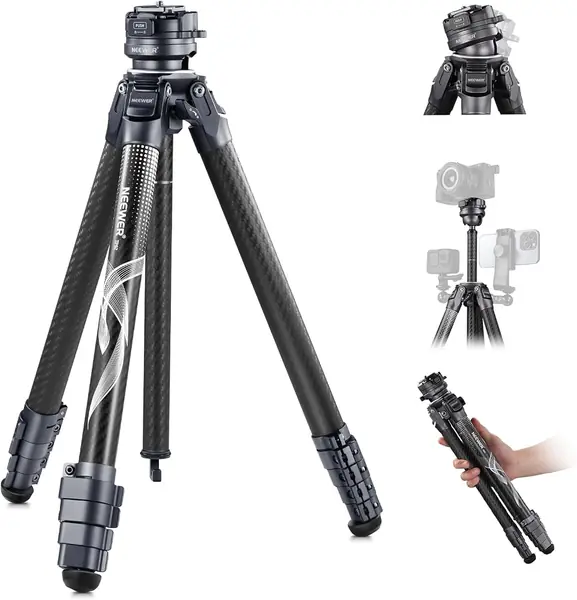
The LITETRIP LT32 fixes the two things that make a travel tripod annoying: slow setup and a crooked horizon. Its leg locks are spring-loaded flip buckles that pop open with a half squeeze and clamp shut with a thumb, so you aren't counting turns on four collars per leg in the dark. Under the head sits a leveling ring that lets you flatten a horizon on uneven ground without touching the legs at all. We came back to both features constantly, and they're why this is our top pick.

The rest of the package holds up. It weighs 2.6 pounds, folds to about 17 inches, and still reaches 62 inches on 26mm carbon legs rated for 22 pounds — enough for a full-frame body and a zoom. The plate is Arca-type with a side button for one-push swaps, and it's compatible with Peak Design plates, so a camera you already carry on a clip moves over without an adapter.

The head is where it asks you to compromise. It tilts through a pair of U slots rather than swinging freely the way a full ball head does, so vertical shots take a deliberate move, and a heavy zoom deserves a check of the plate screw before you walk away from it. If you shoot portrait orientation all day, the Cayer CH35's 42mm ball head with a 90-degree side slot is the friendlier tool.

Pros

  • Flip locks set up in seconds
  • Leveling ring squares the horizon fast
  • 2.6 lb with a 22 lb capacity
  • Folds to 17 inches for a daypack

Cons

  • Head tilt is limited for portrait shots
Our verdict

We recommend the LITETRIP LT32 to any traveler who wants a fast, level setup at 62 inches without carrying three pounds.
Check Latest Price
2

K&F Concept 68-Inch Best Full-Height Value

90 /100
TKZ Score Outstanding

Key details

Weight
2.93 lb
Max Height
68 in
Load Capacity
22 lb
Folded Size
16.5 in
View on Amazon

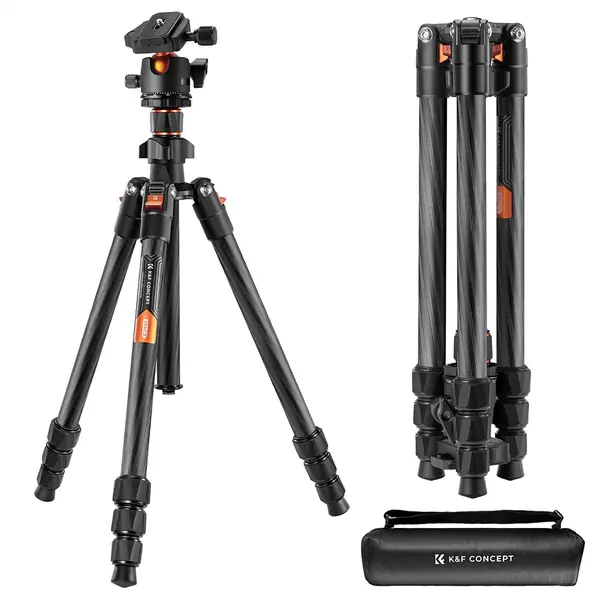
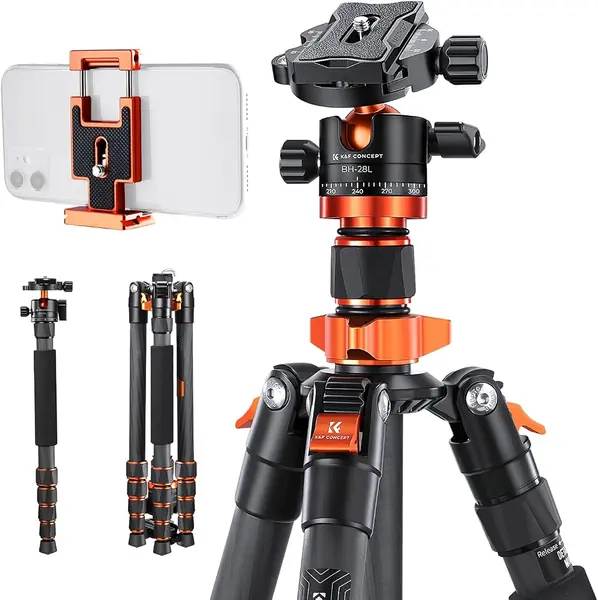
Six more inches of working height than our top pick, for less money: that's the case for the K&F Concept 68-inch. At full extension a taller photographer can stand behind the camera instead of stooping over it, which is the difference between a tripod you take out for landscapes and one you take everywhere.

It gets there on five sections of carbon with a 22-pound rating, folds to 16.5 inches, and weighs 2.93 pounds — under three pounds for a tripod that reaches eye level. One leg unscrews and pairs with the center column to become a monopod, which we think is the most useful extra here for a parade, a track meet, or anywhere a spread tripod would be in everyone's way. A phone mount and a hook under the column are included.

The honest trade for that height is stiffness. At 68 inches the legs are light, and a long lens in a breeze will drift; weight the center-column hook with a camera bag and keep the column down unless you need the last few inches. We think the trade is worth it for architecture, seascapes, and anyone who'd rather not crouch all afternoon.

Pros

  • Reaches 68 inches, the tallest here
  • Converts to a monopod
  • Under three pounds for the height
  • Folds to 16.5 inches

Cons

  • Five sections of twist locks slow setup
Our verdict

Buy the K&F Concept 68-inch if you shoot standing up and want the most working height here for the least money.

Check Latest Price
3

Sirui Traveler 5C Best Ultralight

89 /100
TKZ Score Excellent

Key details

Weight
1.87 lb
Max Height
54.3 in
Load Capacity
8.8 lb
Folded Size
13 in
View on Amazon

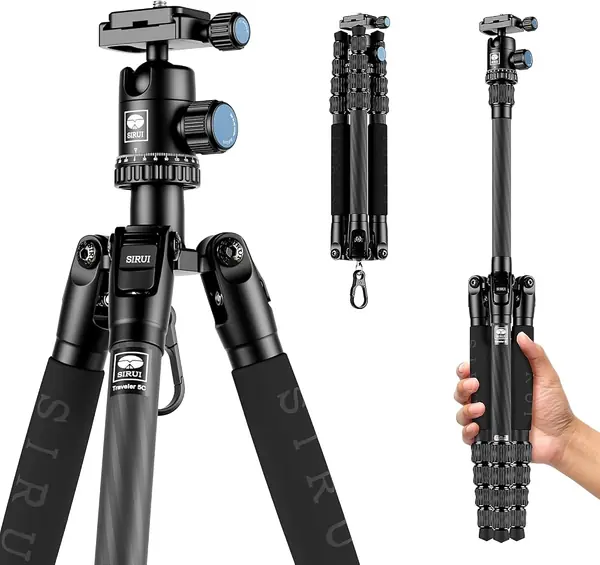
Thirteen inches folded is the number that sells the Traveler 5C. That's short enough to ride in a daypack's bottle pocket, and at 1.87 pounds it's a tripod you stop noticing by the second mile. The legs invert 180 degrees around the head to get there, and the twist collars give a small click as they seat — a nicer cue than most locks offer, and one we trusted more than a silent collar.

The trade arrives at the top. Maximum height is 54.3 inches, so a tall photographer stoops, and the upper sections are thin enough that a full-frame DSLR with a zoom feels tender up there. We kept it under five feet on anything but flat pavement and hung a bag from the column hook, and it settled down.

What it does better than anything else here: ground-level work. Invert the column and it drops to 6.3 inches, which is low enough for a flower or a shoe detail. The ball head is the plainest part of the package — fine for stills, not the head for smooth panoramas. Pair it with a light kit and it's the least fuss of the group.

Pros

  • Folds to 13 inches
  • 1.87 pounds carried
  • Inverts to a 6.3-inch minimum height

Cons

  • Only 54.3 inches at full height
  • Least steady here when fully extended
Our verdict

Choose the Traveler 5C if your tripod has to vanish into a small pack and your kit is a mirrorless body with one lens.

Check Latest Price
4

Sirui AM-124 Best for Heavy Lenses

88 /100
TKZ Score Excellent

Key details

Weight
2.65 lb
Max Height
62.6 in
Load Capacity
26.5 lb
Folded Size
18.9 in
View on Amazon

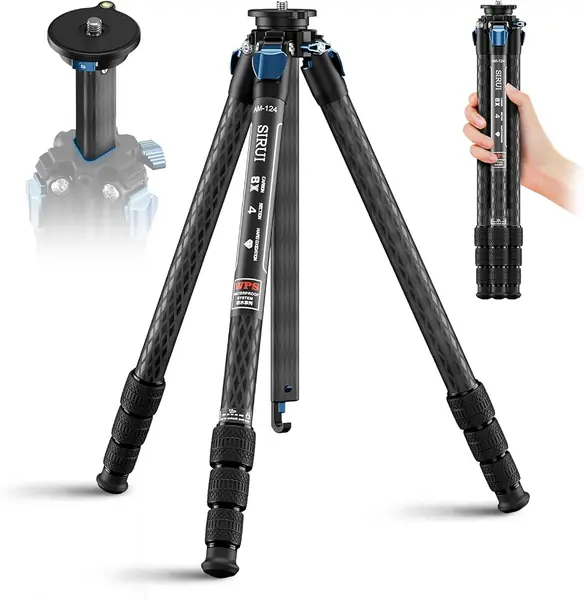
Sand and salt are what kill twist locks, and the AM-124's collars are built with a sealed waterproof structure that keeps water and dust out of the leg tubes. If your tripod work happens on beaches, in drizzle, or in the back of a truck, that's the small feature that decides the purchase.

Everything else is built around load. The legs are 26.5mm carbon, the rating is 26.5 pounds, and the center column is triangular rather than round — stiffer than a round column and shaped so the legs fold closer around it. At 2.65 pounds and 62.6 inches it sits between the ultralights and the tripods you'd never bother packing, and the 14.8-inch minimum handles low work without a separate short column.

We noticed the column first, because it changes how the whole thing feels in the hand: rigid through the middle, where flex usually starts. The cost is packed length. At 18.9 inches folded it wants a tripod pocket or a strap, not a bottle sleeve, and it's most of a pound heavier than the 5C. For a heavy lens or a scope, that's the right trade.

Pros

  • 26.5-pound load rating
  • Sealed waterproof leg locks
  • 26.5mm carbon legs

Cons

  • Folded length of 18.9 inches
  • Heavier than the ultralight picks
Our verdict

Buy the AM-124 for a heavy zoom, a spotting scope, or anyone who shoots in sand and rain and wants locks that survive it.

Check Latest Price
5

K&F Concept 64-Inch Best Budget

87 /100
TKZ Score Excellent

Key details

Weight
2.5 lb
Max Height
64 in
Load Capacity
17.6 lb
Leg Sections
4
View on Amazon

Two and a half pounds at 64 inches is the headline for the K&F Concept 64-inch, and it's the lightest route to a full working height in this group. Four leg sections do the work — fewer collars than the five-section tripods, which means faster setup and a slightly stiffer leg at any given extension.

The head is a 36mm ball with a 360-degree panning dial and an Arca-Swiss-compatible plate, and the kit includes a short center column for low-angle work plus an invertible column for macro. Load capacity is 17.6 pounds, which covers a mirrorless body with a zoom and most full-frame setups short of a super-telephoto.

What you give up is the extras. There's no monopod conversion, unlike its 68-inch sibling, and the 16.3-inch fold is good without being the 13 inches of the ultralight Sirui. We think it's the right pick for a traveler on a budget who wants a standard working height rather than a ground-level or eye-level specialist.

Pros

  • 2.5 pounds at 64 inches
  • Four sections set up faster
  • Short column included for low angles

Cons

  • No monopod conversion
  • 17.6-pound rating is lower than the 68-inch version
Our verdict

Buy the K&F Concept 64-inch if you want a normal working height, a light carry, and no interest in paying for extras.

Check Latest Price
6

Cayer CH35 Best for Low-Angle Work

86 /100
TKZ Score Excellent

Key details

Weight
1.54 lb
Max Height
53.6 in
Load Capacity
11 lb
Folded Size
17.7 in
View on Amazon

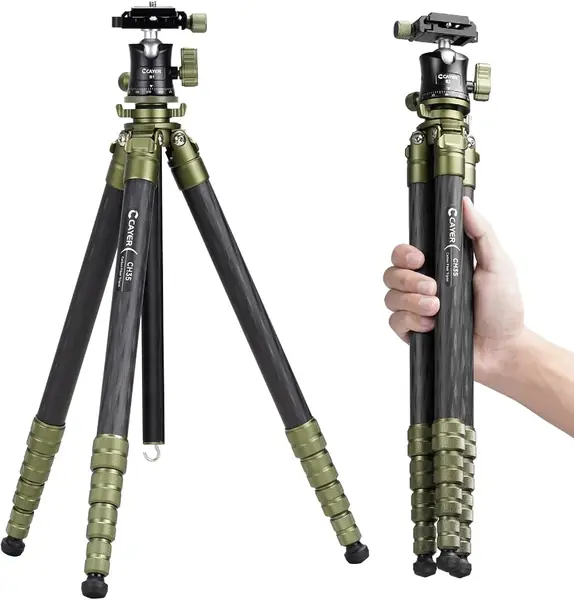
The CH35 arrives as a kit rather than just a tripod: a short center column that drops it to about six inches off the ground, a universal phone clamp, and a carrying case. If you shoot details at ground level, or you're building a phone-first travel kit, most of what you need shows up in one box.

The head is a 42mm ball with 45 degrees of tilt, a 360-degree pan, and a 90-degree side slot for portrait, mounted on an Arca-type plate. Height tops out at 53.6 inches, the load rating is 11 pounds, and five leg sections fold around a Y-shaped center column. At 1.54 pounds it's the lightest complete kit here.

The catch is the fold, and it's the one thing we found ourselves working around. For a 53.6-inch tripod, 17.7 inches packed is long; the Y column gathers the legs tight around the head rather than shortening the package, so it wants a tripod pocket instead of a bottle sleeve. For low-angle and tabletop work that's a fair exchange. For a long hike it isn't, and the Sirui Traveler 5C is the better companion.

Pros

  • Short column drops it to about six inches
  • Phone clamp and case included
  • 42mm ball head with 90-degree side tilt

Cons

  • Long 17.7-inch fold for its height
  • 11-pound load limit
Our verdict

Consider the CH35 if you shoot low, tabletop, or phone-first and want the short column and clamp in the box rather than bought later.

Check Latest Price
7

NEEWER Basics TP17B Phone Video

85 /100
TKZ Score Excellent

Key details

Weight
3.2 lb
Max Height
64 in
Load Capacity
13.2 lb
Folded Size
16.3 in
View on Amazon

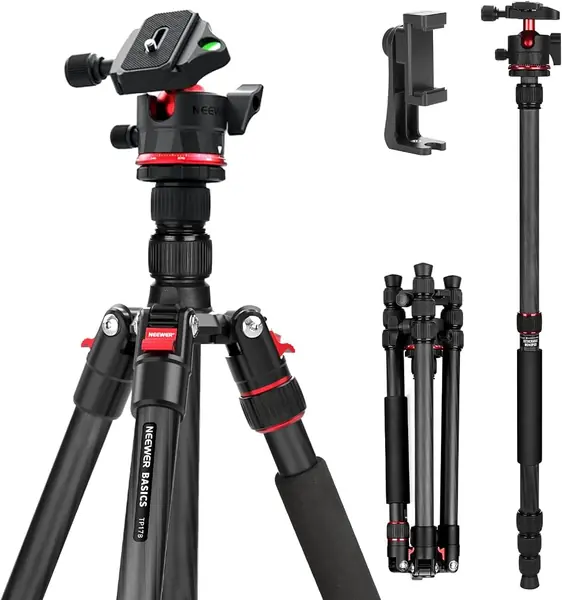
NEEWER's Basics line strips out the extras, and the TP17B is what that looks like in carbon fiber: 64 inches of height, a phone holder in the box, and a price in the same tier as the cheapest tripod here. Reversible legs bring it down to 16.3 inches, and the weight hook and non-slip feet give you something to work with on soft ground.

Look closely at how it reaches 64 inches. The legs top out at 47.2 inches; the remaining height comes from a two-section center column that extends to 63.8 inches. The column is the least steady part of any tripod, so treat the top of the range as a still-air, light-camera setting and use it lower when there's any breeze.

For a phone-first creator who wants a tall stand for video, or a beginner who wants one tripod to learn on, the included clamp and the 13.2-pound rating make this an easy call at its price. We think it's the sensible first carbon tripod for someone who hasn't yet decided what kind of tripod user they are.

Pros

  • Phone holder included
  • 64-inch maximum height
  • Weight hook and non-slip feet

Cons

  • Heaviest tripod of this group at 3.2 pounds
  • Lowest full-height load rating here
Our verdict

Buy the TP17B if you're shooting phone video or learning on one tripod and want height plus a clamp without spending much.

Check Latest Price

How We Tested Carbon Fiber Travel Tripods

We started by rounding up the carbon fiber travel tripods that come up again and again in photographer forums and retailer listings, then filtered that pool by folded length, weight, leg section count, and head type so we weren't testing seven versions of the same design. Twelve made the cut. We've used them for seven months — on trails, on a windy waterfront pier, on a rooftop at dusk, and in the living room with a stopwatch.

Each tripod was weighed on a kitchen scale, bare and in its case, and we measured folded length against the inside of a 22-inch carry-on to see what it displaced. We timed setup and teardown solo with a phone timer, bare-handed and then in gloves, since flip buckles and twist locks separate fast in cold weather. For adjustability we shot low to the ground with the legs splayed, swapped or reversed the center column where the design allowed, and moved two of them into monopod mode.

Stability is where the field split. We mounted a mid-weight zoom on each tripod, raised the center column all the way, and watched for droop after locking the head; then we tapped a leg and counted how long the image kept shivering. On a breezy afternoon we hung a loaded camera bag from the center hook and noted which ones settled and which kept trembling.

Quality and value got judged last. After seven months we checked every leg joint for play, looked for grease seepage at the head and wear on the plate threads, and asked whether we'd keep using the head that came in the box. We also tallied what shipped with each one — case, phone mount, spare plate — because a cheaper tripod that needs a new head isn't cheaper.

How to Choose a Carbon Fiber Travel Tripod

Packed Length Decides Whether It Leaves the Room

Folded length matters more than any other travel specification, because a tripod that doesn't fit your bag stays in the hotel room. The picks here run from 13 inches to 18.9 inches, which is roughly the difference between a water-bottle pocket and a dedicated tripod sleeve.

Treat the word compact on a product page with suspicion: it often describes the carry case or the diameter rather than the packed length. Measure the longest item you already carry in your daypack, then buy a folded length at or under it. If you'd rather not measure, 17 inches is the safe middle for a daypack, and 13 inches is the one that disappears.

Weight Is a Budget You Spend on Steadiness

Carbon legs cut weight from the part of the tripod you carry highest, but there's a floor. Below about two pounds the leg sections get thin, and thin sections flex. Our lightest pick is under two pounds and tops out at 54.3 inches; our stiffest is 2.65 pounds and holds 26.5.

Decide how far you'll carry the tripod, then spend your weight there. Several miles a day means accepting a shorter working height. A mile from the car means taking the stiffer legs every time.

Match Working Height to How You Shoot

Maximum height is not working height. The head and camera sit above the legs, and the center column is the least steady part of any tripod, so a 68-inch tripod used at 62 inches is stiffer than a 62-inch tripod raised all the way.

If you're around five foot ten or taller, look at 62 inches and up for standing shots, and accept that the sub-55-inch models will have you stooping or composing on the rear screen. If you shoot seated, low to the ground, or with a phone, a shorter tripod costs you nothing.

Flip Buckles or Twist Locks

Flip buckles open and close one-handed and show at a glance whether they're seated. Twist collars are slimmer, snag less inside a pack, and take longer. On a five-section leg you have four collars to work per leg, which is why lock type matters most on the most packable tripods.

Whichever you choose, seat every collar firmly before you put weight on it — a partly tightened twist lock is the classic way a leg collapses mid-shot. Check flip buckles after a flight, since handling can knock one open.

The Head Is Where Budgets Get Trimmed

Legs are where carbon earns its price; the head is where manufacturers save. Ball diameter tells you how much drag surface you're getting, a separate panning base keeps panoramas smooth, and the plate is the part that gives trouble first.

Arca-Swiss compatibility matters if you already own plates from other support. For video or landscapes on uneven ground, a leveling base like the one on the LITETRIP LT32 saves real time. For vertical shooting, check the head's tilt range first — a head that only tilts through a side slot takes a deliberate move for portrait orientation.

Frequently Asked Questions

Final Verdict

For most travelers, the NEEWER LITETRIP LT32 is the one to buy. Flip locks and a leveling ring make it fast to set up and easy to square, and 2.6 pounds at 62 inches is a balance no other tripod here strikes as well.

If you hike with a mirrorless body and one lens, the Sirui Traveler 5C packs to 13 inches and saves you most of a pound — just accept 54.3 inches of height. For eye-level landscapes, the K&F Concept 68-inch reaches higher for less money.