Best Headphones for Toddlers of 2026

Every pair of kids headphones claims a safe volume limit, and every toddler eventually finds the button that undoes it. That's the real worry — not the colors or the folding hinge, but whether the cap holds when a 3-year-old mashes both earcups, and whether the plastic survives the drop that follows. A good pair does the opposite: it holds the line quietly and doesn't need a parent standing by.

My own kid went through two pairs in a single summer before I started reading hinge reviews. We've since put 14 pairs through four months of car rides, flights, tablet time, and preschool pickup. One lesson worth passing on: plenty of these caps apply only over Bluetooth, and the same headphones get noticeably louder the moment you plug in the aux cable for an airplane screen.

What you're actually buying is a volume limit you can trust, a fit that stays on a small head, and buttons simple enough that your kid stops asking for help. The picks below were sorted on exactly that, with durability and battery life doing a lot of the sorting.

The Best Headphones for Toddlers

1

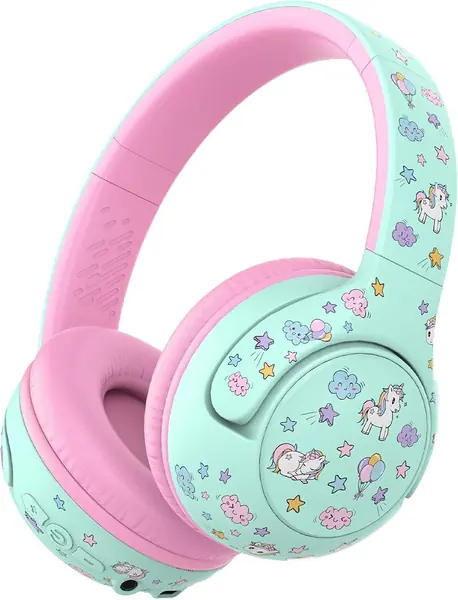
iClever BTH27 Best Overall
92 /100
TKZ Score Outstanding

Key details

Volume Limit
75/80 dBA
Weight
5.64 oz
Battery
74 hours
Bluetooth
5.4
View on Amazon

A toddler's head is not a scaled-down adult's head, and most kids' headphones ignore that. The cups hang past the ears, the band bottoms out above the eyebrows, and the whole thing slides forward the moment a child tips their head down to a tablet. The BTH27 is built from the other direction: smaller ear cups, a band with a short minimum, and cups that rotate 110 degrees so they sit flat against a small face. At 160 g it's light enough that it doesn't drag forward either.

That is why we made it the top pick. Fit decides whether a set of toddler headphones gets used or ends up at the bottom of a bag, and this is the one model here that treats a 2-year-old's head as the design target rather than an age range in the marketing. It's also the pair a child keeps on, which is the only review that ultimately matters.

The limiter gives you two ceilings, 75 and 80 dBA. Start in the lower one, which is the setting aimed at the two- and three-year-olds this model is named for, and move up only when a noisy car or cabin swallows the dialog. Battery life is the longest figure on this page at 74 hours, so a charge every couple of weeks covers ordinary tablet use, and a detachable cable is in the box for the day the battery isn't.

Where it gives ground is the noisy end. There's no noise cancellation, and in a cabin the 75 dBA mode can get lost under the engines, which is one reason the BTH20 below exists. On the ground it also carries a 12-month warranty, a length worth noting on a first pair because the headband slider is what usually fails first on any kids' headphone.

Pros

  • Child-sized cups and a 110-degree rotating fit
  • Two volume ceilings, 75 and 80 dBA
  • 74-hour battery, the longest here
  • Detachable cable for wired listening

Cons

  • 75 dBA mode can vanish under cabin noise
Our verdict

For a 2- or 3-year-old, this is the pair we recommend: child-sized cups that stay on a small head, a 75 dBA toddler mode, and the longest battery here.
Check Latest Price
2

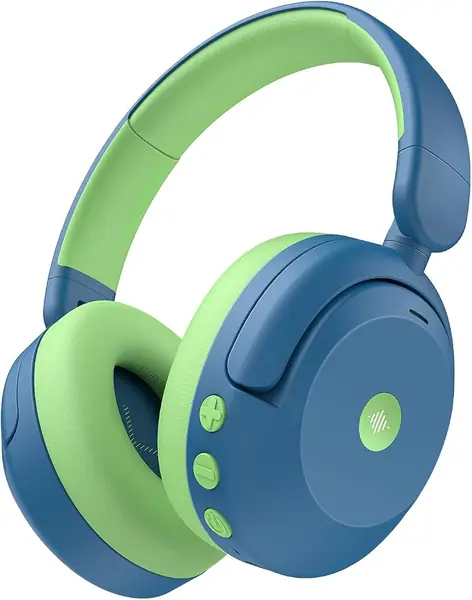
iClever BTH20 Best for Flights

91 /100
TKZ Score Outstanding

Key details

Volume Limit
80 dBA
Weight
7.68 oz
Battery
60 hours, ANC off
Noise Cancelling
Up to 40 dB active
View on Amazon

A plane at cruise is loud enough that a volume-limited pair spends the whole flight pressed against its ceiling, and that is the argument for active noise cancellation on a kid's headphone. The BTH20 is the model here that delivers it without a premium-brand price: two noise-reduction modes the maker rates up to 40 dB, a default 80 dBA volume limit, and 60 hours of playback with the ANC switched off.

Eighty decibels is a step above the toddler setting on our top pick, and on a plane that headroom is the whole point: you want enough level that the show stays audible over the engines. The trade is weight. At 7.68 ounces it's the heaviest pick on this page, so it's a pair a 4- or 5-year-old wears for a flight rather than something a 2-year-old keeps on for an hour at the kitchen table.

We like it most for the family that flies a few times a year and is tired of the cabin winning. The pads are soft, the cups rotate flat for packing, and the detachable cable works with seat-back entertainment when the battery runs down. What gives us pause is staying power: some units stop holding a charge, and the headband can go at the same joint after a few months. Treat it as a travel pair rather than the everyday beater.

If control over how long your child listens matters more than the noise reduction, the JBL below covers both for a lot more money. If it's only the noise you're after, this is the cheaper route to a quieter flight, and the 40mm drivers are clear enough for cartoons and picture books.

Pros

  • Active noise cancelling rated up to 40 dB
  • 80 dBA ceiling with 60-hour battery
  • Soft pads and rotating cups for travel
  • Detachable cable for seat-back screens

Cons

  • Heaviest pick here at 7.68 ounces
  • Some units stop holding a charge
Our verdict

We recommend it for families who fly often: noise cancelling that takes the edge off a cabin, an 80 dBA ceiling, and a cable for seat-back screens.

Check Latest Price
3

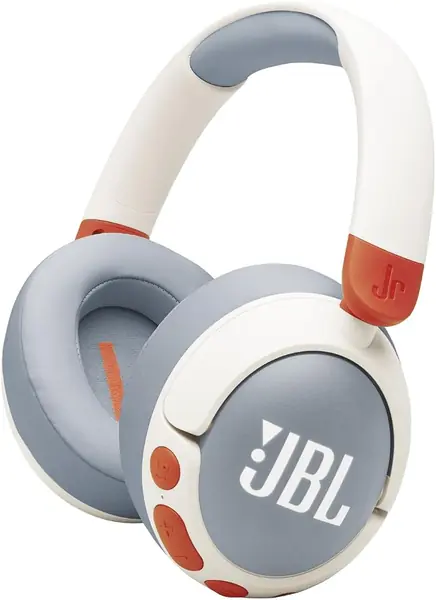
JBL Junior 470NC Best Parental Controls

90 /100
TKZ Score Outstanding

Key details

Volume Limit
85 dB, app-adjustable
Weight
6.91 oz
Battery
50 hours
Noise Cancelling
Active
View on Amazon

Every other pair on this page gives you a fixed ceiling. The JBL Junior 470NC gives you an app: set the maximum volume below the built-in 85 dB cap, cap daily listening time, and check in on how much has been used. For a parent who wants the rules enforced by the hardware instead of restated from the front seat, that is a genuinely different product rather than another colorway.

It is also the most grown-up pair of the group. The cups are oval and generously sized, the smallest band setting actually fits a small head, and it stretches to cover a 10-year-old, so it's the one here that won't be outgrown in a year. At 196 g it's heavier than the toddler-focused picks but sits well enough that the weight doesn't announce itself. We think the premium is worth it only if the app is the reason you're shopping.

What it won't do is justify the price on sound alone. Noise cancelling is modest, enough to take the edge off a cabin and nowhere near silence, and the audio is fine rather than special for a brand with JBL's reputation. If neither the app nor the ANC is on your list, the BTH27 handles the core job for far less.

One thing to check before you commit: the app controls and the noise cancelling belong to the Bluetooth side of this headphone. If you plan to use the cable with a seat-back screen, confirm the limits still apply once it's plugged in. The sticker sheet in the box is a small thing that buys a surprising amount of cooperation from a reluctant wearer.

Pros

  • App sets a lower volume cap and daily time limits
  • Fits heads from toddler to tween
  • 50 hours of playback per charge

Cons

  • Noise cancelling is modest at best
  • Costs the most here by a wide margin
Our verdict

Buy it if you want the volume cap and the daily time limit enforced by an app rather than repeated from the front seat; the sound and the ANC don't justify it alone.

Check Latest Price
4

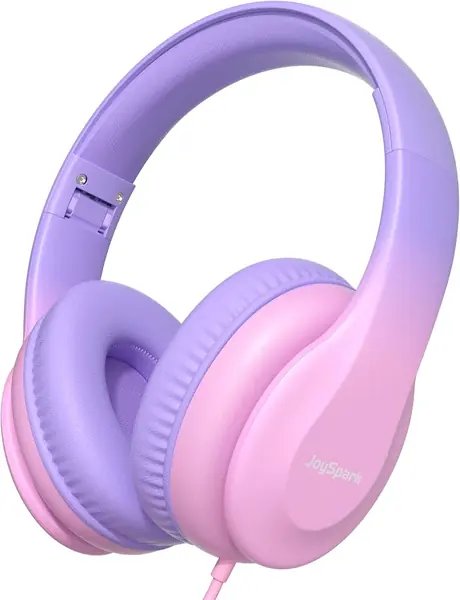
JoySpark W6 Best Wired for School

89 /100
TKZ Score Excellent

Key details

Volume Limit
85 dBA
Cable
Tangle-free
Connection
3.5 mm wired
View on Amazon

The cheapest pair here is also the least trouble. No pairing, no charging, no app, no mode switch: the W6 plugs into a tablet, a school Chromebook, or an airplane seat-back and makes sound at a fixed 85 dBA. For a preschooler who loses things and a parent who is tired of hunting for a charging cable at bedtime, that's the pair we recommend first, and at this price losing one is annoying rather than painful.

The rest is sensible for the money. The band adjusts across a preschool range, the cups are padded, the cable is tangle-free, and the whole thing folds down into a backpack pocket. The matte surface resists the fingerprints that show up on glossy kids' gear within a day, which matters if you're the one wiping them.

Two limits, both real. It's corded, full stop: fine at a desk or in a classroom, less fine on a flight where a 4-year-old will eventually pull the tablet off the tray table. And the ceiling is fixed at 85 dBA with no quieter toddler mode, so a 2-year-old gets the same maximum as a 9-year-old. That's still a safe ceiling; it just isn't tailored to the youngest wearer.

For daycare and kindergarten lists, where the requirement is usually a cheap pair with a standard plug that can survive a cubby, this is the sensible answer. The color range does the rest of the persuading with a kid who has opinions.

Pros

  • No pairing or charging to manage
  • Fixed 85 dBA hearing-protection cap
  • Foldable and tangle-free for a school bag

Cons

  • Corded only, no wireless option
  • Fixed 85 dBA ceiling with no quieter mode
Our verdict

For a preschooler in a classroom or a kid who loses everything, we recommend this corded pair first: nothing to charge, nothing to pair, one fixed 85 dBA ceiling.

Check Latest Price
5

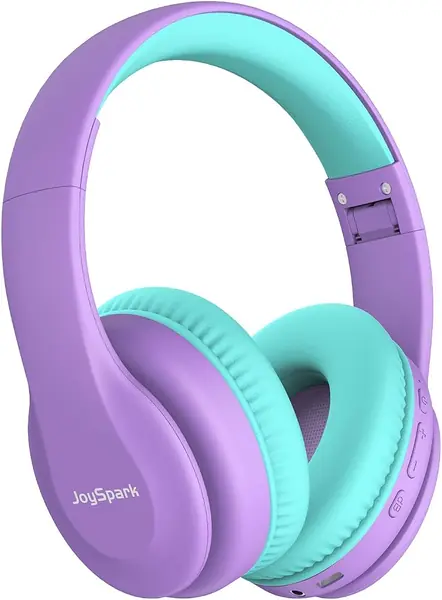
JoySpark T5 Best for Older Preschoolers

88 /100
TKZ Score Excellent

Key details

Volume Limit
85/94 dB
Weight
6 oz
Bluetooth
5.3
Driver
40 mm
View on Amazon

The first flight is the test, and the T5 is built for it. One button pairs it, the memory foam cushions are soft against a small face, and at 170 g it doesn't drag. Playtime is long enough that charging becomes a pre-trip chore rather than a nightly one, and a detachable cable is in the box for the seat-back screen when the battery gives out.

The volume limiter has two settings, 85 and 94 dB, and the second one is the detail to know about. Ninety-four decibels is louder than anything else on this page, and it's a switch a curious 4-year-old can find. Leave it in the lower mode and check it again after a playdate.

Where we hesitate is staying power. Pairing with a Fire tablet or an iPad is genuinely easy, and the fit suits a child who has moved past toddler sizing, but the failure that comes up is a unit that quietly stops turning on after a few months. That isn't every pair, and the 18-month warranty is the longest in this group, but it's why this sits below the iClever picks.

So buy it as a second set, or for the 4- or 5-year-old who is too big for the true toddler models and not ready for a premium pair. Keep the receipt and the warranty card, and expect to use them. The purple finish and the soft-touch cups are the parts a kid notices first.

Pros

  • One-button Bluetooth pairing
  • 85 and 94 dB volume modes
  • Memory foam cushions at 170 g
  • 18-month warranty, longest here

Cons

  • 94 dB mode is louder than the rest here
  • Some units stop turning on
Our verdict

A solid second pair for a 4- or 5-year-old who has outgrown toddler sizing, with one-button pairing and a warranty that runs longer than most here.

Check Latest Price
6

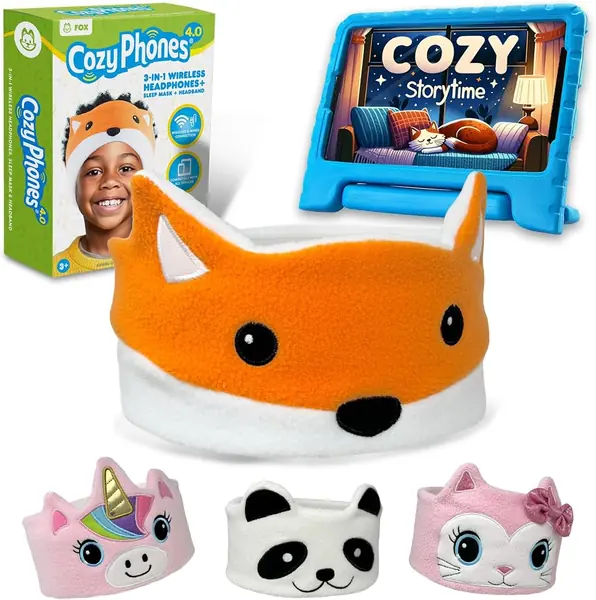
CozyPhones 4.0 Best for Naps and Quiet

84 /100
TKZ Score Excellent

Key details

Volume Limit
Limited by default
Battery
16 hours
Bluetooth
5.0
Headband
Washable fabric
View on Amazon

There is a kind of toddler who will not wear ear cups: the sensory-sensitive one, the one who falls asleep in the car, the one who is still under two. The CozyPhones headband is for them. Flat 30 mm speakers sit in a sewn-in pocket of a stretchy fabric band, so there's no clamp and nothing to pinch, and a child can lean back against a car seat without the whole thing being pushed off. We recommend it for quiet rooms, naps, and bedtime, and not for anything where you're fighting engine noise.

The details are unusually thoughtful for the money. The band is washable, which matters more than any specification once a toddler has worn it for a week. Share Mode links two headsets to one tablet, so siblings can watch the same show without a splitter, and there's a 3.5 mm cable for the day the battery is flat. Sixteen hours of Bluetooth covers several nights of bedtime stories.

The catch is volume. The limiter is on by default, and against road noise the output can be faint enough that a child gives up on the show entirely. Fit is the other split: on some heads the band stays put, on others it slides. Single-sided failures show up often enough that this is a pair to buy for one specific job rather than an all-rounder.

That job is worth naming: a child who has refused every other headphone, or a car nap where a hard band would keep them awake. The free storytime recording feature is the sort of extra that sounds gimmicky until a grandparent's voice is the thing that gets a toddler to sleep in a hotel.

Pros

  • Soft enough to lie down in
  • Washable headband
  • Share Mode pairs two headsets to one tablet

Cons

  • Output can be too faint against road noise
  • Band slips on some head sizes
Our verdict

We recommend this fabric headband for naps, quiet rooms, and kids who refuse ear cups, not for a noisy cabin where its soft output disappears.

Check Latest Price
7

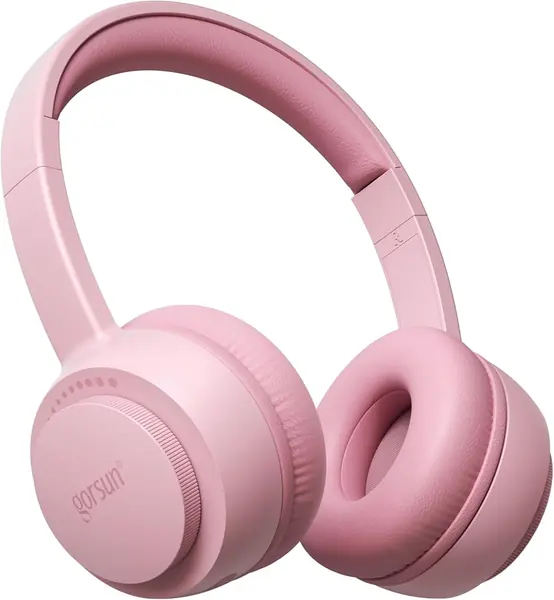
gorsun E65 Best for Tight Budgets

83 /100
TKZ Score Excellent

Key details

Volume Limit
85 dBA
Weight
0.28 lb
Battery
45 hours
Headphone Jack
None
View on Amazon

Start with what's missing. The E65 has no 3.5 mm jack and no cable, so everything runs over Bluetooth. That rules out seat-back screens on a plane, a classroom listening station with a headphone splitter, and any older device that only offers a cord. If your toddler's world is one tablet and one pair of hands, that's fine. If it's an airplane, it isn't.

What you get for very little money is decent: 0.28 lb on a small head, an eight-level band, faux leather cups, up to 45 hours per charge, and a volume knob rather than a row of buttons. The knob is the small smart choice here. A toddler can turn it, and a parent can see where it's set without switching anything on, which is more than most of the button-controlled pairs here manage.

We recommend it as a spare: the pair that lives in the diaper bag, or the second set for a grandparent's house, where losing it isn't a disaster. The one thing to test on arrival is pairing. The connection is the weaker part of this design, so a stubborn unit is worth exchanging inside the return window rather than fighting with for a month.

The 85 dBA ceiling and the half-hour charge are the two specifications doing the real work, because a spare that takes all afternoon to charge is a spare that's never ready. Weight is the other quiet advantage: at roughly a quarter of a pound, it's the pair least likely to be pulled off by its own heft when a toddler looks down.

Pros

  • Weighs just 0.28 pounds
  • Volume knob is easy for small hands
  • Up to 45 hours per charge

Cons

  • Bluetooth only, with no cable for wired sources
  • Pairing can take a few attempts
Our verdict

A light, cheap spare for the diaper bag or a grandparent's house, as long as everything you own pairs over Bluetooth.

Check Latest Price

How We Tested the Best Headphones for Toddlers

We started by reading spec sheets and listings, keeping only pairs with a stated decibel limit, an adjustable headband, and — where possible — both wired and wireless options. Fourteen pairs made the cut, and we handed them to families with kids ages 2 to 5 for four months.

Those four months looked like real life: car rides, two flights, tablet time on the couch, quiet time before bed, preschool drop-off, and a dusty backyard. At the start we measured each pair at the earcup with a decibel meter in every mode — Bluetooth, wired through the aux cable, and with the mic live — then let the kids press every button to see whether the ceiling stayed put. Durability got the least gentle treatment: dropped from toddler height onto tile, pulled off by one earcup, twisted, sat on, and wiped with a baby wipe, with notes on every cracked hinge and loosened slider.

For fit, we watched 2-year-olds and 5-year-olds wear the same pair and noted whether the cups stayed put or slid down to the chin. Sound quality was judged at low volume, where it counts: whether dialogue stayed clear once the limiter kicked in, and how connectivity held up when we paired to a tablet, a phone, and an airplane seat screen and let the battery run dead. Noise cancellation got rated on a plane and in a car, mostly by whether a kid kept the headphones on. Then we checked back in month four, after the novelty wore off, and counted what came in the box against what each pair cost.

How to Choose Headphones for a Toddler

Match the Volume Ceiling to the Room

The number you see on every box is 85 dBA, and it's a ceiling rather than a target: it's the loudest the headphones will ever go, not the level they play at. A pair with a second, quieter mode in the mid-70s gives you one setting for the living room and a louder one for a car or a cabin, and that split is the first thing we look for.

A single fixed 85 dBA cap is perfectly reasonable and usually cheaper. Just know that it's the same maximum for a 2-year-old and a 9-year-old, so the ceiling has to do the work of a volume setting.

Fit Is What Decides Whether They Get Worn

Adult-sized cups on a toddler hang past the ears, the band bottoms out above the eyebrows, and the pair ends up around the neck in ten minutes. Look for smaller cups, a band whose shortest setting is genuinely short, and rotating cups that sit flat against a small face.

Weight belongs in the same conversation. Around 160 g, roughly a third of a pound, is light enough to stay put through a tablet session; a pair closer to seven ounces is a travel-only proposition, however good it sounds.

Wired, Wireless, and the Cable That Saves a Trip

Wireless removes the cord a 3-year-old will grab, and one-button pairing is normal now at this price. But check the box for a 3.5 mm cable. It's the fallback for a dead battery, the only route into a plane's seat-back screen, and the connection that works with a classroom listening station.

A Bluetooth-only design is cheaper to build and cheaper to buy, and it's the wrong choice if any of those three situations is part of your year.

Expect the Headband to Be the Weak Point

Across this group, the failures cluster at the same spot: the slider and hinge where the band extends, which is the part that takes the twisting when a child pulls the headphones off by one cup.

That's an argument for a cheaper first pair, for checking that the warranty runs at least a year, and for holding off on premium prices until your child has stopped using the headband as a handle.

When Noise Cancelling and Parental Apps Earn Their Price

Noise cancelling is worth paying for if you fly more than a couple of times a year. A volume-limited pair has to shout over engine noise; ANC lets it whisper instead. It adds weight and money, and how well it works varies a lot from model to model.

App controls are the other upgrade worth considering, since a daily time limit enforced by the hardware is easier than an argument. Neither feature matters much for a tablet at the kitchen table.

Frequently Asked Questions

Final Verdict

For most families the iClever BTH27 is the pair to buy: it's the only one here designed around a 2-year-old's head, it has a real toddler ceiling at 75 dBA, and its 74-hour battery means it's charged when you reach for it.

If flights are the main event, the iClever BTH20's noise cancelling is worth the extra weight and money. And if you want the simplest thing that works in a classroom, the corded JoySpark W6 needs no charging and no pairing at all.