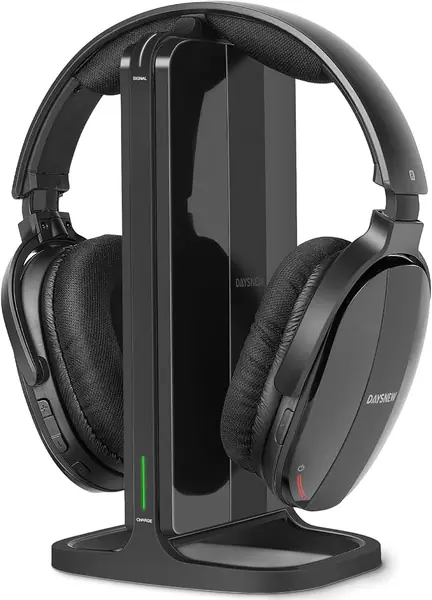
Best Wireless TV Headphones for Seniors of 2026

The first time my father turned his TV up loud enough to follow a detective show, I could hear it from the driveway. That's the tradeoff nobody warns you about: the volume that finally makes dialogue clear for someone with hearing loss also makes the whole house a captive audience. Wireless TV headphones solve both halves of that problem at once — the sound goes straight to the person wearing them, and the room stays quiet enough for everyone else to read, sleep, or have a conversation.

The catch is that a lot of sets sold this way are ordinary Bluetooth headphones with a transmitter tossed in the box. What actually separates a good pair from a frustrating one is whether the dialogue sounds sharp instead of mushy, whether the audio stays in sync with moving lips, and whether the charging base is something a 78-year-old can drop the headphones onto without thinking about it. My team and I have spent the past six months living with 10 sets in our own living rooms, and the winners made all three of those things feel effortless.

One thing worth knowing before you shop: if there's a soundbar in the house, look for a set that passes the audio through rather than hogging the TV's only optical port — otherwise the soundbar goes silent the moment you plug the headphones in. The picks below were chosen for clear voices, simple setup, and long battery life, not for movie-theater bass.

The Best Wireless TV Headphones for Seniors

1

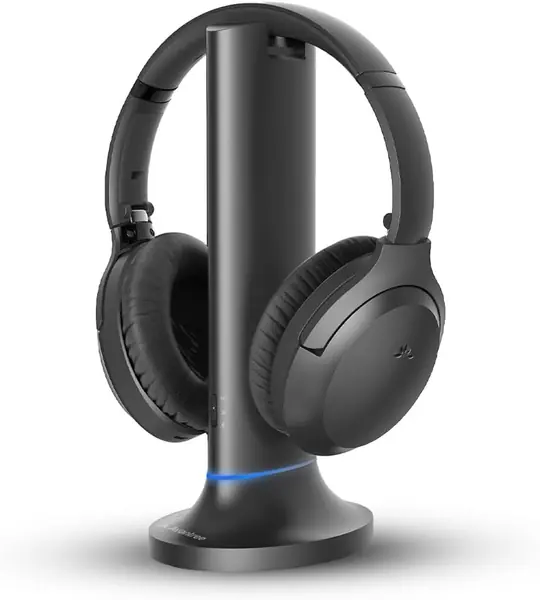
Avantree Opera Plus Best Overall
88 /100
TKZ Score Excellent

Key details

TV Inputs
HDMI ARC, optical, AUX
Battery Life
35 hours
Audio Latency
30 ms
Soundbar Passthrough
Optical output only
View on Amazon

Most TV headphone systems run aground at the back of the television. Optical and AUX jacks are disappearing from newer sets, and a household with an HDMI-only TV and a soundbar can end up with a base that has nowhere to go. The Opera Plus is the only set in this guide with an HDMI ARC input, alongside optical and AUX, and that single port is the reason it's our default.

The rest of it is built around dialogue. Clear Voice pulls speech forward from the music and effects underneath it, and a volume boost adds gain for viewers who need it, though the maker is clear that this is a television headphone rather than a hearing aid. Comfort held up for us across long evenings: the cups are soft, the clamp is gentle, and nothing about the fit asks to be adjusted halfway through a show.

Setup is one cable to the TV and one choice of output in the TV's menu. Two practical notes. Over optical, the digital audio format usually has to be set to PCM, or the headphones play silence and the set looks faulty. And the passthrough that keeps a soundbar running alongside the headphones works through the optical output only, so a soundbar connected over HDMI doesn't get fed.

Where it stops: this is a headphone tuned for speech, and it makes no attempt to replace a hearing aid. Viewers with severe loss or an existing prescription should sort out amplification built for that job first, then come back to a headphone for the room.

Pros

  • HDMI ARC, optical, and AUX inputs
  • Clear Voice and volume boost for dialogue
  • Soft cups stay comfortable for hours
  • Charging dock keeps it ready to wear

Cons

  • Charge capacity fades after a year of nightly use
Our verdict

We start here because the Opera Plus is the only set in this guide that plugs into HDMI ARC, and its dialogue tools and dock suit an older viewer who wants to sit down and hear the news.
Check Latest Price
2

Sennheiser RS 175 Best Sound Quality

87 /100
TKZ Score Excellent

Key details

Battery Life
18 hours
Weight
10.9 oz
Wireless Link
RF (Kleer)
Sound Modes
Bass boost, surround
View on Amazon

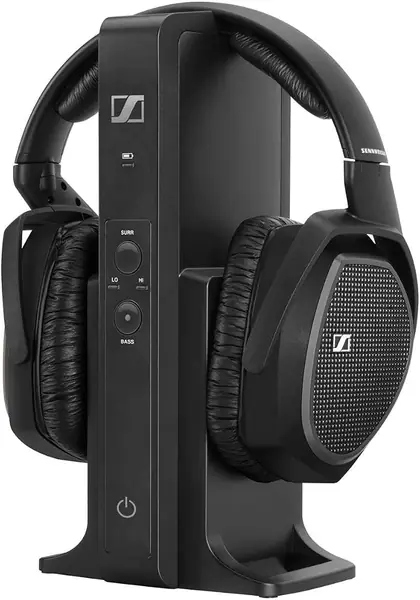
This is the most expensive set we're recommending, and the only one that behaves like a piece of home audio gear rather than an accessory. The base is a transmitter and a charging stand in one, and the link between base and headphone is radio frequency rather than Bluetooth, so there's no pairing step, no codec, and no reconnecting when someone walks past with a phone.

Sound is what the money buys: dynamic drivers with bass boost and surround modes, a wide and detailed presentation, and enough headroom that quiet dialogue in a quiet drama doesn't turn to mush. We found the tone richer than the speech-focused sets here — it flatters films and music and does a little less for a shouted news bulletin.

Radio transmission also sidesteps the delay Bluetooth introduces, which is why lip sync never becomes the thing you're watching. Our read is that this is the set for a good television and a listener whose loss is moderate: if the need is maximum gain rather than maximum fidelity, the boosted sets here are the better purchase, because this one is tuned for tone rather than for lifting whispers out of a mix.

The trade-off is weight and clamp. At 310 grams with a firm headband it's a set you notice after an hour, and a wide head or a pair of glasses makes that worse. Two years of warranty coverage is the longest in this guide, though the printed quick guide is photographs with no text, which is worth knowing before handing it to someone who doesn't do trial and error.

Pros

  • Richest sound in this guide
  • Radio link needs no pairing
  • Charging stand keeps it topped up
  • Two-year parts and labor coverage

Cons

  • Tight clamp and 310 grams get heavy
  • Quick-start guide is pictures only
Our verdict

For the viewer who wants the best sound on this page and doesn't mind a firm clamp, the RS 175 is the one; its radio link is also the least fussy of the group to live with.

Check Latest Price
3

Avantree Duet Best for Two Viewers

86 /100
TKZ Score Excellent

Key details

TV Inputs
Optical, AUX
Battery Life
20 hours
Audio Latency
30 ms
Headsets Included
2
View on Amazon

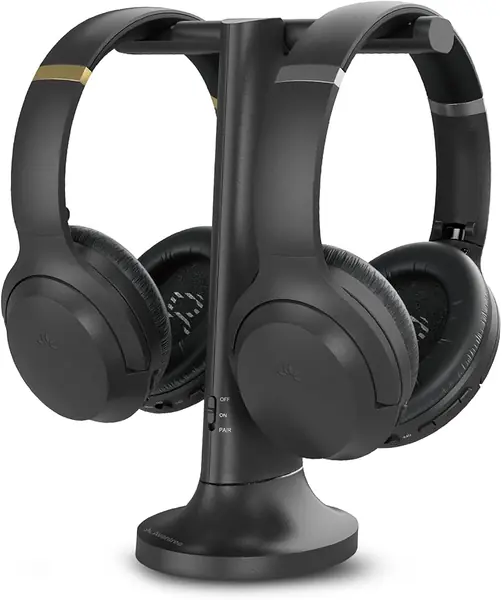
Two headsets, one base, one cable to the TV. The Duet exists for the household where both people are watching and one of them has spent years asking for the volume to come up, and it answers that with a volume control on each headset instead of one shared setting.

That's the feature that earns it a place: independent levels let a hard-of-hearing viewer and a normal-hearing one sit through the same film at completely different volumes without negotiating. Clear Voice works on both headsets, and the cups are soft enough that neither viewer is fidgeting by the second act.

Setup is the same routine as the other Avantree sets. A cable runs from the base to the TV's optical or AUX output, power goes in, and it's live — no pairing, because the link is 2.4 GHz radio. The base passes optical audio through so a soundbar can keep playing, and a charge is good for about 20 hours, which covers a lot of evenings.

What gives us pause is the plastic. The earpiece connections and the headband are where this family of headsets eventually gives out, and that's a hard thing to accept on the priciest system here. Buy it for the two-viewer problem; where only one person is listening, the Opera Plus does the same job for less.

Pros

  • Two headsets with independent volume
  • Clear Voice on both headsets
  • Optical passthrough keeps a soundbar playing
  • No pairing with the 2.4 GHz link

Cons

  • Optical or AUX only, no HDMI ARC
Our verdict

Two people, two volume levels, one dock: the Duet is the pick when both viewers need to hear, and nothing else in this guide solves that problem.

Check Latest Price
4

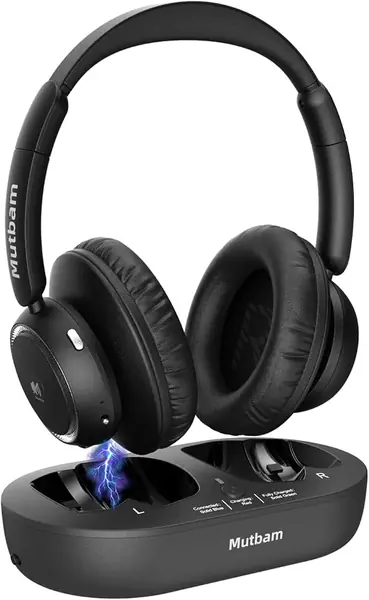
Mutbam LNN-JY04 Best Value

85 /100
TKZ Score Excellent

Key details

TV Inputs
Optical, RCA, AUX, Bluetooth
Battery Life
65 hours
Audio Latency
Under 40 ms
Weight
10.9 oz
View on Amazon

Sixty-five hours is the number that changes how a headset lives in a house. Docked between sessions, that's roughly a week of two-hour evenings before anyone has to think about a cable, and for an older viewer a weekly charging habit is far easier to keep than a nightly one.

We were surprised by how much comes with it: under 40 ms latency, optical, RCA, and AUX cables in the box, Bluetooth 5.2 for pairing a phone or tablet, 40 mm drivers, and a charging base that holds the headset upright between sessions. For the position it occupies in the market, it's the most complete package in this guide.

Comfort is the part that decides whether any of that matters, and this one sits over the ear with protein-leather pads and an adjustable headband rather than pressing on the ear itself. The warranty runs twelve months, which is short for something used every night, so keep the receipt and the box.

Pros

  • 65 hours per charge
  • Optical, RCA, AUX, and Bluetooth inputs
  • Under-40 ms latency
  • Charging dock doubles as a stand

Cons

  • Warranty runs only 12 months
Our verdict

For nightly viewing without charging anxiety, the Mutbam is our value pick: a week per charge, a dock, and every common TV input in the box.

Check Latest Price
5

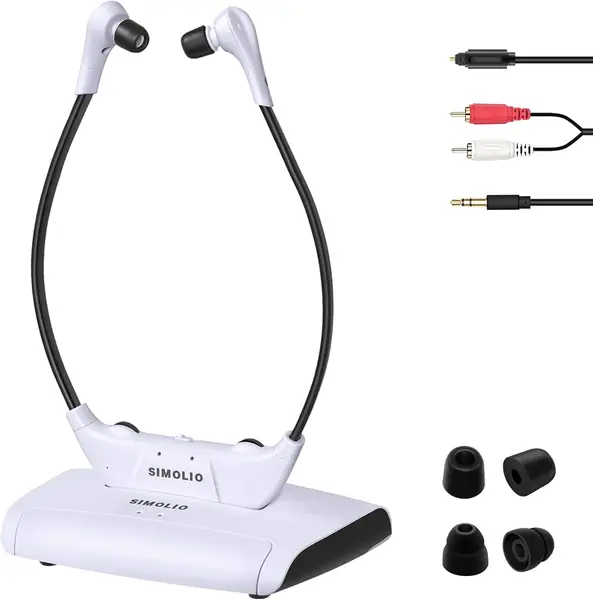
SIMOLIO SM-823D Pro Best for Uneven Hearing Loss

84 /100
TKZ Score Excellent

Key details

TV Inputs
Optical, RCA, AUX
Battery Life
14 hours
Range
50 m
Audio Tuning
Left/right balance, tone
View on Amazon

Hearing loss is rarely symmetrical. Most sets here give you one volume for both ears; the SM-823D Pro gives you separate left and right levels, plus a tone control and a mono/stereo switch, so the ear that's doing the work can be pulled forward without dragging the other one along.

It's a narrow feature that answers a common problem, and it's why this set is on the list rather than buried among the budget options. Two details we appreciated: an ambient mode that lets room sound in when the phone rings or someone speaks, and a battery that can be replaced instead of a sealed one that ends the set's life when it fades.

Setup is automatic — the 2.4 GHz FHSS link pairs itself, and the transmitter's optical bypass keeps a soundbar playing alongside. The compromises land on the body rather than the electronics: the earpieces make themselves felt after a couple of hours, which is fine for the evening news and less fine for a three-hour film.

Pros

  • Left/right balance, tone, and mono controls
  • Ambient mode lets room sound through
  • Replaceable rechargeable battery
  • Optical bypass keeps a soundbar playing

Cons

  • 14 hours per charge is short next to the long-life sets
Our verdict

If one ear hears better than the other, this is the set we point to: separate left and right levels, tone control, and a battery you can swap instead of replacing the whole headset.

Check Latest Price
6

ZUPVIY M98A Best Budget

83 /100
TKZ Score Excellent

Key details

TV Inputs
Optical, AUX, RCA, USB
Wireless Link
2.4 GHz
Charge Time
3 hours
Volume Control
Independent, on headset
View on Amazon

The least expensive set here still has to do the one thing that matters: take the TV's audio, send it across the room, and let the wearer set their own level. The M98A does that with a 2.4 GHz link rather than Bluetooth, a base that charges the headset and connects on its own, and a volume control on the headset itself.

Optical, AUX, and RCA cables are in the box, which covers older televisions, cable boxes, and game consoles, and there's a USB adapter for the occasional set that needs one. In daily use the auto-connect is the part we care about: lift the headset off the base, and the sound is already there.

Where it gives ground is gain. The top of the volume range is modest, which is plenty for mild loss in a quiet room and a genuine limit for anyone who needs the television loud. Treat it as a second-room or guest-room set, or as a first step for someone whose loss is still slight.

Pros

  • Lowest-priced set in this guide
  • 2.4 GHz link with automatic connection
  • Cables for older TVs included

Cons

  • Volume tops out early for serious hearing loss
Our verdict

The M98A is the set we suggest when the budget is tight and the hearing loss is mild; it connects itself, docks to charge, and covers older TVs, as long as the volume ceiling suits.

Check Latest Price
7

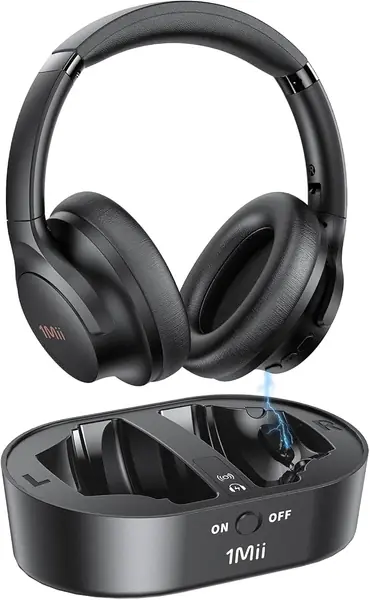
1Mii ClearLinkTV H3 Best for Bedrooms, Long Sessions

82 /100
TKZ Score Excellent

Key details

TV Inputs
Optical, AUX, RCA
Battery Life
75 hours
Audio Latency
Under 40 ms
Bypass Output
Soundbar or second headset
View on Amazon

Two jobs from one base: the ClearLinkTV H3 feeds the headphones and passes the same audio through to a soundbar, a wired speaker, or a second H3 headset. In a living room where somebody else is watching along, that second output is the feature that decides the purchase.

Battery is 75 hours, the longest figure in this guide, and the 2.4 GHz link is rated under 40 ms, so lips and voices stay together. Both numbers matter for a set that gets worn through a double feature and then left on a couch for a week.

Setup is plug-and-play, with optical, AUX, and RCA cables in the box, and the base charges the headset between sessions. Nothing here asks the wearer to pair anything, which is the point for this audience.

We like it best as a bedroom or den set: light to wear, long between charges, and inexpensive enough to add a second headset to later without buying a new base. For the main television in a busy room, the sets with clearer dialogue tools are the safer choice.

Pros

  • 75 hours per charge
  • Bypass output for a soundbar or second headset
  • Under-40 ms latency
  • Optical, AUX, and RCA cables included

Cons

  • Some TVs mute their own speakers when the base connects
Our verdict

We suggest the H3 for a bedroom or a second TV, where 75 hours, low lag, and a bypass output matter more than a dedicated dialogue-boost mode.

Check Latest Price
8

Daysnew DB100 Best for Second-Room TVs

81 /100
TKZ Score Excellent

Key details

TV Inputs
Optical, RCA, AUX
Battery Life
10-15 hours
Audio Latency
20 ms
Range
30 m
View on Amazon

A volume control that keeps working when the television is muted is the detail that makes this set usable for someone with hearing loss: the room can be silent and the headset can still be loud. The DB100 does exactly that, with the control on the headset rather than buried in a menu.

The basics are covered. A 2.4 GHz radio link rated at 20 ms latency, optical, RCA, and AUX cables in the box, a charging dock, and a range of about 30 meters, which reaches the kitchen without dropping out.

Bluetooth 5.3 covers phone and tablet listening when the television is off, and the over-ear cups with an adjustable headband are shaped like the more expensive sets rather than like a travel headphone.

Our read is that this is a bedroom or second-room set. As the household's only TV headphone, with four hours of viewing a night, the battery is what will annoy you first, and the earpieces are the part that wears.

Pros

  • Personal volume that works with the TV muted
  • 20 ms latency
  • Cables and charging dock included

Cons

  • 10-15 hours per charge
Our verdict

A straightforward budget set for a bedroom or den, with a personal volume control that stays loud on a muted TV, as long as you plan on charging it most days.

Check Latest Price

How We Tested the Best Wireless TV Headphones for Seniors

We started by pulling together every set we could find that was built specifically for TV watching rather than music, then filtered the field by what connections each one supported. Because a household might have a 2015 LCD in the den and a new smart TV in the living room, we favored sets that offered optical, RCA, and AUX inputs so they could move between rooms. We also kept an eye on price relative to what came in the box — a charging base and a second pair of headphones go a long way toward justifying a higher number. That left 10 sets, which we tested over six months.

Each one was set up from scratch by someone who had never opened the box, and we timed how long it took to get picture and sound together without a manual. We then watched the same two hours of programming on every set: a nightly news broadcast with soft-spoken guests, an action movie with a lot of whispering between explosions, and a talk show where we could watch mouths up close and catch any lag between the audio and the lip movement. We ran volume boosts and dialogue modes at their highest settings to hear whether the voices got clearer or just louder and harsher, and we checked whether sound leaked out to the person sitting next to the wearer.

Comfort was judged the honest way — two-hour movies, with glasses on, plus a few wearers who took the headphones into the kitchen during commercial breaks to see how far the signal held. Battery life was measured by charging each set fully and running it until it died, then repeating the cycle nightly to see whether the dock was easy to land the headphones on in a dark room. We also checked left-right balance and tone controls for anyone whose hearing is worse on one side, watched whether a paired soundbar kept working when the headphones were off, and inspected the headbands and hinges for wear after months of daily handling.

How to Choose Wireless Tv Headphones for Seniors

Start With the Port on the Back of the TV

Almost everything here depends on one jack. Optical (labeled TOSLINK or Digital Audio Out) and 3.5 mm AUX are the outputs most of these bases accept, and RCA covers older sets. Televisions that offer only HDMI are the trap: a headphone base cannot take a plain HDMI output, and only one set in this guide, the Avantree Opera Plus, accepts HDMI ARC.

There's a second setting to settle. Over optical, the TV's digital audio format usually needs to be PCM rather than Dolby or Auto, or the headphones play silence and the set looks broken. Set it once during installation and the problem never comes back.

Decide Whether the Rest of the Room Keeps Listening

If someone else watches alongside, look for a base with passthrough: the headphones take the audio and the same signal continues to a soundbar or the TV's own speakers. Optical passthrough is the common version and works well; HDMI passthrough is rarer and fussier.

Watch for bases that silence the television's own speakers when they connect. The 1Mii H3 is the set to check on that point, and it's the kind of detail worth confirming before a birthday rather than after.

Look Past Volume to Dialogue and Balance

Two features do more for a hard-of-hearing viewer than raw loudness. A Clear Voice or speech mode lifts dialogue out of music and effects, and a volume boost adds gain on top of it. Beyond that, left/right balance is the one that changes evenings for uneven loss, and the SIMOLIO is the set here that offers it alongside tone and mono controls.

Be realistic about the ceiling. None of these is a hearing aid, and the boosted sets are explicitly not intended for severe loss. If the loss is significant, have the ears assessed first, then choose a headphone for the room.

Weigh the Charging Habit Over the Battery Figure

Playback per charge runs from about 14 hours to 75 in this group, and the number matters less than the routine around it. A dock turns charging into a habit, because the headset goes back on the base when it comes off a head. A cable requires remembering, and a set that dies mid-film stops being used.

A replaceable battery, as on the SIMOLIO, buys extra years; the rest are sealed, so the dock is the maintenance plan.

Fit, Weight, and Buttons a Non-Technical Viewer Can Work

Soft over-ear cups and a gentle clamp are the difference between a two-hour film and an hour of fidgeting. Around 310 grams is enough to be noticed, and glasses make a firm headband worse. Then the controls: real buttons beat touch panels for cold or arthritic fingers, and automatic connection beats any pairing step.

A useful test in the store or on the first evening: if the wearer won't read a manual, favor a set that starts playing the moment it's lifted off the dock.

Frequently Asked Questions

Final Verdict

For most households, the Avantree Opera Plus is the set to buy: it takes HDMI ARC as well as optical and AUX, so it works with the television people actually own, and its dialogue tools and dock are aimed squarely at older viewers.

If the TV has no HDMI ARC and two people listen at once, the Duet puts the same speech tools into two headsets at independent volumes. And if the room is quiet and sound is the whole point, the Sennheiser RS 175 is the upgrade.