Best Garmin Watches of 2026

Every Garmin decision comes down to a tradeoff you can see on your wrist: the brighter and prettier the display, the more often you go hunting for the charger. The models that run two weeks on a charge usually look dimmer than the ones that need a top-up every few days, and neither is automatically right. What matters is whether you'll actually use mapping on unfamiliar trails, want music on your wrist so the phone stays home, or just need something that looks like a watch at dinner.

My team and I spent seven months wearing eight of these — morning runs, overnight for the sleep data, long weekend hikes, and plenty of desk days. First-time buyers tend to overrate sport profile counts; what separated these watches was the handful of things you touch or check every day: how the menus feel at mile eight, whether the distance and heart rate hold up, how long the battery lasts with GPS and a bright screen running, and how readable the display is in direct sun. The picks below are sorted by who they fit.

The Best Garmin Watches

1

Garmin Forerunner 265 Best Overall
94 /100
TKZ Score Outstanding

Key details

Battery
Up to 13 days; 20 hours GPS
Display
1.3-inch AMOLED
Weight
1.66 oz
Training
Training readiness, multi-band GPS
View on Amazon

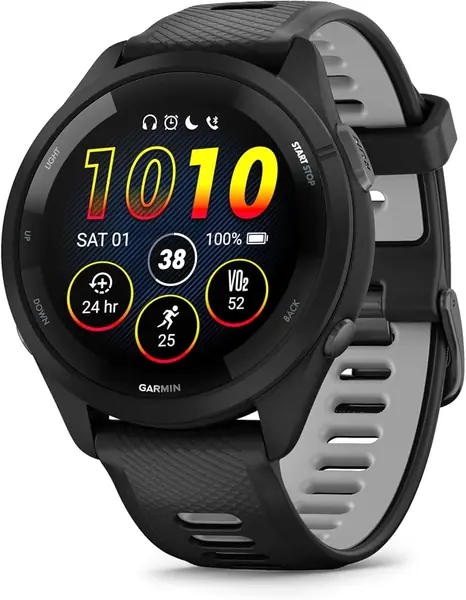
At 47 grams, the Forerunner 265 is light enough to forget about during a long run, and the 1.3-inch AMOLED screen is bright enough to read pace and heart rate at a glance. That combination is why it is our default pick: it gives you serious training data without the wrist presence of a Fenix or the size of the 965.

The training package goes deeper than the price suggests. Daily suggested workouts adapt to your recovery, training readiness pulls in sleep and HRV, and multi-band GPS holds a cleaner line around tall buildings and tree cover. We also like the 8 GB of storage for music, which lets you leave your phone behind on shorter runs. Battery life is rated at up to 13 days in smartwatch mode and 20 hours in GPS mode, a practical balance for daily wear and marathon training.

The 46 mm case is substantial, though it wears lighter than the number suggests. On a smaller wrist, the Venu 3S or Forerunner 165 will feel less obtrusive. And if you need full-color maps for unfamiliar trails, the Forerunner 965 is the better tool; the 265 is built around training, not navigation.

What keeps us coming back is the range. The 265 can guide a first 5K plan, track a tempo session, and then show sleep and recovery scores overnight without asking you to swap watches. It is the one Garmin here that feels equally at home in a training block and a normal week.

Pros

  • Light 47 g body for daily wear
  • Bright 1.3-inch AMOLED display
  • Advanced training and recovery metrics
  • Up to 13 days smartwatch battery

Cons

  • Menus take time to learn
  • Long-term reliability is mixed
Our verdict

For most runners and fitness-focused buyers, the Forerunner 265 is the Garmin to buy: advanced training tools in a light, bright package.
Check Latest Price
2

Garmin Forerunner 965 Best for Maps and Ultras

93 /100
TKZ Score Outstanding

Key details

Battery
Up to 23 days; 31 hours GPS
Display
1.4-inch AMOLED
Weight
1.87 oz
Navigation
Full-color built-in maps
View on Amazon

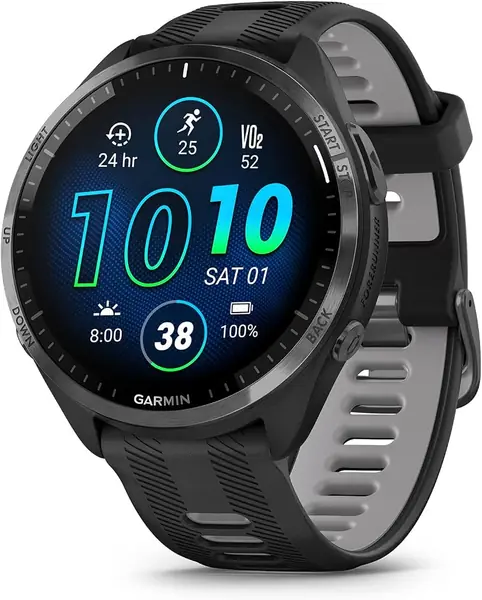
The Forerunner 965 is the upgrade you feel on a long, unfamiliar route: full-color maps and turn-by-turn directions on a 1.4-inch AMOLED screen, with a titanium bezel that shrugs off more than the plastic Forerunners. It is still a running watch, not a Fenix, but it feels like the premium version of the 265.

Battery life is the quieter advantage. Up to 23 days in smartwatch mode and 31 hours in GPS mode means a marathon block, a weekend hike, or a week of travel without a charger. We also found the larger display easier to read mid-run than the 265's 1.3-inch screen, and the 32 GB of storage holds a useful music library. For runners who care about maps and battery more than a flashlight or speaker, this is the sweet spot.

The 47 mm case is the catch. It looks and feels like a training tool on smaller wrists, while the 265 slips under a cuff more easily. The maps and extra battery only matter if you actually run or hike unfamiliar routes; if you stay on home roads, the 265 gives you most of the training experience in a smaller package.

What we appreciate most is that the 965 does not make you choose between a big, bright screen and serious battery. It is the Garmin we reach for when the route is the point, and the one we recommend to runners who would rather glance at a map than stop and fish out a phone.

Pros

  • Full-color maps with turn-by-turn
  • Up to 23 days battery; 31 hours GPS
  • Large 1.4-inch AMOLED display
  • Titanium bezel and 32 GB music storage

Cons

  • Premium price for maps
  • Long-term reliability is mixed
Our verdict

For runners who regularly explore unfamiliar routes, the Forerunner 965 earns its premium with maps, a big AMOLED screen, and 23-day battery.

Check Latest Price
3

Garmin Fenix 8 Best Premium Multisport

92 /100
TKZ Score Outstanding

Key details

Battery
Up to 16 days; 47 hours GPS
Display
1.4-inch AMOLED
Smart Features
Speaker, mic, flashlight
Water Resistance
100 m
View on Amazon

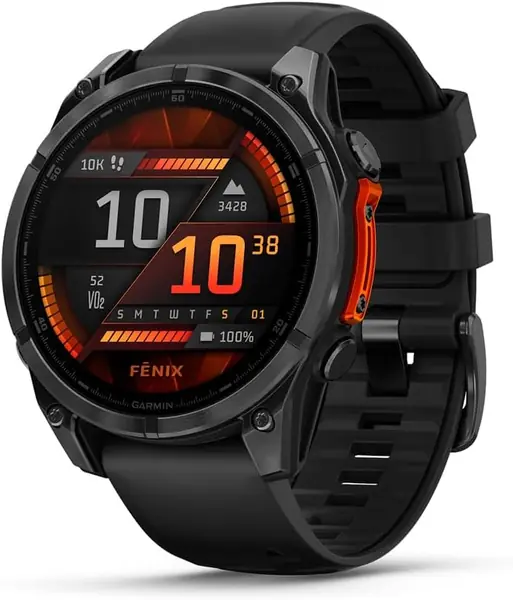
The Fenix 8 is the first Garmin here that lets you take a call from your wrist, and that convenience is more useful than it sounds when your hands are full on a hike or you are pulling on a wetsuit. The built-in speaker and mic sit alongside a bright 1.4-inch AMOLED display and a stainless-steel bezel that looks at home with a jacket.

What we like is the range: 100-meter water resistance, a built-in flashlight, multi-band GPS, and up to 16 days in smartwatch mode or 47 hours in GPS mode. It is a watch for the person who wants one device for trail runs, dives, gym sessions, and travel. The dive rating and flashlight are not novelty add-ons; they are the reasons to choose this over a Forerunner.

For the buyer who will actually use those tools, the Fenix 8 is a justified splurge. It is overkill for someone who mainly checks steps and wants a light, simple watch; the Forerunner 265 is easier to live with and much less expensive. But if you want a single premium Garmin that can handle water, trails, and the office, this is the most complete watch in the group.

Pros

  • Built-in speaker and mic for calls
  • 100 m water resistance and flashlight
  • Up to 16 days battery; 47 hours GPS
  • Bright 1.4-inch AMOLED and stainless bezel

Cons

  • 80 g weight is noticeable
  • Software can feel sluggish
Our verdict

For adventurers who want one premium watch for trails, water, and daily wear, the Fenix 8 delivers capability and polish—at a price and weight.

Check Latest Price
4

Garmin Instinct 3 AMOLED Best Rugged

91 /100
TKZ Score Outstanding

Key details

Battery
Up to 18 days
Display
1.2-inch AMOLED
Water Resistance
100 m
Outdoor Tools
Flashlight, barometric altimeter, compass
View on Amazon

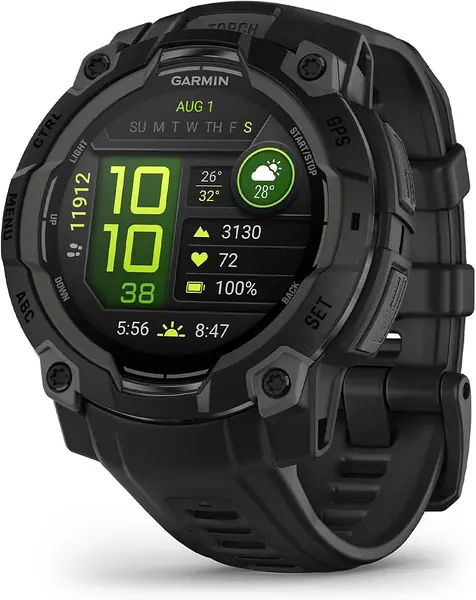
The built-in flashlight is the feature we did not expect to use every day. On an early trail run, in a dark garage, or finding a keyhole at night, it turns the Instinct 3 into a tool rather than just a tracker. The 1.2-inch AMOLED display is bright and easy to read, and the 45 mm fiber-reinforced case with a metal-reinforced bezel feels ready for rocks and branches.

Ruggedness here is not just a look: 100-meter water resistance, multi-band GPS with SatIQ, a barometric altimeter, and a 3-axis compass cover hiking and water sports. Battery life is up to 18 days in smartwatch mode, so you can take it on a week-long trip without packing the charger. At 53 g it has some presence, but it sits comfortably for a watch this tough.

The Instinct 3 is not a navigation-first watch. If you need full-color maps and turn-by-turn directions, the Forerunner 965 is the better fit. The Instinct's strength is battery, toughness, and quick access to data on the trail, not planning a route from your wrist.

What we keep coming back to is the value: you get the tough build, flashlight, and battery without paying Fenix money. It is the Garmin for someone who wants a watch that can take a hit and keep going, and who would rather have a flashlight than a color map.

Pros

  • Built-in flashlight for dark starts
  • 100 m water resistance
  • Bright 1.2-inch AMOLED
  • Up to 18 days battery

Cons

  • No touchscreen; button-only controls
  • 1.2-inch screen feels tight for data
Our verdict

For hikers, trail runners, and outdoor workers who want a tough watch with a flashlight, the Instinct 3 AMOLED is the rugged pick.

Check Latest Price
5

Garmin Venu 4 Best Everyday Health Watch

90 /100
TKZ Score Outstanding

Key details

Battery
Up to 12 days
Display
1.4-inch AMOLED
Smart Features
Flashlight, contactless payments
Case
Stainless steel
View on Amazon

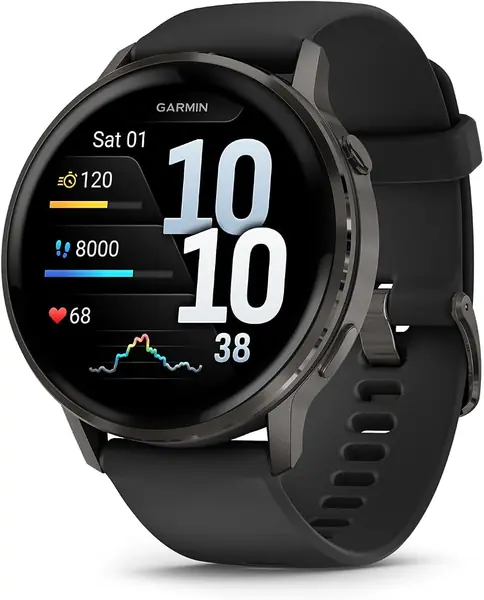
The Venu 4 is the Garmin that looks like a watch first and a fitness tracker second. The stainless-steel case gives it a dressier finish than the plastic Forerunners, and the 1.4-inch AMOLED display is big enough to show a useful health snapshot without feeling like a sports computer. That finish is why it is our pick for the person who wants one watch for workouts and real life.

Under that finish, it covers the everyday basics well: 80+ sports apps, sleep coaching, Body Battery, a health status feature, contactless payments, and a built-in flashlight. We like the 12-day battery in smartwatch mode because it makes sleep tracking realistic—you can wear it overnight without babysitting a charger. The 45 mm case and 1.3-ounce weight are reasonable for daily wear, though smaller wrists may prefer the 41 mm Venu 3S.

The Venu 4 is not the most training-focused watch here. If you want maps, multi-band GPS, or race-day pacing tools, the Forerunner 965 and 265 go deeper. The Venu 4 is for the person who wants strong health insights, a flashlight, and a watch that works with a blazer. We also noticed that the bright screen and stainless case make it a nicer object to wear than the spec sheet suggests.

What sold us is the balance: it is smart enough for daily health tracking, handsome enough to wear out, and tough enough for a sweaty gym session. It is the Garmin for someone who wants one watch that does not look like a gym membership.

Pros

  • Stainless-steel case looks dressier
  • 1.4-inch AMOLED display
  • Up to 12 days battery
  • Built-in flashlight and contactless payments

Cons

  • Premium price for everyday features
Our verdict

For buyers who want Garmin health tracking in a stainless-steel watch they can wear to dinner, the Venu 4 is the best-looking all-rounder here.

Check Latest Price
6

Garmin Venu 3S Best for Small Wrists

89 /100
TKZ Score Excellent

Key details

Battery
Up to 10 days
Display
1.2-inch AMOLED
Weight
1.4 oz
Smart Features
Speaker and mic
View on Amazon

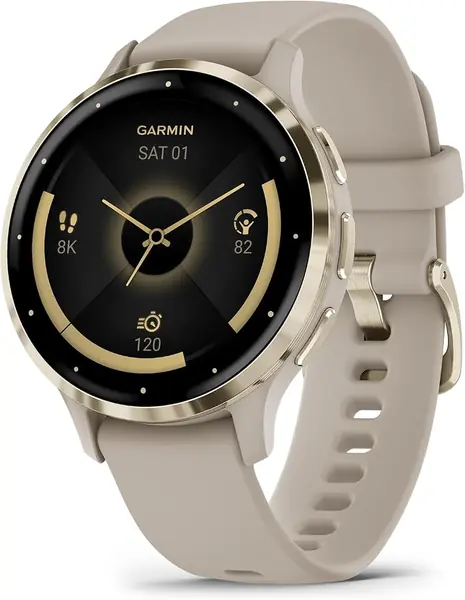
A 41 mm case is the reason the Venu 3S earns a place. On a smaller wrist, the 1.2-inch AMOLED screen still shows messages and workout stats clearly, but the watch does not swallow your arm. We also like the soft gold and French gray finish, which looks more like jewelry than most fitness watches.

It keeps the useful Venu features: speaker and mic for calls, sleep coaching, Body Battery, 30+ sports apps, and up to 10 days in smartwatch mode. The 1.4-ounce weight disappears on the wrist, and the 18 mm band has enough adjustment for a snug fit during runs. For someone who wants calls on the wrist without a 45 mm slab, it is a genuinely comfortable alternative, and that comfort is why we recommend it for smaller wrists.

The Venu 3S costs close to the larger Venu 4. If you have a larger wrist, the Venu 4 is the better value; if you do not, the size advantage is worth it. The smaller body is the whole point of this watch, and it does not feel like a compromised fitness tracker on a narrow wrist.

What we appreciate is that Garmin did not strip out the health features to make a small watch. It is the one we point to when someone wants a Garmin that fits a narrow wrist and still handles calls, sleep, and workouts.

Pros

  • 41 mm case suits small wrists
  • Speaker and mic for wrist calls
  • Up to 10 days battery
  • Bright 1.2-inch AMOLED

Cons

  • 1.2-inch screen is small for charts
  • Interface takes time to learn
Our verdict

For smaller wrists, the Venu 3S packs calls, health tracking, and a bright AMOLED screen into a 41 mm case that actually fits.

Check Latest Price
7

Garmin Forerunner 165 Best Budget Running Watch

88 /100
TKZ Score Excellent

Key details

Battery
Up to 11 days; 19 hours GPS
Display
1.2-inch AMOLED
Weight
1.38 oz
Training
25+ activity profiles
View on Amazon

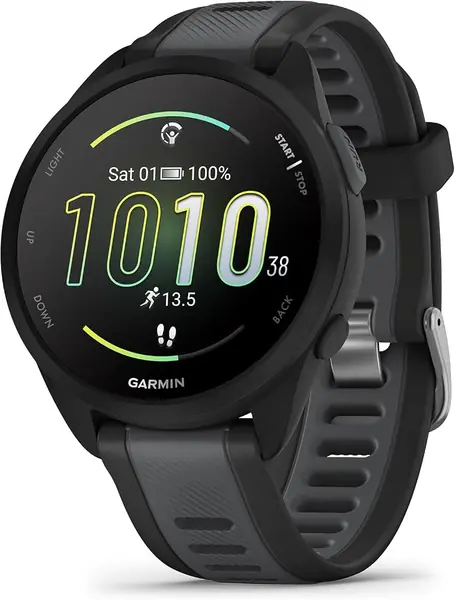
The Forerunner 165 is the price that gets you into a bright AMOLED running watch without stepping up to the 265. That matters because the display is the part you look at every run: pace, distance, and heart rate are crisp, and the 43 mm case is smaller and easier to wear all day than the 46 mm 265.

It covers the essentials well: built-in GPS, wrist heart rate, daily suggested workouts, Garmin Coach plans, and 25+ activity profiles. Battery life is up to 11 days in smartwatch mode and 19 hours in GPS mode, so it will handle a marathon or a week of training without panicking. We also like the 1.38-ounce weight, which makes it a good first running watch for someone coming from a basic fitness band.

The 165 is not the watch for someone who wants race-level navigation or the deepest recovery metrics. It stops short of the 265's training readiness and multi-band GPS, and the interface still takes some learning. But for the runner who runs familiar routes and wants the core numbers, those omissions will not matter. It is the one we recommend when you are ready to train, not just track.

Our favorite thing about the 165 is how much it gets right for a first serious watch. It made us pay attention to pace and recovery without feeling like a lab instrument, and it leaves room to upgrade later if you get hooked.

Pros

  • Bright 1.2-inch AMOLED display
  • Up to 11 days battery; 19 hours GPS
  • Daily suggested workouts and Garmin Coach
  • Light 1.38-ounce build

Cons

  • 43 mm case is large for small wrists
Our verdict

For new runners who want a bright AMOLED screen and daily workouts without a big spend, the Forerunner 165 is the smart entry point.

Check Latest Price
8

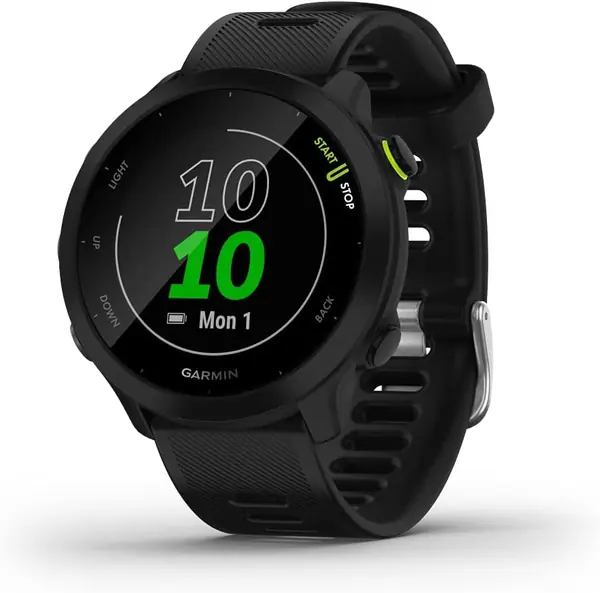
Garmin Forerunner 55 Best for Simple Run Tracking

87 /100
TKZ Score Excellent

Key details

Battery
Up to 2 weeks; 20 hours GPS
Display
1.04-inch MIP
Weight
1.31 oz
Training
PacePro and daily workouts
View on Amazon

The Forerunner 55 is the Garmin for people who do not want to learn a touchscreen on the run. Five buttons handle start, stop, lap, and back, and the transflective MIP display is always on without lighting up like a phone. That simplicity is why it remains a useful budget running watch rather than a stripped-down smartwatch.

It has the running basics: GPS, wrist heart rate, daily suggested workouts, PacePro pacing guidance, race predictions, and profiles for running, cycling, pool swim, HIIT, and more. Battery life is up to two weeks in smartwatch mode and 20 hours in GPS mode, and the 37 g body is light enough to forget about. We like it for someone who wants to track runs and not much else.

The Forerunner 55 is not trying to be a smartwatch. It is for the runner who wants a simple, tough watch and does not need the extra layers of the 165 or 265. If you want a bright display and deeper scores, those models exist; the 55's appeal is that it asks less of you.

What we appreciate is that it does not overcomplicate the run. It tracks the route, shows the basics, and keeps going for days. That focus is rare, and it is why the 55 stays in the conversation for new runners and anyone who wants a backup watch.

Pros

  • Two-week battery; 20 hours GPS
  • Light 37 g body
  • Button-only controls work with gloves
  • PacePro and daily workouts

Cons

  • Small 1.04-inch MIP display
  • Advanced training metrics stop at basics
Our verdict

For budget-minded runners who want buttons, GPS, and two-week battery, the Forerunner 55 is the no-fuss choice.

Check Latest Price

How We Chose and Tested These Garmin Watches

We started by mapping the current lineup — cases from 41mm to 47mm, screens ranging from dim memory-in-pixel panels to bright AMOLED, and price gaps of several hundred dollars between watches that look nearly identical on a product page. We ruled out discontinued models, anything that only works well with a phone in hand, and near-duplicates that shared a case with a watch we'd already picked, then bought eight at retail so nobody owed a brand a favor. They've been showered in, swum in, and scraped against more doorframes than I'd like to admit.

Battery life got its own tracking sheet: each watch was charged to 100 percent and the percentage logged every morning, with separate notes for heavy GPS days and light ones. To check accuracy, I ran the same measured 5-mile loop pairing two watches at a time and compared distance, pace, and heart rate against the known loop and a chest strap. Screens were judged at noon outdoors with sunglasses on, then again on a treadmill under gym lighting.

Because a watch is jewelry as much as a tool, we wore each one to the office, to dinner, and to bed, and asked people with wrists several sizes apart how the case sat. We navigated menus with sweaty fingers mid-run and with gloves on a cold morning, paired every watch to both an iPhone and an Android phone, and noted when notifications lagged or a paired sensor dropped mid-workout. Finally, we weighed what the extra money bought — whether maps, music, or a flashlight became something we reached for weekly or forgot about by month two.

How to Choose a Garmin Watch

Match the Model to Your Main Activity

A running-first watch prioritizes pace, interval, recovery, and sometimes maps; an everyday fitness watch prioritizes comfort, sleep, stress, and phone notifications. We sort the Forerunner models toward runners, the Venu models toward daily health and style, and the Instinct toward rugged outdoor use. If you run three times a week and lift twice, a Forerunner 265 is more watch than you need; the 165 covers the basics. If you hike unfamiliar trails, pay for maps—the 965 earns them.

Look at Battery in the Right Mode

Smartwatch-mode battery is the number you live with; GPS-mode battery is the number that matters on race day. A 20-hour GPS rating covers a marathon and most day hikes, while 31 to 47 hours gives you room for ultras or long adventures. AMOLED screens and always-on displays cut runtime, so treat the headline figure as a best case. Our rule: choose at least 18 hours of GPS battery for marathon training, and step up to 30+ hours if you regularly go beyond six hours.

Size and Weight Matter More Than You Think

Case diameter tells you how the watch will look; weight tells you how it will feel by bedtime. A 41–43 mm case suits smaller wrists, while 45–47 mm is fine for larger wrists but can crowd a narrow one. Under 50 g is easy to wear overnight; the Fenix 8's 80 g build buys capability but makes itself known. We prioritize comfort if you plan to wear the watch for sleep tracking, because a watch you take off at night cannot track recovery.

Choose the Display and Controls You'll Actually Use

AMOLED screens are colorful and easy to read, but they cost battery; MIP displays are always-on, sunlight-friendly, and less power-hungry, with a more utilitarian look. Touchscreens are handy for scrolling maps and widgets, while buttons are better with gloves or sweaty hands. The Instinct 3 is button-only for a reason, and the Forerunner 55 shows how little you need for basic run tracking. If you want maps, a touchscreen plus buttons is the more usable combination.

Decide Which Smart Features Are Worth Paying For

Music storage, wrist calls, contactless payments, and a flashlight are the conveniences that separate a good training watch from a good everyday watch. They are also the fastest way to add cost. We think a flashlight is genuinely useful on early runs and dark hikes, and wrist calls are worth it if you leave your phone in a pack. Maps are the one feature we would not buy speculatively: they add size and price, and they only pay off on unfamiliar routes.

Frequently Asked Questions

Final Verdict

The Forerunner 265 is the Garmin we recommend to most people. It has the training depth, bright screen, and battery to handle daily runs and everyday wear without the bulk or price of the premium models. If you need full-color maps and longer GPS runtime, choose the Forerunner 965; if you want a tougher watch with a flashlight and 100-meter water resistance, the Instinct 3 AMOLED is the better match.

The Venu 4 is the pick when style matters as much as training, and the Venu 3S is the one to choose if a 41 mm case fits your wrist better.