Best Garmin Watches for Running of 2026

A running watch is three demanding things crammed into one small case: a GPS radio that eats power, a screen that wants to be bright, and a battery that has to survive a twenty-mile Sunday. Push one and the other two pay for it — which is why two watches with near-identical specs can feel like completely different tools by mile three. The right one should disappear on your wrist and simply log the work.

I've run with a watch strapped on for years, and my team spent the past seven months putting eight of them through a full marathon block, a measured track, treadmills, rainy mornings, and plenty of nights and weekends. Accuracy, honest battery life, a screen you can actually read in July sun, menus you can work with cold fingers, and whether it looked like something you'd wear with regular clothes separated the good ones from the rest.

One thing first-timers tend to overrate: mapping. Most of us reached for daily suggested workouts and recovery guidance far more often, so paying extra for maps and music is a personal call rather than a requirement — and the battery number on the box assumes the most flattering settings. The picks below are the ones we kept reaching for, sorted by the kind of runner each one suits.

The Best Garmin Watches for Running

1

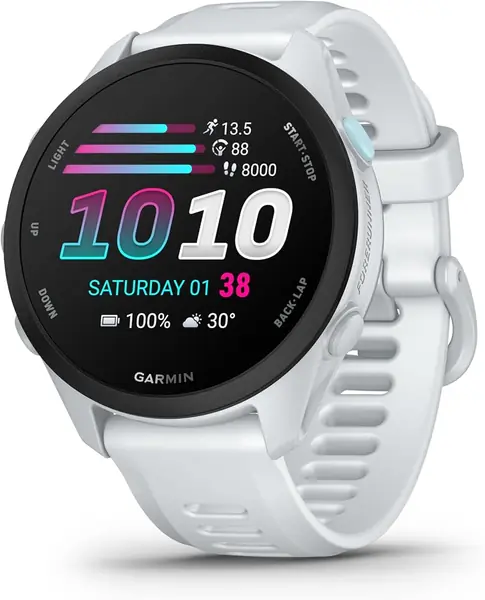
Garmin Forerunner 265 Best Overall
94 /100
TKZ Score Outstanding

Key details

Display
1.3 in AMOLED
Battery, GPS Mode
Up to 20 hrs
Battery, Smartwatch Mode
Up to 13 days
On-watch Music
8 GB storage
View on Amazon

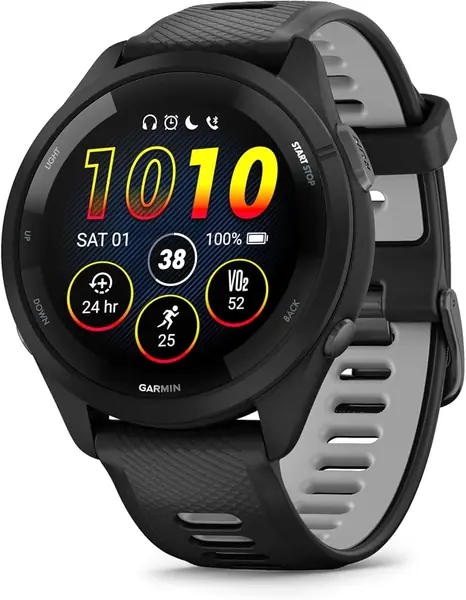
The 265 is the watch we hand to most runners, and the case for it is a balance rather than a single headline number. It carries the same button-plus-touch controls and a 1.3-inch AMOLED screen as the flagships, adds music storage and a training readiness score, and stops short of the maps and titanium that push the 965 and 970 into another bracket. Thirteen days in smartwatch mode and 20 hours with GPS running covers a full training week plus a race.

The receiver is what separates it from the cheaper 165. Multi-band GPS with SatIQ reacquires a lock under tree cover and between buildings, and the payoff shows up in the pace graph rather than the spec sheet: fewer spikes, less drift down the block. Training readiness and HRV status land in the morning report, so whether to run hard the day after a bad night has an answer before you find your shoes.

The learning curve is real, though. Garmin's menu tree is deep, and the first week goes into hunting for settings you later reach without thinking; the touchscreen helps, and the buttons still work with wet hands. Set your data screens once and leave the rest alone. After a month the watch stops being a gadget and becomes the thing that tells you what the week looks like.

Pros

  • Multi-band GPS that holds a line in the city
  • Bright 1.3-inch AMOLED, readable at pace
  • 13 days smartwatch, 20 hours with GPS
  • Training readiness and HRV in the morning report

Cons

  • Menu system takes a while to learn
  • Costs a good deal more than the 165
Our verdict

For most runners this is the one we point to: dual-band GPS, a bright 1.3-inch AMOLED, music, and 13 days of battery without flagship pricing.
Check Latest Price
2

Garmin Forerunner 165 Best Value

93 /100
TKZ Score Outstanding

Key details

Display
1.2 in AMOLED
Battery, GPS Mode
Up to 19 hrs
Battery, Smartwatch Mode
Up to 11 days
Activity Profiles
25+
View on Amazon

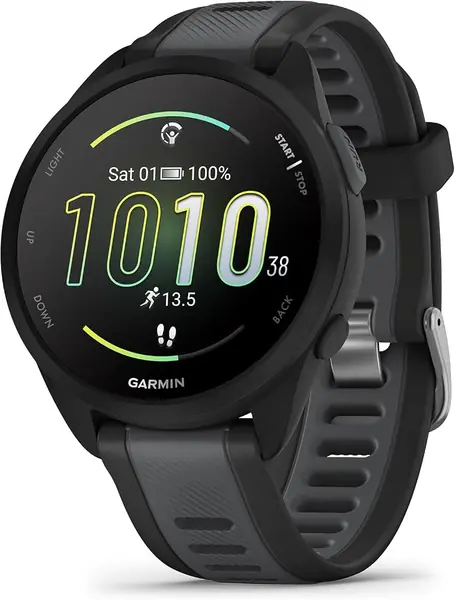
The 165 is the least expensive way into an AMOLED screen in this lineup, and the screen is what you notice on every glance: 1.2 inches, sharp, and rated to 1,000 nits so mid-morning sun does not wash out your pace. The 43 mm case and 1.38-ounce weight put it in the group you forget you are wearing.

We think that combination is the right trade for a first serious watch. The core coaching software is the same as on the expensive models — daily suggested workouts that adapt to your training and recovery, Garmin Coach plans from a 5K through a half marathon, and a morning report with sleep, recovery, and HRV status — plus 25-plus activity profiles for the pool and the gym. Nothing about the training side feels like a starter version.

Step up to the 265 and you buy a larger screen, music storage, training readiness scoring, and the multi-band receiver that keeps pace honest between tall buildings. Stay with the 165 if your routes are open, your phone comes along, and you prefer to put the difference into race entries. That is a defensible choice rather than a compromise.

Pros

  • AMOLED screen at the lowest price here
  • Coached workouts and a full morning report
  • Light 1.38-ounce, 43 mm case

Cons

  • No multi-band GPS for dense city routes
  • Setup takes patience for first-timers
Our verdict

We hand the 165 to anyone buying a first serious running watch: an AMOLED screen and coached workouts for the least money in this group.

Check Latest Price
3

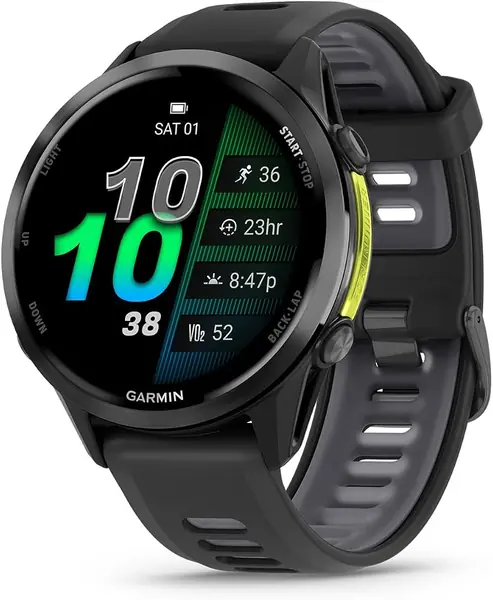
Garmin Forerunner 965 Best for Maps and Long Runs

92 /100
TKZ Score Outstanding

Key details

Display
1.4 in AMOLED
Battery, GPS Mode
Up to 31 hrs
Battery, Smartwatch Mode
Up to 23 days
Maps
Full-color, turn-by-turn
View on Amazon

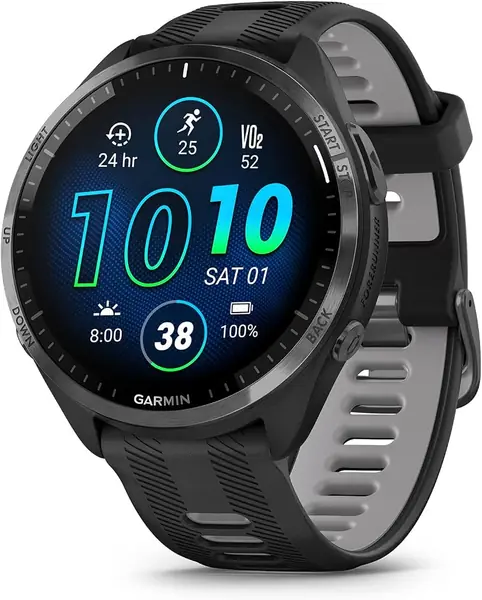
Twenty-three days is the figure that keeps the 965 relevant even with the 970 sitting above it. That is smartwatch mode; with satellites running you get 31 hours, which covers a hundred-kilometer race with hours to spare and means a weekend of back-to-back long runs does not send you hunting for a cable.

The 1.4-inch AMOLED is the biggest screen in this group, and the built-in maps earn their place beyond gadgetry: load a course and the watch shows the turn rather than a breadcrumb, which is the difference between confidence and stopping to check a phone on an unfamiliar trail. Turn-by-turn routing, a titanium bezel, and 32 GB of storage make it the travel watch of the bunch.

What it does not buy is the flashlight, the sapphire lens, and the newest sensor work of the 970 — that is the only reason we still send people to the newer watch. Everything else about the 965, from the 31-hour GPS rating to the music on your wrist, is the long-distance package, and it is the one we pack for a race weekend.

Pros

  • 31 hours of GPS and 23 days in smartwatch mode
  • Full-color maps with turn-by-turn routing
  • Largest screen here at 1.4 inches
  • Titanium bezel and 32 GB of storage

Cons

  • 47 mm case and 53 g weigh on smaller wrists
Our verdict

Buy the 965 if your runs leave the city grid or last all day; the maps and 31-hour GPS rating justify both the size and the spend.

Check Latest Price
4

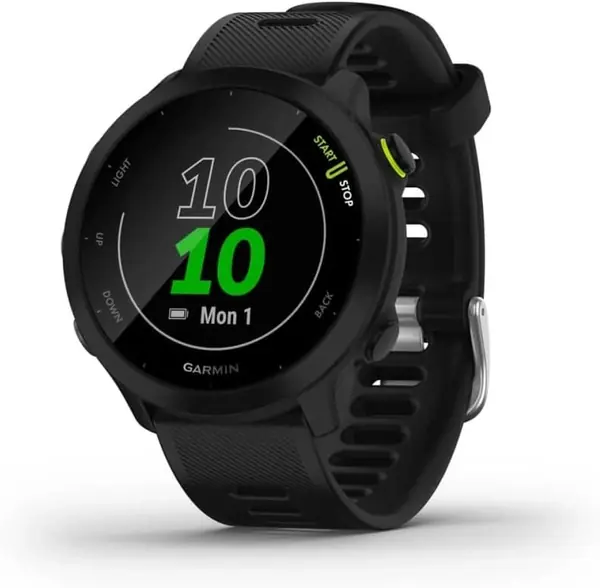
Garmin Forerunner 55 Best Budget

91 /100
TKZ Score Outstanding

Key details

Display
1.04 in LCD
Activity Profiles
17
Weight
1.31 oz
Satellite Systems
GPS, GLONASS, Galileo
View on Amazon

The 55 does the basics properly and skips the rest. Multi-satellite GPS, 17 activity profiles, PacePro pacing for race day, and free training plans for a 5K, 10K, or half marathon are all here, in a 37-gram watch that disappears on the wrist. For a new runner who wants distance, pace, and heart rate from a device that charges once a week or so, this is the value pick of the group.

Buttons are a feature here, not a compromise: in rain, with gloves on, or with sweaty fingers, a physical button starts and laps a workout every time. What you give up is everything phone-adjacent — there is no music storage and no mapping, so if you want a watch that doubles as a smartwatch between runs, the 165 is the better spend. If you want a training log on your wrist and nothing more, this is where the money goes furthest.

Pros

  • Multi-satellite GPS and 17 activity profiles
  • PacePro pacing and free race training plans
  • Featherweight 37 g on the wrist

Cons

  • 1.04-inch LCD is small and dim next to AMOLED
Our verdict

Our budget pick for runners who want distance, pace, and PacePro without paying for features they will never open.

Check Latest Price
5

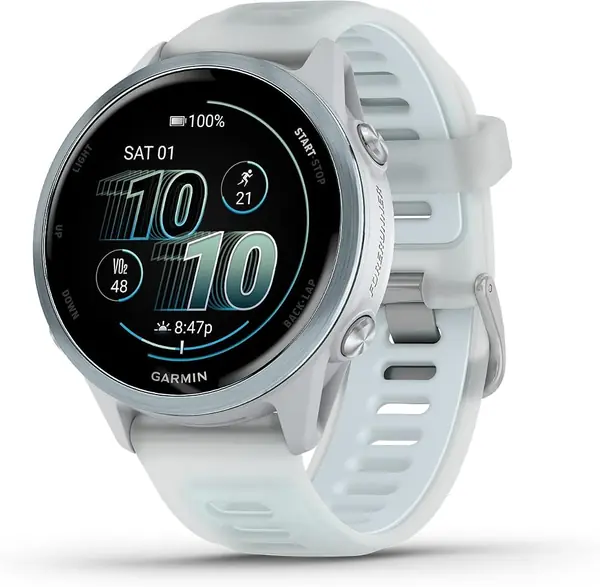
Garmin Forerunner 570 Best for Smaller Wrists

90 /100
TKZ Score Outstanding

Key details

Display
1.2 in AMOLED
Battery, GPS Mode
Up to 18 hrs
Battery, Smartwatch Mode
Up to 10 days
Case
42 mm aluminum
View on Amazon

Forty-two millimeters is the whole pitch. The 570 fits the full training package — training readiness, HRV status, Garmin Coach plans, daily suggested workouts — into an aluminum case that does not hang past the edge of a smaller wrist, and Garmin rates its 1.2-inch AMOLED as its brightest. If you have tried on a 47 mm Forerunner and felt like you were wearing a wall clock, this is the correction.

It also makes and takes calls through a built-in speaker and microphone, which we were ready to dismiss and then used constantly on cool-downs and the walk back to the car. The smaller case costs you battery — 10 days in smartwatch mode and 18 hours with GPS is the shortest span of the AMOLED models here — so a runner training for a hundred-miler is better served by the 965. For everyone whose wrist rules out a 47 mm case, there is nothing else here that fits the same brief.

Pros

  • Full training suite in a 42 mm case
  • Bright 1.2-inch AMOLED display
  • Speaker and microphone for wrist calls

Cons

  • Priced alongside the larger Forerunner 965
Our verdict

The 570 is the one for a small wrist that still wants flagship training tools: 42 mm, a bright AMOLED, and calls from the watch.

Check Latest Price
6

Garmin Forerunner 970 Best Premium

89 /100
TKZ Score Excellent

Key details

Display
1.4 in AMOLED
Battery, GPS Mode
Up to 26 hrs
Battery, Smartwatch Mode
Up to 15 days
Flashlight
Built-in LED
View on Amazon

A flashlight on a running watch sounds like filler until the first winter run that starts in the dark. The LED sits above the display on the 970 and throws enough light to pick out the pavement a few strides ahead; we reached for it far more often than we expected, on evening runs, in unfamiliar hotel rooms, and once to find a dropped key.

The rest is the top of Garmin's running line: a 1.4-inch AMOLED under a sapphire lens, a titanium bezel, 32 GB of storage, full-color maps, and 26 hours of GPS. The advanced metrics come with a caveat — running economy and step-speed-loss readings require the HRM 600 chest strap, which is not in the box, so budget for it if those numbers are the reason you are shopping.

The wrinkle in the lineup is battery. Fifteen days in smartwatch mode and 26 hours with GPS is generous by any normal standard, but it is shorter than the 965's 23 days and 31 hours, and that is before the flashlight, maps, and music start working the cell. We treat the 970 as the watch for the runner who wants the toughest hardware and the newest sensors, not the longest runtime.

Pros

  • Built-in LED flashlight for dark starts
  • Sapphire lens and titanium bezel
  • Maps plus 26 hours of GPS

Cons

  • Most expensive watch in this group
Our verdict

For the runner who trains after dark and wants the toughest build here, the 970 earns its keep with a flashlight and sapphire.

Check Latest Price
7

Garmin Forerunner 70 Best for New Runners

87 /100
TKZ Score Excellent

Key details

Display
1.2 in AMOLED
Battery, GPS Mode
Up to 23 hrs
Battery, Smartwatch Mode
Up to 13 days
Case
43 mm
View on Amazon

The 70 is Garmin's beginner watch, and its numbers do not read like a beginner's: 13 days in smartwatch mode and up to 23 hours with GPS, which is a few hours more than the 165 manages, in a 43 mm case that weighs 1.4 ounces.

Beginner, in this case, means the software does the planning. Daily suggested workouts adapt to how the last few days went, Garmin Coach builds a plan toward a race date, and a sleep score plus a daily energy reading give you something concrete to look at on rest days. There is nothing to configure before your first run, which is the point.

The gap to the rest of the lineup is depth rather than function. Storage runs to 512 MB, the profile list leans on running rather than multisport, and the training picture stops short of the readiness scoring on the 265. For someone whose week is three runs and a long one, none of that registers as a loss.

What we appreciated most is that nothing needs explaining: put it on, take the suggested workout, and the watch handles the rest. It is the model we hand someone who has never worn a training watch and does not want to spend the first month in settings menus.

Pros

  • 23 hours of GPS, longest in the small-case group
  • Coaching that plans the training week
  • Light 43 mm case at 1.4 ounces

Cons

  • Costs more than the more capable Forerunner 165
Our verdict

A sensible first Garmin for someone who wants simple coaching and long battery, though the 165 gives you more for less.

Check Latest Price

How We Tested the Best Running Watches

We started by mapping out the lineup runners actually cross-shop, then narrowed it by case size — the 42 and 43mm options against the 46 and 47mm models — along with screen type and whether each one could carry music, maps, or both. Eight watches made the cut, spanning beginner-focused models up to the premium end of the range.

Testing ran for seven months and overlapped with a full marathon build, which meant easy morning loops, weekly track sessions, long Sunday runs on mixed terrain, treadmill days, and a couple of soaked runs nobody enjoyed. We also wore each watch for ordinary life — sleep, showers, errands — because a running watch spends far more time off the run than on it.

For accuracy, we ran every watch on a certified 400-meter track and on a wheel-measured route, then compared recorded distance and pace against both, and we repeated the same route under heavy tree cover to see whether the GPS trace wandered. Heart-rate readings were checked against a chest strap during intervals. For battery, we charged to full, ran with GPS and music going on the brightest setting, logged the percentage lost per hour, and separately counted how many days each watch lasted between charges with daily wear.

Usability got tested by handing each watch to someone who had never used one: we timed the cold start to an active run, counted button presses, and checked whether pace was legible at a glance mid-run with cold, wet hands. Each was worn with normal clothes for a week to judge size and looks, screens were checked in direct sun, and we noted strap comfort and whether the case picked up scratches. We logged pairing and syncing failures against a phone, and a month in, we asked ourselves which features we were still using — the most honest measure of what's worth the money.

How to Choose a Garmin Running Watch

Read the Battery Rating in GPS Hours

Up to 13 days is the smartwatch-mode figure, and it assumes you rarely press start. The number that governs your week is the GPS rating, because that is what a long run, a race, and a weekend of back-to-back efforts actually draw down. The 265's 13 days becomes 20 hours with satellites locked; the 965's 23 days becomes 31 hours.

A marathon takes most runners under five hours, so even the shortest rating here covers one comfortably. The gap shows up on ultra distances, big back-to-back weekends, and the morning you forgot the cable. Work out your longest single effort and double it — that is the rating you need.

Decide How Much GPS Precision You Need

Standard GPS is fine on open roads, park paths, and most trails. Multi-band reception, which the 265 and 965 list, keeps its lock when the sky is partly blocked — downtown streets between tall buildings, dense canopy, canyon walls. You see it in the pace graph as a line without spikes rather than as a dramatic change in total distance.

That receiver is the main thing the step from the 165 to the 265 buys, along with a bigger screen and training readiness. If your routes are wide open, put the difference into shoes and race entries instead.

Pay for Maps or Music Only If You'll Use Them

Built-in maps on the 965 and 970 put a route line and turn prompts on your wrist, which is worth real money on unfamiliar trails and in cities where you reroute as you go. On-watch music matters if you run without a phone: the 265, 965, and 970 hold tracks and pair with Bluetooth headphones.

Carry your phone and neither feature earns its premium. Spend the savings on a chest strap — it improves heart-rate accuracy more than any watch upgrade at this level.

Match the Case to the Wrist You'll Sleep In

These watches spend the night on your wrist if you want sleep and recovery data, so fit matters more than it does for a watch you take off at nine. The small models here — the 165 and 70 at 43 mm, the 570 at 42 mm — sit around 1.4 ounces, while the 47 mm 965 carries 53 grams of case.

If a large face covers your whole wrist or catches on a jacket cuff, start with the 42 to 43 mm group. The training software on the 570 is the same suite the big watches run.

Know Which Training Features You'll Actually Use

Every watch here runs daily suggested workouts and Garmin Coach plans, so basic coaching is not a reason to spend more. What the 265, 570, 965, and 970 add is a training readiness score built from sleep, HRV, and load — useful if you tend to train through fatigue, noise if you already follow someone else's plan.

At the very top, the 970's running economy and step-speed-loss readings need the HRM 600 chest strap, which is not in the box. If you know your week, buy the screen and the battery you want and skip the scores.

Frequently Asked Questions

Final Verdict

Across this group, the Forerunner 265 is the one we recommend without a caveat beyond its price: dual-band GPS for city routes, a 1.3-inch AMOLED you can read at pace, 20 hours of GPS battery, and the recovery scores that keep a training week honest.

Spend less and the 165 still coaches you through a first half marathon. Spend more only for a specific reason — maps and 31 hours on the 965, a 42 mm case on the 570, or the flashlight and sapphire of the 970.