Best Garmin Watches for Triathlon of 2026

I still think about the swim exit of my first Olympic-distance race: cold hands, wet fingers, and a watch that refused to leave swim mode while the rest of my wave ran past me. A triathlon watch has one job no running watch has to do, and that's carrying you from water to bike to run without making you think. Everything else, from training load to maps to music, is a bonus riding on top.

Over the past nine months, my team and I have swum, biked, and run with seven of them, from a 42mm case that disappears under a wetsuit sleeve to a titanium flagship that doesn't. Case size and screen type ended up mattering more than I expected; design and appearance stop being vanity when you're wearing the same watch for six hours straight.

The number I'd tell a first-timer to focus on is battery life, and not the spec-sheet figure — the real question is whether the watch survives a long-course race with GPS, music, and a power meter all running at once. Interface, connectivity, reliability, and plain value for money separate these watches far more than the feature list does.

The Best Garmin Watches for Triathlon

1

Forerunner 965 Best Overall
93 /100
TKZ Score Outstanding

Key details

Display
1.4-inch AMOLED
GPS Battery
Up to 31 hours
Weight
1.87 oz
Triathlon Profiles
Yes
View on Amazon

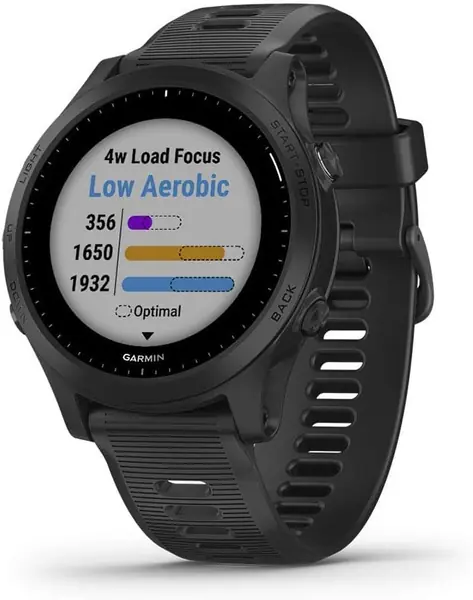
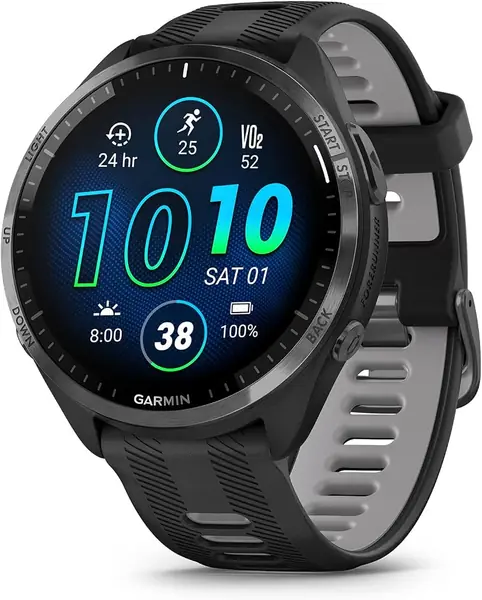
The first thing we check on a triathlon watch is whether it can carry us from swim to bike to run without breaking stride. The Forerunner 965 has dedicated triathlon and multisport profiles, and its full-color maps are the part we kept using after the race—loading a course, glancing at turns on the bike, and following a new run route without pulling out a phone. The 1.4-inch AMOLED display is bright and readable, and at 53 grams it stays comfortable for long days.

Battery is the quiet advantage: up to 23 days in smartwatch mode and 31 hours in GPS mode. That is enough for a long-course race with margin, and we did not have to think about charging between sessions. Training readiness, daily suggested workouts, and race predictions give structure to the week.

The 970 is the upgrade if you want the brightest screen and a sapphire lens; the 965 keeps the maps, battery, and lighter feel that make it our default. The 570 is the better fit for a smaller wrist, but neither of those alternatives makes the 965 feel like a compromise on race day.

Pros

  • Triathlon and multisport profiles built in
  • 31-hour GPS battery and 23-day smartwatch mode
  • Full-color maps and bright AMOLED display
  • Comfortable 53-gram case

Cons

  • Menu system takes time to learn
Our verdict

The Forerunner 965 is our default triathlon watch because it handles swim-bike-run transitions, full-color maps, and a 31-hour GPS rating without the premium price of the 970.
Check Latest Price
2

Forerunner 970 Best Premium

92 /100
TKZ Score Outstanding

Key details

Display
1.4-inch AMOLED
GPS Battery
Up to 26 hours
Storage
32 GB
Build
Titanium bezel, sapphire lens
View on Amazon

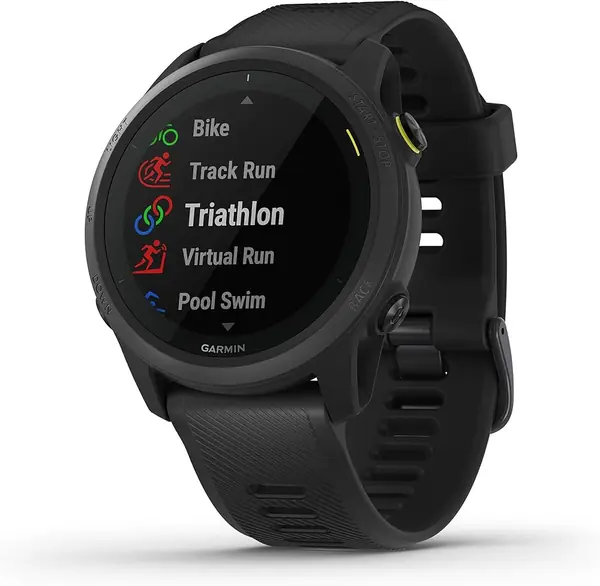
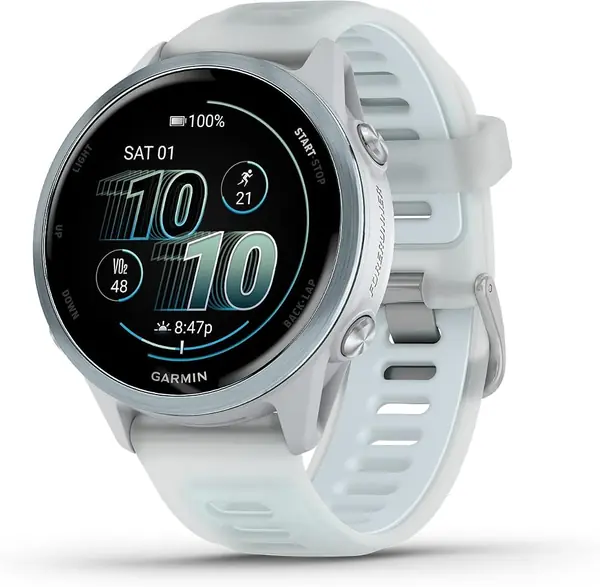
The Forerunner 970 is the watch you choose when the 965 feels sensible rather than special. It adds a brighter AMOLED display, a titanium bezel with a sapphire lens, a built-in LED flashlight, and a speaker and mic for calls from the wrist.

We noticed the flashlight more than any training metric—it is genuinely useful for early starts and dark trail transitions—and the sapphire lens shrugged off the kind of knocks that make us nervous on a premium watch. The triathlon and multisport support is there, along with Garmin Coach plans that adapt to your race.

The 970 is still the one we hand to someone who wants the best-feeling hardware and the brightest display, even though it costs more than the 965. It is a premium purchase for athletes who want the extras.

Pros

  • Bright 1.4-inch AMOLED with sapphire lens
  • Built-in LED flashlight and speaker/mic
  • Triathlon plans and 32 GB storage

Cons

  • GPS battery is shorter than the 965's
Our verdict

The Forerunner 970 is the premium triathlon pick for athletes who want the brightest screen, a sapphire lens, and a built-in flashlight, and who can accept less GPS battery than the 965.

Check Latest Price
3

Forerunner 570 Best for Smaller Wrists

91 /100
TKZ Score Outstanding

Key details

Display
1.2-inch AMOLED
GPS Battery
Up to 18 hours
Smartwatch Battery
Up to 10 days
Case Size
42 mm
View on Amazon

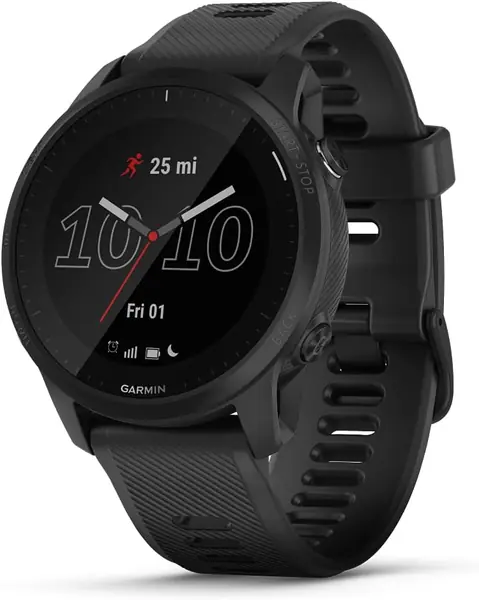
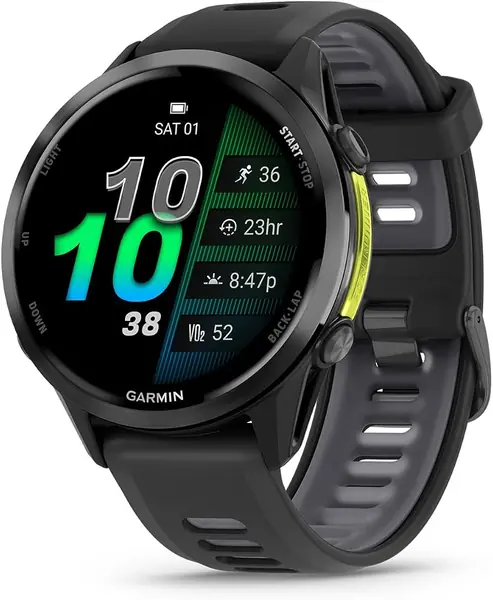
A 47 mm watch can swallow a smaller wrist, especially under a wetsuit sleeve. The 570's 42 mm aluminum case is the reason we kept it in the mix: it sits closer to the wrist, leaves room for a sleeve, and still gives you a 1.2-inch AMOLED display and button controls.

We like that Garmin did not strip the triathlon basics to get there. It has running and triathlon plans, training readiness, and up to 10 days in smartwatch mode or 18 hours in GPS mode. The battery is the compromise: 18 hours is fine for most age-group races, but it is not the long-course margin the 965 offers. If your wrist is the limiting factor, this is the one we point to first.

Pros

  • 42 mm case fits smaller wrists
  • Triathlon plans and training readiness
  • 10-day smartwatch battery and 18-hour GPS

Cons

  • Smaller display is less glanceable at speed
Our verdict

The Forerunner 570 is the best fit for smaller wrists because its 42 mm case still carries triathlon plans, a bright AMOLED screen, and an 18-hour GPS rating.

Check Latest Price
4

Forerunner 945 Best for Maps and Music

90 /100
TKZ Score Outstanding

Key details

Display
1.2-inch LCD
GPS Battery
Up to 10 hours with music
Maps
Full-color onboard
Ultratrac Battery
Up to 60 hours
View on Amazon

The 945 is the older watch in this group, and its 1.2-inch LCD is a step behind the AMOLED models. What keeps it relevant is the combination of full-color onboard maps, music storage, and a 60-hour ultratrac mode that outlasts most race cutoffs.

We used the maps on unfamiliar bike courses and liked having turn prompts on the wrist without a phone. The triathlon profile is there, and the watch handles swim, bike, and run with separate data screens. The 60-hour ultratrac mode is the reason it stays in the conversation for ultra-distance events.

But if you value maps, music, and a battery mode that can go the distance, the 945 still earns its place.

Pros

  • Full-color maps and music storage
  • 60-hour ultratrac mode
  • Triathlon-ready sport profiles

Cons

  • GPS battery with music is much shorter than ultratrac
Our verdict

The Forerunner 945 is a credible triathlon watch for athletes who want full-color maps, music, and a 60-hour ultratrac mode in a proven package.

Check Latest Price
5

Forerunner 745 Best Budget

89 /100
TKZ Score Excellent

Key details

Display
1.2-inch
Storage
4 GB
Triathlon Profiles
Yes
Warranty
90 days renewed
View on Amazon

We like the 745 for the athlete who already has a bike computer or phone for navigation and wants the watch to handle intervals, transitions, and the run. It is the cheapest way into a proper swim-bike-run Garmin in this group, and it does not feel like a stripped-down toy: preloaded triathlon and multisport profiles, on-device run and cycling suggestions, structured workouts, and a 1.2-inch button-controlled screen.

The 4 GB storage is enough for workouts and music, and the buttons are easy to use with wet hands. It is not the watch for onboard maps or the longest battery; that is the 965's job.

Pros

  • Swim, bike, run, and triathlon profiles
  • On-device run and cycling suggestions
  • 4 GB storage and button controls

Cons

  • 90-day renewed warranty
Our verdict

The renewed Forerunner 745 is the budget triathlon pick for athletes who want swim, bike, run, and triathlon profiles without paying for maps or a premium display.

Check Latest Price
6

Forerunner 945 LTE Best for Phone-Free Safety

88 /100
TKZ Score Excellent

Key details

Display
1.2-inch LCD
GPS Battery
Up to 12 hours with music
Weight
1.73 oz
LTE LiveTrack
Subscription required
View on Amazon

The 945 LTE adds the one thing the standard 945 cannot: phone-free safety and tracking over cellular. LiveTrack and Assistance can work without your phone, which matters on remote bike loops and early open-water swims.

The 7-hour GPS-with-music-and-LTE-LiveTrack rating is the number to watch for long-course racing. The standard 12-hour GPS-with-music mode is more forgiving, but the safety feature is why you pay for this model.

We kept the LTE version in the roundup for athletes who train alone or race in areas where a phone is a hassle. It still has the 945's maps and music, and the triathlon profile is intact. If you do not need cellular safety, the standard 945 or the 965 is the better spend.

Pros

  • Phone-free LiveTrack and Assistance
  • Full-color maps and music
  • Triathlon profile intact

Cons

  • LTE features require a subscription and coverage
Our verdict

The Forerunner 945 LTE is the pick for triathletes who train alone and want phone-free safety and live tracking, with the maps and music of the standard 945.

Check Latest Price
7

Forerunner 265 Best for Run Training

87 /100
TKZ Score Excellent

Key details

Display
1.3-inch AMOLED
GPS Battery
Up to 20 hours
Weight
1.66 oz
Smartwatch Battery
Up to 13 days
View on Amazon

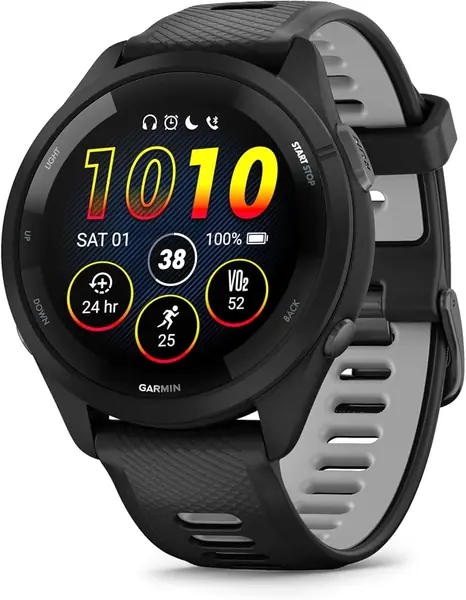
The 265 is the watch we reach for when the session is a run and nothing else. At 47 grams it disappears on the wrist, the 1.3-inch AMOLED display is easy to read at tempo, and the 20-hour GPS rating is plenty for marathon training.

It also brings training readiness, daily suggested workouts, and a race widget that can be set from a course in Garmin Connect. We like that the buttons and touchscreen work together, so you can swipe through metrics and still hit lap with a physical button when your hands are wet.

The 265 is built around running, cardio, and fitness first; we treat it as a run-focused companion rather than the watch that carries you through all three legs. That is the boundary to know before you buy.

If you already have a bike computer and a separate swim watch, the 265 gives you the best run experience per dollar in this group. Its 13-day smartwatch mode also means it can stay on your wrist between sessions without a nightly charge.

Pros

  • Light 47-gram build
  • 20-hour GPS and 13-day smartwatch battery
  • Training readiness and daily suggested workouts
  • Bright 1.3-inch AMOLED

Cons

No notable drawbacks to flag.

Our verdict

The Forerunner 265 is a light, bright run-training watch for triathletes who want daily run guidance and comfortable all-day wear.

Check Latest Price
8

fēnix 8 Rugged Multisport

86 /100
TKZ Score Excellent

Key details

Display
1.4-inch AMOLED
GPS Battery
Up to 47 hours
Weight
2.82 oz
Water Resistance
100 meters
View on Amazon

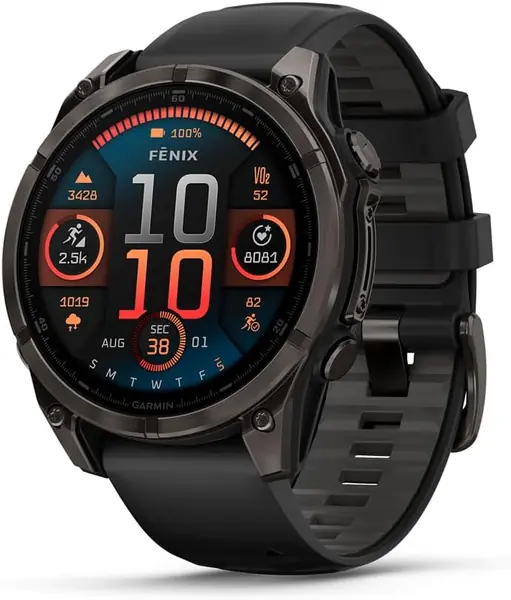
The fēnix 8 is the tank of this group. Its 80-gram case, 100-meter water resistance, sapphire lens, and 47-hour GPS rating make it look ready for an expedition, and the 1.4-inch AMOLED display is bright enough to read in direct sun.

The battery is the headline: up to 16 days in smartwatch mode and 47 hours in GPS mode, which is more margin than the 965 offers. That matters for long-course racing and for the days when you forget the charger.

Where it earns its place is multisport versatility. It has swimming, running, and multisport activity types, a built-in speaker and mic, and a rugged 100-meter case. For a triathlete who also hikes, dives, or spends long days outside, that breadth is the point.

We do not recommend it as the default race watch for most age-groupers; the 965 is lighter and has the triathlon profiles we want. The 80 grams are the trade-off, and on a long run you feel them. But if you want one premium watch for training, racing, and everything off the course, the fēnix 8 makes a strong case.

Pros

  • 100-meter water resistance and sapphire lens
  • 47-hour GPS and 16-day smartwatch battery
  • Bright AMOLED and speaker/mic

Cons

  • Premium price is steep for race-only use
Our verdict

The fēnix 8 is a premium multisport watch for triathletes who want a rugged 100-meter case, a 47-hour GPS rating, and a bright AMOLED display.

Check Latest Price

How We Chose and Tested the Best Triathlon Watches

We started by pulling every multisport-capable model out of the current lineup and narrowing by what actually changes a race day: case size, screen type, a dedicated triathlon mode with open-water swim, onboard music, and mapping. That left seven watches, one of them a refurbished unit we checked for battery health and sensor condition before it ever got wet. Testing ran nine months, roughly a full base-build-race cycle.

Those months looked like a real training block: 5:45 a.m. pool laps, trainer rides in the garage, weekend centuries, treadmill intervals, and two open-water races. We slept in each watch for a week to feel how the case sat at 3 a.m., and we rehearsed transitions in a parking lot — swim cap and goggles coming off — to see how quickly each watch moved from swim to bike mode with wet hands.

For battery, we charged to full and ran a five-hour simulated race day with GPS, music, and a paired power meter and chest strap live, then noted what percentage was left. We paired each watch with a phone, headphones, and two sensors to see how fast they reconnected, and timed how long a finished workout took to reach the phone.

Appearance got judged the boring way, worn through workdays and dinners to see whether the case snagged a shirt cuff or the screen washed out in direct sun. Quality and reliability hid in small things — a GPS line wandering under tree cover, a lap button that needed two presses. And value came down to one question per unit: what does this one do that the step-down model doesn't?

How to Choose a Garmin Watch for Triathlon

Start With the Transition, Not the Spec Sheet

A watch can list swim, bike, and run separately and still be annoying on race day if you have to stop and dig through menus between legs. Look for a dedicated triathlon or multisport profile that moves through the three disciplines with a button press, because wet hands and race adrenaline are not the time to learn a new menu. The Forerunner 965, 570, and 745 all carry that kind of profile; practice the sequence before race day.

Match GPS Battery to Your Race, Not the Smartwatch Claim

A long smartwatch-mode rating can look reassuring and still leave you short on race day. GPS, music, and LTE all draw from the same battery, so the number that matters is GPS mode—or GPS with music and live tracking if you use those features. The 965 is rated for 31 hours in GPS mode, the 570 for 18, and the 945 for 10 with music; the 945 LTE drops to 7 with LTE LiveTrack. Pick a buffer beyond your expected finish time.

Size and Weight Matter More Than You Think

A 47 mm case can feel fine on a training run and then catch on a wetsuit sleeve or sit heavy during a marathon. The 570's 42 mm case is the obvious choice for smaller wrists, while the 965's 53 grams is manageable for most age-groupers. The fēnix 8's 80-gram build is a different category of watch: it is built for rugged use, and you feel that on the run. Try the watch on with a sleeve before you commit.

Maps and Display: Bright Is Not Always Better

A bright AMOLED screen is easier to read at a glance, but it also draws more power than a simpler display. If you race unfamiliar bike and run courses, full-color maps are worth more than a little extra brightness; the 965 and 945 both carry them. The 970 adds a brighter AMOLED and a sapphire lens, while the 265 is the run-focused option in this group. Decide whether you need navigation or just pace and heart rate.

Frequently Asked Questions

Final Verdict

For most triathletes, the Forerunner 965 is the watch we point to first. It has the triathlon and multisport profiles, full-color maps, and 31-hour GPS rating that make race day feel handled, and it does it without the premium hardware markup of the 970. If your wrist is smaller, the 570 is the better fit; if you want the brightest screen and a flashlight, the 970 earns the upgrade. The renewed 745 is the budget route when a 90-day warranty is acceptable.