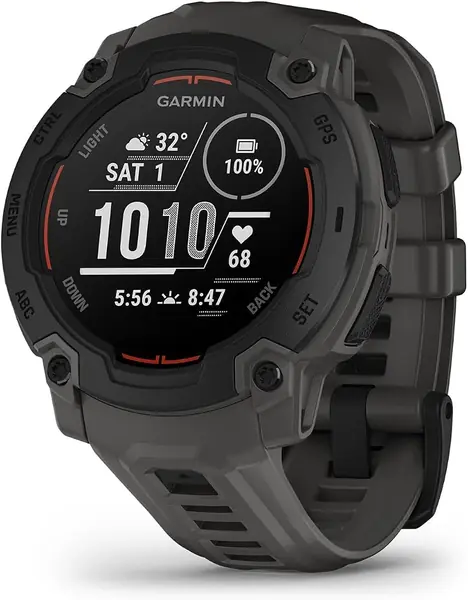
Best Garmin Watches for Health Tracking of 2026

A health-tracking watch proves itself at 3 a.m., not on the spec sheet. Plenty of them will show you a heart rate number; far fewer turn weeks of those numbers into something you can act on — a quieter day when your sleep has been rough, a resting heart rate that creeps up two days before you feel a cold coming on. What you're really buying is fewer guesses about how your body is doing.

I've worn some version of one of these every day for years, and my team and I have spent the past eight months living with 10 of them — sleeping in them, showering in them, wearing them through long runs and longer meetings. The gap between the good ones and the rest rarely comes down to the sensor; it's everything built around it. A bright AMOLED screen is easy to fall for until you're charging the thing every other day, and the small built-in flashlight is the feature I expected to ignore and now reach for constantly.

What follows are the ones that held up — on battery life, on accuracy, and on the plain question of whether you'd still want it on your wrist in month six.

The Best Garmin Watches for Health Tracking

1

Garmin Venu 4 Best Overall
93 /100
TKZ Score Outstanding

Key details

Display
1.4-inch AMOLED
Battery (smartwatch)
Up to 12 days
Case Size
45mm
Health Features
Health status, sleep coach, lifestyle log
View on Amazon

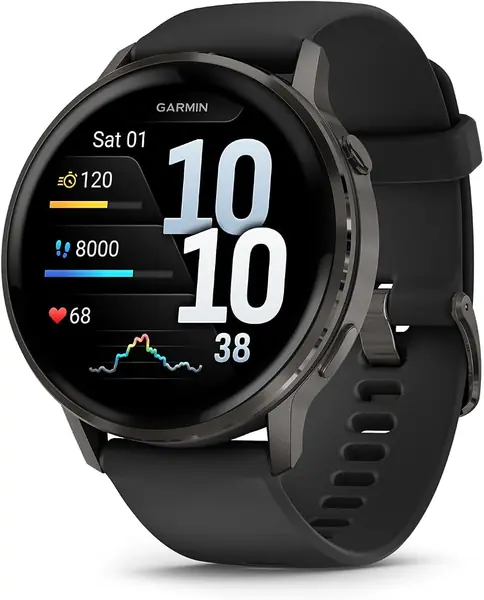
Health status is the Venu 4's headline feature. Instead of handing you one score, it looks for changes across heart rate, HRV, skin temperature, and other signals that can show added stress on your body. The daily behavior log adds another layer: you can note caffeine or alcohol and see how those choices line up with your sleep and stress.

We think that combination is genuinely useful. Plenty of health watches give you a pile of numbers and leave you to work out what changed; the Venu 4 is more interested in the direction of travel. Sleep coaching is similarly practical, with recommendations on how much sleep you need and tips for improving it, rather than a bare score. The result is a watch that explains why your energy dipped instead of just recording that it did.

The 1.4-inch AMOLED display is bright and easy to read, and the stainless steel case looks dressier than the plastic Garmins here. Garmin rates battery life at up to 12 days in smartwatch mode, which makes overnight wear realistic without a daily charging habit. The built-in flashlight is one of those small additions we appreciate more than expected.

For pure health tracking, this is the most complete watch in this group. The health-status layer is what separates it from the cheaper picks, and the lifestyle log gives that data somewhere useful to go.

Pros

  • Health-status tracking watches for meaningful changes
  • Lifestyle log connects caffeine and alcohol to sleep
  • Bright 1.4-inch AMOLED and 12-day battery

Cons

  • Premium price tag
  • 45mm case is large for smaller wrists
Our verdict

We recommend the Venu 4 as the most complete health-tracking Garmin here, with sleep coaching, health-status changes, and a flashlight in one polished watch.
Check Latest Price
2

Garmin Vívoactive 6 Best Value

92 /100
TKZ Score Outstanding

Key details

Display
1.2-inch AMOLED
Battery (smartwatch)
Up to 11 days
Case Size
42mm
Health Features
Body Battery, sleep coach, HRV status
View on Amazon

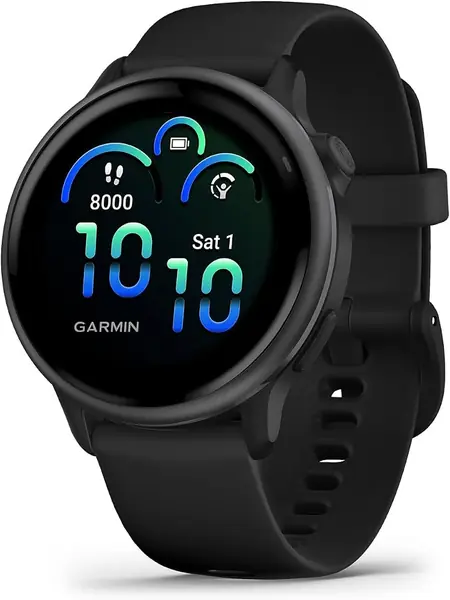
If the Venu 4 sounds like more watch than you need, the Vívoactive 6 is the one we point to first. It keeps the health basics that matter — Body Battery, sleep coaching, HRV status, and stress tracking — in a 42mm case that is easier to live with day and night. You give up the Venu's health-status layer and flashlight, but the core picture is still strong.

We were also struck by the smart wake alarm, which gently vibrates at what Garmin considers an optimal point in your sleep cycle. It makes a health watch feel considerate rather than clinical. The 80 built-in sports profiles and daily suggested workouts give it more range than most people need, and they are easy to ignore if you mainly walk, cycle, or do strength work.

The 1.2-inch AMOLED screen is bright, and the 11-day battery estimate is long enough to wear overnight without turning charging into a daily chore. At 1.3 ounces, it stays comfortable through sleep and long days. We think this is the best balance of health features, size, and price in the lineup, especially for someone who wants the data without a bulky watch.

Pros

  • Body Battery and sleep coaching in a 42mm case
  • Smart wake alarm and 80 sports apps
  • 11-day battery and 1.2-inch AMOLED

Cons

  • Menu system takes time to learn
Our verdict

For most buyers, the Vívoactive 6 is the health watch we point to first, thanks to Body Battery, sleep coaching, and a comfortable 42mm fit.

Check Latest Price
3

Garmin Venu 3S Best for Smaller Wrists

91 /100
TKZ Score Outstanding

Key details

Display
1.2-inch AMOLED
Battery (smartwatch)
Up to 10 days
Case Size
41mm
Calling
Speaker and microphone
View on Amazon

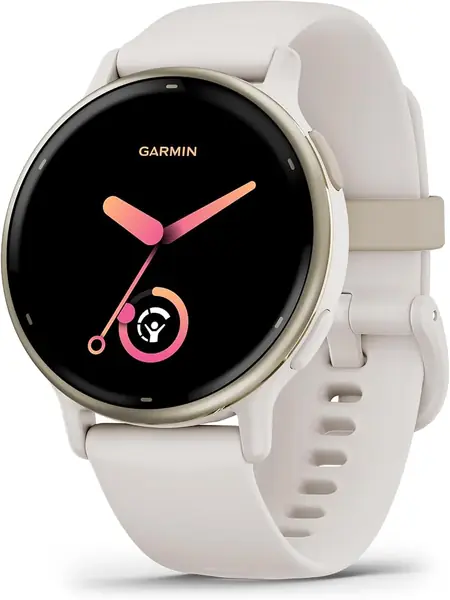
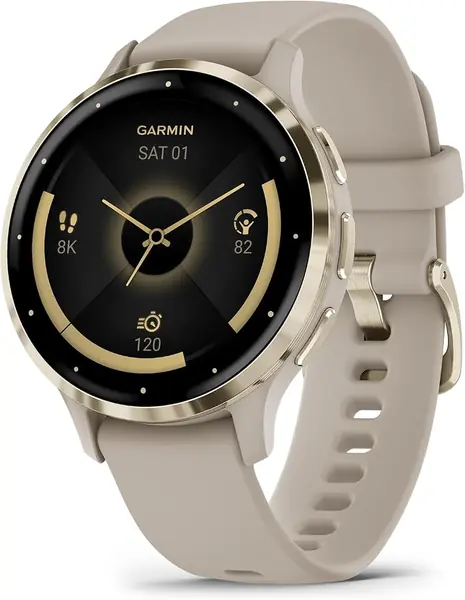
A 41mm case is the first thing that makes the Venu 3S work for smaller wrists. It has a 1.2-inch AMOLED display and weighs 1.4 ounces, so it does not feel like a brick during sleep or a long workday. The soft gold and French gray finish looks more like an everyday watch than a gym gadget.

The health suite is the familiar Garmin mix done well: Body Battery, sleep score and coaching, HRV status, stress tracking, and menstrual cycle tracking. The speaker and microphone are the practical bonus — you can take and make calls from your wrist when your phone is nearby. Garmin also includes a wheelchair mode that tracks pushes rather than steps, which is still rare in this category.

We think the Venu 3S is the pick for anyone who wants full health tracking in a smaller case and values wrist calls. The 10-day battery estimate is the quiet advantage: it lets you keep the watch on through the night without planning around a charger. It is not the newest Venu, but it remains a comfortable, capable health watch.

Pros

  • 41mm case suits smaller wrists
  • Wrist calls through speaker and microphone
  • 10-day battery with full health suite

Cons

  • Phone pairing can be inconsistent
  • Heart-rate accuracy can waver in hard intervals
Our verdict

The Venu 3S is our pick for smaller wrists and anyone who wants to take calls from the watch without giving up Body Battery, sleep coaching, or a 10-day battery.

Check Latest Price
4

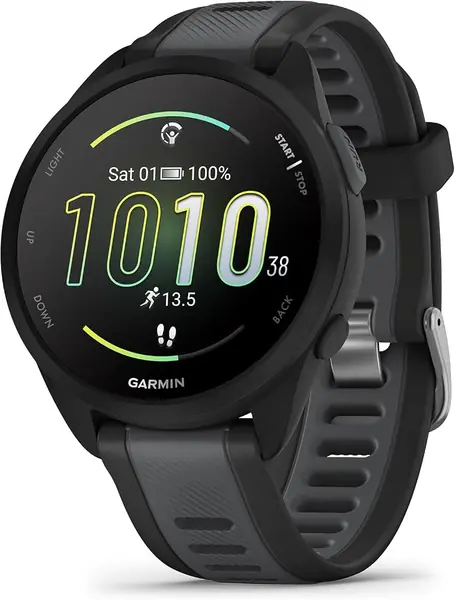
Garmin Forerunner 165 Best for Runners

90 /100
TKZ Score Outstanding

Key details

Display
1.2-inch AMOLED
Battery (smartwatch)
Up to 11 days
Training
Daily suggested workouts, Garmin Coach
GPS Battery
Up to 19 hours
View on Amazon

The morning report is the first thing we check on the Forerunner 165. It gives you sleep, recovery, training outlook, weather, and HRV status in one place before you start the day. For a running watch, that is a useful health briefing rather than a pile of training jargon.

We think the adaptive daily suggested workouts are the real draw. They adjust to your performance and recovery, and Garmin Coach plans add structure if you want a race goal. The 25-plus activity profiles cover cycling, HIIT, strength, and more, but the watch never lets you forget that running is the main event.

The 1.2-inch AMOLED screen is bright and the 43mm case is light at 1.38 ounces. Garmin rates battery life at up to 11 days in smartwatch mode and 19 hours in GPS mode. The GPS estimate of 19 hours is the number that matters for long runs, and it leaves room for a marathon without a mid-run charge.

Pros

  • Morning report bundles sleep, recovery, and HRV
  • Adaptive daily suggested workouts and Garmin Coach
  • Light 43mm AMOLED with 11-day battery

Cons

  • Training-heavy menus take time to learn
Our verdict

We recommend the Forerunner 165 for runners who want a light, bright training watch that still covers sleep, stress, and recovery without the premium price.

Check Latest Price
5

Garmin Instinct 3 Solar Best Battery Life

89 /100
TKZ Score Excellent

Key details

Display
0.9-inch monochrome MIP
Battery (smartwatch)
Up to 28 days
Water Rating
100 meters
Solar Charging
Yes, solar lens
View on Amazon

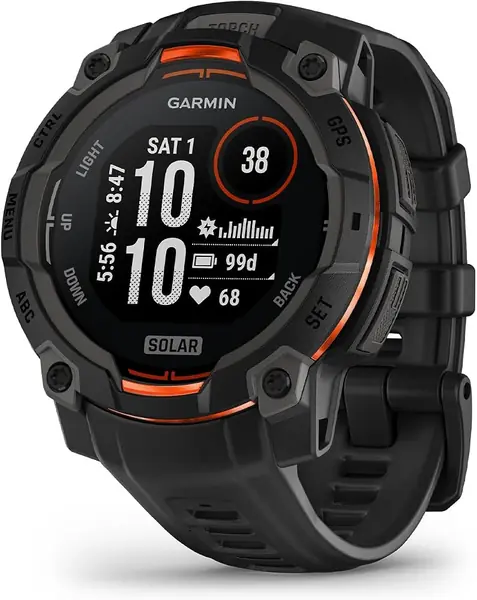
The 28-day battery estimate is the reason the Instinct 3 Solar stands out. With solar charging, it can stretch even further if you spend time outdoors, and that changes the watch from something you charge weekly into something you mostly forget about. We choose it when battery life matters more than a colorful screen.

The rest of the package is built for rough use: a 45mm fiber-reinforced case, a metal-reinforced bezel, 100-meter water resistance, and a built-in flashlight with strobe modes. The 0.9-inch memory-in-pixel display is easy to read in sunlight and sips power. Health tracking covers wrist heart rate, advanced sleep monitoring, Pulse Ox, and stress.

We also appreciate the navigation tools: a 3-axis compass, barometric altimeter, and multi-band GPS with SatIQ. Those are genuinely useful if your health walks or hikes take you off the pavement. The button controls are deliberate and work with gloves. The combination of a flashlight, long battery life, and a tough case makes it feel purpose-built rather than stripped down.

Pros

  • 28-day battery plus solar charging
  • Rugged 45mm build with 100-meter water rating
  • Built-in flashlight and multi-band GPS

Cons

  • Monochrome display lacks color detail
Our verdict

If battery life is the priority, we choose the Instinct 3 Solar for its 28-day estimate, solar charging, and a case that can take a beating.

Check Latest Price
6

Garmin Instinct 3 AMOLED Best Rugged Display

88 /100
TKZ Score Excellent

Key details

Display
1.2-inch AMOLED
Battery (smartwatch)
Up to 18 days
Case Size
45mm
Flashlight
Built-in LED
View on Amazon

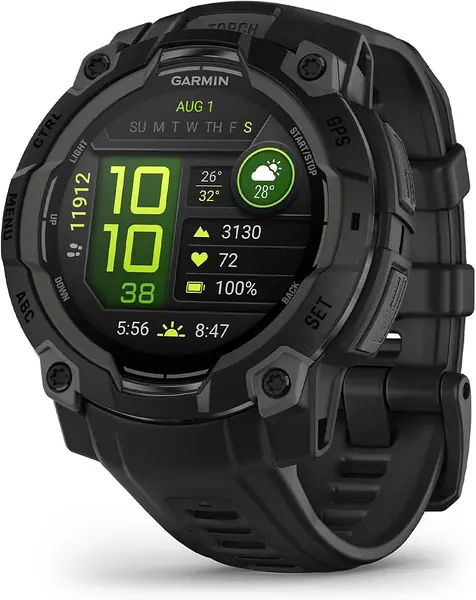
The 1.2-inch AMOLED display is the upgrade that makes the Instinct 3 AMOLED easier to live with. It is bright, colorful, and readable at a glance, with a 1000-nit peak that holds up outdoors. Garmin still rates the battery at up to 18 days in smartwatch mode, so the color screen does not turn this into a nightly charge.

The rest is Instinct DNA: a 45mm fiber-reinforced case, metal-reinforced bezel, 100-meter water resistance, multi-band GPS, a barometric altimeter, and a built-in LED flashlight. Health tracking covers wrist heart rate, advanced sleep monitoring, Pulse Ox, stress, and Garmin's broader wellness metrics. It is a watch you can take hiking, swimming, or into a gym without worrying about it.

We think the AMOLED is the easier Instinct to recommend for daily wear. The screen makes notifications, workout stats, and watch faces more legible, and the flashlight is useful in ways you do not expect until you have it. The display is the part that changes how often you reach for it.

Pros

  • Bright 1.2-inch AMOLED at 1000 nits
  • 18-day battery in a rugged case
  • Built-in flashlight and multi-band GPS

Cons

  • 18-day battery trails the Solar model
  • 45mm case is bulky at night
Our verdict

We like the Instinct 3 AMOLED for anyone who wants the Instinct's tough build and flashlight but refuses to give up a bright, colorful screen.

Check Latest Price
7

Garmin Vívoactive 5 Best Budget

87 /100
TKZ Score Excellent

Key details

Display
1.2-inch AMOLED
Battery (smartwatch)
Up to 11 days
Case Size
42mm
Health Features
Body Battery, sleep coach, HRV status
View on Amazon

The Vívoactive 5 is the lower-cost way into Garmin's health suite in this group. It keeps Body Battery, sleep score and coaching, HRV status, stress tracking, and 30-plus sports apps. Nothing about the health basics feels stripped down.

The wheelchair mode is the detail that makes it more thoughtful than most budget fitness watches. It tracks pushes rather than steps and includes push and handcycle activities, along with preloaded strength, cardio, HIIT, Pilates, and yoga workouts. That is a meaningful inclusion for anyone who uses a chair, and it costs nothing in size or battery life.

The 1.2-inch AMOLED screen is bright and the 42mm case is light at 1.3 ounces, so it works for overnight wear. Garmin rates battery life at up to 11 days in smartwatch mode. The interface is familiar Garmin and rewards a little setup time.

We think this is the right budget compromise. It covers the core health picture without the health-status extras, and the wheelchair mode gives it a purpose beyond shaving cost. It is a lot of health tracking for the money, and the missing extras are the kind you can live without.

Pros

  • Body Battery, sleep coach, and HRV status
  • Wheelchair mode tracks pushes instead of steps
  • 42mm AMOLED with 11-day battery

Cons

  • Always-on display cuts battery to about 5 days
Our verdict

The Vívoactive 5 is the budget pick we trust for Body Battery, sleep coaching, and a wheelchair mode that most rivals here lack.

Check Latest Price
8

Garmin Instinct E Rugged Basics

86 /100
TKZ Score Excellent

Key details

Display
0.9-inch monochrome MIP
Battery (smartwatch)
Up to 16 days
Case Size
45mm
Durability
MIL-STD-810, 10 ATM
View on Amazon

The Instinct E is built for people who want a Garmin that keeps going. Garmin rates the battery at up to 16 days, and the 45mm case is engineered to MIL-STD-810 for thermal and shock resistance with a 10 ATM water rating. At 48 grams, it is heavy enough to feel substantial but not so heavy that it drags on a long hike.

Health tracking is more basic than the Venu or Vívoactive models, but the essentials are here: wrist heart rate, advanced sleep monitoring, Pulse Ox, stress, and hydration. You also get a 3-axis compass, barometric altimeter, and multi-GNSS support, which make it a better trail companion than its price suggests. The 0.9-inch memory-in-pixel display is sunlight-friendly and power-efficient.

The button-only controls are deliberate and work with gloves, though they take more getting used to than a touchscreen. There is no color, but the screen is clear enough for steps, heart rate, and notifications. The watch feels like a tool rather than a gadget, and the display stays readable when the sun is at its worst.

We keep the Instinct E on this list because it strips health tracking back to the parts that matter and wraps them in a case that can take a knock. The 16-day battery and armored build are the argument; everything else is secondary.

Pros

  • 16-day battery with 10 ATM water rating
  • MIL-STD-810 thermal and shock resistance
  • Compass, altimeter, and multi-GNSS navigation

Cons

  • Monochrome display lacks color detail
Our verdict

We keep the Instinct E on this list for simple health tracking, long battery life, and a case that can take a knock without a color screen.

Check Latest Price

How We Tested 10 Health-Tracking Watches

We started by pulling every current health-focused model we could get our hands on, then narrowed to 10 that represent the real spread of the category: small 41mm cases and larger 45mm ones, bright AMOLED displays and solar-assisted screens, polished everyday watches and chunky rugged ones. Price guided the shortlist so we covered the range you'd actually cross-shop, but every watch still had to earn its place on the wrist.

Each one spent at least three weeks as someone's only watch. That meant 24/7 wear — sleeping, showering, washing dishes, through full workdays and weekends of yard work — so durability and appearance were judged in daylight and dishwater rather than under a store lamp. We ran, lifted, hiked, and swam in them, and kept a shared log of scratches, scuffed bezels, and bands that had started to smell.

Battery life got its own routine. We noted the charge percentage every morning, counted the days between charges with the screen always-on and again with it off, and recorded the drain from a one-hour GPS run so we could tell which watches would strand you on a long day out.

For accuracy, we wore a chest strap through the same sessions and compared wrist readings mid-interval, then matched sleep and recovery scores against a written log of how we actually felt — the mornings we slept badly were the real test. Usability came down to setup time, how far we could walk from a paired phone before notifications stopped, and whether the menus made sense without the manual. Value was the last question: whether the extra health features on a pricier watch changed a single decision we made that week.

How to Choose a Garmin Watch for Health Tracking

Start With the Health Data You Will Actually Check

Body Battery, sleep score, stress, and HRV status are the core metrics across this group. The Venu 4 adds health-status changes and a lifestyle log, while the Vívoactive 6 covers the essentials for less. We prioritize sleep and stress trends over a long list of one-off measurements because those are the numbers that change behavior. If you mainly want to know when to rest, Body Battery and sleep coaching matter more than sport modes. If you want to spot broader changes, the Venu 4's health-status layer is the differentiator.

Fit the Case to Your Wrist, Not the Spec Sheet

A 45mm Instinct or Venu 4 can feel fine on a large wrist and like a hockey puck on a small one, especially at night. The 41mm Venu 3S and 42mm Vívoactive models are easier to sleep in. Weight matters as much as diameter: a 48-gram Instinct E feels different from a 1.3-ounce Vívoactive. If you wear it overnight, choose the smaller case unless you know you like a big watch.

Choose a Display and Charging Rhythm

AMOLED screens like the Venu 4 and Instinct 3 AMOLED are bright and colorful, but they use more power. The monochrome memory-in-pixel display on the Instinct 3 Solar is easier on the battery and still readable in sunlight. Garmin's estimates range from 10 days on the Venu 3S to 28 days on the Instinct 3 Solar, and always-on display or long GPS sessions will shorten them. Decide whether you want a weekly charge or a monthly one, then pick the screen that supports that habit.

Decide How Much Training Guidance You Need

The Forerunner 165 is built around daily suggested workouts, Garmin Coach, and recovery insights. The Vívoactive 6 carries 80 sports profiles and daily suggestions without making running the main event. If your goal is sleep, stress, and general activity, a training-heavy watch can add menus you never open. If you run or hike regularly, the extra recovery context is worth the complexity.

Check the Smartwatch Basics and Phone Compatibility

The Venu 3S can take calls through its speaker and microphone, while the Vívoactive and Instinct models focus on notifications and health data. All of these pair with iPhone and Android, but call and message-reply features vary by phone, and pairing can be fussy on some models. Confirm that the features you care about work with your phone before you commit, and check whether contactless payment is part of the model you are considering.

Frequently Asked Questions

Final Verdict

After comparing these watches on health features, fit, and battery life, we recommend the Garmin Venu 4. Its health-status changes and lifestyle logging give you more context than a standard score, and the 12-day battery makes overnight tracking practical.

If you want the core health suite for less, choose the Vívoactive 6; for a smaller case and wrist calls, the Venu 3S is the better fit. The Instinct 3 Solar is the one to take when going weeks between charges matters most.