Best Wired Headphones for Travel of 2026

Wireless earbuds are wonderful right up until the battery quits somewhere over the middle of the country and the seat-back screen keeps right on playing. Wired headphones never do that to you — no pairing, no charging case, no firmware update at the gate. What they do ask is that you pay attention to the parts that actually fail: the cable, the plug, and the pads that press against your ears for six hours straight.

My team and I have spent the past four months with 14 pairs, from featherweight on-ears to folding over-ears with inline mics, and the differences come down to details you can't see in a product photo. The plug matters more than most shoppers expect: a plain 3.5mm jack works with airplane seat-back adapters and older laptops, but plenty of newer phones need a dongle, so check what you're plugging into before anything else. Clamping force is the other one — a pair that feels fine for a podcast will ache by hour three of a flight. Here are the ones that held up through a full travel season.

The Best Wired Headphones for Travel

1

Sony MDR-ZX110 Best Overall
91 /100
TKZ Score Outstanding

Key details

Weight
4.76 oz
Cord Length
3.94 ft
Ear Placement
On-ear
Plug
L-shaped 3.5 mm
View on Amazon

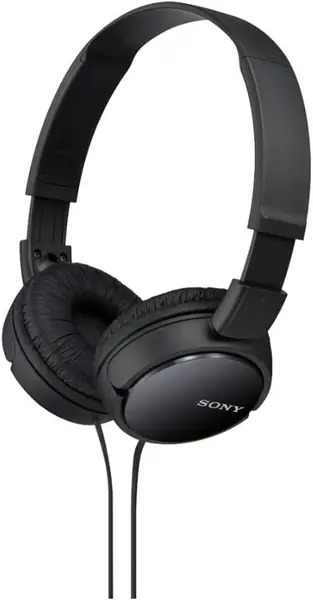
Swivel both cups flat and the Sony MDR-ZX110 turns into a package about the size of a paperback. That's the move that earned it the top spot here: at 135 grams it disappears into a backpack's laptop sleeve, and the closed-back cups do the noise blocking on their own, with no battery, no charging cable, and nothing to pair.

Nothing about the design is fussy, which suits a travel set. The headband slides wide, the cups rotate far enough to sit flat against your collarbone when the headphones hang around your neck, and there's no case, no dongle, and no manual to keep track of. Sound is the surprise: the low end has real weight and voices stay clear even with the volume down, which is how most people actually listen on a plane.

What settles it for us is the plug. It's L-shaped, so it sits down against an armrest jack instead of standing straight up where a tray table or a knee can catch it, and 24-ohm impedance means a phone or an older seat-back system drives it without strain. Of everything here, this is the set that gets the most travel details right for the money.

The honest caveat is build. The hinge and the cable are where these wear out, and the plastic cups won't shrug off a week at the bottom of a duffel. That's the trade for a pair cheap enough to replace without a second thought, and for a set that lives in a bag, it's a trade worth making.

Pros

  • Swiveling cups fold flat in a bag
  • 135 g, light enough to forget in a backpack
  • L-shaped plug sits down at an armrest jack
  • Sound and price beat the rest of this group

Cons

  • No microphone or in-line remote
  • On-ear pads press after a couple of hours
Our verdict

Buy this one unless a long-haul flight or a bigger pair of ears says otherwise; nothing else here gets the travel details right for the money.
Check Latest Price
2

Sony MDR-ZX110NC Best with Noise Cancellation

90 /100
TKZ Score Outstanding

Key details

Weight
5.29 oz
Folding
Swivel and fold
Battery Life
Up to 80 hours
Noise Control
Active noise cancellation
View on Amazon

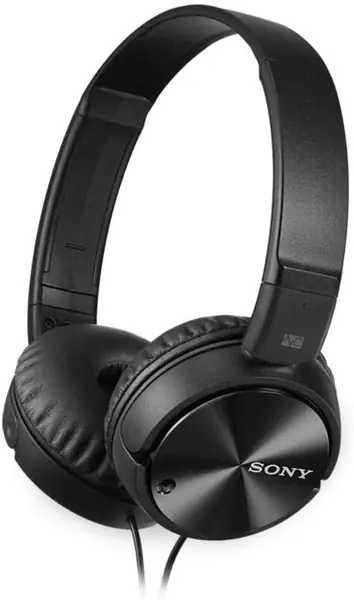
Take the MDR-ZX110, add a switch and a battery, and you get the MDR-ZX110NC — the only set here that cancels noise actively rather than by sealing your ears. The cable still carries the audio; the battery only runs the electronics, and it's rated for up to 80 hours, so a spare set of cells covers a long trip. For a flight, that's the feature worth paying for: the drone drops and you can listen at a lower volume.

Modest is the right word for the cancellation. It handles the constant sounds — engines, air conditioning, road noise — better than it handles voices a row away, and on a short hop you may wonder whether the switch is doing anything. On a long-haul flight the difference shows up late, in the last couple of hours, when the noise normally starts to grind you down.

The trade is a battery to remember and a little more weight — 5.29 ounces against the plain ZX110's 135 grams — though the cups still swivel flat into the same slim package. If you fly twice a year and mostly listen to podcasts, the corded version does the job for less. If the flight is the reason you're shopping, this is the one to pack.

Pros

  • The only active noise cancellation in this group
  • Up to 80 hours on a battery
  • Swivel and folding design still packs flat

Cons

  • Cancellation is modest, especially on voices
  • Ear pads and hinges are the wear points
Our verdict

Pack this one if the flight itself is the problem: it's the only set here that cancels noise actively, and it still folds flat.

Check Latest Price
3

JBL Tune 500 Best for Packing

89 /100
TKZ Score Excellent

Key details

Ear Placement
On-ear
Cable
Tangle-free flat
Design
Foldable
Remote
1-button remote and mic
View on Amazon

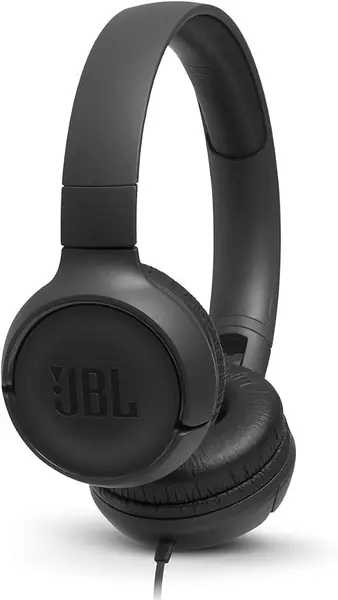
The cable on the JBL Tune 500 is flat rather than round, and that's the detail we noticed first: flat cable doesn't coil into knots and it doesn't hold the shape of however it was last folded. The cups fold flat on their hinges as well, so the set drops into a tote or a seat pocket without a case.

The tuning is the bigger reason it earns a place. JBL pushes the bass forward, which suits the thin, compressed audio from a seat-back system better than a flat, accurate tuning would, and low end is the first thing to vanish on a noisy flight. We also appreciated the single button that wakes Siri or Google — a small thing until you're juggling a bag and a boarding pass. For a set with no battery, no app, and nothing to configure, it does a lot.

The flat cord is the part to watch: flat cables crease where they meet the plug, and that's the failure point on any budget set, so coil it loosely instead of wrapping it around a phone. Beyond that there's very little to manage here — no charging, no pairing, no case — which is exactly what you want from something that lives in a bag.

Pros

  • Flat cable resists tangling in a bag
  • Folds flat without a case
  • One button reaches calls and voice assistants

Cons

  • Single-button remote can't change volume
Our verdict

Buy this if you want a set that packs itself into a tote and handles thin in-flight audio better than a flat-tuning pair would.

Check Latest Price
4

JVC HAS160B FLATS Best Ultralight

88 /100
TKZ Score Excellent

Key details

Weight
2.33 oz
Ear Placement
Flat on-ear
Driver
30 mm
Frequency Response
12–24,000 Hz
View on Amazon

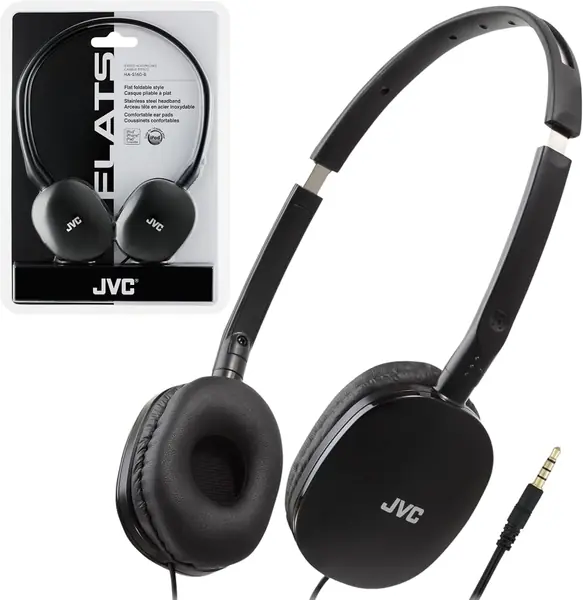
Sixty-six grams is the number to hold onto. The JVC HAS160B FLATS is the lightest set in this group by a wide margin — less than half the weight of the noise-canceling Sony — and that's why it's the pair we pack when we don't want to think about what's on our heads. The flat cups sit against the ear rather than around it, and the thin band slides into a jacket pocket.

Lightness usually costs something in sound, and here it costs a little bass. The 30 mm drivers and the 12 Hz to 24 kHz range look ordinary on paper, but speech is where these shine: podcast voices and audiobook narration come through crisp and easy to follow at low volume, which is most of what travel listening really is. Music built around low end is where the compromise shows.

Pros

  • 66 g, the lightest set here
  • Clear speech at low volume
  • Flat cups pack thin in a jacket pocket

Cons

  • Headband joint is the weak point
  • Runs tight on larger heads
Our verdict

Take this if weight is what bothers you most on a trip; at 66 grams it's the pair you forget you're wearing and barely notice in a bag.

Check Latest Price
5

COOSII AC01 Best for Long Listening Sessions

87 /100
TKZ Score Excellent

Key details

Warranty
1 year
Driver
40 mm
Ear Pad Opening
3.54 x 1 in
In-line Controls
Volume and mic
View on Amazon

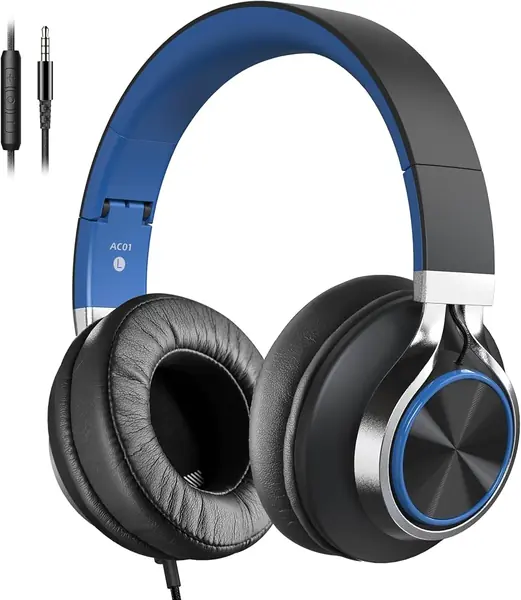
The ear pads on the COOSII AC01 measure 3.54 by 1 inch, the largest opening in this group, and that number is what you feel four hours into a flight: your ears sit inside the cup instead of being pressed by it. The set folds, the headband adjusts, and it ships with a storage bag — the only one here that does.

For a long flight, that coverage is the reason to choose these over any on-ear set here. Isolation is passive and decent rather than dramatic: the drone drops, it doesn't vanish. The in-line volume buttons and microphone make this the pick if you'll be taking calls from a hotel room as well as watching films, and the 40 mm drivers give music more body than the cheapest sets in this guide manage.

Pros

  • Widest ear pads in this group
  • Volume buttons and microphone on the cable
  • Folds with a storage bag included

Cons

  • Hinge and headband are the wear points
Our verdict

Choose these when the flight is long and your ears need room; the wide pads and in-line controls do more for a nine-hour leg than anything smaller here.

Check Latest Price
6

KVIDIO Wired Headphones Best for Teens and Spares

86 /100
TKZ Score Excellent

Key details

Warranty
6 months
Cord Length
4.9 ft
Plug
120° curved 3.5 mm
Cable
Nylon braided
View on Amazon

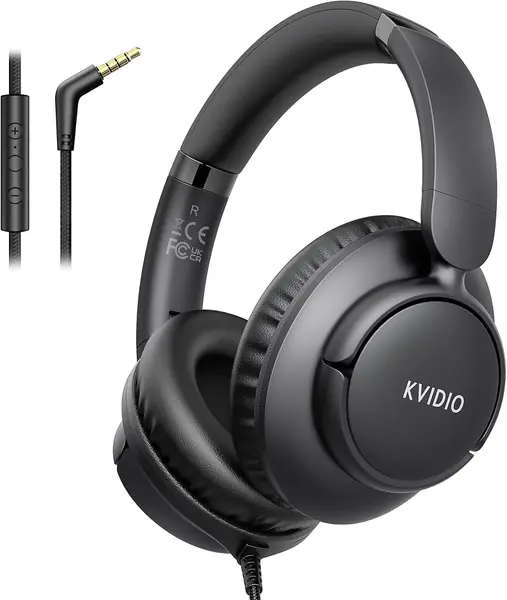
A 4.9-foot braided cord is the longest here, and it's the reason the KVIDIO works in an economy seat: there's enough slack to get the headphones on, plug into the seat-back jack, and still reach down for a bag.

The rest is sensible rather than special. The cups rotate to lie flat, the headband extends for a bigger head, and the 120-degree curved plug angles down out of the jack instead of jutting straight out where a knee can catch it. A microphone in the cable handles calls and classroom video, and the whole thing folds into a backpack without a case.

There's nothing premium here and it doesn't pretend otherwise. What you're buying is a foldable over-ear set with a long cord, a microphone, and controls you can find by feel, at a price that makes it a spare rather than an investment. For a teenager's backpack or a second pair that stays in a suitcase, it's the easiest call in this guide.

Pros

  • 4.9-foot braided cord gives real slack
  • Rotating over-ear cups fold flat
  • Microphone in the cable for calls

Cons

  • In-line volume doesn't work with some laptops
  • Six-month warranty
Our verdict

Buy these for a teenager or as a second pair that lives in a suitcase: long cord, real over-ear cups, and a price that makes losing them survivable.

Check Latest Price
7

Koss KPH7 Emergency Backup

85 /100
TKZ Score Excellent

Key details

Weight
2.88 oz
Warranty
Lifetime
Cord Length
4 ft
Frequency Response
80–18,000 Hz
View on Amazon

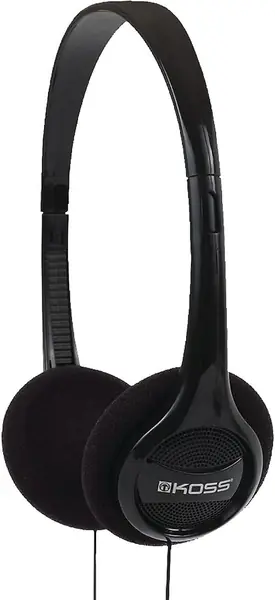
A lifetime warranty on the least expensive set here is the whole pitch of the Koss KPH7. These are the headphones you leave in a glove box, hand to a kid, or take as the pair that doesn't ruin a trip if it gets left in a hotel room — and if the wire goes, Koss backs it for life.

Sound is the compromise. The frequency range stops at 80 Hz at the bottom, which is high for a headphone and audible: bass lines lose their weight and dense mixes flatten out. For spoken word — audiobooks, podcasts, a movie on a tablet — that matters far less than it does for music, which is exactly the role this set fills.

Fit is snug on a bigger head, and the band bends rather than sliding on a track, so a gentle stretch over a couple of days is the adjustment. It's a 4-foot cord with a straight plug, which is fine at a laptop and a little short if you're passing the headphones to someone in the next seat.

Buy it for what it is: an emergency pair that handles speech well, costs almost nothing, and carries a guarantee that outlasts the trip and probably the phone you plug it into. For music on a long flight, spend more. For a set you won't mourn, this is the one.

Pros

  • Lifetime warranty
  • Light enough to leave in a bag
  • Good for speech and audiobooks

Cons

  • Foam pads come off with use
  • Bass is thin next to the rest of the group
Our verdict

Keep a pair as the spare that doesn't matter — the lifetime warranty and low cost outweigh thin bass and snug fit for speech and emergencies.

Check Latest Price

How We Tested Wired Headphones for Travel

We started by rounding up every wired model we could find with a standard 3.5mm plug — on-ear and over-ear, folding and fixed — then crossed off anything without an inline remote or volume control, since digging for your phone mid-flight defeats the purpose of a wired set. We also dropped models whose cables weren't flat or reinforced at the plug, a detail that predicts how long they'll last in a bag. That left 14 pairs, which we lived with for four months.

Each pair flew at least two round trips, rode a commuter train at rush hour, and handled a week of ordinary desk work and evening walks. We wore them in three-hour stretches and wrote down when the headband started to press and whether our ears got hot. Every time they went into a backpack we folded the hinges and coiled the cable the way a hurried person actually would, and we tugged each cable at the plug to see if the signal crackled.

For noise, we compared how much of a jet cabin's low drone disappeared with cancellation switched on versus off, and noted which pairs simply sealed better thanks to pad shape. Volume controls got tested with a thumb in a jacket pocket and, once, with gloves on. At the end we weighed what each pair promised against what it still was after four months of daily handling — pads intact, hinges tight, cable still passing signal.

How to Choose Wired Headphones for Travel

Start With the Jack

Every set here ends in a 3.5 mm plug, and that's the reason to buy corded headphones for travel: no pairing, no charging, and a direct line into a seat-back screen. The catch is at your end of the cable. Most current phones have dropped the headphone jack, so if yours has, add a USB-C or Lightning adapter and keep it attached to the cord so it doesn't vanish into a seat pocket.

Laptops are their own puzzle. A combo jack accepts a headset plug with mic; older machines split audio and microphone into two ports and need a splitter before the microphone in the cable will work.

On-Ear or Over-Ear for a Long Flight

Coverage matters more than driver size once you're a few hours in. Over-ear cups surround the ear and spread the clamp across a wider area — the COOSII AC01 has the widest opening here, at 3.54 by 1 inch. On-ear sets like the Sony MDR-ZX110 rest against the ear itself and win on packed size.

Our rule: on-ear for a short flight and a small bag, over-ear for anything past four hours. If you wear glasses, the arms sit under an on-ear pad and start to ache sooner, which is worth knowing before a nine-hour leg.

What a Folding Hinge Buys, and What It Costs

A hinge is what makes a headphone portable. The Sony MDR-ZX110's swiveling cups and the JBL Tune 500's flat-fold design both shrink a set to something you can drop in a tote. The trade is mechanical: every hinge, slider, and rotating cup is a place where budget plastic fails, and the joint usually goes before the driver does.

If you prefer not to think about it, a fixed-band set like the JVC HAS160B FLATS has fewer moving parts to lose — it packs small by being thin rather than by folding.

How Much Noise Cancellation Is Worth Paying For

Active cancellation needs power, and in a wired set that means batteries living beside the cable. The Sony MDR-ZX110NC is the only active model here, rated for up to 80 hours, and it earns its keep on engine drone rather than conversation. Closed cups do more than most people expect on their own: a sealed set takes the edge off a cabin with no electronics at all.

For short, mostly urban trips, put the difference into fit and a lighter bag instead.

Read the Cord and the Warranty

Length and plug shape decide how a set behaves in a seat. The KVIDIO's 4.9-foot braided cord gives you slack to move; the Sony MDR-ZX110's 3.94-foot cord keeps you tidy and tethered. An L-shaped or curved plug angles down out of the jack, which is the shape we prefer anywhere a tray table or a knee comes close.

Warranty length is the quiet specification. Koss covers the KPH7 for life and KVIDIO covers theirs for six months, and that gap tells you something about how each maker expects the joint and the cable to hold up.

Frequently Asked Questions

Final Verdict

The Sony MDR-ZX110 is what we hand most travelers: 135 grams, cups that swivel flat into a bag, an L-shaped plug that behaves at a seat-back jack, and sound that embarrasses its place at the bottom of the price range. If a long-haul flight is the main event, the Sony MDR-ZX110NC adds modest active cancellation and up to 80 hours on a battery.

And if you want to forget you're wearing anything at all, the 66-gram JVC HAS160B FLATS is the lightest thing here — just accept that bass goes missing first.