Best Wall Chargers for Phones of 2026

Waking up to a phone still sitting at 40 percent is its own small betrayal — the charger was shared, the cable worked loose, the brick was the one that came in the box years ago. A wall charger is the least exciting item on your list, right up until four devices are fighting over one outlet. The right block fixes that quietly: fewer bricks, less cable clutter, and a full battery by the time your alarm goes off.

My drawer is full of chargers that promise fast charging and don't deliver. Over four months, my team and I kept 14 of them plugged in around the clock, and the pattern is clear: wattage gets shared across ports, so a five-port brick can top up a tablet more slowly than a two-port one with a smarter split. Port count, speed, and size all pull against each other.

The picks below land on both sides of that tradeoff — some for a single phone on a nightstand, some for a counter where a phone, tablet, earbuds, and a watch all land at once. A few come in two-packs, which matters if one of them is going to live in your bag.

The Best Wall Chargers for Phones

1

Anker Zolo 50W 4-Port Charger Best Overall
96 /100
TKZ Score Outstanding

Key details

Max Output
50W
Pack Count
2
Ports Per Block
4 (2 USB-C, 2 USB-A)
Plug
Foldable prongs
View on Amazon

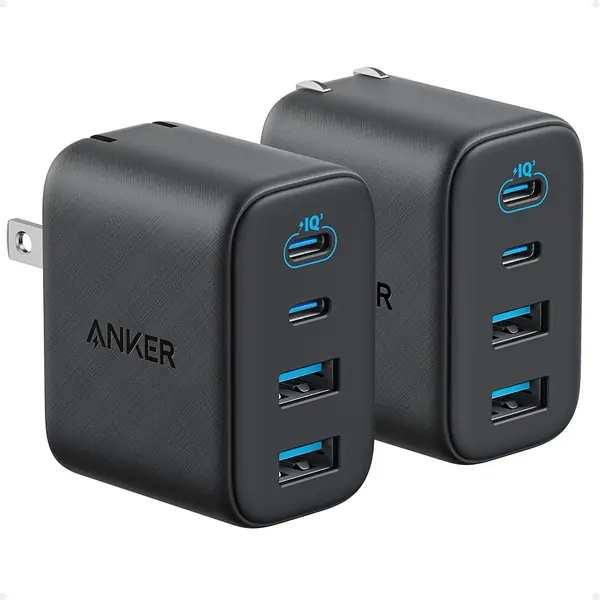
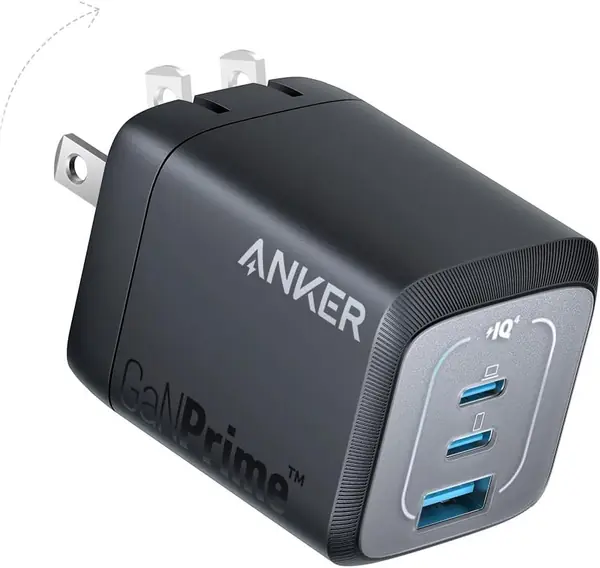
Two blocks, four ports each, and 50 watts to share — that's the short version of the Anker Zolo, and it's why it's our top pick. Each block has two USB-C ports and two USB-A ports, so a new phone and an old Lightning cable can live on the same outlet. The 50W is the entire budget: USB-C1 holds 30W while USB-C2 takes 20W, enough to fast-charge a phone and top up a tablet together. The USB-A pair gets what's left, which is the right job for it — earbuds, a watch, a controller.

Size is the other half of the story. With the prongs folded, a block disappears into a jacket pocket or the front pocket of a backpack. Foldable prongs matter more than they sound: a fixed-prong block rolling around in a bag is a scratched screen waiting to happen. The input is rated to 240 volts, so a trip abroad costs you a plug adapter and nothing else, and it runs no more than warm with two phones charging at once.

Fifty watts won't carry a laptop, so if a MacBook or a large tablet is part of your daily carry, the Prime 67W below is the better travel block. For phones, tablets, and earbuds, the Zolo covers a whole household: one block on the nightstand, one in the bag, and the kitchen outlet stops being a negotiation. Anker's 18-month warranty and continuous temperature monitoring are the quiet reasons it costs more than the no-name multipacks.

Pros

  • Four ports on each of two blocks
  • Holds 30W while a second device charges
  • Prongs fold and the body is pocket-sized

Cons

  • USB-A ports only get leftover power
  • 50W total rules out laptop charging
Our verdict

Our default recommendation for most people: two blocks, four ports apiece, and enough power to fast-charge a phone with a second device attached.
Check Latest Price
2

Anker Prime 67W 3-Port Charger Best for Traveling With a Laptop

94 /100
TKZ Score Outstanding

Key details

Max Output
67W
Total Ports
3 (2 USB-C, 1 USB-A)
Plug
Foldable prongs
Weight
5.12 oz
View on Amazon

Sixty-seven watts used to mean a brick the size of a deck of cards. Anker's Prime is 51% smaller than Apple's original 67W MacBook charger, and that's the first thing you notice — small enough for a jacket pocket, dense enough in the hand that its five ounces are obvious. Two USB-C ports and one USB-A sit on the front. One device can draw the full 67W; two devices share up to 65W.

This is the one we take when a laptop comes along. A MacBook Air pulls what it needs from one USB-C port while a phone fast-charges from the other, and two chargers have become one — which matters most in a hotel room with a single free outlet. For phones alone it's more power than you can use, since no phone will take anything close to 67W, so the Zolo does that job for less. Buy this one for the laptop.

Two details earn their keep. The prongs fold, so it travels without snagging a cable or a screen, and Anker's ActiveShield monitoring runs continuously rather than only at startup. The weight cuts both ways: five ounces in a worn outlet or a loose power strip can sag and lose contact, so give it a wall outlet rather than the strip under your desk.

Pros

  • Retires a laptop charger on trips
  • 67W in a body 51% smaller than Apple's
  • Prongs fold for travel

Cons

  • Only one USB-A port
Our verdict

If a laptop travels with you, this is the block to take — 67W, three ports, and a body barely bigger than a phone charger.

Check Latest Price
3

Auorld 60W 5-Port Charger Best for a House Full of Devices

93 /100
TKZ Score Outstanding

Key details

Max Output
60W
Pack Count
2
Ports Per Block
5 (3 USB-C, 2 USB-A)
View on Amazon

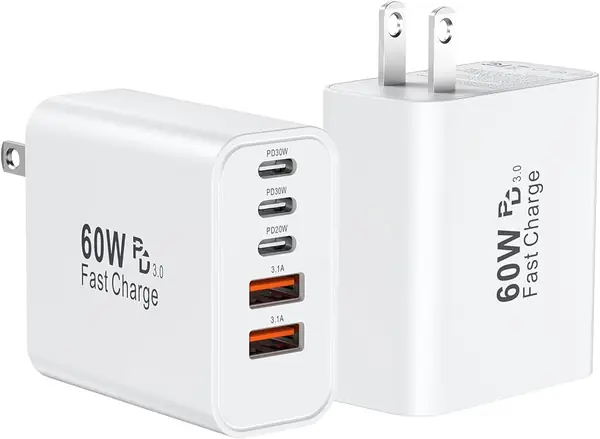
More ports for less money than our top pick is the Auorld's pitch: two blocks, five ports each — three USB-C and two USB-A — for less than the Zolo two-pack. Count ports per dollar and nothing else here comes close. Sixty watts is the catch, because that total gets divided five ways.

The USB-C ports are where the speed lives. A USB-C to USB-C connection charges a phone quickly; move the same phone to one of the USB-A ports and it drops back to ordinary charging, a pattern worth planning around rather than discovering at bedtime. We also like that two blocks means two rooms — one on the desk with the monitor and tablet, one in the kitchen where everyone dumps a phone at dinner.

Treat the 60-watt figure as a ceiling for the block, not a promise for each port. With three or four devices attached everything slows, and a phone that fast-charges alone will trickle along with company. That's the trade for one outlet doing the work of five, and it's fair if your devices are mostly overnight chargers. The two-year guarantee is the longest of any pick here, which counts for a block that will sit on a desk for years.

Pros

  • Five ports on each of two blocks
  • USB-C ports fast-charge phones
  • Two-year guarantee

Cons

  • 60W is shared, so speed drops with several devices
  • USB-A ports are much slower than USB-C
Our verdict

For a house with more devices than outlets, we point here: ten ports across two blocks, with the speed concentrated where phones can actually use it.

Check Latest Price
4

Aioneus 40W 4-Port Charger Best Budget Pick

92 /100
TKZ Score Outstanding

Key details

Max Output
40W
Total Ports
4 (2 USB-C, 2 USB-A)
USB-C Output
20W max
Safety Listings
CE, FCC, RoHS
View on Amazon

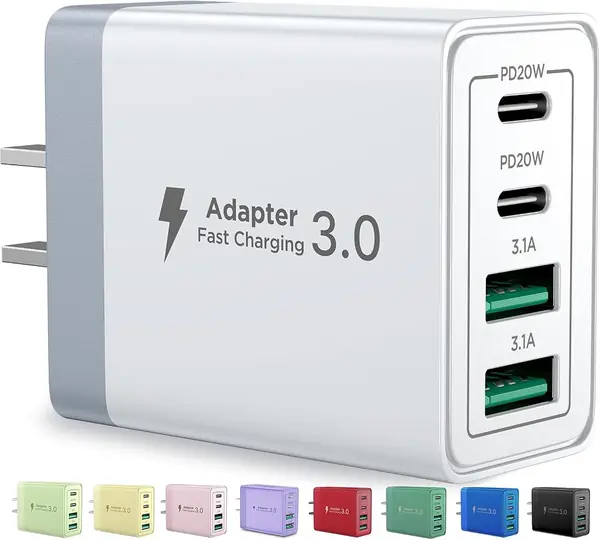
The Aioneus is the least expensive single block here, and it still gives you four ports — two USB-C and two USB-A — in a cube narrow enough to leave the next wall socket usable. The USB-C port tops out at 20W, which is exactly what an iPhone wants for fast charging, and 40W is the total for the block. For a kitchen counter or a spare bedroom that's plenty, and we like that the price lets you put one in each without thinking about it.

Add a second device and the arithmetic changes. Forty watts split between two phones is fine; across three or four it's a trickle, and the port that was fast becomes ordinary. It's also light enough that a hard yank on a cable can pull it partway out of the outlet, so pull from the plug rather than the cord.

The part to watch is longevity. Ports are the first thing to go on budget charger blocks, and this one is no exception — some units stop charging on one port after a few months. That isn't a reason to skip it at this price. It is a reason to treat it as the second or third block in the house rather than the one your morning alarm depends on.

Pros

  • Four ports for the least money here
  • 20W USB-C port fast-charges iPhones
  • Narrow body leaves the next outlet free

Cons

  • Ports can stop charging within months
  • Slows to a trickle with three or four devices
Our verdict

The cheapest way to get four ports on one outlet, and a sensible charger block for a kitchen counter or a spare room.

Check Latest Price
5

Karhood 60W 5-Port Charger One Busy Desk Outlet

91 /100
TKZ Score Outstanding

Key details

Max Output
60W
Pack Count
1
Total Ports
5 (3 USB-C, 2 USB-A)
Safety Standard
ETL
View on Amazon

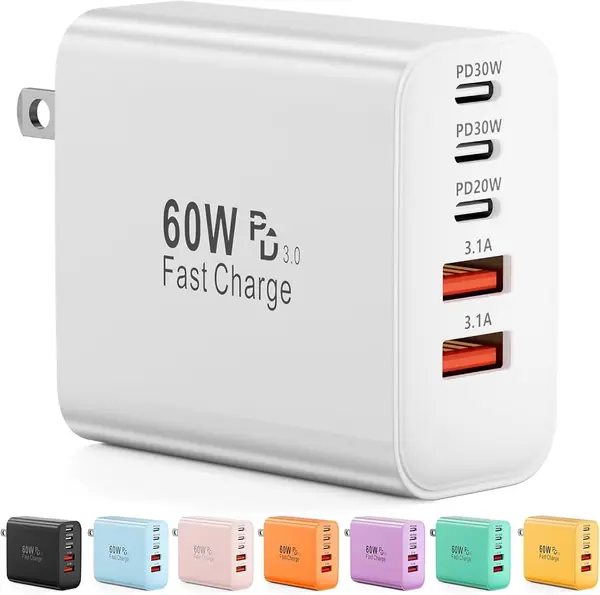
Karhood's charger block carries five ports — three USB-C and two USB-A — and 60 watts to share between them. It's a single block, not a pack, so the math differs from the Auorld: you're buying one fixture for the outlet by the couch rather than a charger for every room. It also comes in colors beyond white, a small thing that matters when the block is at the bottom of a bag.

The prongs are fixed, so this one stays in the wall. That's the right call for a block with five cables running out of it and the wrong one for travel — pack a folding block instead. With one or two devices attached, a USB-C port charges a phone quickly. With four or five attached, everything divides the 60W and slows, so keep the USB-C ports for phones and tablets.

Where it wins is the messy outlet behind a desk. Three USB-C ports mean you aren't rotating cables between a phone, a tablet, and headphones, and the lack of a multi-pack isn't a problem when you only need one. The ETL listing and one-year warranty put it a step above unbranded blocks at the same money, and we think it looks better than most of them doing it.

Pros

  • Five ports, three of them USB-C
  • Color options beyond plain white
  • ETL listed with a one-year warranty

Cons

  • Fixed prongs make it a wall fixture, not a travel charger
  • Speed drops once several devices are plugged in
Our verdict

A fixed five-port fixture for the outlet behind your desk, and the only pick here that comes in colors.

Check Latest Price
6

Dulums 40W 4-Port Charger Best for Guest Rooms and Spare Bags

90 /100
TKZ Score Outstanding

Key details

Max Output
40W
Pack Count
2
Ports Per Block
4 (2 USB-C, 2 USB-A)
View on Amazon

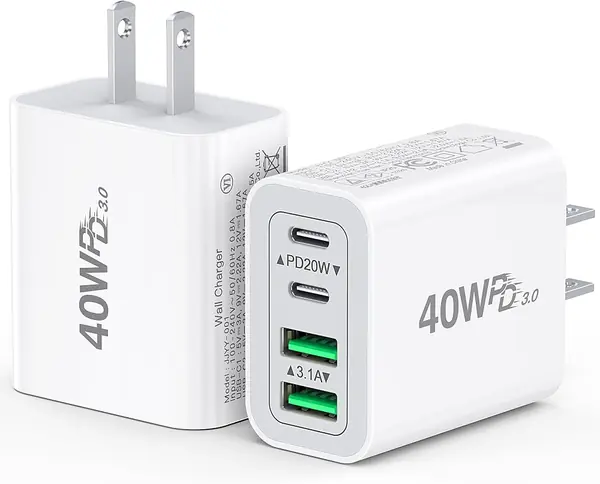
Nothing about the Dulums blocks is meant to be admired: white plastic, a plain cube, two USB-C ports and two USB-A ports on the face. What they are is two of them in one box, each with four ports and 40W to divide, for less than a lot of single blocks cost. That's the entire pitch, and for the right buyer it's enough.

Forty watts across four ports decides how you use it. One device at a time gets a quick charge, two is reasonable, and four is a slow overnight top-up for everything. Plan on the USB-C ports for phones and leave the USB-A pair for earbuds and older gear, and the block behaves predictably rather than surprising you.

Our take is to buy these for the places a charger disappears — the guest room, the beach bag, the drawer at the office — and keep a better block for the outlet you use every day. Two of them means one can live in a bag without emptying a room of its charger, a problem a single-block purchase never solves. A one-year warranty covers the obvious worry.

Pros

  • Two four-port blocks in one box
  • USB-C and USB-A on each block
  • One-year warranty

Cons

  • 40W is shared across four ports
Our verdict

We treat these as the blocks to scatter — four ports each, two in the box, for the rooms where a charger always goes missing.

Check Latest Price

How We Tested the Best Wall Chargers

We started with the multiport blocks that keep surfacing in customer reviews and on store shelves, then filtered out anything under 30 watts or with only a single port. What stayed was a spread of port mixes — two-port cubes up to five-port bricks — plus a few two-packs, since that's how a lot of these are sold. That left 14 chargers, which we put into rotation for four months.

Each one lived in three places: the nightstand for overnight charging, the kitchen counter where the whole household's devices land at once, and my backpack on work trips and weekend travel. To measure speed instead of trusting the label, we ran a USB power meter in line and logged wattage every 10 minutes through a charge on the same phone. Then we filled every port at once — phone, tablet, earbuds, watch — and watched the meter to see how much power each device actually got.

Weight got checked on a kitchen scale, and we noted whether a block sagged in a loose outlet or pulled free when we tugged the cable. Durability was the unglamorous part: months of plugging, unplugging, wrapping a cable around the block, and tossing it in a bag, then checking whether the prongs or the housing had loosened and how warm the case ran under a full load. We also wrote down what came in the box, because a cheap brick that needs a separate cable isn't the bargain it looks like.

How to Choose a Wall Charger for Your Phone

Count Ports Before You Count Watts

Start with what you charge overnight. A phone, a watch, and earbuds means three ports, and at least two of them should be USB-C, since that is the connector every phone sold now uses. The USB-A ports still earn their place for older cables and for guests who arrive with a Lightning cord. More than four ports on one block only helps if you accept slower charging for everything plugged in at once, so buy the count you actually use, not the biggest number on the shelf.

What the Wattage Number Really Means

A 60W label describes the block's total output, not what your phone receives. Around 20W is where most phones hit their fast-charging ceiling; 30W or more buys headroom for a tablet or a laptop, not a faster phone. The figure that matters day to day is what stays available when something else joins, which is why the Zolo's 30W-plus-20W split works with two phones attached while a five-port block marked 60W can leave each one with a trickle.

Match the Plug to Where the Block Lives

Foldable prongs are for the bag; fixed prongs are for the wall. If the charger travels, folding prongs keep it from snagging cables and scratching a screen. If it stays put, a fixed plug seats more firmly in an outlet that already has five cables pulling at it. The trap is the word compact: it describes the body, not the footprint, and a wide block can still cover the second socket. Weight matters too — a five-ounce charger will sag out of a worn outlet, so give it the wall rather than the strip under your desk.

Shop for the Second Year, Not the First Week

The usual way a cheap charger fails is undramatic: one port stops responding, or the block starts running hot and gets retired. Look for a stated safety listing such as ETL, UL, or FCC and a warranty longer than a year — Anker's 18- and 24-month coverage and Auorld's two-year guarantee are the strongest in this group. Two blocks from a brand that will replace them beat five unbranded ones that will not. If a block ever gets too hot to hold comfortably, stop using it.

Frequently Asked Questions

Final Verdict

Most people should buy the Anker Zolo two-pack and stop looking. Four ports per block, folding prongs, and a 30W/20W split mean a phone, a tablet, and a pair of earbuds all get charged without anyone waiting, and the second block solves the bag-versus-bedroom problem outright.

If a laptop is in your daily carry, the Anker Prime 67W is the one that retires another charger. And if you simply need a spare outlet covered for as little as possible, the Aioneus four-port cube does it without asking much of you.