Best GaN Travel Chargers of 2026

There's a particular moment every traveler knows: it's nearly midnight, the hotel room has exactly one reachable outlet, none of your prongs fit it, and three devices are under five percent. A good GaN charger ends that negotiation — one small brick, the right plug for wherever you landed, and enough output to run a laptop and a phone at the same time.

The catch is that the big number on the box is the total across all ports, not what each one gets. Split 65 or 100 watts between a laptop, a tablet, and a phone and the allocation can shift in ways the packaging never explains. The word "adapter" is slippery too: some simply pass the wall's current through to a different socket shape, while others are real chargers with their own USB-C circuitry. If you want a lighter bag, you want the second kind.

We've spent the past nine months living with 10 of these, on long-haul flights, at kitchen counters, and in far too many hotel rooms. Weight, warmth, and whether the plug stays put in a loose outlet turned out to matter as much as raw wattage. The ones that held up are below.

The Best GaN Travel Chargers

1

MOMAX 70W GaN Universal Travel Adapter Best Overall
94 /100
TKZ Score Outstanding

Key details

Total Output
70W
Ports
3 USB-C, 2 USB-A
Weight
6.35 oz
Plug Types
Type A, B, C, G, I
View on Amazon

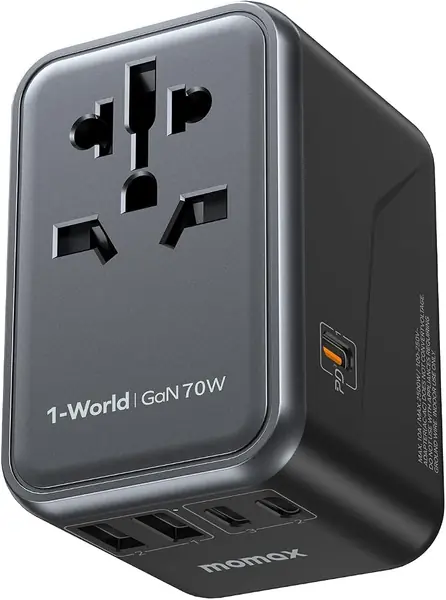
Type A and B for the US and Japan, C for most of Europe, G for the UK, I for Australia — four plug types slide out of one body, so the pouch of adapters stays home. That stack is why this one leads our list. A single outlet in Rome, London, or Sydney charges a laptop and two phones with nothing else in your bag.

Seventy watts over USB-C is the number that matters on a work trip: enough to run a 13-inch laptop at full speed, with two more USB-C ports and two USB-A ports left for phones, earbuds, a watch, and a camera. Fill everything and the MOMAX splits the total, as any charger this size does, but nothing drops to a trickle that would ruin an overnight charge.

At 6.35 ounces and about three inches across, it's a pouch charger rather than a pocket one, and the plug hardware inside is what you're buying in that size. The protection is a 10A dual fuse rather than a surge circuit, which is also what keeps it welcome in a cruise cabin rather than confiscated at the terminal.

The ceiling is 70W, and that's the one place it comes up short — a 16-inch MacBook Pro will top up slowly rather than quickly. If that's your laptop, the Anker 100W or the Satechi 145W is the better buy; for everything smaller, this is the one to pack.

Pros

  • Four plug types cover the US, UK, EU, and Australia
  • 70W USB-C runs a 13-inch laptop at full speed
  • Five USB ports for one wall outlet
  • Fused protection with no surge circuit

Cons

  • 70W caps charging speed for 16-inch laptops
  • Boxier than the compact wall chargers here
Our verdict

For most international trips, this is the charger we hand people: pins for the US, UK, Europe, and Australia in one body, and 70W across five ports for a laptop and two phones.
Check Latest Price
2

Anker 67W GaN Wall Charger Best for Light Packing

93 /100
TKZ Score Outstanding

Key details

Total Output
67W
Ports
2 USB-C, 1 USB-A
Weight
5.12 oz
Plug Type
US 2-pin, foldable
View on Amazon

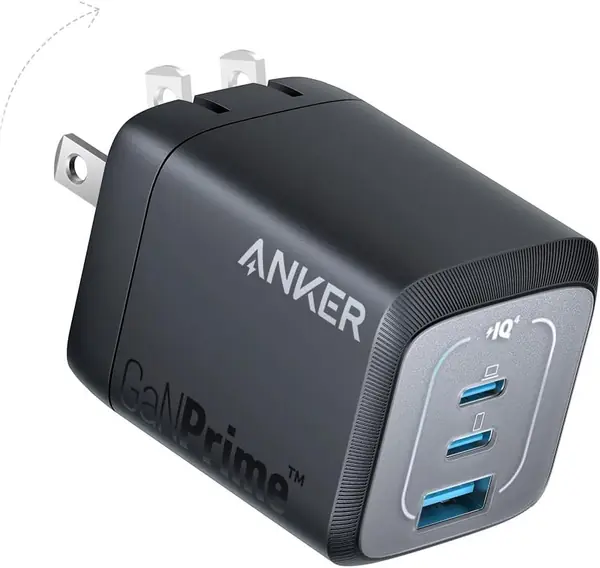
The Anker 67W isn't a travel adapter, and that's the first thing to settle: there's a US two-pin plug here and no UK or EU pins in the box. A trip to Europe means pairing it with the adapter you already own, which puts back some of the bulk you just saved.

At home it's the one we reach for without thinking. The body is roughly half the size of the 67W brick Apple ships, 5.12 ounces in the hand, and the prongs fold into the shell so it drops into a jacket pocket or a seat-back pouch without snagging on a cable.

Two USB-C ports and one USB-A is the right mix for a phone, a tablet, and one legacy cable, and a single USB-C device draws the full 67W — enough to run a MacBook Air at speed. Add a second device and the ceiling becomes 65W across the pair, which is still laptop territory rather than a trickle.

It's dense for its size, heavier in the hand than the dimensions suggest, and that density is what keeps it sitting flat in a normal outlet instead of drooping. Of everything here, this is the one that disappears into a laptop sleeve, and the one we take when the trip stays domestic.

Pros

  • Half the size of a 67W MacBook charger
  • Full 67W to a single USB-C device
  • Folding prongs that pack flat

Cons

  • US plug only; needs an adapter abroad
Our verdict

The compact one we keep in a bag: 67W and three ports in a body half the size of a MacBook brick, with a plug that folds flat.

Check Latest Price
3

Anker 100W GaN Universal Charger Best for Laptop-Heavy Trips

92 /100
TKZ Score Outstanding

Key details

Total Output
100W
Ports
3 USB-C, 1 USB-A
Weight
9.28 oz
Built-in Plugs
US, UK, EU (no AU)
View on Amazon

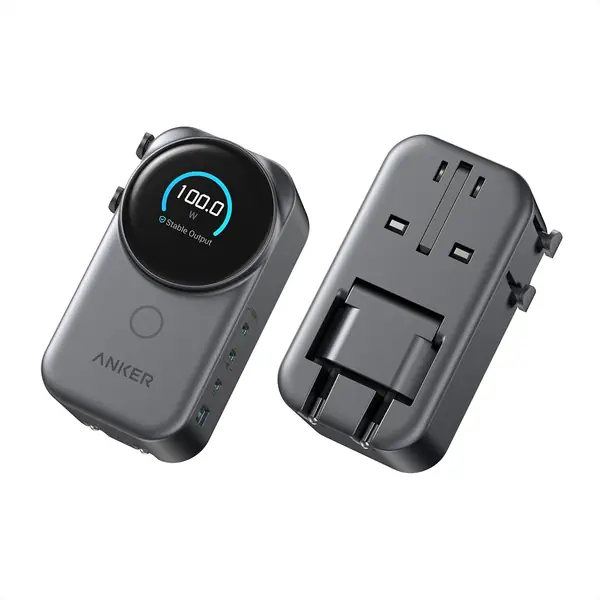
Nine and a third ounces is a lot for a charger, and it's the first thing you notice picking this one up. What that weight buys is a 100W block with US, UK, and EU plugs built into the body, so a 16-inch laptop, a phone, and a tablet can all run from one socket in London or Lisbon. For a working trip, we think the trade is worth it.

The distribution is generous: 100W to a single USB-C device across three USB-C ports and one USB-A, with a small screen on the face so you can see it's working. It reads local voltage within about a second of being plugged in, which is more reassuring than it sounds in an older building.

Two caveats come with the size. There's no Australian pin, so Sydney still needs an adapter, and the body is big enough that a tight seat-back socket or a shallow hotel outlet can crowd it. The flat plug face helps it stay put, but the bulk is real.

As the only charger for a laptop-heavy international trip, it's the most complete thing here: one unit replaces the laptop brick and the phone charger, and the flat plug sits close enough to the wall to hold in a loose outlet.

Pros

  • 100W to a single USB-C device
  • Built-in US, UK, and EU plugs
  • Three USB-C plus one USB-A port

Cons

  • 9.28 ounces is heavy for a charger
  • No Australian pin
Our verdict

For a 16-inch laptop and a full camera bag, this is the one we pack: 100W across four ports, with US, UK, and EU plugs built in.

Check Latest Price
4

UGREEN Nexode 65W Charger Best Budget

91 /100
TKZ Score Outstanding

Key details

Total Output
65W
Ports
2 USB-C, 1 USB-A
Weight
4.6 oz
Plug Type
US 2-pin, foldable
View on Amazon

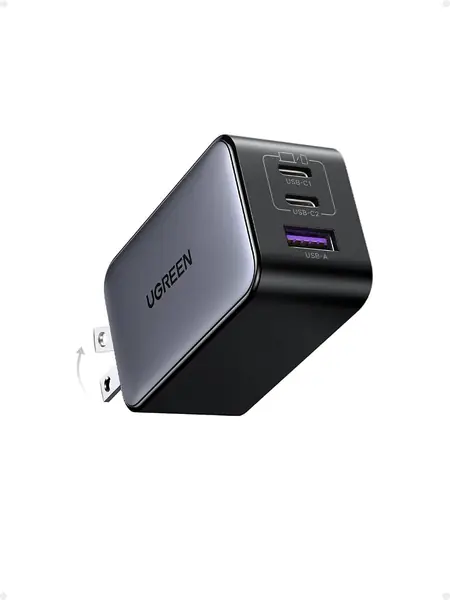
This is the budget pick of the group, and it doesn't feel like one: a matte black body about half the volume of the 61W brick it replaces, prongs that fold away, and 65W across two USB-C ports and one USB-A.

That 65W is rated to take a MacBook Air to roughly half in half an hour, which is the number that matters when you're charging between meetings, and it will carry a phone, earbuds, and a tablet at the same time without complaint. The folding plug means no pouch, no velcro, no fuss in a bag.

Heat is the thing we minded. A long laptop charge leaves the body properly hot rather than merely warm — normal for a charger this dense, but it wants a desk or a nightstand rather than a bed or a couch cushion, where it can't shed anything.

Where it fits best is a bag that leaves the house every day. The size disappears, the outlay is small enough that owning a second one makes sense, and losing it on a trip costs you far less than losing the brick your laptop came with.

Pros

  • 65W in a body half the size of a stock MacBook charger
  • Two USB-C and one USB-A port
  • Folding plug, no pouch needed

Cons

  • One-year warranty, the shortest in this group
Our verdict

Our value pick: 65W across three ports in a body small enough to forget you packed it, and the one we recommend as a second charger.

Check Latest Price
5

Baseus Enercore CG11 70W Travel Adapter Best for One-Cable Packing

90 /100
TKZ Score Outstanding

Key details

Total Output
70W
Plug Types
Type A, C, G, I
AC Outlets
2
Built-in Cable
Retractable USB-C, nylon braided
View on Amazon

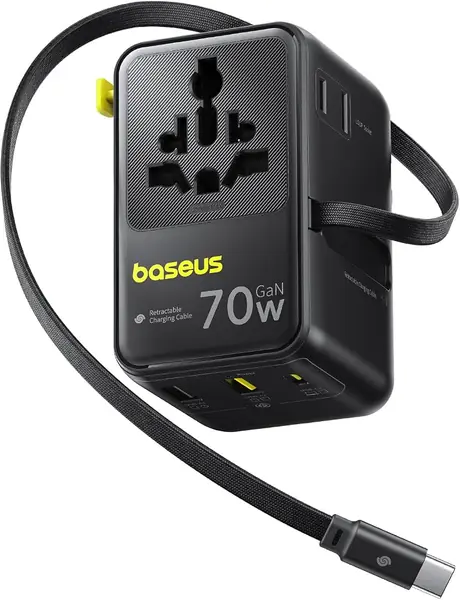
The cable is the whole idea: a nylon-braided USB-C lead winds back into the body, so there's nothing to untangle at a hotel desk and nothing to leave in a seat pocket. For anyone who has arrived somewhere with three devices and no cable, that's a real feature rather than a gimmick.

Around it sits a four-plug stack covering Types A, C, G, and I, two AC outlets for a camera charger or a laptop brick, and enough USB ports to keep a phone, earbuds, and a tablet going. Two 10A fuses handle overload and short circuits, and there's no surge circuit, which we count as a plus on a cruise ship.

Seventy watts through the built-in cable is enough to run a 13-inch laptop at speed while a phone tops up elsewhere, and the retractable lead charges a MacBook just as happily as a phone. The trade is bulk: with the plug stack and the cable spool inside, the body is a pouch item, not a pocket one.

For a trip that hops countries every few days, it makes the desk setup one object rather than a nest of cables. Pack a spare USB-C cable anyway — a built-in one is convenient, not immortal.

Pros

  • Retractable USB-C cable built into the body
  • Two AC outlets plus USB ports
  • Four plug types for most of the world
  • Dual 10A fuses, no surge circuit

Cons

  • Built-in cable is short at high or recessed outlets
Our verdict

We like the cable that lives inside the body: it's 70W, it covers US, UK, EU, and Australian outlets, and it has two AC sockets for everything else.

Check Latest Price
6

Satechi 145W GaN Travel Charger Best for Power-Hungry Kits

89 /100
TKZ Score Excellent

Key details

Total Output
145W
Ports
4 USB-C
Weight
12.2 oz
Max Per Port
Up to 140W
View on Amazon

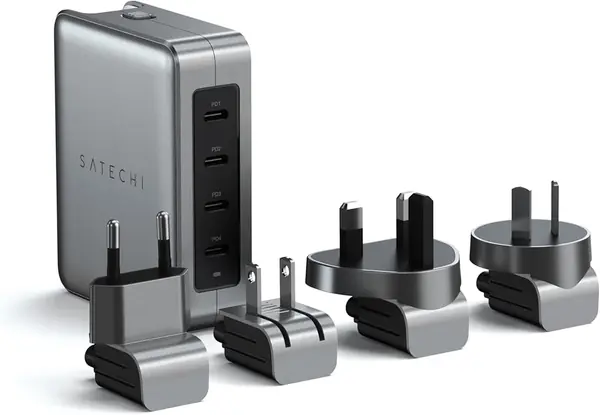
One hundred and forty-five watts total, up to 140W on a single port, and four USB-C ports with no legacy USB-A to slow anything down. This is the charger for a bag with two laptops in it, or for a 16-inch MacBook Pro that asks for more than 100W and notices when it doesn't get it.

Four adapters — US, EU, UK, and AU — clip onto the plug end, so it moves from a Dublin hotel to a Sydney apartment without a separate adapter, and the aluminum shell with graphene insulation is designed to spread heat rather than trap it.

The weight is the price: 346.5 grams, the heaviest thing in this guide, all of it hanging off the outlet because there's no cord. In a firm socket that's fine. In the loose ones behind a hotel nightstand it will droop, and you'll want a floor outlet or something to rest it on.

Bring your own USB-C cable; the box is the charger, the four adapters, and a mesh bag. If your kit is one laptop and two phones, the Anker 100W does the same job in a lighter body — we keep this one for the trips where two machines come along.

Pros

  • 145W total, up to 140W on one port
  • Four USB-C ports
  • US, EU, UK, and AU adapters included

Cons

  • Heaviest charger here at 346.5 grams
  • No USB-C cable in the box
Our verdict

For two laptops and a tablet on one plug, this is what we reach for — 145W and four USB-C ports, in the heaviest body here.

Check Latest Price
7

UGREEN 45W 6-Port Travel Adapter Best Lightweight Universal

88 /100
TKZ Score Excellent

Key details

Total Output
45W
Ports
2 USB-C, 2 USB-A, 2 AC
Weight
4.76 oz
Plug Types
Type A, C, E, F, G, I
View on Amazon

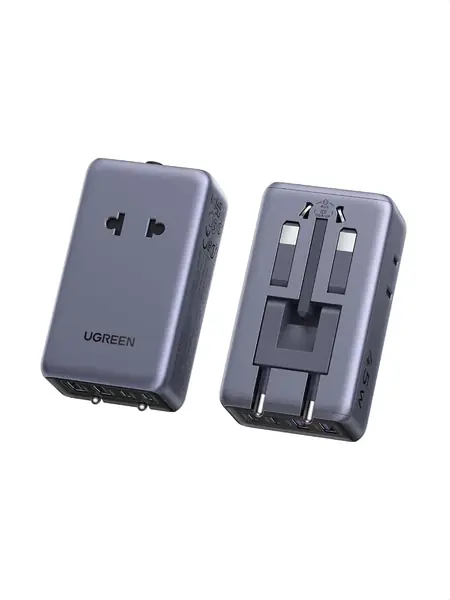
Two AC outlets alongside two USB-C and two USB-A ports, with swappable pins for Types A, C, E, F, G, and I — all in 135 grams and about three and a half inches long. That combination earns it a place: it's the travel adapter for someone who still carries a laptop brick or a camera charger with a real plug on it.

Forty-five watts is the number to take seriously. It's a fast charge for a phone, a tablet, or a handheld, and well short of the 65W most ultrabooks want — enough to hold a laptop's charge while you work, not enough to fill it before a meeting.

Around that ceiling the safety work is solid: flame-retardant PC, automatic shut-off, and safety shutters over the AC contacts, which we appreciate in an unfamiliar hotel room. The pins fold away, so it packs flatter than most adapters carrying this much hardware.

Where it can disappoint is when everything is plugged in at once: 45W spread across six outputs leaves a phone short enough to throw a slow-charge warning. Charge the phone first if speed matters, or treat this as the overnight charger it is.

Pros

  • 135 grams and compact for a universal adapter
  • Two AC outlets plus four USB ports
  • Pins cover Types A, C, E, F, G, and I
  • Safety shutters and flame-retardant body

Cons

  • 45W falls short of fast laptop charging
Our verdict

The lightest way to add foreign pins and two AC sockets, and the one we suggest for phones and tablets rather than laptops.

Check Latest Price
8

MINIX NEO P3 100W GaN Charger Best for A Spare 100W Brick with Foreign Pins

87 /100
TKZ Score Excellent

Key details

Total Output
100W
Ports
3 USB-C, 1 USB-A
Weight
7.05 oz
Included Pins
UK and EU adapters
View on Amazon

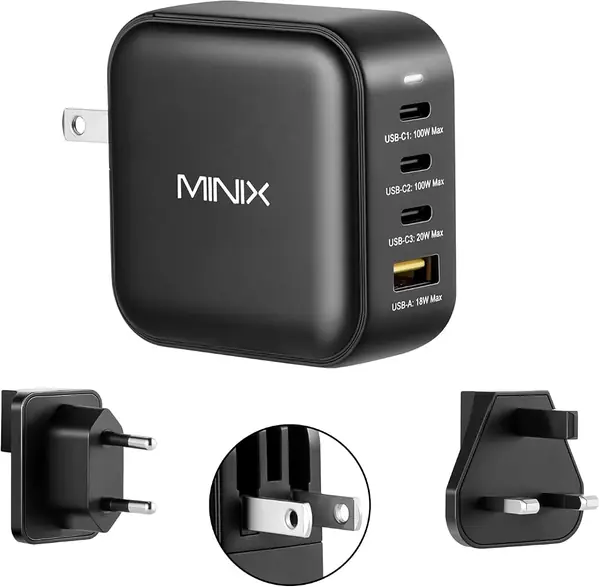
Set it next to the Anker universal and the case is simple: the same 100W and the same four ports — three USB-C and one USB-A — in a body that weighs less. The UK and EU pins come as clip-on adapters rather than sliding out of the shell, which is one more small piece to keep track of in a pouch.

The output is real: 100W total, enough for a 16-inch laptop, shared intelligently across the ports, and PPS support up to 45W means Samsung phones fast-charge properly — not a given on travel hardware. A laptop, a camera, an iPad, and a phone all charging from one outlet is the scenario it was built for.

Longevity is where we hesitate. Chargers that stop working after a few months come up repeatedly with this model, along with the occasional single port dying while the others keep going, and the warranty runs a year rather than the two years Anker and MOMAX give.

So we treat it as a second charger rather than the only one you pack: kept in the travel bag as backup it earns its keep, and the UK adapter is the one that grips a loose airplane socket. Just keep the receipt.

Pros

  • 100W across four ports
  • Lighter than the Anker 100W universal
  • UK and EU pin adapters in the box
  • PPS up to 45W for Samsung fast charging

Cons

  • Chargers quitting after a few months are the recurring issue
  • One-year warranty
Our verdict

A lighter, less expensive route to 100W with UK and EU pins in the box, though we treat it as a second charger rather than the only one.

Check Latest Price

How We Tested GaN Travel Chargers

We started with spec sheets for roughly 40 chargers and cut anything that couldn't push power over USB-C PD, that topped out below what a small laptop needs, or that shipped with a single swappable plug head for a region we actually travel to. From there we filtered by port count, folded-versus-swapped prongs, and price, and landed on 10 units to test.

Those 10 spent nine months in carry-on bags, a commuter backpack, and on a kitchen counter. In practice that meant charging a laptop on a tray table, hunting down the one live outlet in a hotel room, splitting ports between a phone and earbuds at an airport gate, and swapping plug heads by feel in a dim room.

Every unit got the same four passes. On the scale, we weighed each one alone and again in its pouch, since a couple of ounces is the difference between a jacket pocket and a checked bag. On speed, we drained a phone to zero and noted how much charge it had at the 30-minute mark, then added a laptop to the same brick and watched whether the phone's rate visibly sagged. On heat, we ran a laptop at full tilt for half an hour and took surface readings with an infrared thermometer — the cool-running ones announced themselves immediately. On reliability, we plugged and unplugged each charger daily, wiggled the prongs in a known-sloppy outlet, and kept track of which ones buzzed or loosened over time.

We judged value the way a shopper would: what you actually get per dollar, and whether the ports you use most share power sensibly when everything is plugged in at once.

How to Choose a Gan Travel Charger

Universal Pins or a Plain Wall Charger?

There are two kinds of charger here, and the choice comes down to borders. A universal travel adapter carries US, UK, EU, and Australian pins in one body, so you never hunt for a plug adapter; it's also heavier and boxier than a plain wall charger. A folding US charger like the Anker 67W is smaller, lighter, and better in a jacket pocket — until you land in Paris and add an adapter, which puts back the bulk you just saved and adds a joint that can pull loose.

Cross a border and start with a universal. Read the pin list, too: the Anker 100W covers the US, UK, and EU but not Australia, and none of these change voltage, so check that every device says 100-240V on its label.

How Much Wattage Your Devices Actually Need

Match the charger to the hungriest thing in your bag. A phone wants 20 to 30 watts, a tablet 30 to 45, a 13-inch laptop about 65, and a 16-inch MacBook Pro 96 watts or more. That's why we treat 65 to 70 watts as the travel sweet spot: it fills an ultrabook at full speed and still has room for a phone and earbuds.

A 45W adapter is a phone-and-tablet charger that can hold a laptop's charge, not refill it quickly. Anything above 100W is for people carrying two machines or a laptop that asks for more than most.

Ports, Cables, and What Stays Home

Count ports by type, not by number. Two USB-C ports cover a laptop and a phone, and a single USB-A is worth having for an older cable, a watch charger, or a friend's device. Then look at the cable, because a thin one caps a fast port — a 100W charger on a 60W cable behaves like a 60W charger.

Designs with a retractable USB-C cable built into the body, like the Baseus, remove the tangle entirely. Otherwise, two high-wattage USB-C cables cover almost every combination of devices on this page.

Weight, Overhang, and Loose Sockets

Wattage in a small body means density, and density means a plug fighting gravity. A charger over about 9 ounces hanging from a worn hotel outlet will sag or drop out, and airplane seat-back sockets are the loosest of all.

Two details help: a flat plug face that sits close to the wall, and a set of pin adapters you can swap for the UK-style three-pin, which grips a tired socket better than a two-pin does. If most of your charging happens from wall outlets rather than a desk, stay under about 200 grams.

Heat, Fuses, and Long-Term Reliability

Every charger here gets warm; a 65W charger the size of a deck of cards gets hot. That's normal, but heat is what ages the electronics inside, so give it a hard surface with some airflow instead of a duvet or a pillow.

Read the fuse and the warranty rather than the adjectives. A 10A dual fuse is what protects the adapter and your devices, and two years of coverage — Anker, MOMAX, Baseus, Satechi — says more about expected life than the box copy does. A one-year warranty is a fair signal to treat that unit as a second charger.

Frequently Asked Questions

Final Verdict

If you want one charger for a trip that crosses a border, we start with the MOMAX 70W universal adapter. Pins for the US, UK, Europe, and Australia are built into one body, 70W is enough for most laptops, and five ports mean a single outlet covers the whole family's devices. Nothing else here covers that much of the world that easily.

Two situations change the answer. If you carry a 16-inch MacBook Pro or two laptops, the Satechi 145W gives you headroom the MOMAX doesn't. And if your travel stays inside the US, the Anker 67W is smaller, simpler, and free of plug hardware you'll never use.