Best Travel Chargers of 2026

The moment I decided travel chargers deserved real scrutiny was in a hotel room at midnight, phone at 4 percent, laptop dead, watch circling the drain, and exactly one reachable outlet hidden behind the nightstand. What a good travel charger actually fixes is that math: it turns a single wall socket into enough power for everything you carry, and it does it without taking up the space you budgeted for socks. The bad ones do the opposite — they're bricks that hog the outlet, run hot, and charge one thing at a time while you wait.

I've been packing chargers into carry-ons for years, and my team has now spent four months living with 14 of them — in hotel rooms, at airport gates, on a colleague's kitchen counter, and on my own nightstand. A few things I wish someone had told me sooner: the wattage on the box is the total across all ports, not per port, so a charger that claims big numbers can slow to a crawl once you plug in a second device. Prongs that fold flat matter more than they sound like they do, and a compact brick with the right mix of USB-C and USB-A is worth more on a trip than a slightly faster one you have to dig for.

The picks below run from a single-device block for a short trip to multi-device stands and adapters built for overseas outlets. Some were chosen for a carry-on, some for a bedside table at home — and the testing notes will tell you which is which.

The Best Travel Chargers

1

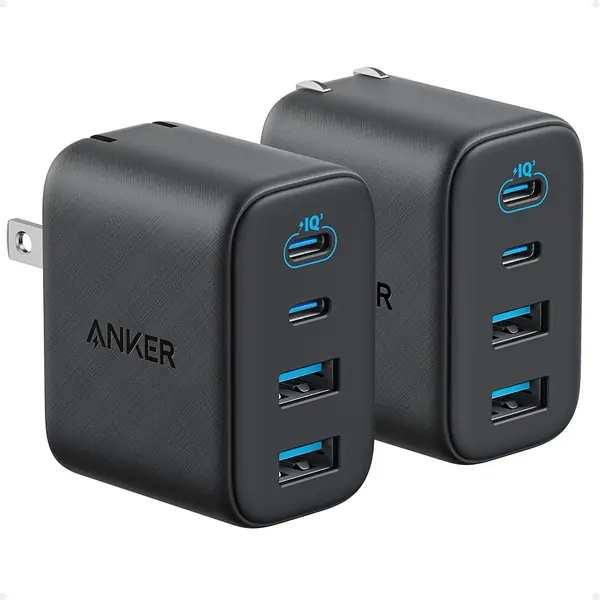
Anker Zolo 50W 4-Port Charger Best Overall
96 /100
TKZ Score Outstanding

Key details

Ports
4 (2 USB-C, 2 USB-A)
Max Output
50W total; 30W on USB-C1
In The Box
Two chargers
Plug
Built-in folding 2-prong
View on Amazon

Two chargers arrive in the box, which sounds like padding until you decide where the second one lives: one stays plugged in beside the bed at home, the other never leaves the bag. Each block folds its prongs and takes up roughly the room of an earbuds case, so it drops into a toiletry pouch or a jacket pocket and stops being something you have to remember.

The four ports are what turn it into a travel charger rather than a spare. Two USB-C and two USB-A cover a phone, a watch, earbuds and one older device without a dongle, and the output is shared sensibly — USB-C1 keeps its full 30W while the second C port charges at 20W. That split is why we reach for this ahead of a three-in-one pad on a mixed-device trip: it doesn't care what brand your gear is. We were also struck by how little it costs to keep a second one permanently in the suitcase, which quietly solves the oldest travel-charging problem there is.

The ceiling is 50W total, so a laptop is out — a MacBook will trickle rather than charge, and a laptop trip wants the Anker Universal 100W instead. Abroad you'll still need a plug adapter, since the prongs are North American only. Neither limit touches the bag this was built for: phone, watch, earbuds, maybe a tablet.

Pros

  • Four ports cover phone, watch, earbuds and a tablet
  • Folding plug and compact body pack easily
  • Two units in the box, so one can stay packed

Cons

  • 50W total can't fast-charge a laptop
  • Needs a plug adapter for outlets abroad
Our verdict

The travel charger we point most people to: four ports, a folding plug, a body small enough to forget, and a spare in the box.
Check Latest Price
2

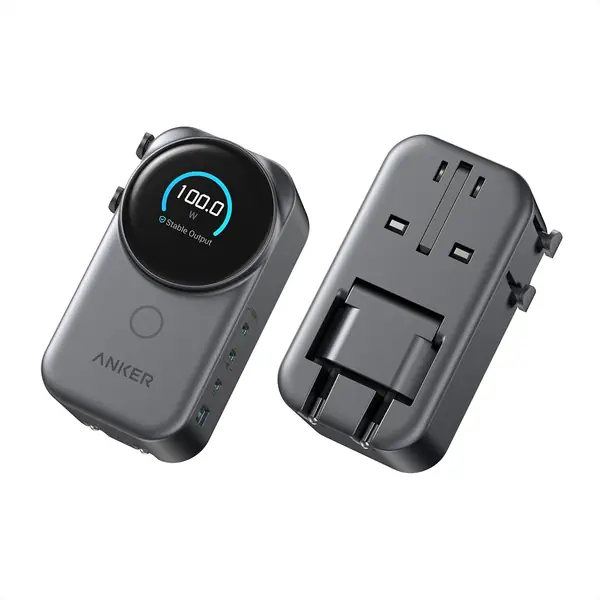
Anker Universal 100W Travel Charger Best for International Travel

91 /100
TKZ Score Outstanding

Key details

Ports
4 (3 USB-C, 1 USB-A)
Max Output
100W total
Plugs
Built-in US, UK, EU (Types A, C, G)
Weight
9.3 oz
View on Amazon

The plug is why this one earns its space. US, UK and EU pins are built into the body and slide out when you need them, so changing countries is a thumb-press rather than a hunt through a pouch for the right clip-on adapter. We've handled travel adapters that feel like a bag of loose parts; this feels like one object, and the flat plug sits close enough to the wall to stay put in the loose sockets you meet in older hotels.

Behind the plug it's a 100W four-port charger — three USB-C and one USB-A — with the output redistributed as devices join, and a 100–275V input range that covers essentially every grid you'll meet. It measures 3.74 by 1.98 by 1.59 inches and weighs 9.3 ounces, which is heavy for something this small and entirely worth it when it replaces a laptop brick plus two other chargers. On a one-bag trip, that's the difference between one charger and three.

What it doesn't have is an AC outlet, so a lamp, a camera battery charger or anything with a mains plug still needs the hotel's socket — that's the gap the Ceptics adapter fills. Australia and New Zealand are missing from the pin set, which means a Type I adapter for that trip. Otherwise the details are reassuring: NRTL certification and a two-year warranty are the boring facts that matter when you're plugging into wiring you don't know.

Pros

  • Built-in US, UK and EU pins, no loose attachments
  • 100W across four ports charges laptop and phone
  • 100–275V input covers most of the world

Cons

  • No AC outlet for a lamp or non-USB device
  • No Type I pin for Australia and New Zealand
Our verdict

If the trip crosses an ocean and includes a laptop, start here: built-in US, UK and EU pins and enough power to leave the laptop brick home.

Check Latest Price
3

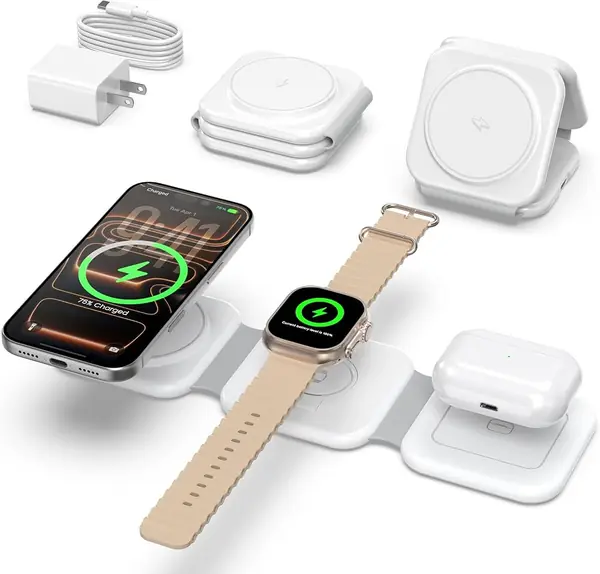
KEEPRO 3-in-1 Foldable Charging Station Best for Apple Devices

90 /100
TKZ Score Outstanding

Key details

Weight
9.52 oz
Devices
3 (phone, watch, earbuds)
In The Box
20W adapter and cable
Phone Charging
15W magnetic
View on Amazon

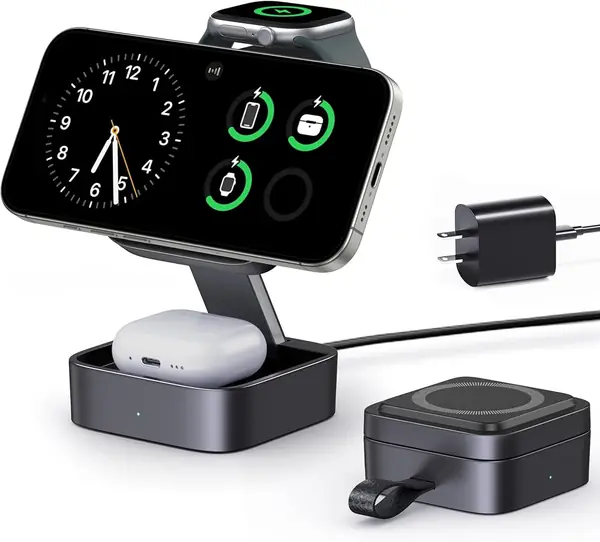
An iPhone, a Watch and a pair of AirPods means three cables, two bricks and a nightly negotiation over who gets the outlet. The KEEPRO collapses that into a single folding pad: a magnetic mount for the phone, a watch module, and a small surface for the earbuds case, all fed by one 20W adapter that comes in the box.

Folded, it's a dense little square at 270 grams — noticeable in a jacket pocket, invisible in a backpack. Open, the phone and watch modules both tilt, so the phone can stand upright for a notification while the watch lies flat on its charger, and the whole thing becomes a nightstand dock in a rental apartment. We came back to the fold again and again: it's the reason this travels instead of staying home.

Wireless is the trade. Fifteen watts to the phone is well under what a cable delivers, so this is an overnight charger rather than a top-up between flights. The other thing to check is your earbuds case: the pad needs a wireless-charging case, and KEEPRO specifically excludes the older A1602, A2897 and A3058 models. If yours is one of those, the earbuds corner does nothing and the maths changes.

Pros

  • Charges phone, watch and earbuds on one pad
  • Folds flat and tilts for nightstand use
  • 20W adapter and cable included

Cons

  • 15W wireless is slower than a cable
  • Older AirPods cases A1602, A2897 and A3058 won't charge
Our verdict

For an all-Apple bag, this replaces three cables and two bricks with one folding pad, at the cost of slower wireless charging.

Check Latest Price
4

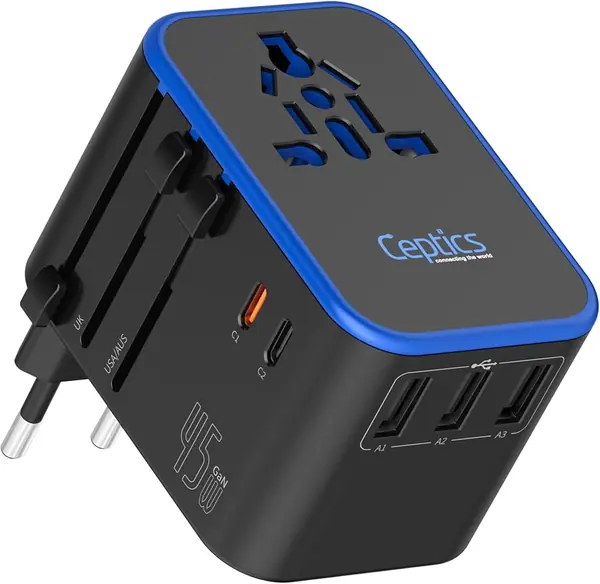
Ceptics 45W Universal Travel Adapter Best Budget Travel Adapter

89 /100
TKZ Score Excellent

Key details

Ports
3 USB-A, 2 USB-C, plus universal AC socket
Max Output
45W USB-C Power Delivery
Plugs
Types A, C, G, I output
Fuse
8A, spare included
View on Amazon

Where the Anker universal is about power, the Ceptics is about sockets. The front takes a plug from almost anywhere and passes it straight through, and beside it sit three USB-A and two USB-C ports, one of which delivers 45W Power Delivery. That combination is what makes it useful for a family sharing one hotel outlet: a laptop brick in the universal socket, two phones on USB-C, a watch and a camera on USB-A, and nobody waiting. At 5.9 ounces with an 8A fuse and a spare in the box, it's the kind of thing that saves a trip rather than just simplifying one.

The 45W ceiling is the honest limit: only one USB-C port carries it, so a laptop charges but slowly, and two laptops is out of the question. It also changes plug shape and nothing else — the socket passes local voltage through, so a single-voltage device plugged into 230V abroad will not survive. Check the label on anything you plan to use; dual-voltage gear is marked 100–240V, and everything else stays home.

Pros

  • Universal AC socket plus five USB ports
  • 45W USB-C PD for a phone or tablet
  • Light enough to live in a suitcase

Cons

  • Only one USB-C port delivers full power
  • Changes plug shape, not voltage
Our verdict

The adapter to keep in the suitcase: a universal socket, five USB ports, and enough power for a phone, tablet and camera at once.

Check Latest Price
5

SMILE STATION 15W Foldable Charger Best for Cheap Apple Charging

88 /100
TKZ Score Excellent

Key details

Devices
3 (phone, watch, earbuds)
Phone Charging
15W magnetic
Input
20W over USB-C
Indicator
LED off after 10 seconds
View on Amazon

Three-in-one pads usually cost more than a plain charger, which is what makes this one interesting: it's the least expensive of the folding Apple chargers here and it does the same job — iPhone on a 15W magnetic pad, Watch on its own charger, AirPods on a third. It folds into a flat white slab, and the LED indicator switches itself off after ten seconds, a small thing that matters more in a hotel room at midnight than it does on a spec sheet.

Our reservation is speed and the small print. Fifteen watts is well under what a cable delivers, and the earbuds pad needs a wireless-charging case — an older AirPods case won't charge on it at all. It also draws 20W over USB-C, so confirm what's in the box before you leave rather than assuming a brick is included. None of that troubles the buyer we have in mind: someone who wants one tidy object on an Airbnb nightstand and charges overnight rather than in a hurry.

Pros

  • One folding pad for iPhone, Watch and AirPods
  • LED switches off so it won't light the room
  • Lowest-priced folding Apple charger here

Cons

  • 15W wireless is slower than a cable
  • Needs a wireless-charging AirPods case
Our verdict

The least expensive way to get an iPhone, Watch and AirPods charging from one folding pad, and the one to buy if speed isn't the point.

Check Latest Price

How We Tested Travel Chargers

We started by pulling together the chargers that show up most often in traveler forums and retailer listings, then filtered on the things that actually decide whether one earns bag space: port count and mix, folding prongs, whether the plug works in more than one country, and how bulky the thing is next to a phone. Anything that was too large to drop into a quart bag, or that offered a single port with no fast-charging standard, got cut before testing. That left 14 chargers, which we used for four months.

Each one went into the same small pouch in a carry-on and came back out at security, at a gate, and in hotel rooms. We timed a phone from dead to full at an airport gate and noted whether it hit a fast-charge rate or settled into a trickle. In hotel rooms with a single reachable outlet, we plugged in a laptop, a phone, and a watch at once and watched how much the laptop's charging slowed — that's where smart power allocation either works or quietly doesn't. We also checked whether a loose European or UK socket held the brick firmly, whether the prongs blocked the second outlet on a strip, and whether the adapter stacked cleanly with a plug instead of dangling.

Size got measured, not eyeballed: we weighed each charger and set it beside a deck of cards, then checked whether the prongs folded flat enough to stop snagging the lining of a bag. Durability came down to a four-month toss-and-carry cycle plus a few deliberate drops onto a hardwood floor, and we felt each brick after half an hour of laptop charging to see which ones got uncomfortably warm. Compatibility was a rotating cast of an iPhone, a Pixel, an iPad, a MacBook, a smartwatch, and earbuds — we noted which devices negotiated a fast charge and which simply accepted whatever they were given. Value came last: we counted how many devices each charger could realistically serve at once and weighed that against what it cost.

How to Choose a Travel Charger

Start With the Ports You Actually Use

Count what you charge overnight, not everything you own. A phone, a watch and earbuds need three outlets at most; add a tablet or a laptop and four is a sensible ceiling. The mix matters as much as the number — two USB-C and two USB-A, as on the Anker Zolo, covers newer gear and the odd legacy cable without a dongle.

Then look at what happens when every port is busy. A charger that holds 30W on one USB-C port while sharing the rest is far more useful than one that splits its total evenly and leaves everything crawling.

How Many Watts Your Laptop Needs

Wattage is the number that decides whether the laptop brick stays home. Phones top out around 20 to 30W, thin laptops and tablets want 45 to 65W, and a full-size laptop wants 100W to charge at normal speed. A headline figure is a total, not a promise per port: 100W is shared across everything plugged in, so a second device takes some of it back.

If a computer travels with you, buy on the per-port number rather than the total. If it doesn't, a 50W block is plenty and saves weight.

Adapters Move Pins, Not Volts

The most expensive mistake in this category is assuming a travel adapter converts voltage. It doesn't; it changes the shape of the plug. Check the small print on every charger, laptop brick and camera charger for a 100–240V rating before it meets a foreign wall, because a 120V-only device will not survive 230V.

Coverage differs, too. The Anker Universal's built-in pins handle the US, UK and EU, while the Ceptics adds Australia and New Zealand. Match the pin set to your itinerary, and remember that many compact adapters take two-prong plugs only.

Folding Prongs, Packed Size and Loose Sockets

Prongs that fold are the difference between a charger that slides into a pocket and one that snags on everything in the pouch. Compactness has a cost, though: a small block handling 100W is dense, and dense blocks are the ones that sag out of a worn airplane or hotel socket.

A flat plug that sits close to the wall helps. So does a short corded strip with a flat head, which reaches the outlet hiding behind the desk — at the price of a few ounces in the bag.

Wireless Pads Versus a Cable

A folding three-in-one charging station is the tidiest way to power an iPhone, a Watch and AirPods from one outlet, and the least efficient. Fifteen watts to the phone is roughly half what a good cable delivers, and the watch and earbuds pads add only a few watts each — fine overnight, frustrating at an airport gate.

The other check is the earbuds case. Magnetic pads need a wireless-charging case, and some older AirPods cases are explicitly excluded by the maker.

Frequently Asked Questions

Final Verdict

For most trips the Anker Zolo 50W is the charger to buy: four ports, a folding plug, a body the size of an earbuds case, and a second unit to leave permanently packed. If the trip involves a laptop and a passport, step up to the Anker Universal 100W — its built-in US, UK and EU pins replace both a laptop brick and a pouch of adapters.

And if everything you carry is Apple, the KEEPRO folds three chargers into one pad, provided your AirPods case supports wireless charging.