The Best Tablets for Sheet Music for Practice and Performance

Anyone who has played outdoors knows the drill: a binder of sheet music, a couple of clothespins, and a breeze that shows up exactly at the page turn. I switched to a tablet after one too many of those afternoons and haven't clipped a page since. A tablet solves the obvious problem, which is no more printing and no more hauling a folder around, but it also fixes things you don't think about until you're on stage: a screen that stays readable under a stand light, a page turn that takes a tap instead of a shuffle, and a battery that outlasts a long rehearsal.

Over the past eight months my team and I have played from 14 different tablets, from compact 10-inch models up to a 15.6-inch display wide enough for a full two-page spread. The first thing you learn is that bigger isn't automatically better. A large screen means less squinting and fewer page turns, but it can make a flimsy stand clamp sag and it takes up real room in a gig bag. The second thing you learn is to read the fine print on what comes in the box, because a stylus and a case can be the difference between a good value and a hidden second purchase.

What follows are the tablets that survived a full season of rehearsals, gigs, and the occasional windy outdoor set, sorted by the players they suit best.

The Best Tablets for Sheet Music for Practice and Performance

1

TCL NXTPAPER 14 Best Overall
89 /100
TKZ Score Excellent

Key details

Screen
14.3 in, 2400 x 1600
Battery
10,000 mAh
Storage
256 GB
Display
Matte NXTPAPER 3.0
View on Amazon

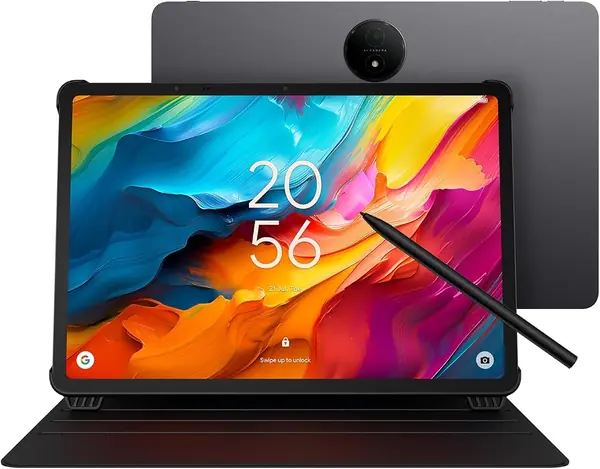
Point a stand lamp at most tablets and the score dissolves into a white rectangle. The NXTPAPER 14 is the pick here that handles that, because its 14.3-inch panel is matte: light scatters across it instead of reflecting back, so a bright stage or a window behind the stand does not wash out the page. For reading music that one property does more work than any processor or speaker specification in this group, and it is why this is our top pick. At 2400 x 1600, a full page of music sits on screen with real margin left for tap zones.

The display modes are a feature rather than filler. A dedicated key switches the panel between a normal color setting and a paper setting that softens the blue cast, and the paper setting is the one we leave it in for long rehearsals. The 4096-level stylus and a flip case both ship in the box, so marking bowings, fingerings, and cuts costs nothing extra and you are not shopping for a case the same week.

The Helio G99 is the honest limit. Page turns, PDF rendering, and app switching feel fine; heavy split-screen work is where it stumbles, and that is the trade for a screen this size at this price. Storage is 256GB, enough for a library of several thousand pages without adding a microSD card.

Pros

  • Matte 14.3-inch screen kills stand-light glare
  • A full page of music reads clearly without zooming
  • Stylus and flip case included at no extra cost

Cons

  • Battery may not stretch to a full day of heavy use
Our verdict

We point most players to the NXTPAPER 14: the matte 14.3-inch screen swallows stand-light glare, and the stylus and case come in the box.
Check Latest Price
2

TECLAST T65 Best Value

88 /100
TKZ Score Excellent

Key details

Screen
13.4 in, 1920 x 1200
Battery
8,000 mAh
Weight
1.59 lb
Brightness
350 nits
View on Amazon

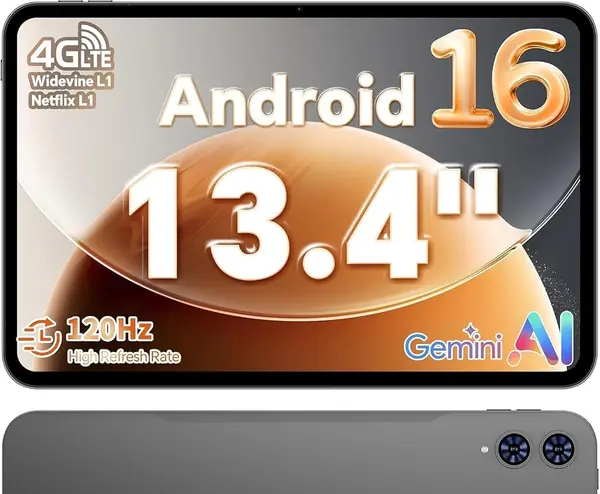
Nothing else in this group gets you past 13 inches for anything close to what the T65 costs. The 13.4-inch 1920 x 1200 panel is sharp enough for printed scores, the 120Hz refresh makes scrolling a long PDF feel smooth rather than draggy, and at 720 grams the tablet rides in a tote alongside a folder of charts without complaint.

We point players who want a big reading surface and no stylus tricks to this one. The 3.5mm headphone jack is the detail we appreciate most, because in-ears for a click track or a quiet practice room plug straight in with no dongle. There is a microSD slot that takes up to 1TB if your library outgrows the 128GB on board, and this is the 4G LTE version, so a data plan can stand in for venue Wi-Fi.

Brightness is where it gives ground. At 350 nits behind a standard glossy finish, the T65 is comfortable on a kitchen table and much less so under a bright stand lamp, where reflections come back into the music. If most of your playing happens indoors under soft light, that trade is easy to take here; if you gig under par cans, pay more for a matte panel.

Pros

  • 13.4-inch screen for the least money here
  • 120Hz refresh keeps long scores scrolling smoothly
  • Headphone jack and microSD slot up to 1TB

Cons

  • Slow charging, with no fast-charge support
Our verdict

If the budget decides, we buy the T65: a 13.4-inch 120Hz screen, a headphone jack, and microSD expansion for less than any other big tablet here.

Check Latest Price
3

MESWAO B3 Pro 15.6 Best for Full Paper Pages

87 /100
TKZ Score Excellent

Key details

Screen
15.6 in, 1920 x 1080
Battery
12,000 mAh
Storage
256 GB
Charging
30W
View on Amazon

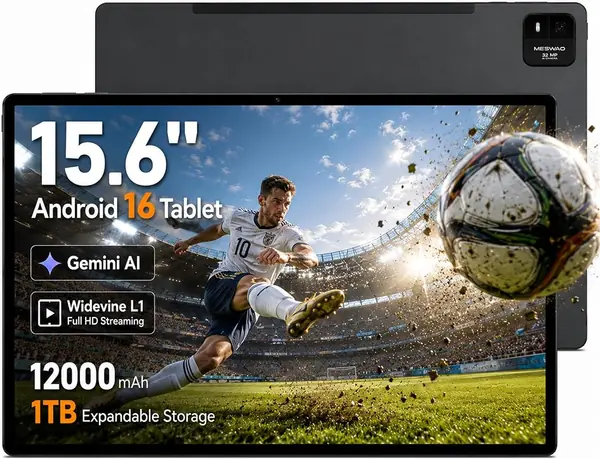
If the TCL's 14.3 inches still leave you leaning in toward a dense piano reduction, the B3 Pro adds another 1.3 inches of diagonal, and that is enough for a full letter-size page with room around it rather than a page squeezed edge to edge. At 1920 x 1080 across 15.6 inches it is the softest picture in this group; text stays perfectly legible, it just does not look crisp the way the 2.4K panels do.

This is the one we hand to players who read full paper pages, the church-orchestra and pit-book crowd, and two things make it practical. The storage is 256GB rather than the 128GB of the base model, which a scanned library fills faster than you expect, and 30W charging means a top-up at the interval actually gets you somewhere, unlike the slower-charging budget pick.

The cost is bulk. At nearly 14.5 inches wide and close to two pounds with a case, it wants a sturdy stand and does not want to be carried far, which makes it a leave-it-in-the-rehearsal-room tablet rather than a commute companion. A microSD slot extends storage to 1TB, so a whole library of scores fits without thinning anything out.

Pros

  • Full paper-size page for dense scores
  • Fastest charging in this set at 30W
  • 256GB storage plus 1TB microSD expansion

Cons

  • Bulky 15.6-inch body needs a sturdy stand
  • Least sharp display in this group
Our verdict

We hand the B3 Pro to players who need a full paper page in front of them: 15.6 inches, 256GB, and 30W charging, at the cost of sharpness and portability.

Check Latest Price
4

Samsung Galaxy Tab S10 Lite Best for Travel

86 /100
TKZ Score Excellent

Key details

Screen
10.9 in, 2112 x 1320
Battery
8,000 mAh
Weight
1.2 lb
Stylus
S Pen included
View on Amazon

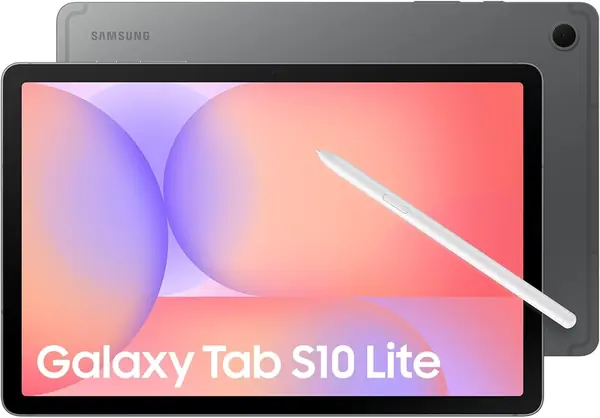
At 10.9 inches this is the smallest screen in the group, and that is a genuine limit: a dense piano-vocal score needs cropping or zooming, and a two-page spread is out of the question. What you get in exchange is a tablet that disappears into a gig bag, weighs about as much as a hardcover book, and arrives with Samsung's S Pen in the box.

The rest of the package is where it earns its place. The 2112 x 1320 panel is sharp for its size, the 90Hz refresh keeps scrolling and annotation smooth, and the microSD slot takes up to 2TB on top of the 128GB built in. Samsung rates the battery at up to 16 hours, the longest claim of anything here, and the two-year manufacturer warranty is the quiet advantage when the tablet lives in a bag between gigs.

We treat this as the singer-songwriter's and traveling player's pick: lead sheets, chord charts, lyric sheets, and a pen for marking keys. If your book is mostly full scores, the extra screen on the TCL or the MESWAO is worth the weight. One pattern worth knowing about is charging that gives out after about a year of use, which the two-year warranty turns from a loss into an inconvenience.

Pros

  • S Pen included, no separate purchase
  • Fits a gig bag at 10.9 inches and 1.2 pounds
  • Longest battery claim here, at up to 16 hours

Cons

  • 10.9-inch screen is tight for full scores
Our verdict

For players who need a tablet in a gig bag, the Tab S10 Lite is the one: the smallest screen here, but the S Pen is included and it is the easiest to live with.

Check Latest Price
5

VIWOODS AiPaper Bright Outdoor Light

79 /100
TKZ Score Very Good

Key details

Screen
10.65 in E Ink
Pen
4096 levels
System
Android 13
Resolution
2560 x 1920
View on Amazon

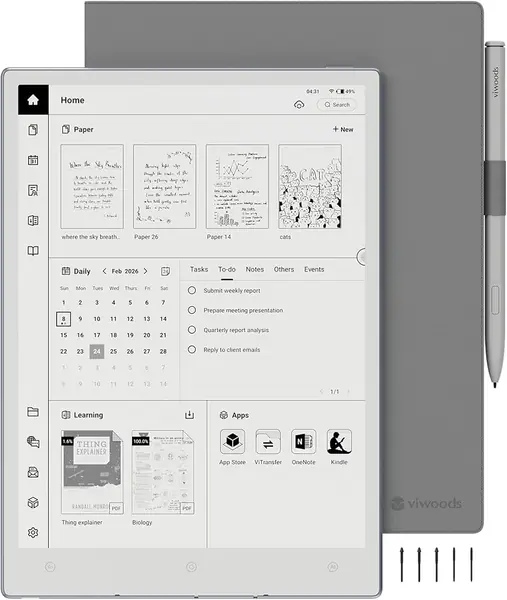
Reading a score on the AiPaper in direct afternoon sun is the closest thing here to reading paper. There is no backlight to lose the fight with daylight and no glass to throw a reflection, and the Carta 1300 panel at 2560 x 1920 is the sharpest per inch in this set, around 300 pixels per inch, so notation looks printed rather than rendered. It also asks far less of a battery than any backlit screen here.

The cost is size and speed. At 10.65 inches it holds one page comfortably and nothing more, so a two-page spread or a full orchestral score means scrolling. E Ink redraws the entire screen on every page turn, which shows as a brief flash: fine between movements, less charming in the middle of a phrase. It runs Android 13, and app fit is the thing to verify before you commit, since a reading tablet is only as good as the library app it can install and sync.

What you are paying for is the pen and the quiet. The W2 Stylus Pro with 4096 pressure levels and the folio cover are in the box, and the pen feel is the most paper-like of the picks here, so marking up a score by hand finally feels like a pencil rather than a fingertip on glass. Buy it for silent, glare-free reading and annotation; look elsewhere if you need two pages at once.

Pros

  • No glare and no backlight, ideal in daylight
  • Sharpest text of anything here at 2560 x 1920
  • Pen and folio cover included in the box

Cons

  • One page only at 10.65 inches
  • E Ink refresh flashes between page turns
Our verdict

We like the AiPaper for daylight reading and pen-first players: an E Ink page with no glare and no backlight, as long as one page at a time is enough.

Check Latest Price
6

URAO 14-Inch Tablet Bundle on a Budget

77 /100
TKZ Score Very Good

Key details

Screen
14 in, 1920 x 1200
Battery
10,000 mAh
Storage
256 GB
Charging
30W
View on Amazon

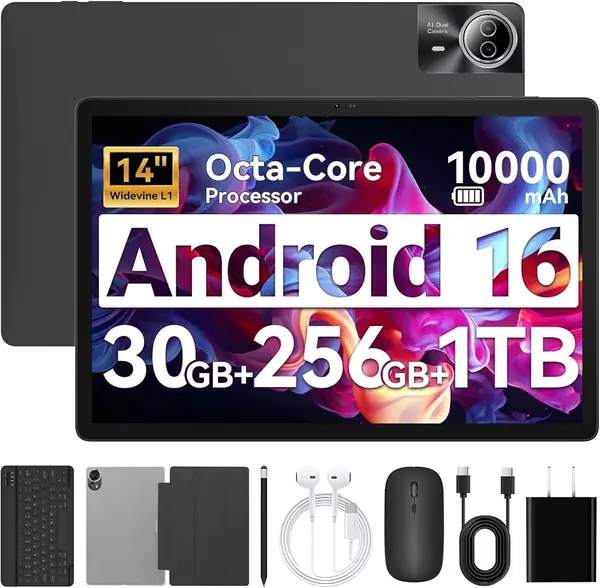
Open the URAO's box and you have a keyboard, a mouse, a stylus, headphones, a case, and a charger before you have bought anything else. We think that bundle is the reason to consider it: the 14-inch 1920 x 1200 panel is a good reading surface, and the keyboard turns the same tablet into something you can edit charts on between rehearsals.

The rest holds up on paper. There is 256GB of storage with microSD expansion to 1TB, a 10,000mAh battery with 30W charging, Wi-Fi 6, and Android 16. At 1920 x 1200 on 14 inches the screen works out sharper per inch than the 15.6-inch MESWAO, so a full page of music is legible without zooming, and the 30W charging puts it level with the fastest pick here.

The processor is the catch. The 2.0GHz octa-core is the least proven chip in this group, and it is what decides whether turning three pages in a row feels instant or sticky. Test the charging port in the first week, too: a tablet that stops taking a charge is the failure to watch for on this one, and an easy return window is worth more than another gigabyte of memory.

Pros

  • Keyboard, stylus, case, and headphones included
  • 14-inch screen with 256GB storage
  • 30W charging and Wi-Fi 6

Cons

  • Least proven processor in this set
  • Charging faults are the weak point
Our verdict

The URAO is worth a look if you want a 14-inch screen and a full desk kit in one order, as long as you accept the slowest processor here and test the charging port early.

Check Latest Price

How We Tested the Best Tablets for Sheet Music

We built the shortlist from the tablets musicians actually bring to rehearsal: screens of at least 10 inches, stylus support, and enough battery to cover a long evening. From there we filtered by price and by what shipped in the box, then loaded the survivors with the same library, including a 40-page piano reduction, a four-part choral score, a single lead sheet, and a handful of PDFs scanned at noticeably different qualities.

Every tablet spent time clamped to a standard music stand and read from about 18 inches away, first in a bright rehearsal room and then in a dim one with only a stand light, with the screen tilted to see where glare landed. We timed page turns on the same file and watched for stutter while a metronome app kept running in the background. We also noted which tablets made the stand clamp sag, whether the back flexed when we gripped it, and how the buttons felt with a page-turn swipe already in progress.

Battery life got measured rather than trusted. Each tablet started a rehearsal-length session at full charge and 60 percent brightness, and we wrote down whatever was left three hours later. We marked bowings and fingerings with each stylus to check palm rejection, and we kept a running log of the unglamorous stuff: Wi-Fi that dropped while syncing setlists, apps that froze mid-page, and ports that loosened after months of nightly charging. Reliability over time, not the first impression, is what separated the keepers from the rest.

How to Choose a Tablet for Sheet Music

Page Size and Shape

Digital sheet music comes down to whether the page in front of you is big enough to read at arm's length. A single page of a lead sheet or a sonata reads comfortably from about 11 inches up; add a couple of inches and you can keep margins free for the app's tap zones. Two-page spreads want the 15.6-inch class.

Shape matters as much as the diagonal. A 16:10 or 3:2 screen gives a page more height than a 16:9 letterbox, which spends width on nothing. And sharpness counts at close range: the 15.6-inch pick here renders fewer pixels per inch than the 14-inch ones, which you notice on a dense piano reduction.

Matte, Glossy, or E Ink

Ask what a screen looks like under a lamp before you ask how bright it is. A glossy panel at any brightness turns a stand light or a window into a white smear, and pushing the backlight up only adds glare of its own. Matte treatments scatter that light instead; the NXTPAPER finish on the TCL is the one we keep coming back to.

E Ink goes further, because there is no backlight to fight daylight with. If you perform under lights or read outdoors, pick the finish first and the resolution second.

Battery and Charging on a Two-Gig Day

Milliamp-hours are not hours. A 10,000mAh cell behind a bright 14-inch screen can still run down inside a long afternoon, and what rescues you is how quickly it refills. Compare charging wattage as carefully as capacity: 30W gets a big tablet back to useful during an interval, while a model with no fast-charge support wants a full night on the cable.

Carry a USB-C PD power bank sized for the tablet's draw, and switch Wi-Fi off once the setlist is downloaded.

Weight and What It Does to a Stand

A 13-inch tablet runs around 720 grams; the 15.6-inch class feels closer to a hardcover dictionary once a case is on it. Wire stands sag and tip under that load. Check your stand's rating before you buy the biggest screen you can afford, and prefer a case with a stiff spine or a dedicated holder once you move into the 14-inch class.

The trade cuts both ways: heavier tablets sit still and barely move when you turn a page, while lighter ones are the ones that travel.

Storage, Stylus, and Marking Up a Score

Scanned scores are bigger than people expect, and a thick book of charts can pass a gigabyte on its own, so 256GB is comfortable and 128GB is fine if a microSD slot sits behind it.

Stylus support matters if you mark bowings, fingerings, or cuts. Check the pen is in the box rather than a separate purchase: it is with the Samsung, TCL, URAO, and VIWOODS picks, and it is not with the TECLAST or the MESWAO.

Frequently Asked Questions

Final Verdict

The TCL NXTPAPER 14 is the tablet we point most musicians toward, because a matte 14.3-inch page under a stand lamp is the difference between reading and squinting, and the stylus and case come with it.

Choose the TECLAST T65 if budget decides and you play in soft light; choose the MESWAO B3 Pro if you need a full paper page and can live with the weight and the softer picture. Each gives up a little of the TCL's glare handling in exchange for something concrete: money, or inches.