Best Solar Power Banks for Backpacking of 2026

A solar panel on a power bank is not a power plant. It's a trickle charger that might buy you a few percent on a bright ridge, and the packs that pretend otherwise are the ones that let you down. What actually keeps your phone alive is a battery sized for the days you're out, light enough to forget in your pack, and honest about how fast it can pass a charge along.

I've been the person at the trailhead with a dead phone and a brick of a power bank, so weight-to-capacity matters more to me than the biggest number on the box; the highest-capacity packs in this category weigh about as much as a full water bottle. Built-in cables and wireless charging pads are the two features that change how a pack feels in daily use, though both buy convenience with a little speed. Over the past four months, we've carried 14 of these on day hikes, two overnights, and a wet weekend, timing recharges and watching how they survived the bottom of a pack. The picks below are the ones I'd press into a friend's hands before a trip.

The Best Solar Power Banks for Backpacking

1

BLAVOR 10,000mAh Solar Power Bank Best Overall
88 /100
TKZ Score Excellent

Key details

Battery Capacity
10,000mAh
Weight
9.3 oz
Output
20W USB-C
Water Resistance
IPX5
View on Amazon

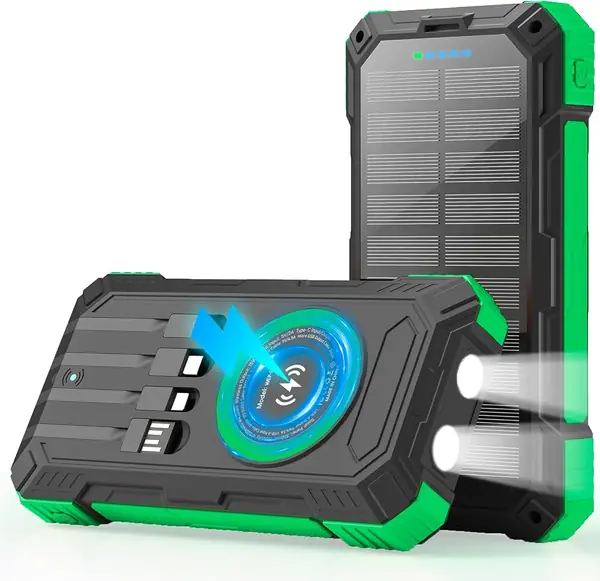
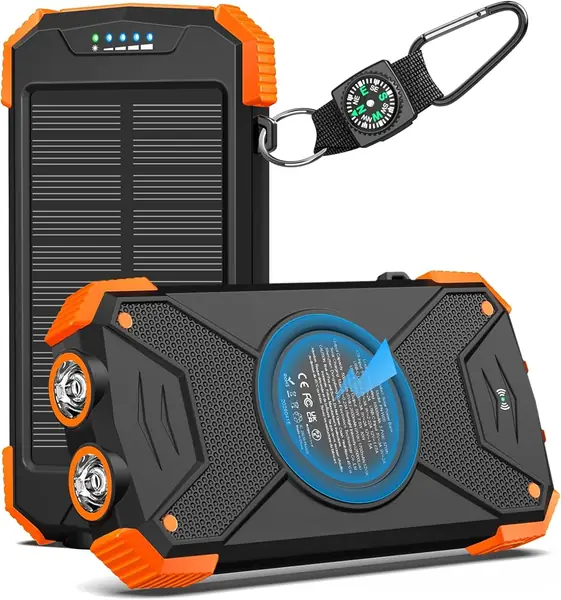
The BLAVOR is the one that disappears into a pack. At 9.3 ounces and about 5.9 by 3.1 by 0.8 inches, it takes up less room than a paperback and adds little to a daypack. That matters more for backpacking than a huge capacity number, and it is why we make it our default: 10,000mAh is enough for a phone, a headlamp, and maybe a camera battery over a weekend.

The 20W USB-C port is the one we reach for first; it gives a modern phone a useful top-up without a long stop. The Qi pad is the other convenience we appreciate at camp, since you can drop a compatible phone on it without hunting for a cable. Three ports make it easy to share with a trail partner. We also like the dual flashlight, which earns its place as a backup in a pack.

The built-in solar panel is the part to keep in perspective. We treat it as an emergency trickle, not a replacement for a wall charge; a panel this size cannot refill a 10,000mAh battery in an afternoon. Start every trip with the bank full, then let the panel slow the drain on a sunny rest day. The IPX5 shell and port covers suit a pack that gets set down in damp grass, though we keep the ports closed when it is raining.

Pros

  • Light enough to forget in a daypack
  • 20W USB-C plus Qi wireless charging
  • Pocket-size IPX5 body

Cons

  • 10,000mAh is a weekend-sized reserve
Our verdict

We reach for the BLAVOR because it disappears into a daypack, still has 20W USB-C and wireless charging, and covers a weekend of phone top-ups.
Check Latest Price
2

YELOMIN PS36K Solar Power Bank Best with Built-In Cables

87 /100
TKZ Score Excellent

Key details

Battery Capacity
38,800mAh
Output
22.5W USB-C
Water Resistance
IP65
Built-in Cables
4
View on Amazon

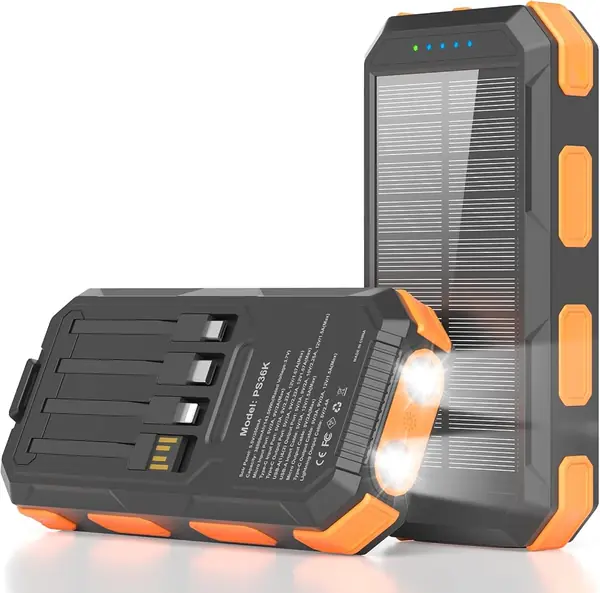
Four cables live inside the YELOMIN PS36K: USB-C, Lightning, Micro USB, and USB-A. That is the feature that makes it easy to recommend for a family pack or a wet weekend, because there is no pouch of tangled cords to remember. The 38,800mAh battery and four ports give it enough reach for several phones, and the IP65 shell is rated for dust and water spray.

Where it earns its place is as the shared bank in a group. We like that the 22.5W USB-C output is quick enough for a modern phone, and the built-in cables cover the odd mix of devices that turn up on a camping trip. The body is 6.3 by 3.1 by 1.4 inches, so it belongs in a lid pocket or side sleeve, not a hip-belt pouch.

The solar panel is a supplemental trickle, not a reason to leave the wall charger at home. We start it full and use the panel to slow the drain on sunny days. The IP65 rating is the other detail we care about, since a bank that lives on the outside of a pack will meet mud, rain, and dropped straps. If you want one bank that covers three phones and a headlamp without a cable roll, this is the one we hand to the group.

Pros

  • Four built-in cables cover mixed devices
  • IP65 shell handles dust and spray
  • 38,800mAh with 22.5W USB-C

Cons

  • Bulkier than pocket-size picks
Our verdict

We recommend the YELOMIN PS36K when you want the cables built in and a weather-sealed body, and you can spare the extra pack space.

Check Latest Price
3

SOARAISE SPB2601 Solar Power Bank Best High-Capacity

86 /100
TKZ Score Excellent

Key details

Battery Capacity
50,000mAh
Weight
16 oz
Output
22.5W USB-C
Wireless Charging
15W
View on Amazon

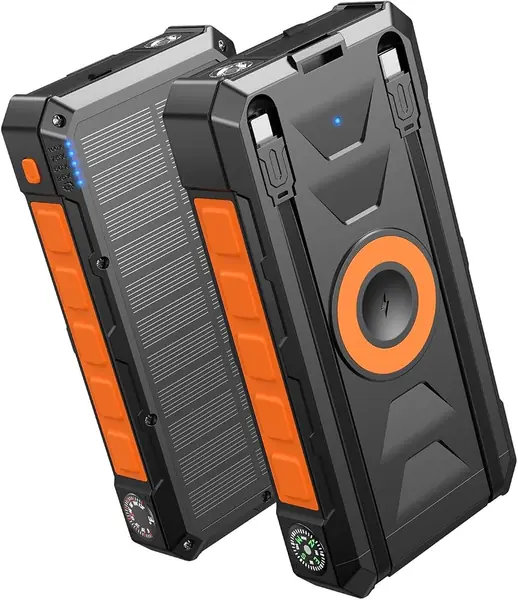
A 50,000mAh battery is a different kind of travel insurance. The SOARAISE puts that reserve in a 16-ounce body about 6 by 3 by 1 inch, with 22.5W USB-C, 15W wireless charging, two built-in cables, and enough outputs to charge six devices at once.

The port layout is built for a group. The 22.5W USB-C port is quick enough to top up a phone during a meal, the 15W wireless pad saves a cable for a compatible phone, and the built-in USB-C and Lightning cables cover the two plugs most people forget. Six-device charging matters when everyone comes back at dusk with a dead phone.

We keep the SOARAISE for basecamp trips, where the reserve and output count matter more than a light pack. The solar panel is a supplement, not a generator; we start it full from the wall and let the panel add a little on sunny days. It stays in the tent or vehicle rather than on a summit push. For a cabin or car camp, that is a good trade.

Pros

  • 50,000mAh for multi-day basecamps
  • 22.5W USB-C plus 15W wireless
  • Charges up to six devices at once

Cons

  • 16 oz is heavy for all-day carry
Our verdict

We keep the SOARAISE for basecamp trips where its 50,000mAh reserve and six-device charging matter more than a light pack.

Check Latest Price
4

YELOMIN S1008D Solar Power Bank Best Budget

85 /100
TKZ Score Excellent

Key details

Battery Capacity
38,800mAh
Weight
9.9 oz
Ports
2 USB-A, 1 USB-C
View on Amazon

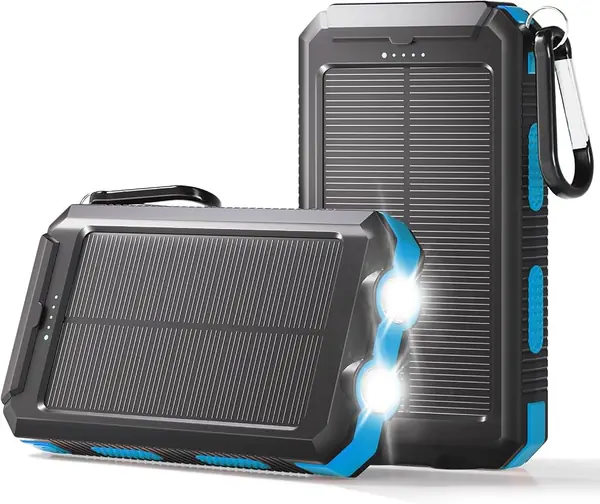
The S1008D is the budget surprise here: a 38,800mAh rating, a 9.9-ounce body, and a carabiner clip for hanging it from a pack strap. We think that combination is hard to beat for a first backpacking bank, especially if you already carry your own charging cables. It does not try to be a pocket charger; it is a reserve you clip on and forget until evening.

Two USB-A outputs and one USB-C input/output give you room for a phone and a headlamp at the same time. The dual LEDs have steady, SOS, and strobe modes, and we like the SOS setting as a just-in-case feature rather than a daily tool. The ports are standard, so the cables you already carry for your phone and headlamp are the ones you use.

The solar panel is a supplemental trickle, best for slowing the drain on a sunny day. We start it full from the wall, then let the panel do what it can while we hike. For a budget backpacker who wants a large reserve without paying for a bundle of attached cables, we think it earns the spot over pricier banks with more packaging. The carabiner clip is the detail that keeps it on the outside of a pack where you can reach it.

Pros

  • 38,800mAh at a budget price
  • 9.9 oz with carabiner clip
  • Dual LEDs with SOS and strobe

Cons

  • No built-in cables
Our verdict

We think the S1008D is the budget pick for backpackers who want big capacity and will pack their own USB-C cable.

Check Latest Price
5

FEELLE SPB2603 Solar Power Bank Emergency Backup

84 /100
TKZ Score Excellent

Key details

Battery Capacity
50,000mAh
Weight
1.1 lb
Solar Panels
4
Built-in Cables
4
View on Amazon

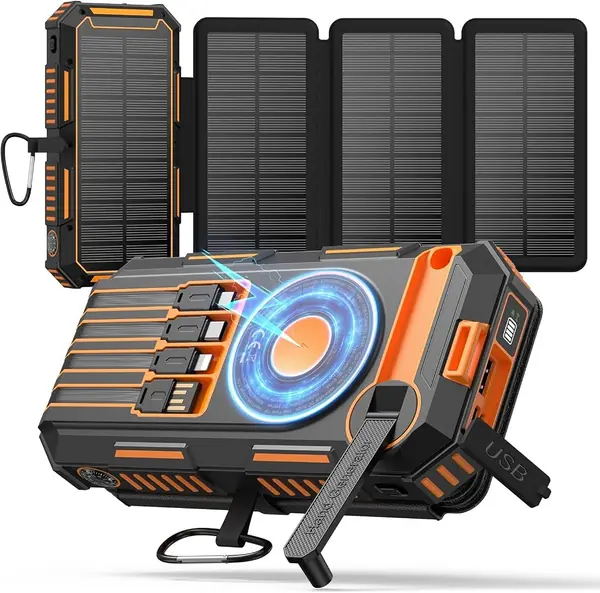
The FEELLE looks like a power bank that expects the grid to fail. It pairs a 50,000mAh battery with four solar panels, a hand crank, four built-in cables, and a magnetic wireless pad, all in a 0.5-kilogram body that measures about 7.2 by 3.5 by 2 inches. That is a lot of emergency kit in one box.

We see it as an emergency kit first and a backpacking bank second. The hand crank is the feature that sets it apart from the SOARAISE; when the sun disappears for a day, it gives you a manual way to put a little charge back in. The four panels are more surface area than a pocket bank offers, and the built-in cables cover the usual phone and tablet plugs. The magnetic pad is handy for a compatible phone, and the built-in cables cover the usual plugs.

We leave it at basecamp, in a vehicle, or in a power-outage box, where its size is easier to forgive. The solar panels need direct sun and a flat surface, and the hand crank is a backup rather than a workout plan. Charge it from the wall before a trip and treat the other two inputs as insurance. Choose it over the SOARAISE when the hand crank matters; the solar panel alone will not make up the difference.

Pros

  • Hand crank adds manual backup
  • Four solar panels for more sun
  • 50,000mAh with four built-in cables

Cons

  • Heavy and bulky for backpacking
Our verdict

We see the FEELLE as an emergency kit first and a backpacking bank second; the hand crank and four panels are for basecamp.

Check Latest Price
6

SolarTred M5WS Solar Power Bank Fixed Camp

83 /100
TKZ Score Excellent

Key details

Battery Capacity
20,000mAh
Weight
1.63 lb
Water Resistance
IP67
Solar Panels
4
View on Amazon

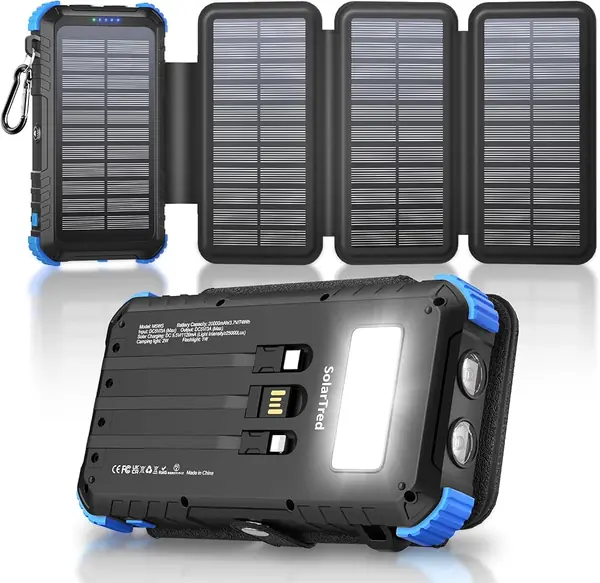
The SolarTred's calling card is the four-panel array and the 1.6-pound body it comes attached to. The array is the most generous here, and the 20,000mAh battery, three built-in cables, IP67 shell, dual flashlight, and camping light make it look like a basecamp tool rather than a pocket bank.

We like it for a camp where the bank can sit in the sun for hours. The four panels give it more chance of catching light than a single panel, and the IP67 rating means rain or a spilled mug is less of a crisis. The built-in cables cover USB-C, Lightning, and USB-A, so a small group can share it without a pouch of extras.

The trade-off is size. It is a large, heavy object for a 20,000mAh bank, and it takes up real room in a pack. We see it as a car-camping or basecamp charger, not something we want on a long climb. The camping light is a nice extra at night, but it does not change that calculation. If your camp is a fixed spot with sun, the four-panel array is worth the carry; if you are moving all day, it is not.

Pros

  • Four-panel array for more sunlight
  • IP67 weatherproof shell
  • Three built-in cables and camping light

Cons

  • Heavy for a 20,000mAh bank
Our verdict

We recommend the SolarTred for campers who want the largest panel array here and can live with its weight and footprint.

Check Latest Price
7

YOLOSKS WEP-82 Solar Power Bank Best for Group Travel

81 /100
TKZ Score Excellent

Key details

Battery Capacity
49,800mAh
Weight
16 oz
Output
22.5W USB-C
Ports
6
View on Amazon

The YOLOSKS is built for the campsite table where four people are jostling for a charge. It packs a 49,800mAh battery, six outputs, four built-in cables, 22.5W USB-C, and wireless charging into a 16-ounce body. On paper, it is the shared hub of this group.

We like the mix of built-in cables and ports because it covers the phones, earbuds, and watch that turn up on a weekend. The wireless pad is convenient for a compatible phone, and the 22.5W USB-C port is the one to use when someone needs a quick top-up. The 6.5 by 3.5 by 1.2-inch body fits in a car console or a large lid pocket, not a running vest.

At 16 ounces, it is not the bank we choose for a fast-and-light trip. The solar panel is a supplemental trickle, so start it full from the wall and use the panel to slow the drain on sunny days. The port count is the reason it makes sense for a shared kit.

We see it as a car-camping or group-trip charger, where the weight is shared and the output count matters more. The six-output count is the reason it stays in the group kit; the weight is why it stays in the car.

Pros

  • Six outputs for group charging
  • 22.5W USB-C plus wireless
  • 49,800mAh with four built-in cables

Cons

  • 16 oz is heavy for backpacking
Our verdict

We like the YOLOSKS as a shared travel hub when several devices need charging, not as the lightest thing in a pack.

Check Latest Price

How We Tested Solar Power Banks on the Trail

We started with roughly 60 listings and cut anything vague about capacity, too thinly reviewed to judge, or priced like a piece of gear rather than a backup battery. That left 14 packs, which we carried for four months across day hikes, two overnights, and a wet weekend that put every port cover to work.

Speed and capability: each morning we started a phone at zero and timed how long it took to reach 50 percent, then added a watch, a headlamp, and earbuds to the other ports to see whether the first device slowed down. We ran the panels in full midday sun and again in tree cover, because a panel in shade is a different product than one on a rock, and we timed how quickly each pack refilled from a wall outlet, which is what most of us end up doing between trips.

Rough handling and daily use: packs rode in hipbelt pockets next to keys, slid off log seats, and sat out a drizzle while we checked the seals. We pulled the built-in cables out and back in a few dozen times to see if the strain relief held, tried wireless charging mid-walk to see whether the phone stayed put, and re-checked the first pack at the end of four months to see if its capacity had slipped. Value came down to cost per full phone charge rather than the number printed on the shell, and we noted the small things, like a flashlight bright enough to cook by and buttons you can find in the dark.

How to Choose a Solar Power Bank for Backpacking

Start With Weight and Realistic Capacity

For a weekend pack, a solar charger with a 10,000mAh bank is the sweet spot: the BLAVOR weighs 9.3 ounces and covers a phone, a headlamp, and a camera battery. Once you move to 38,800mAh or 50,000mAh, the bank becomes a basecamp tool; the SOARAISE and YOLOSKS are both 16 ounces, and the FEELLE is heavier still.

Capacity ratings are not the same as usable output. Conversion losses eat some of the stored energy, and a tablet or a cold phone draws more than a phone at room temperature. Buy for the number of charges you need, not the biggest number on the box.

Treat the Built-In Solar Panel as a Top-Up

A panel that fits on a power bank adds a trickle, not a full recharge. Start every trip with the bank charged from the wall, then use the panel to slow the drain on sunny days. If solar is your main source, a separate folding panel does more, but that is a different piece of kit.

More panel area helps: the SolarTred's four panels are the most generous array here, though its 1.6-pound body is a fixed-camp trade-off. Do not expect any of these banks to refill from empty during a lunch stop.

Match Ports and Cables to Your Kit

For a phone, 20W USB-C is the useful baseline; 15W wireless is a convenience, not a fast charge. Built-in cables save clutter and are the reason to choose the YELOMIN PS36K or FEELLE, but they add bulk and only cover the plugs the maker chose. A separate USB-C port gives you room for a new device or a longer cable.

Count what you carry: phone, watch, headlamp, earbuds, camera. A three-port bank is enough for one person; a group or a family pack is better served by four to six outputs.

Check Weather Sealing and Port Protection

IPX5 handles rain and splashes; IP65 and IP67 add dust protection and survive more abuse. None of these banks is a dive case, so keep the port covers closed and dry the bank before opening them. We prioritize a sealed port cover over a bigger capacity number for a pack that lives outside.

Frequently Asked Questions

Final Verdict

Start with the BLAVOR if you want the lightest bank here: at 9.3 ounces, with 20W USB-C and wireless charging, it is the one we pack for a weekend. The YELOMIN PS36K is the better choice when four built-in cables and an IP65 body matter more than pack space. For a basecamp with several devices, the SOARAISE's 50,000mAh reserve and six outputs make more sense than a pocket bank.