Best Solar Power Banks of 2026

A solar power bank is a battery first and a solar panel a distant second. The panel on any of these is a trickle charger — enough to claw back a partial charge over a long day outside, not enough to bring a dead phone back from zero in an hour. What actually separates them is the battery underneath, plus the small things you only notice after a week in a pack: built-in cables that reach past a phone case, a light you'd genuinely use at night, a shell that survives being set down on rocks.

My team put 14 of them through four months of hikes, car trips, and a two-day outage at home, and the pattern held: capacity claims run optimistic, wireless charging is a convenience rather than a fast lane, and the models with real built-in cables are the ones I stopped thinking about — and the ones I actually enjoyed carrying.

The picks below are the ones that held up on charging speed, honest capacity, durability, and value, not the ones with the biggest number printed on the side.

The Best Solar Power Banks

1

BLAVOR Solar Power Bank Best Overall
86 /100
TKZ Score Excellent

Key details

Battery Capacity
10,000 mAh
Weight
9.3 oz
Water Resistance
IPX5
Wireless Charging
Qi
View on Amazon

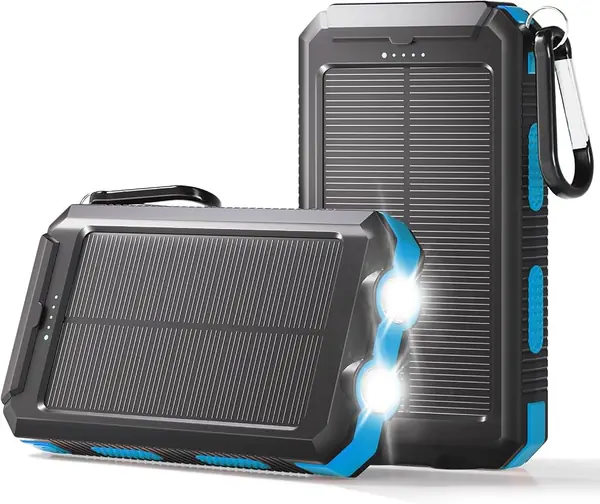
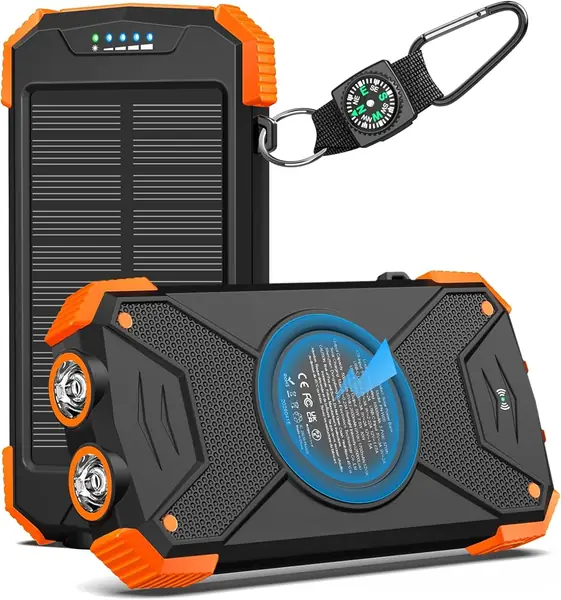
At 9.3 ounces and under an inch thick, the BLAVOR is the pack that ends up in a jacket pocket rather than at the bottom of a duffel, and that's most of why it holds the top spot here. Ten thousand milliamp-hours looks modest beside the five-digit claims elsewhere on this list, and it's the figure we trust: it works out to about two full phone charges, which is what a weekend away actually asks for.

The wireless pad is what we kept coming back to. Setting a phone on the back and walking away is a small convenience that turns into a real one at a campsite, where the alternative is hunting through a bag for the right cable by headlamp. There's a 20W USB-C port for the times you want speed rather than convenience, and the twin LEDs are bright enough to light a tent vestibule or a trailhead sign.

The panel is where expectations need setting. A panel that size will hold the battery roughly where it sits on a sunny dashboard or the top of a pack, and it won't refill 10,000mAh while you wait. Charge from the wall before you leave and let the sun cover the trips that run long. The silicone-edged shell takes a splash from a water bottle without drama, and IPX5 is the right rating for something that lives out in the open.

Pros

  • Light enough at 9.3 ounces for a jacket pocket
  • Wireless pad saves hunting for a cable
  • Twin flashlights are genuinely useful at camp

Cons

  • Some units stop holding a charge within months
Our verdict

This is the solar power bank we hand to most people: pocketable, wireless, and honest about how much charge it actually carries.
Check Latest Price
2

SolarTred 4-Panel Solar Power Bank Best for Serious Sun

85 /100
TKZ Score Excellent

Key details

Battery Capacity
20,000 mAh
Built-in Cables
3
Water Resistance
IP67
Solar Panels
4 built-in panels
View on Amazon

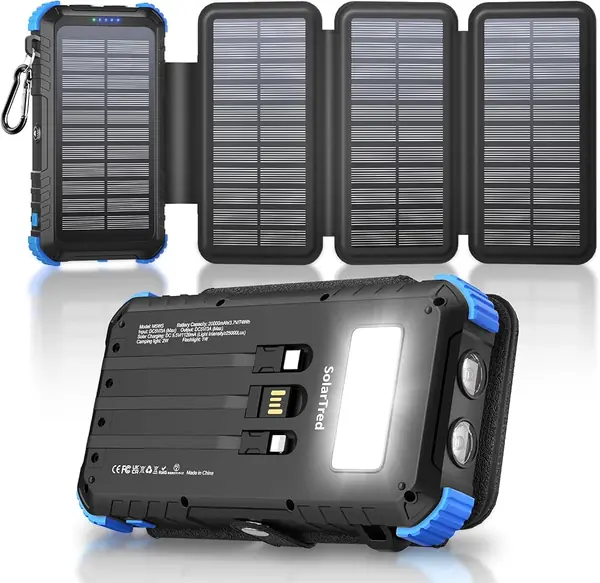
Four hinged panels fold out of the back of the SolarTred like a small satellite array, and they are the reason it's on this list at all. Every other pack here has a single panel about the size of a business card; this one spreads the work over four times the surface. It's the only solar charger in the group where the panel reads as part of the design rather than a sticker that justifies the name.

We won't oversell what that buys you. No panel this size refills 20,000mAh in an afternoon, and the honest pitch is one of degrees: four panels make a dent where one makes a gesture. The rest of the package doesn't lean on the gimmick, either. Twenty thousand milliamp-hours covers several days of phone use, three built-in leads cover USB-C, Lightning, and USB-A input, and up to five devices can draw at once.

Two details earn their keep. IP67 means dust, rain, and a dunking are survivable, which matters for something you leave outside to charge, and the side camping light throws three brightness levels across a tent far better than a phone flashlight does. Set it up at camp with the panels angled at the sun and let it work while the rest of the day happens.

Pros

  • Four folding panels collect far more sun than one
  • IP67 shell survives rain, dust, and drops
  • Three built-in cables plus a camping light

Cons

  • Heavy at 0.74 kg for anything but basecamp
  • Priced above everything else here
Our verdict

If you want solar to do more than decorate the back of a pack, the SolarTred is the one here built for it.

Check Latest Price
3

Etsuati 20,000mAh Solar Power Bank Best Cable-Free Kit

84 /100
TKZ Score Excellent

Key details

Battery Capacity
20,000 mAh
Built-in Cables
4
Fast Charging
20W
Wall Charge Time
3.8 hours
View on Amazon

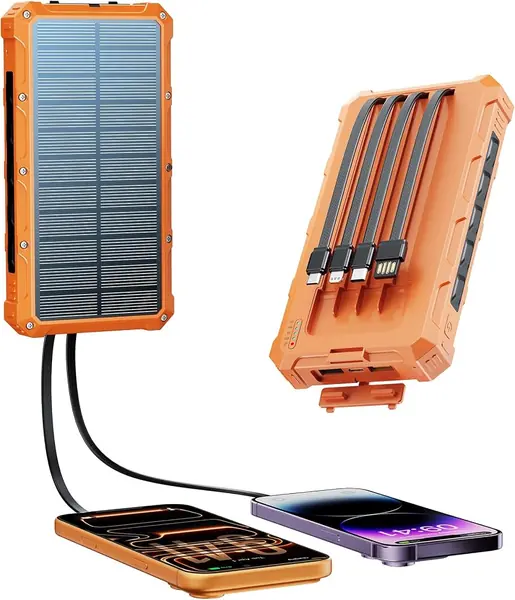
Every charging kit starts with the same small negotiation about which cable goes in the bag. The Etsuati ends it: Lightning, USB-C, Micro-USB, and USB-A leads are built into the body, so the pack is the kit. It also starts charging the moment you connect a device, with no button to find in the dark.

Behind those leads is a 20,000mAh battery with a 20W output, which the maker rates at about 65% of a phone in half an hour. We're more interested in the shape. At 6.89 by 3.74 inches it's a flat, wide pack made for a glovebox or a tote rather than a jeans pocket, and that's the right compromise for something meant to serve four kinds of device.

Where it earns its place is as the household pack — the one that lives in the car and comes out when someone's phone is at 4% halfway to the beach. The trade for built-in leads is that they're short, so expect a phone to ride on top of the pack rather than beside it. There are ports as well, so a longer cable of your own still has somewhere to go.

Pros

  • Four built-in cables cover nearly every phone
  • 20,000mAh carries a weekend of phone use
  • Starts charging on plug-in with no button

Cons

  • Built-in cables can't be replaced if one dies
Our verdict

For anyone whose charging kit is mostly a drawer of mismatched cords, the Etsuati is the pack that ends the argument.

Check Latest Price
4

YELOMIN 38,800mAh Solar Power Bank Best Budget

83 /100
TKZ Score Excellent

Key details

Battery Capacity
38,800 mAh
Weight
9.9 oz
Ports
3
Outputs
2 USB-A, 1 USB-C
View on Amazon

The YELOMIN is the least expensive pack on this list, and at 9.9 ounces it's the second lightest. Those two facts sit oddly next to a 38,800mAh headline, and that tension tells you most of what you need to know before you buy.

Our rule with any pack this light is to plan on a couple of phone charges and treat anything beyond that as a bonus, and by that measure the YELOMIN is a good deal. You get two USB-A outputs plus a USB-C port that takes a charge in and gives one out, a pair of LEDs with steady, strobe, and SOS modes, and a carabiner that clips to a haul loop without a fight.

In hand it feels outdoors-basic in a way we appreciated: a rubberized shell, port covers that seat with a push, and buttons you can find with gloves on. It's the pack for a day hike where the phone is mostly a camera, or a glovebox spare you forget about until you need it. A year of warranty coverage is a reasonable safety net at this end of the market.

Pros

  • 9.9 ounces makes it an easy pack to carry
  • Two USB-A outputs plus USB-C in and out
  • Dual LEDs with strobe and SOS modes

Cons

  • Charge retention is the weak point
Our verdict

The YELOMIN is the one we point to when the budget is the deciding factor and the phone still has to stay alive.

Check Latest Price
5

YOLOSKS 49,800mAh Solar Power Bank Best for Charging a Group

81 /100
TKZ Score Excellent

Key details

Battery Capacity
49,800 mAh
Weight
16 oz
Ports
6
Wireless Charging
Yes
View on Amazon

Sixteen ounces and 1.2 inches thick, the YOLOSKS is not a pack anybody carries by accident — and it's the one that gets passed around a campsite, because six outputs means six phones charging at once. We minded the bulk far less once it was doing that job.

The count is real: three built-in cables, a USB-A output, USB-C and Micro-USB inputs, and a wireless pad, all fed by a 49,800mAh battery rated for 22.5W QC 3.0 on the fast port. We treat that capacity figure as a ceiling rather than a promise, the way we treat every five-digit number on this page, and even so the YOLOSKS will carry a group through a long weekend.

Think of it as household infrastructure rather than hiking gear: the one that sits on a kitchen table when a storm warning goes up, or in the middle of a picnic table with everyone's gear plugged in. Overnight on a wall charger resets it for another day of that, which is the rhythm it's built for.

Pros

  • Six outputs keep a group charged at once
  • 22.5W QC 3.0 on the fast port
  • Wireless pad for phones with no cable handy

Cons

  • Wireless pad often fails to connect
Our verdict

For a car-camping table or a storm kit, the YOLOSKS is the pack that keeps everybody's phone alive at once.

Check Latest Price
6

wongkuo 49,800mAh Solar Power Bank Slim Value Pick

80 /100
TKZ Score Excellent

Key details

Battery Capacity
49,800 mAh
Built-in Cables
4
Fast Charging
QC 3.0
Dimensions
5.7 x 3 x 0.67 in
View on Amazon

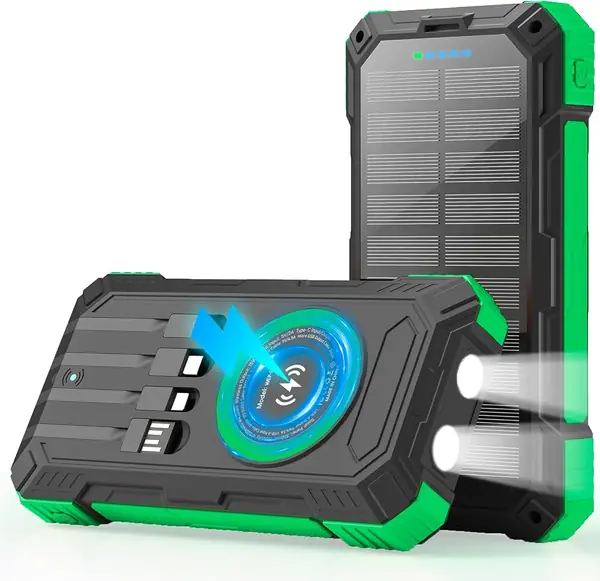
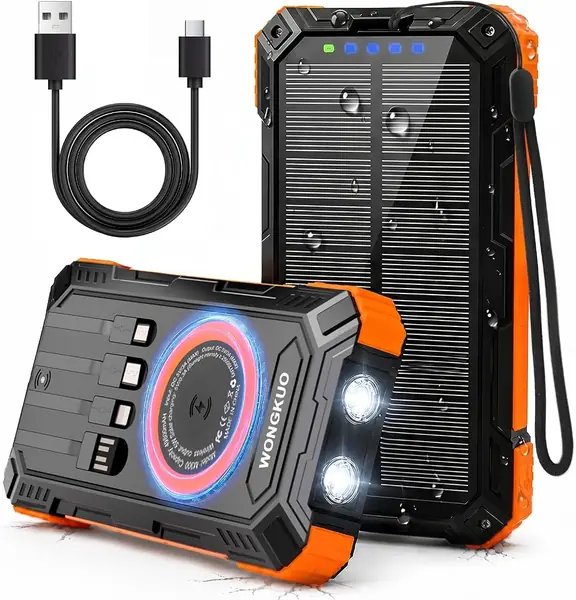
The wongkuo claims the same 49,800mAh as the YOLOSKS and the same wireless pad, in a body roughly two-thirds the size and at about half the money. That combination is why it's on this list — and it's also why we read its spec sheet with one eyebrow up.

The 0.67-inch profile is the part that matters in daily use: it slides into a seat-back pocket or a jacket without the wedge shape the bigger packs have. Four built-in leads plus two USB-A ports and a wireless pad cover a family's worth of devices, QC 3.0 handles the fast-charging claim, and the maker's protection chip covers the usual overcharge and short-circuit guardrails.

Our honest read is that this is a pack built to win a comparison table, and the parts we can check are the good ones: the slim case, the built-in cables, the ports, and the money. What we can't speak to yet is how the battery behaves after a season of real use, so buy it as the second pack — the glovebox one, the festival one — rather than the pack a backcountry trip depends on.

Pros

  • Slim 0.67-inch body slides into a seat pocket
  • Four built-in cables plus two USB-A ports
  • Matches rivals' capacity claim for far less

Cons

No notable drawbacks to flag.

Our verdict

The wongkuo is the value play for big capacity claims: slim, cable-free, and inexpensive enough to keep as a second pack.

Check Latest Price

How We Chose and Tested the Best Solar Power Banks

To build the shortlist, I started with the solar banks that keep surfacing in outdoor forums and customer reviews, then cut anything whose listing wouldn't commit to an output wattage, a stated capacity, or a water-resistance rating. That left 14 models, which we ran through four months of ordinary use: day hikes, one very wet camping weekend, a two-day power outage at home, and the bottom of a hiking pack between trips.

Every unit got the same charge test. I drained it flat, plugged in a phone, and wrote down the percentage gained after 30 minutes to see whether the advertised fast charging showed up in practice, then repeated it with two devices plugged in at once to see how the output split. For solar, I set each bank on a sunny table for a full afternoon and checked how much the panel actually put back — the spread between best and worst was wider than I expected, and it's the claim I now trust least on a spec sheet. Built-in cables got handled the way they get handled in real life: pulled out, bent around a phone in a thick case, and fed back into their channel. Wireless charging was timed the same way, with the case on and off.

Portability came down to where each bank ended up: I weighed it, dropped it in a jacket pocket, and noted which ones I reached for on the way out the door. Durability and reliability came from the boring stuff — a waist-high drop onto concrete, a splash under the faucet, an hour of flashlight run time after dark. Value was a matter of dividing the price by the usable capacity after charging losses, not the number on the label.

How to Choose a Solar Power Bank

What a Panel This Size Can Actually Do

A solar panel that folds onto a phone-sized pack produces a few watts in perfect sun, where a wall charger delivers 10 to 20. That arithmetic is the whole story: think days of direct sun for a meaningful refill, not an afternoon. Charge from the wall the night before any trip where power matters, and let the panel cover the trip that runs longer than planned.

Panel design is what changes the trickle. The SolarTred's four folding panels are the only ones here built around real surface area; the rest are single-panel packs that will hold a charge on a dashboard. If you want the sun to contribute, buy surface area. If you want a charged phone, buy the better battery.

Capacity Claims vs. Usable Charge

Pick the pack up before you believe the number on the box. Lithium cells are heavy, so capacity and weight climb together, and a pack under a pound claiming 38,800 or 49,800mAh is quoting a ceiling rather than a promise. Our working rule is two phone charges from anything around ten ounces, with whatever comes after that as a bonus.

Then allow for conversion. No pack hands its full rating to your phone, because stepping a 3.7-volt cell up to a 5-volt USB output costs a slice of the total. Compare the BLAVOR's 10,000mAh at 9.3 ounces against the five-digit claims, and decide which number you'd rather plan a weekend around.

Weight Decides Whether It Comes Along

Batteries are the heaviest thing in a power bank, so weight tells you both how much capacity you're getting and how often the pack will be with you. Under about ten ounces it disappears into a jacket pocket — the BLAVOR at 9.3 and the YELOMIN at 9.9 both qualify. Past a pound it becomes bag cargo, and the SolarTred at 0.74 kg is basecamp equipment rather than summit kit.

Then match the shell to the trip. IPX5 shrugs off rain and splashes, IP67 survives a dunking, and port covers only do their job when they're seated. For a boat bag or a tailgate, pay for the higher rating.

Ports, Cables, and Honest Speed

Built-in cables are the biggest convenience upgrade in this group. The Etsuati carries four connector types in its body, while the wongkuo and the YOLOSKS give you leads plus spare ports. The trade is that a built-in lead is short and can't be swapped, so treat the ports as your backup rather than as extras.

On speed, 20W over USB-C is the useful benchmark and will move a modern phone quickly; 5V/3A ports work but take longer. Wireless charging is the wildcard — genuinely convenient when a phone lines up on the pad, slower than a cable, and worth having a cord on hand for.

Frequently Asked Questions

Final Verdict

The BLAVOR is the one we recommend first, because on every pack here the solar panel is the least important part of the purchase. What you're really buying is a battery you'll carry, and 9.3 ounces with a wireless pad and a real 10,000mAh earns its pocket space.

When the sun is genuinely the power source — a boat, a basecamp, a week off-grid — the SolarTred's four panels and IP67 shell justify the weight. Working to a tight budget, the YELOMIN covers the basics.