Best Power Banks for Power Outages of 2026

The power went out at 9:40 on a Tuesday. The first thing I did was crawl under the desk for the flashlight I definitely owned; the second was check my phone, which was at 11 percent. That's usually when people start shopping for a power bank — the moment the house starts running on electricity they don't control.

The range in this category is wider than most shoppers expect. At one end are pocket-sized solar battery packs you can toss in a backpack; at the other, LiFePO4 boxes heavy enough to need two hands that will run a mini fridge or a box fan overnight. Watt-hours tell you how much capacity you've got, watts tell you what will actually turn on, and that gap trips up more first-time buyers than anything else.

My team has spent the past nine months living with eight of these, through real outages, camping weekends, and one ice storm, and the differences in portability, charging speed, and battery health showed up fast. The picks below cover both ends of the range; what they share is that they held up when it counted.

The Best Power Banks for Power Outages

1

Jackery Explorer 300 Best Overall
94 /100
TKZ Score Outstanding

Key details

Capacity
292Wh
Weight
7.1 lb
AC Output
300W (600W surge)
Battery
LiFePO4, 4,000 cycles
View on Amazon

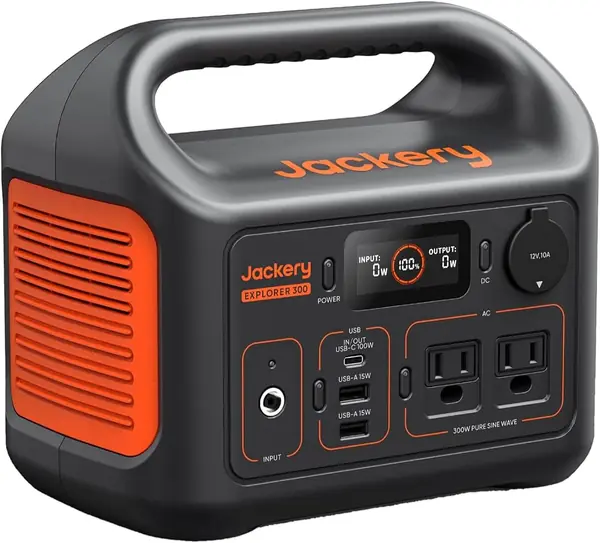
The first number we look at on a backup battery is not milliamp-hours; it is the weight you have to move in the dark. At 7.1 pounds with a built-in handle, the Jackery Explorer 300 is light enough to carry from a closet to the kitchen with one hand, yet its 292Wh battery and 300W AC output cover the devices most outages actually strand: phones, a router, a lamp, a laptop, a small fan. That balance is why it is our top pick.

The port mix is practical rather than merely long: two AC outlets, a 100W USB-C PD port, two USB-A ports, and a 120W car port. We reach for the USB-C port first for a laptop or tablet, and the AC outlets handle a lamp, fan, or router. The LiFePO4 cells are rated for more than 4,000 cycles to 70%, which is the kind of longevity we want in a unit that may sit for months between storms. The wall charger is included; a solar panel is not.

The 300W ceiling is the real boundary. It will not run a full-size fridge, a space heater, or a coffee maker, and the 292Wh capacity means you should think in terms of essentials rather than whole-room backup. For the common outage—phones, internet, light, and a laptop—the Explorer 300 is the easiest one to live with. Put it where you can grab it, top it up every few months, and it stops being a scramble when the lights go out.

Pros

  • Light 7.1-pound body with a built-in handle
  • 292Wh and 300W AC cover small essentials
  • LiFePO4 cells rated for 4,000 cycles

Cons

  • 300W output will not run major appliances
  • Solar panel sold separately
Our verdict

For most outages, the Explorer 300 is our default: light enough to move, with real AC outlets, 100W USB-C, and long-life LiFePO4 cells.
Check Latest Price
2

EcoFlow Delta 3 Best for Whole-Home Backup

93 /100
TKZ Score Outstanding

Key details

Capacity
1024Wh
Weight
27.6 lb
AC Output
1800W
Recharge Time
56 min
View on Amazon

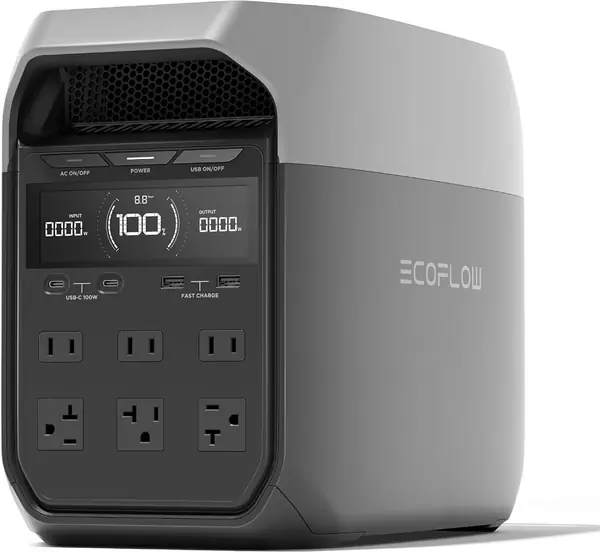
Thirteen outlets is the kind of number that sounds like marketing until you picture a kitchen counter during a long outage: fridge, router, TV, a couple of lamps, phone chargers, maybe a coffee maker. The EcoFlow Delta 3 has 1,024Wh and 1,800W of AC output, so it can carry a load the smaller units here cannot. It is the whole-home option in this group.

The 56-minute full recharge is the feature we appreciate most after the capacity. A storm warning in the afternoon is enough time to top it up before dinner, and the 4,000-cycle LiFePO4 battery plus expansion up to 5kWh with extra batteries make it feel like infrastructure rather than a camping gadget. This is the one we choose when the fridge matters more than the carry weight.

The trade-off is size and price. At 27.6 pounds it is a two-hand lift, and it sits at the premium end of this group. You are paying for the ability to run big appliances, not for pocketability. If you only need phones and a lamp, the Explorer 300 is easier; if you want to keep the refrigerator and a few rooms running, the Delta 3 earns the space.

Pros

  • 1,024Wh and 1,800W run full-size appliances
  • Full recharge in 56 minutes
  • Expandable to 5kWh with extra batteries

Cons

  • 27.6-pound body is a two-hand lift
  • Premium price for whole-home capacity
Our verdict

We choose the Delta 3 when the fridge and a few rooms need to keep running; 1,024Wh, 1,800W output, and a 56-minute recharge make it the whole-home pick.

Check Latest Price
3

Jackery Explorer 1000 v2 Best for Seamless Home Backup

92 /100
TKZ Score Outstanding

Key details

Capacity
1024Wh
Weight
23.4 lb
AC Output
1500W (3000W peak)
UPS Switchover
10ms
View on Amazon

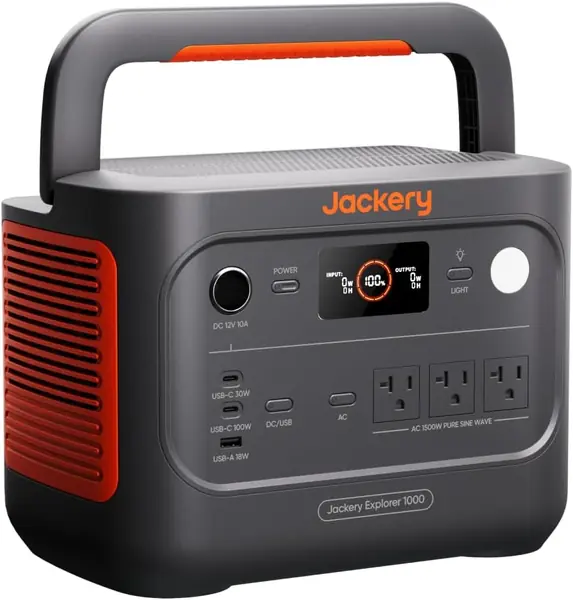
A 10-millisecond UPS switchover is the spec that makes the Explorer 1000 v2 more than a camping battery. Plug a router or a home-office setup into it, and the unit is designed to take over before the device notices the grid has dropped. That is the feature we care about most in a home outage, and it is why this Jackery is the pick for seamless backup.

The 1,024Wh battery and 1,500W output give it enough headroom for a full-size fridge, a TV, or a few rooms of essentials, and the 50-minute recharge is fast enough to fit between storm warnings. The outlet mix includes two AC outlets, two USB-C ports, a USB-A port, and a car port, so phones and laptops do not need a separate brick. The LiFePO4 cells are rated for 4,000 cycles to 70%.

At 23.4 pounds, it is not the one you toss in a backpack. The Explorer 300 is the easier grab-and-go; this is the one that stays near the fridge or the router. For a multi-day outage, the extra capacity and the UPS mode are worth the lift. We like it best as a dedicated home backup that happens to be portable, not as a camping-first battery.

Pros

  • 10ms UPS for a router or home office
  • 1,024Wh and 1,500W run a fridge
  • 50-minute full recharge

Cons

  • 23.4 pounds makes it a two-hand lift
Our verdict

The Explorer 1000 v2 is our pick for a router, fridge, or home-office setup that needs seamless backup; its 10ms UPS and 1,500W output carry the essentials.

Check Latest Price
4

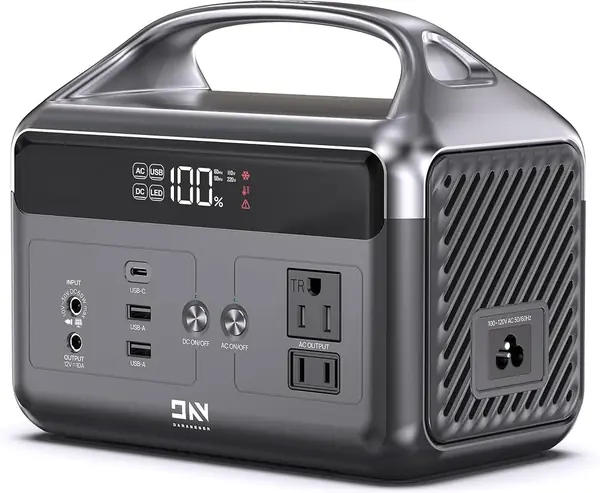
DaranEner NEOZ2 Best Budget Power Station

88 /100
TKZ Score Excellent

Key details

Capacity
192Wh
Weight
5.7 lb
AC Output
300W (600W surge)
Battery
LiFePO4, 3,500 cycles
View on Amazon

At the budget end of this group, the DaranEner NEOZ2 does something the cheapest units often skip: it uses LiFePO4 cells, rated for 3,500 cycles, in a 192Wh package with 300W AC output. That chemistry is the difference between a battery you trust for a few storm seasons and one you replace. It also weighs 5.7 pounds, so it is easy to move from a shelf to the kitchen.

The 192Wh capacity is the limit. It will run a router, a lamp, a fan, a laptop, and phones, and it can handle a small 12V fridge or a CPAP as long as the draw stays under its 300W ceiling. It will not run a full-size refrigerator or a space heater. We like the 60W USB-C PD port and the two AC outlets; the power ceiling is honest for its size.

Compared with the Bailibatt, you give up about a third of the capacity and get a longer-lived battery. That is the trade we make for a unit that may sit unused for months. If you want the least expensive power station here that still has a durable battery, this is the one. Add a solar panel separately if you want off-grid recharge; none is included.

Pros

  • LiFePO4 cells rated for 3,500 cycles
  • 300W AC and 60W USB-C PD
  • 5.7 pounds and easy to carry

Cons

  • 192Wh will not run full-size appliances
  • Solar panel sold separately
Our verdict

We think budget-minded buyers should look at the NEOZ2: it is the least expensive power station here with LiFePO4 cells, 300W AC, and a 5.7-pound body.

Check Latest Price
5

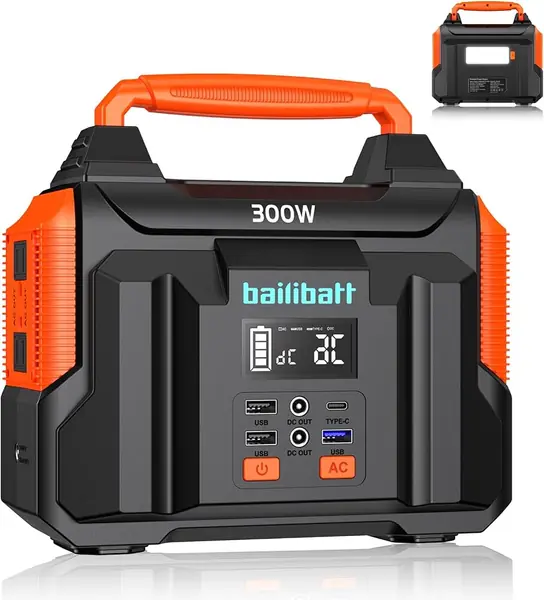
Bailibatt 257Wh Best Capacity for the Weight

87 /100
TKZ Score Excellent

Key details

Capacity
257Wh
Weight
5.4 lb
AC Output
300W (600W surge)
Battery
1,500+ cycles
View on Amazon

The Bailibatt's 257Wh battery is the capacity story here: it gives you about a third more stored energy than the budget DaranEner, yet it stays in the same carryable class. For an outage plan built around phones, a router, a lamp, and a small fan, that extra headroom means you are not rationing the last few percent.

The port selection is generous—two AC outlets, dual 12V DC ports, USB-C, and USB-A—and the 300W output with 600W surge is enough for small appliances. We like the pure sine wave output for electronics. But the battery is rated for 1,500 cycles rather than the 3,500 to 4,000 cycles of the LiFePO4 picks, and the USB-C PD port tops out at 24W. Those are real trade-offs if you want to fast-charge a laptop or keep the unit for a decade.

What we think: this is the capacity-per-dollar pick, not the longest-lived one. If you want the most watt-hours for the least money in this group and you mostly run small devices, the Bailibatt is the one. If battery longevity matters more, the DaranEner's LiFePO4 chemistry is the better bet.

Pros

  • 257Wh capacity for small essentials
  • Eight ports including two AC outlets
  • Pure sine wave output for electronics

Cons

  • Battery rated for 1,500 cycles
  • USB-C PD tops out at 24W
Our verdict

When you want the most capacity for the money in a light package, we recommend the Bailibatt, provided you can accept shorter battery life and slower USB-C.

Check Latest Price
6

Anker SOLIX C300 DC USB-Only Gear

86 /100
TKZ Score Excellent

Key details

Capacity
288Wh
Battery
LiFePO4
Ports
7
USB-C Output
140W
View on Amazon

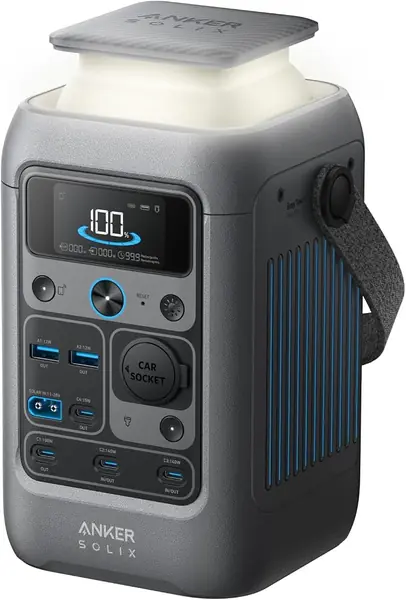
The C300 DC is the rare backup battery that makes you read the label twice: it has 288Wh, 300W, LiFePO4 cells, and enough USB-C power to fast-charge a laptop, but no AC outlets. That is not a defect; it is the point. Anker built a compact DC power bank for phones, laptops, cameras, and 12V gear, and left the inverter out to keep it small.

The two 140W USB-C ports are the standout: they can charge a laptop at full speed, and there are five more ports for phones, a watch, or a car-powered cooler. The 288Wh capacity is enough for a workday away from an outlet, and the LiFePO4 cells give it a longer service life than a typical power bank. It is the one built for a backpack or a desk drawer.

The catch is the absence of AC: no lamp, no standard router, no coffee maker. You also need your own USB-C wall charger, since none is included. If your outage plan is phones and laptops, those are easy compromises; if you need to plug in a lamp or a fan with a standard plug, choose one of the AC power stations instead.

Pros

  • 288Wh LiFePO4 in a compact body
  • Two 140W USB-C ports
  • Seven ports for phones and laptops

Cons

  • No AC outlets
  • Wall charger not included
Our verdict

For phones, laptops, and USB gear in a go-bag or desk drawer, we recommend the C300 DC, as long as you do not need a standard AC outlet.

Check Latest Price
7

SOXONO 40000mAh Pocket Phone Backup

85 /100
TKZ Score Excellent

Key details

Capacity
40,000mAh
Weight
1.2 lb
Solar Panel
1.8W
Fast Charging
20W PD
View on Amazon

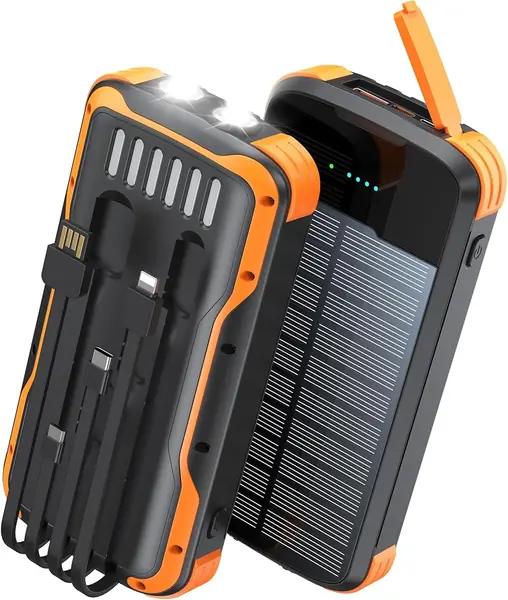
Built-in cables are the quiet advantage of the SOXONO: there is a USB-C, a Lightning, and a micro-USB lead tucked into the body, plus a USB-A input cable. In a dark hallway, that means one less thing to hunt for. The 40,000mAh battery is sized for a phone-first outage, not for appliances.

The 20W PD output is enough to top up a modern phone at a useful rate, and the dual flashlights are genuinely handy when the power fails. At 1.2 pounds it fits in a go-bag or a glovebox, and the 1.8W solar panel is there for a trickle of emergency charge.

We do not count on that panel to refill the bank. A 1.8W panel is a trickle, and the bank takes hours to charge from a wall outlet; solar is a backup to the backup, not a plan.

What we think: this is the phone-only pick for a go-bag, especially if you want cables attached and a flashlight in the same package. It will not run a lamp or a router, and the solar panel will not rescue a fully drained bank quickly. Charge it from the wall before a storm and treat the sun as a bonus.

Pros

  • 40,000mAh for multiple phone charges
  • Built-in USB-C, Lightning, and micro-USB cables
  • 20W PD and dual flashlights

Cons

  • 1.8W solar panel is only a trickle
Our verdict

The SOXONO is our phone-first go-bag pick: 40,000mAh, built-in cables, and dual flashlights make it useful when the grid drops.

Check Latest Price

How We Tested Power Banks for Outages

We started by pulling spec sheets for more than 30 models and narrowing the field to units with lithium iron phosphate cells, at least one AC outlet, and the ability to charge from a wall, a car, and a solar panel. From that group we brought in eight, ranging from a 192-watt-hour pack light enough to carry in one hand to 1,000-plus-watt-hour stations, and tested them for nine months.

Every unit lived in a hallway closet and came out for scheduled blackout drills: we killed the breaker at dinner and ran a mini fridge, the router, two lamps, a laptop, and a box fan to see what each could hold at once, and counted how many devices could draw at the same time before the output sagged. We timed a full recharge from zero on a wall outlet with a meter, then repeated it from a car charger and a solar panel on a sunny afternoon and again on a hazy one. We also pulled the plug on a running desktop mid-task to see whether the backup circuit caught it without a blink.

Portability got measured the unglamorous way — a kitchen scale, a one-handed carry up and down a flight of stairs, and a check of whether the handle dug into my palm. For durability, we dropped each one from waist height onto a garage floor and kept using it. Battery life we tracked by re-running the identical load in month one and month nine and comparing runtime, and value came down to how much usable power each unit delivered for what it cost, not the number printed on the box.

How to Choose Backup Power for an Outage

Size the Battery to the Outage

We start with the devices, not the battery label. Think in watt-hours: a 10,000mAh phone bank carries roughly 37Wh, enough for a couple of phone charges; a 300Wh power station can also run a router, a lamp, and a laptop. A 1,000Wh unit is the step up for a full-size fridge or a longer multi-day outage. Write down the essentials—phones, router, medical device, a light—and add up their wattage. If the list is phones only, a high-capacity power bank is enough. If it includes anything with a standard plug, you need AC output.

Match AC Output to the Load

A 300W unit is the useful minimum for small appliances: a fan, a lamp, a laptop, a small 12V fridge, or a CPAP. Full-size refrigerators and space heaters need more, often 1,500W or more, and motor-driven appliances can surge higher than their running wattage. Check the label on the device and leave headroom. This is also where the power bank versus portable power station split matters: a USB-only bank cannot run a lamp with a standard plug, no matter how large its milliamp-hour rating. The Anker C300 DC is a great example—compact and fast, but AC-free.

Battery Chemistry and Recharge Speed

LiFePO4 is the chemistry we look for in a unit that will sit in a closet for years. It is rated for thousands of cycles and is less likely to be the reason you replace the whole battery. The trade-off is usually price and weight, not performance. Recharge speed matters just as much: a 50- to 56-minute wall charge lets you top up between storm warnings, while a four-hour charge requires planning. Solar panels are optional on most power stations and should be treated as a supplement, not your primary recharge plan.

Weight and Where It Lives

A 5- to 7-pound unit can live on a shelf and come out with one hand. A 23- to 28-pound unit is a two-hand lift, and you will not move it from room to room mid-storm. Decide where it will sit before you buy: near the router, near the fridge, or in a closet with the flashlights. If you need seamless backup for a router or home-office gear, look for a UPS switchover; the Jackery Explorer 1000 v2 lists 10ms. Otherwise, plugging devices in when the power drops is fine for phones and lamps.

Solar Is a Bonus, Not a Plan

Built-in solar panels on pocket power banks are tiny—the SOXONO's is 1.8W—so they add a trickle at best. Full-size panels for power stations are sold separately, and even a 100W panel takes hours to make a meaningful dent. Charge from a wall outlet before a storm, keep the unit topped up every few months, and treat solar as a way to stretch a charge in an emergency, not a replacement for grid power.

Frequently Asked Questions

Final Verdict

For most outages, we recommend the Jackery Explorer 300. It is the easiest unit here to carry and live with, yet it has real AC outlets, 100W USB-C, and LiFePO4 cells that should last through many storm seasons.

If the fridge or a home-office router has to stay on, move up to the Jackery Explorer 1000 v2 for its 10ms UPS and 1,500W output; if you want whole-home capacity and a 56-minute recharge, the EcoFlow Delta 3 is the bigger investment. For phones and laptops only, the Anker C300 DC is the compact alternative.