Best Power Banks for Multiple Devices of 2026

A power bank makes a simple promise: your phone, your tablet, and maybe your laptop all make it to the end of the day. The trouble is that the promise scales with the brick — capacity big enough for a laptop and two phones can weigh as much as a hardcover book, and the slim ones that slip into a jacket pocket usually deliver one phone charge and quit.

I've carried some version of one of these on nearly every trip for years, and over the past seven months my team and I ran 12 power banks through airport gates, train seats, and one muddy camping weekend. Here's what nobody tells a first-time buyer: the built-in cable is not a gimmick. A pack with its own USB-C cables can be handed to a seatmate without the whose-cord-is-whose negotiation, and a percentage readout you can trust beats four blinking dots every time.

What follows is sorted the way we actually choose — by how much weight you're willing to carry for how many devices you need to keep alive.

The Best Power Banks for Multiple Devices

1

Anker Zolo 20K 45W Best Overall
93 /100
TKZ Score Outstanding

Key details

Battery Capacity
20,000 mAh
Simultaneous Devices
4
Max Output
45W
Built-In Cables
2 USB-C
View on Amazon

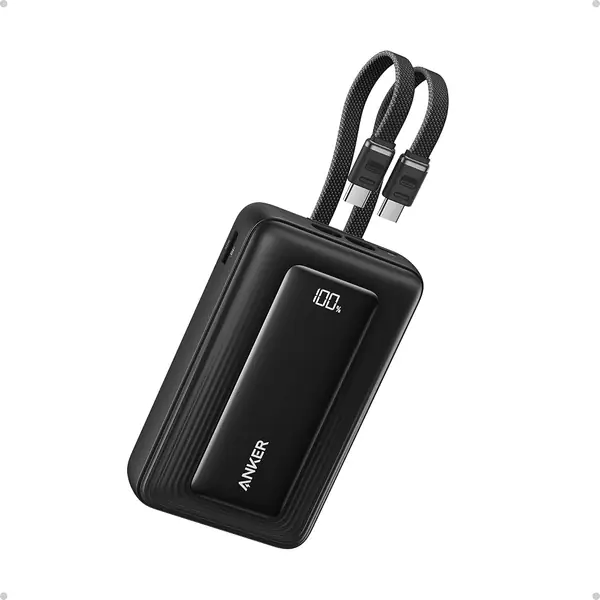
The two built-in USB-C cables are why the Anker Zolo is our default pick. It has two cables plus a USB-C port and a USB-A port, so four devices can share the 20,000mAh battery without a nest of loose cords. For phones, a tablet, and earbuds, that is the useful kind of overkill: one pack, no cable pouch.

The 45W total output is the part that needs context. It is enough for a phone and tablet to charge at a sensible pace, and the built-in USB-C cable supports fast charging on newer iPhones and Android phones. It will not replace a laptop brick, and at 12.85 ounces it is better in a tote than a jeans pocket. The USB-A port is the escape hatch for an older device or a borrowed cable.

What we appreciate most is the combination of capacity and cable discipline. The two USB-C cables are the ones we reach for first, and the spare port means a Lightning cable can still join the party for an older iPhone. The catch is that the built-in cables are USB-C only; if your household still runs Lightning, add a short cable. The 18-month warranty covers the battery, and the Zolo is the least fussy way to leave the house with four charging options.

Pros

  • Two built-in USB-C cables reduce cord clutter
  • Four outputs cover phone, tablet, and earbuds
  • 20,000mAh and 45W balance capacity with speed

Cons

  • Five-hour recharge is slow for a 20K pack
  • Built-in cables are short for tablet charging
Our verdict

We recommend the Anker Zolo to most people because its two built-in USB-C cables and four outputs make multi-device charging genuinely less fiddly.
Check Latest Price
2

Orfeika 20000mAh Best for Families

92 /100
TKZ Score Outstanding

Key details

Battery Capacity
20,000 mAh
Simultaneous Devices
6
Max Output
20W
Built-In Cables
4
View on Amazon

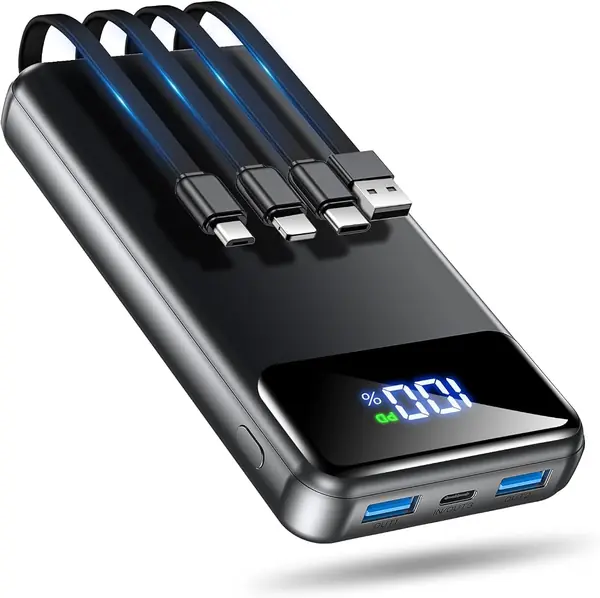
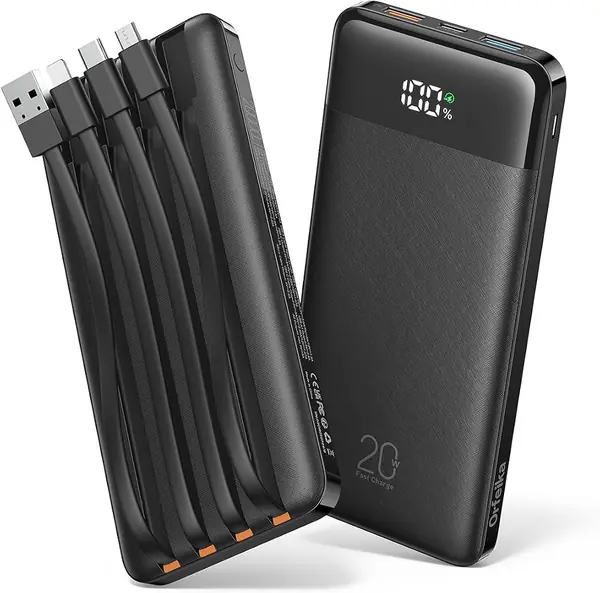
Six outputs sounds like a spec-sheet boast until you are carrying the charging bag for a family. The Orfeika backs it up with three built-in output cables and three external ports, plus four inputs for topping up the pack itself. That is a lot of redundancy, and the good kind: an iPhone, a USB-C phone, a tablet, and a pair of earbuds can all find a place. It is the pack for a rental car, a campsite, or a hotel room with one outlet.

The feature we value most is connector coverage. The built-in cables handle Lightning, USB-C, micro-USB, and USB-A, so a mixed household can leave the adapter pouch at home. The 20W USB-C PD output is enough to move a modern phone without pretending to be a laptop charger, and 20,000mAh gives a realistic three to four phone charges. The LED display is a useful check before a day out. The 0.73-pound body is bag-only, and the attached cables cannot be replaced if one is damaged; the two-year warranty is the reassurance.

Pros

  • Four built-in cables cover mixed connectors
  • Six outputs charge a family's devices at once
  • 20W USB-C PD and 20,000mAh capacity

Cons

  • Long-term battery life is the open question
Our verdict

We reach for the Orfeika when several phones and tablets need charging; its six outputs and four built-in cables are the reason.

Check Latest Price
3

HELLEE 15000mAh Best Budget

91 /100
TKZ Score Outstanding

Key details

Battery Capacity
15,000 mAh
Simultaneous Devices
6
Weight
8.82 oz
Built-In Cables
4
View on Amazon

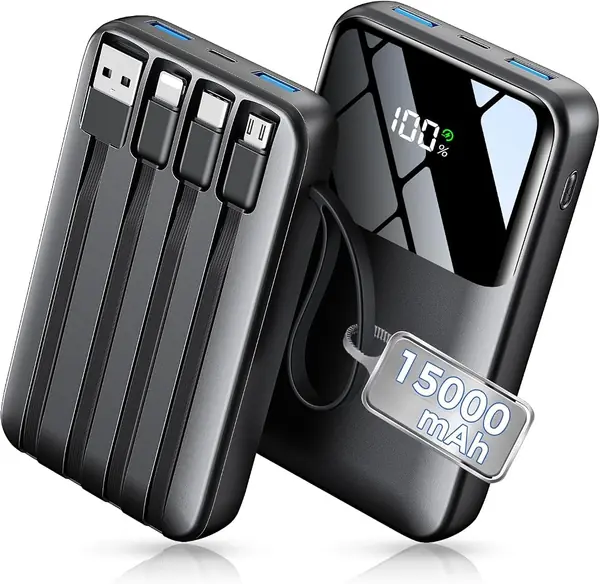
The HELLEE is the budget portable charger that does not act like one. It gives you six outputs, four built-in cables, and a 15,000mAh battery that is sized for phones rather than laptops. For a family that needs to keep three phones alive on a day out, that is the right trade.

At 250 grams, it is light enough to live in a purse or a glovebox, and the 22.5W output is quick enough for a phone. The LED display is more useful than a row of dots when you are deciding whether to recharge at lunch. We also appreciate the bi-directional USB-C port, which lets the pack recharge through the same cable you use for a phone.

The catch is the ceiling: six outputs share 22.5W, so a tablet and two phones will slow each other down. For phone-first trips, that is a fair trade; the compact body and the built-in cables are the reason it comes along. A laptop needs its own USB-C cable and a lot of patience, so this is not the pack for a work trip.

Pros

  • Six outputs and four built-in cables
  • 250-gram body travels easily
  • 22.5W fast charging with LED display

Cons

  • Built-in cables are fixed and cannot be replaced
Our verdict

We keep the HELLEE on the budget shortlist because it gives a family six outputs and four built-in cables without the bulk of a high-capacity pack.

Check Latest Price
4

Anker 25K 165W Best for Laptops

90 /100
TKZ Score Outstanding

Key details

Battery Capacity
25,000 mAh
Simultaneous Devices
4
Max Output
165W
Weight
10.6 oz
View on Amazon

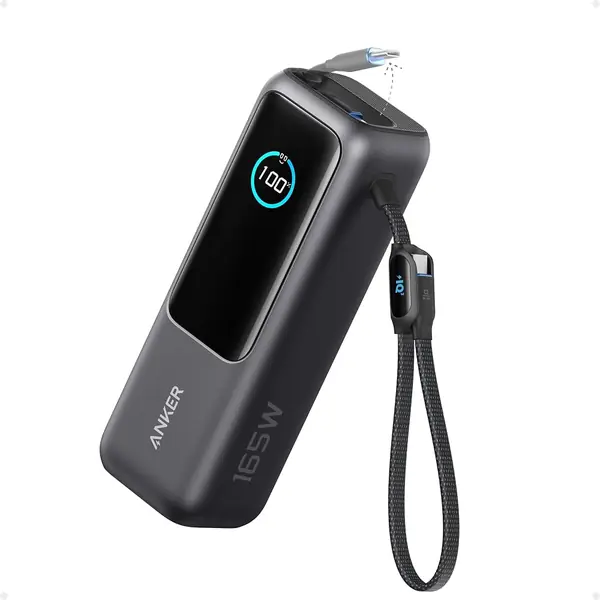
The Anker 25K is the pack that treats a laptop as a first-class device, not an afterthought. Three USB-C ports, each rated up to 100W, and 165W total output mean a MacBook Air and a phone can share the pack without one crawling. It also has two built-in USB-C cables, one retractable to 2.3 feet, plus a USB-A port, so four devices can charge at once.

We value the retractable cable more than the wattage number. It extends far enough to reach a laptop on a tray table and retracts into the body, which is the difference between a pack that lives in a bag and one that tangles in it. The shorter cable doubles as a carrying strap, a small design choice that keeps the whole thing together.

The 165W total is shared, not per port, so three laptops will not each pull 100W; one laptop plus a phone is the realistic load. At 300 grams, it is lighter than several 20K packs here, though its brick shape still belongs in a bag. The 25,000mAh capacity is a long-haul reserve rather than a pocket top-up.

For a road warrior, the retractable cable and triple USB-C layout are the real prize: they replace the laptop charger and the cable pouch for a day of work away from an outlet. The 18-month warranty is the backstop, and the retractable mechanism deserves careful handling.

Pros

  • 165W total across three USB-C ports
  • Retractable built-in USB-C cable
  • Four-device charging with 25,000mAh
  • Lighter than several 20K packs here

Cons

  • Wall charger is not included
  • Long-term reliability is the open question
Our verdict

We recommend the Anker 25K for anyone who needs to charge a laptop and phone together; its triple USB-C ports and retractable cables are the difference.

Check Latest Price
5

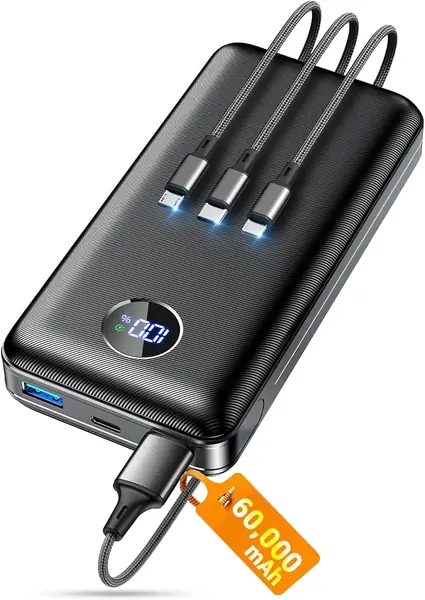
IAPOS 60000mAh Best Massive Capacity

89 /100
TKZ Score Excellent

Key details

Battery Capacity
60,000 mAh
Simultaneous Devices
5
Max Output
22.5W
Weight
15.5 oz
View on Amazon

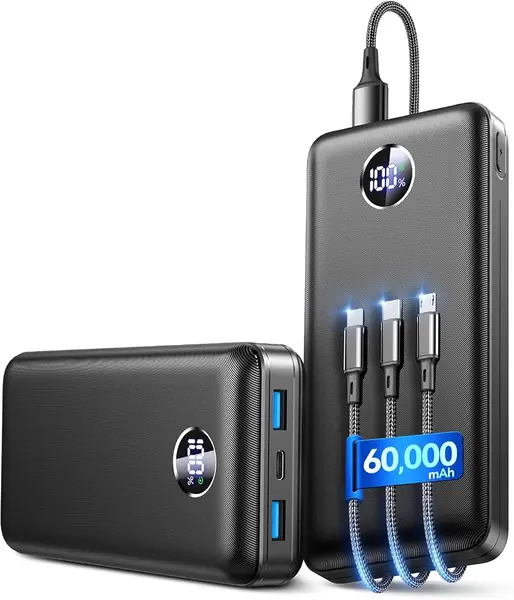
Sixty thousand milliamp-hours is the kind of number that makes a power bank a piece of furniture. The IAPOS puts that capacity in a 5.9 by 2.95 by 1.1-inch body and lays out five-device charging through two USB-A ports, one USB-C port, and a 3-in-1 cable. That is enough to refill a phone several times, charge a tablet, and still leave something for a camera or earbuds on a long trip. The digital display is the right call at this size, because a row of vague dots would be useless when you are deciding whether to pack it for a flight.

We value the 3-in-1 cable more than the raw capacity: it covers USB-C, Lightning, and micro-USB, so a mixed group can leave the cable pouch at home. The three-year warranty is longer than most here, and on a pack that may live in a car or campsite, that coverage matters. For a camping box or an outage kit, the capacity and the built-in connector mix are the reasons it earns the space.

Pros

  • 60,000mAh capacity for multi-day trips
  • Four built-in cables cover major connectors
  • Five-device charging for groups
  • Three-year warranty backs the battery

Cons

  • 22.5W ceiling is phone-only
  • Heavy at 15.5 ounces
Our verdict

We choose the IAPOS for long trips because 60,000mAh and five-device charging keep a group going, as long as you can live with the weight.

Check Latest Price
6

Zmmyuluo 10000mAh Pocket Carry

88 /100
TKZ Score Excellent

Key details

Battery Capacity
10,000 mAh
Simultaneous Devices
5
Weight
6.63 oz
Built-In Cables
4
View on Amazon

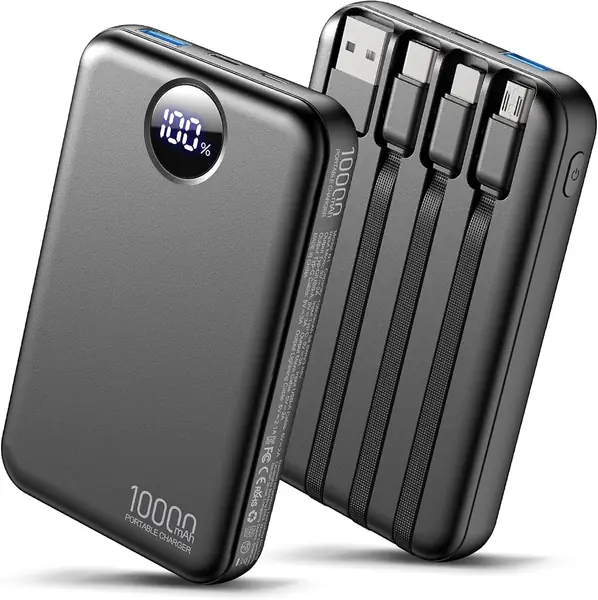
At 188 grams, the Zmmyuluo is the pack that disappears into a small bag. It is about the weight of a thick phone, yet it carries four built-in cables and enough outputs for five devices at once. That is the trick: a 10,000mAh pack is usually a compromise, but this one is small enough to carry without planning.

The four built-in cables cover the everyday mix: Lightning, USB-C, and micro-USB are the connectors most bags still need. The LED display shows percentage, which is more useful than guessing from four dots. We also appreciate the five-device layout for a phone, earbuds, and a friend's phone, though the 10,000mAh battery is the real limit on how long that lasts.

The LED display is a small detail we notice more than expected: on a pack this small, the difference between 20% and 60% decides whether you grab it on the way out. The four built-in cables are the reason it earns its 188 grams. It is a top-up pack, not a weekend pack, and that is the right role for something this light.

Pros

  • 188-gram body is pocketable
  • Four built-in cables cover common connectors
  • Five-device charging in a tiny pack

Cons

  • Charging speed can feel slow
  • Cables are fixed and cannot be replaced
Our verdict

We like the Zmmyuluo for a small bag: it weighs 188 grams, still carries four built-in cables, and covers five devices at once.

Check Latest Price
7

OHOVIV 50000mAh Group Capacity

87 /100
TKZ Score Excellent

Key details

Battery Capacity
50,000 mAh
Simultaneous Devices
6
Max Output
22.5W
Built-In Cables
4
View on Amazon

Fifty thousand milliamp-hours is the kind of number that makes a power bank a piece of furniture. The OHOVIV puts that capacity in a 5.82 by 2.83 by 1.18-inch body and adds four built-in cables for iPhone, USB-C, micro-USB, and USB-A. That is a lot of charging for a pack that still fits in a backpack.

The layout is built for a group: four cables plus three ports, with six devices charging at once. The digital display is the right call on a pack that can run for days, and the 22.5W output gets a phone moving.

What we like is the cable mix. A group rarely carries the same phone, and having Lightning, USB-C, micro-USB, and USB-A attached removes the most common reason a shared pack goes unused. For a camping box or an outage kit, the cable mix is the practical part; the capacity is what keeps a group off the outlet hunt.

Pros

  • 50,000mAh capacity at a value price
  • Four built-in cables cover major connectors
  • Six-device charging
  • Digital display shows remaining power

Cons

  • 22.5W ceiling is phone-only
  • 12-month warranty is short
Our verdict

We see the OHOVIV as the value route to 50,000mAh, with four built-in cables and six-device charging for group trips.

Check Latest Price
8

ZZI 60000mAh Best for Extended Outages

86 /100
TKZ Score Excellent

Key details

Battery Capacity
60,000 mAh
Simultaneous Devices
5
Max Output
22.5W
Weight
15.4 oz
View on Amazon

The ZZI pairs a 60,000mAh battery with a 3-in-1 cable, which is a useful way to cover USB-C, Lightning, and micro-USB without adding three separate cords. It is the largest battery here with a built-in cable, and the shape is still a bag pack rather than a suitcase.

It charges five devices from that cable and three ports, and the 22.5W output gets a phone to 60% in 30 minutes. The three-year warranty is the standout: longer coverage than most here on a battery that is likely to live in a car or cabin.

At 15.36 ounces, it is a bag pack, not a pocket one, but that is expected at this capacity. The 3-in-1 cable is one assembly, so a household with several devices still benefits from a spare USB-C cable for tablets or laptops.

What we appreciate most is the warranty and the connector coverage together. A budget-capacity pack that can sit in a vehicle for a season needs both, and the ZZI delivers them without asking you to pack three separate cables. The 3-in-1 cable is the feature we reach for first; the 60,000mAh cell is the reason it stays in the car rather than a pocket.

Pros

  • 60,000mAh capacity for extended use
  • 3-in-1 cable covers three connectors
  • Five-device charging
  • Three-year warranty

Cons

  • Seven-hour recharge is slow
  • No laptop-grade output
Our verdict

We keep the ZZI in the large-capacity conversation because it pairs 60,000mAh and five-device charging with a three-year warranty.

Check Latest Price

How We Tested Power Banks for a Bag Full of Devices

We started with every pack that offered at least two outputs and 10,000mAh or more, then trimmed the field to models with built-in cables and a track record of steady output rather than peak numbers. We also recorded the watt-hour rating of each one, since that figure — not the milliamp-hours printed on the front — is what determines whether a pack travels in a cabin or stays home. That left 12 packs, from a pocketable 10,000mAh to a 60,000mAh unit that really belongs in a car trunk.

Every pack went into real rotation for seven months: a week of commuting with a phone and earbuds, a cross-country trip with a tablet and a laptop, and a two-night camping weekend where three people shared one battery. We timed how long each took to bring a dead phone to 50 percent, then ran it again with a second device plugged in to see how much the newcomer slowed the first. We logged how many full charges each pack delivered before it died, and compared the on-screen percentage to the actual drain so we knew whether the display told the truth.

Then we got physical. Each one was weighed on a kitchen scale, measured against a coat pocket and a small sling bag, and dropped twice from waist height onto pavement. Between trips they lived at the bottom of a tote with keys and a water bottle, which is where we found out whether the cable ends or the seams gave out first.

Finally, we divided the price by the number of full phone charges each pack produced. A few big-capacity models lost their shine there, and a couple of mid-size ones turned out to be the bargains.

How to Choose a Power Bank for Multiple Devices

Count outputs and built-in cables together

Ports and cables both count as outputs, but they are not interchangeable. Built-in cables are convenient for phones, while a USB-C port is the escape hatch for a tablet or laptop that needs a separate cable. Look for at least three outputs if you routinely charge a phone, earbuds, and one more device; six is useful for a family, not essential for one person.

Power is shared across those outputs. A 45W pack may charge one phone quickly, but split that across three devices and each gets a trickle. The total wattage matters as much as the highest single-port rating.

Match capacity to the trip, not the spec sheet

10,000mAh is a phone-day pack: enough for a top-up and some earbuds, not a weekend. 15,000 to 20,000mAh is the sweet spot for a night away or a long day out, while 50,000 to 60,000mAh is group or outage territory. Those bigger packs are not just more capacity; they are more weight and bulk. We start with the smallest pack that covers the longest trip we actually take, because a 60,000mAh brick that stays home is worse than a 15,000mAh pack that comes along.

Buy output for the hungriest device

Phone charging tops out well below laptop charging. A 20W to 30W pack is fine for phones; 45W starts to make sense for tablets and small laptops; 100W or more is laptop territory. The pack's total output is the ceiling for everything plugged in, so a 165W pack does not give 165W to each port. Match the highest output to the device you must charge, then accept that the second and third devices will be slower. The Anker 25K is the clear laptop pick here because it has three 100W USB-C ports and a 165W total.

Weight and shape decide whether it leaves home

Pocketability is a shape question as much as a weight question. A 188-gram pack with rounded edges can disappear in a jacket; a 300-gram brick with hard corners cannot. Check the longest dimension against the bag you carry, not just the ounce figure. We treat anything above about a pound as a bag pack, and we prefer a short built-in cable to a long one that tangles. If you are buying for a commute, pick the smaller pack; for a car or campsite, capacity wins.

Displays, warranties, and cable wear

A percentage display is more useful than four dots on any pack you will use for a trip, because it tells you when to recharge before you leave. Built-in cables are convenient but they are also the first thing to wear; a pack with a two- or three-year warranty is worth more than a slightly larger battery with 12 months of coverage. Check whether the wall charger is included, especially on premium laptop packs.

Frequently Asked Questions

Final Verdict

For most people, the Anker Zolo 20K 45W is the right multi-device power bank: two built-in USB-C cables, four outputs, and enough capacity for a weekend bag without the weight of a 60,000mAh brick. If a laptop is part of the load, step up to the Anker 25K 165W; its triple USB-C ports and retractable cable are worth the extra bulk. For a group or an outage kit, the IAPOS 60000mAh is the capacity choice.