Best Power Banks for Air Travel of 2026

The number that decides whether your power bank flies isn't the one printed biggest on the box. Airlines count watt-hours, and the carry-on ceiling is 100 — a 25,000mAh pack lands around 92, which is why it slides through security while a slightly larger one can get you pulled out of the line. Past that checkpoint, the questions that actually ruin trips are simpler: does it charge your phone fast enough during a 40-minute layover, and will it ride in a jacket pocket without dragging it down?

I've carried a power bank in my personal item for years, and my team spent the past six months living with 14 of them, from palm-sized 10,000mAh packs to a 25,000mAh brick with retractable cables. Built-in cables mattered more than I expected — one less cord to leave behind in a hotel room — though the cable's length and stiffness are what decide whether it's usable with a tray table down. And 10,000mAh is smaller than it sounds: after conversion loss, you're getting roughly a charge and a half into a phone, which is why the picks below split cleanly between short-hop packs and laptop-class bricks.

The Best Power Banks for Air Travel

1

AIFENG 10,000mAh Portable Charger Best Overall
93 /100
TKZ Score Outstanding

Key details

Battery Capacity
10,000 mAh
Max Output
22.5W
Weight
7 oz
Recharges Via
Foldable AC plug
View on Amazon

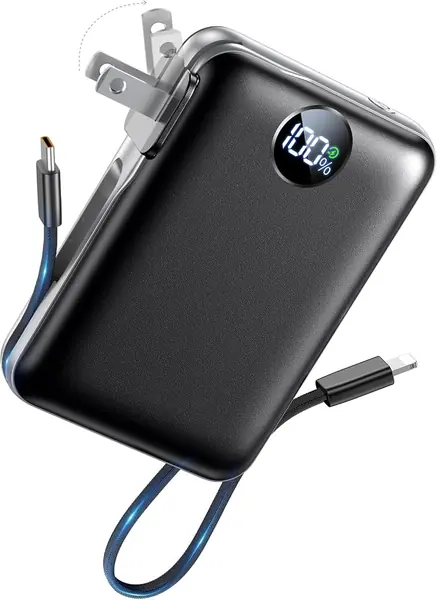
The reason this one leads our list is a pair of foldable prongs on the back. Plug the AIFENG into any wall outlet and it refills itself in about four hours, so the charger for your phone can stay home and every morning of the trip starts at full. The prongs fold flush, which means nothing is catching on the lining of a pouch.

At 10,000mAh it's good for roughly two phone charges, and it manages that in a body 3.66 inches tall and about seven ounces, with built-in cables for iPhone and USB-C devices. That combination — small, self-contained, and able to refill itself — is why we hand it to most travelers first.

Charging runs at 22.5W, which takes a modern phone about half full in half an hour, quick enough for a boarding wait. We also noted the three-year warranty, matching the longest in this group, which counts for more on a pack that gets cycled hard than on one that lives in a drawer. If two charges won't cover your trip, the HELLEE gives you half again the capacity for the same money.

Pros

  • Refills from any wall outlet
  • Built-in cables cover iPhone and USB-C
  • About 7 ounces in a small body

Cons

  • Deep body for a 10,000mAh pack
  • No laptop charging
Our verdict

Buy this one if you fly with a phone and a tablet: it packs its own cables, charges about twice, and refills from a wall socket without a charger.
Check Latest Price
2

HELLEE 15,000mAh Power Bank Best for Longer Trips

92 /100
TKZ Score Outstanding

Key details

Battery Capacity
15,000 mAh
Max Output
22.5W
Weight
8.8 oz
Built-in Cables
4
View on Amazon

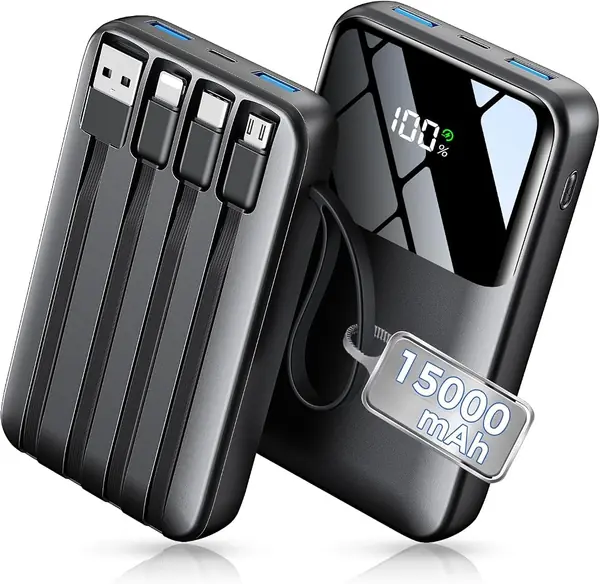
Same money, half again the capacity: that's the trade the HELLEE offers, and on a long trip it's the better one. The 15,000mAh cell is rated for about three and a half phone charges, and the pack carries four cables built into its case plus six outputs in total.

Six outputs is more than one person needs, and that's the point. Three phones and a tablet on a rental-car dash is the load this was built for, and the percentage display takes the guesswork out of the last bar. The bi-directional USB-C port means the same socket charges a device or refills the pack. It's the one we take when more than one person is traveling.

Refilling takes about three hours, so it's an overnight job at the hotel rather than a top-up at the gate — plug it in when you get back and it's ready by morning. Given what the capacity buys on a long trip, that's a fair exchange.

Pros

  • 15,000mAh, about three phone charges
  • Four built-in cables and six outputs
  • Percentage display instead of bars

Cons

  • Six inches long, so it rides in a bag
  • About three hours to refill the pack
Our verdict

We point travelers who need more than two phone charges at the HELLEE: 15,000mAh, four built-in cables, and enough outputs for a family's devices.

Check Latest Price
3

Anker 20,000mAh 87W Power Bank Best for Laptop Travel

91 /100
TKZ Score Outstanding

Key details

Battery Capacity
20,000 mAh
Max Output
87W total
Weight
15.2 oz
Built-in Cable
USB-C
View on Amazon

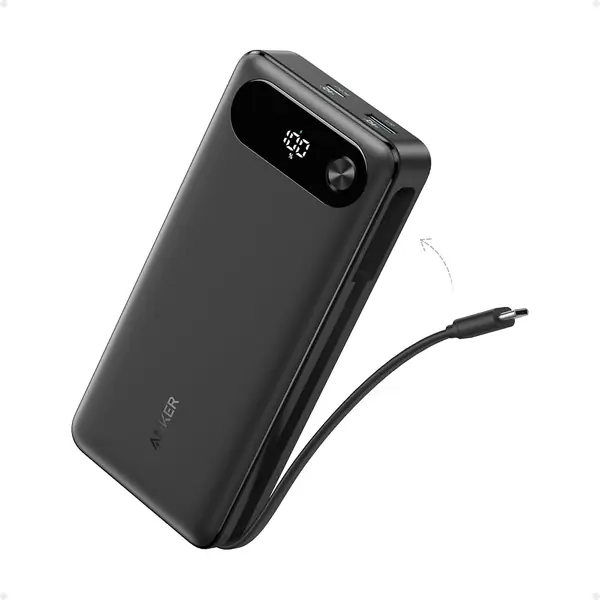
A laptop changes what you need from a power bank: enough output that the machine accepts a charge, and enough capacity that the weight was worth carrying. The Anker 20,000mAh covers both, pushing 65W to a single device and 87W across three ports.

The built-in USB-C cable is the part we appreciate most. A laptop is the device people forget a cable for, and having one attached — rated for 10,000 bends — means the pack works straight out of the bag. It also refills in about an hour and a half from a 65W charger, so an airport outlet during a connection is enough to start the next flight full.

At 20,000mAh it sits comfortably inside the 100Wh ceiling most airlines apply, with enough headroom that the label won't draw a second look at security. What you pay for over the 10,000mAh picks is laptop power and a cable you can't leave behind.

Pros

  • 65W to one device, 87W total
  • Built-in USB-C cable rated for 10,000 bends
  • Refills in about 90 minutes

Cons

  • 15.2 ounces in the bag
  • Built-in cable can fail first
Our verdict

For a carry-on with a laptop in it, we recommend this Anker: 65W to one device, a built-in USB-C cable, and cabin-legal capacity with room to spare.

Check Latest Price
4

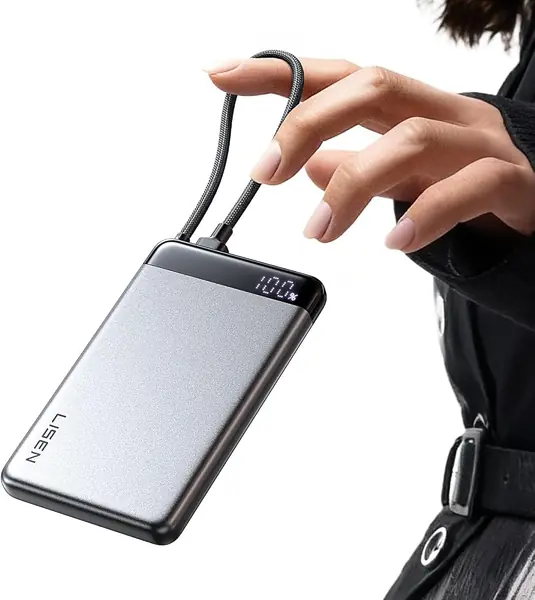
LISEN 10,000mAh Ultra-Slim Best for China and International Trips

90 /100
TKZ Score Outstanding

Key details

Battery Capacity
10,000 mAh
Max Output
22.5W
Thickness
0.5 in
Rated Energy
37Wh
View on Amazon

The LISEN is the only pack in this group with a CCC mark printed on the case, and if China is on the itinerary that small logo is the difference between boarding and leaving a power bank behind at security. Chinese airports check for the mark on power banks, and this is the one here that carries it.

It's also the thinnest 10,000mAh pack here, at half an inch and 6.7 ounces, in an aluminum shell that looks a step above the plastic cases around it. The built-in USB-C cable works in both directions — it charges your phone and refills the pack — and the readout gives an exact percentage instead of four bars.

The limit is cable variety. One permanent USB-C lead is everything a USB-C phone and tablet need, and if you're still on Lightning that's one short cord to pack. At 37 watt-hours there's a wide margin under the ceiling too, which is the sort of thing you stop thinking about until a gate agent asks.

Pros

  • CCC mark printed for China security
  • Half an inch thick, 6.7 ounces
  • Built-in USB-C cable charges both ways
  • 37Wh is well under the carry-on ceiling

Cons

  • One built-in cable, USB-C only
Our verdict

For a trip through China — or anyone who wants the thinnest legal bank — we recommend the LISEN: CCC marked, half an inch thick, and 37 watt-hours.

Check Latest Price
5

INIU 20,000mAh 65W Power Bank Best High-Capacity That Packs Small

89 /100
TKZ Score Excellent

Key details

Battery Capacity
20,000 mAh
Max Output
65W
Weight
13.4 oz
Included Cable
Detachable lanyard USB-C
View on Amazon

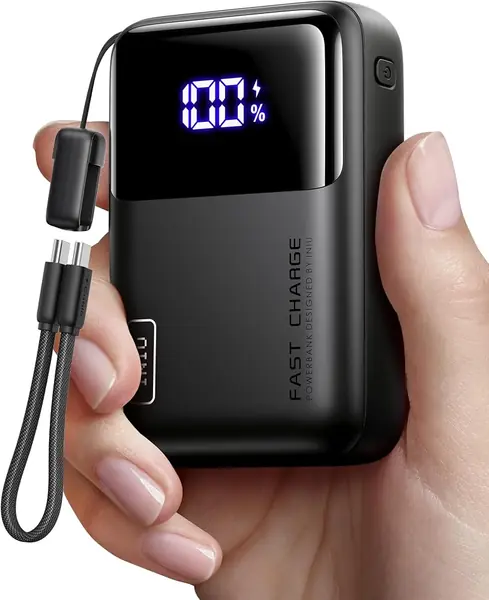
Twenty thousand milliamp hours usually means a brick. The INIU 20,000mAh is 4.3 by 2.7 by 1.1 inches — shorter and narrower than a phone, about twice as thick — and 13.4 ounces, which is about as much capacity as you can carry in a personal item without giving a pocket over to it.

Sixty-five watts is the other argument: enough for a MacBook Air, an iPad or a Steam Deck at full speed, with three ports so a phone and a tablet can share. The 4.7-inch USB-C cable is detachable and doubles as a lanyard, which we count as a plus — a cable that wears out gets replaced instead of retiring the pack.

An exact percentage readout handles the guessing, so nobody's interpreting four bars at a gate, and three years of warranty is as long as any pack here offers.

If one bank has to cover a phone and a laptop for a long weekend, this is the one we reach for. The Anker above matches the capacity and adds a cable built into the case; the INIU answers with a smaller body and a lower price, and in a bag that's already full, that's the argument that wins.

Pros

  • 20,000mAh in a body shorter than a phone
  • 65W output for laptops and handhelds
  • Detachable lanyard cable

Cons

  • Some units have stopped charging within months
  • 13.4 ounces is too much for a pocket
Our verdict

We reach for the INIU when one bank has to cover a phone and a laptop for a weekend: 20,000mAh and 65W in a body that punches below its size.

Check Latest Price
6

Zmmyuluo 10,000mAh Power Bank Best Budget

88 /100
TKZ Score Excellent

Key details

Battery Capacity
10,000 mAh
Weight
6.6 oz
Built-in Cables
4
Warranty
1 year
View on Amazon

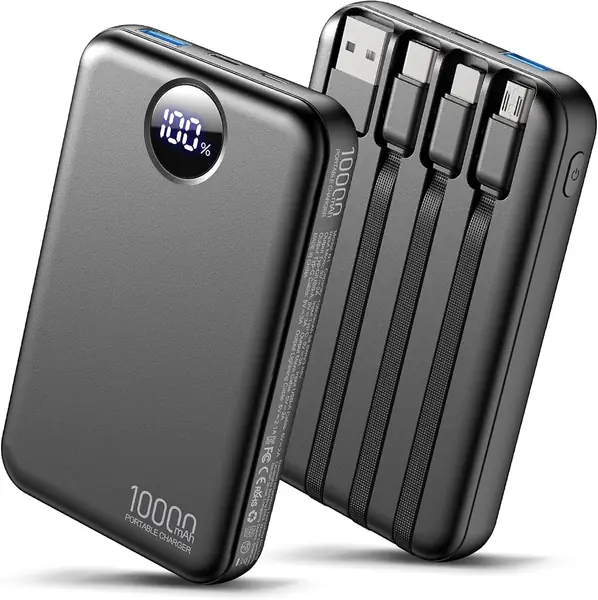
Nothing about the Zmmyuluo feels cut-rate until you ask it to charge quickly. Four cables are built into the case — Lightning, USB-C and micro-USB among them — plus a percentage display, in a body 4.4 inches tall and about the weight of a phone.

Speed is where the corners were cut: there's no fast-charge figure attached, and a phone fills steadily rather than quickly. Everything else punches above the price. Four attached cables mean a phone, a pair of earbuds and a tablet can all charge without unpacking anything, and the display tells you where you stand before you leave the room.

What that adds up to is the pack we recommend as a second one. It's the bank that lives in a daypack between trips, the spare you can hand to a friend without a lecture about losing the cable. For a two-week trip with a laptop it's the wrong tool, but that was never the job.

Pros

  • Four built-in cables cover iPhone and Android
  • Exact percentage display
  • About the weight of a phone

Cons

  • Slow to fill next to the rest of this list
  • One-year warranty
Our verdict

We point budget shoppers at the Zmmyuluo: four attached cables, a real percentage readout, and a body that disappears into a daypack.

Check Latest Price
7

Orfeika 20,000mAh Power Bank Best for Mixed-Device Families

87 /100
TKZ Score Excellent

Key details

Battery Capacity
20,000 mAh
Max Output
20W
Weight
11.7 oz
Built-in Cables
4
View on Amazon

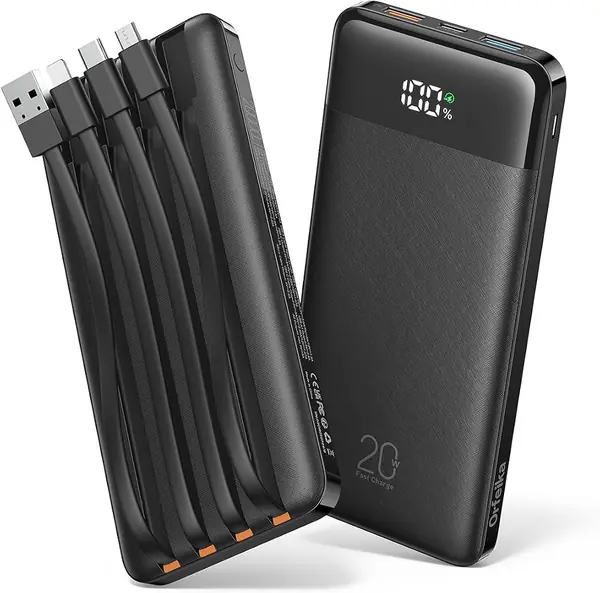
Four cables live on the back of the Orfeika — three for output, one for input — and that's the whole pitch: a 20,000mAh pack you can hand to anyone in the car without asking what phone they have.

The capacity is real: 20,000mAh, roughly three charges for a recent iPhone, spread over six outputs so two phones and a tablet can charge at once. At 0.74 inches thick it slides into a seatback pocket, and the display gives an exact percentage.

It splits the difference in this group: the same cable convenience as the budget packs, twice the capacity of the 10,000mAh options, and less money than the laptop banks.

Two years of coverage is more than either Anker offers, and it's the right thing to guarantee on a pack whose main feature is a set of cables that can wear out.

Pros

  • Four built-in cables, six outputs
  • 20,000mAh at 0.74 inches thick
  • Two-year warranty

Cons

  • 20W is slow for anything bigger than a phone
  • 11.7 ounces is a bag item
Our verdict

We recommend the Orfeika for a group trip where everyone's phone has a different connector: 20,000mAh with four cables attached to the case.

Check Latest Price
8

Anker 25,000mAh 165W Power Bank Best for Two-Laptop Trips

86 /100
TKZ Score Excellent

Key details

Battery Capacity
25,000 mAh
Max Output
165W total
Built-in Cables
2, one retractable
USB-C Ports
3 at 100W
View on Amazon

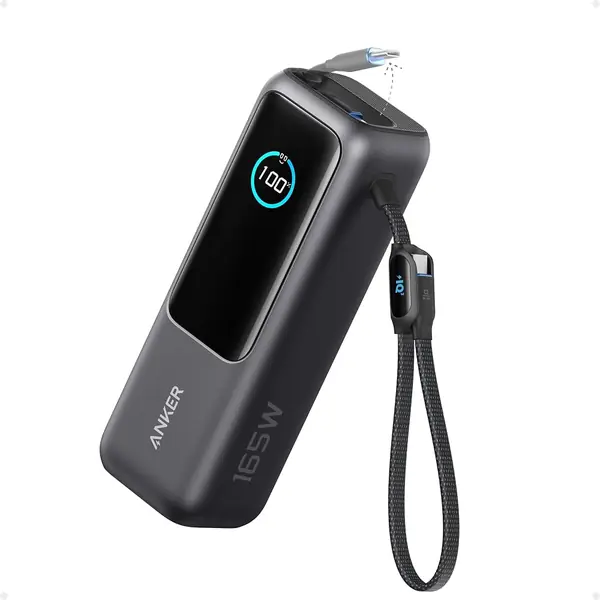
One hundred sixty-five watts is more than the wall charger in most hotel rooms, and it's what the Anker 25,000mAh puts out across three USB-C ports. Two of them feed built-in cables — one retractable to 2.3 feet, one short enough to work as a carry handle — and a fourth port takes USB-A.

The retractable lead is the detail we appreciate most: it reaches from a seatback pocket to a tray table, then winds back into the case instead of dangling in a bag, and Anker rates it for 20,000 retractions. With 165W to share, a laptop, a tablet and a phone can all charge without one of them being demoted to a trickle.

Capacity is 25,000mAh, the largest here and the closest to the 100Wh line — under it, but with less headroom than the 20,000mAh packs if anyone starts counting at the gate. It refills to full in about 110 minutes from a 100W charger, so a hotel stop covers it.

Buy it for the itinerary, not the battery: two laptops on one bank is a real problem this solves and nothing else here solves at this speed. For a trip that's one phone and a pair of headphones, the 10,000mAh picks will feel like a relief.

Pros

  • Three USB-C ports rated at 100W each
  • Retractable built-in cable
  • 25,000mAh, the largest capacity here

Cons

  • Some units have failed around six months
  • The priciest pack here
Our verdict

We recommend this Anker for travelers who carry two computers: three 100W USB-C ports, retractable cables, and 25,000mAh that still clears the cabin limit.

Check Latest Price

How We Tested Power Banks for Air Travel

We pulled every flight-friendly pack we could find and filtered on the numbers that matter at an airport: capacity under the 100-watt-hour carry-on limit, honest output wattage, at least one cable built into the body or a USB-C port we could reach without digging, and a price that made sense against the capacity on the label. That left 14 packs, which we carried for six months through security lines, gate waits, middle seats, hotel rooms with one working outlet, and weekend trips where everything had to fit in a single bag.

Charging speed got timed rather than estimated. We drained a phone to zero, plugged in, and clocked how long it took to hit 50 percent and then a full charge, repeating the test on a tablet and, for the higher-output packs, a laptop. Where a pack had a built-in cable, we used only that cable for a week to see how it handled being folded back into the housing and whether the connector stayed seated when the phone was picked up and moved around a tray table.

For weight and portability, each one went on a kitchen scale and then into a jacket pocket, a sling, and a packed personal item, and we noted which ones we felt by the end of a travel day. Battery life was counted in real charges instead of advertised ones — we ran every pack from full to empty and tracked how much the phone actually gained, then left several in a bag for two weeks to see which held their charge and which bled out. Durability came from ordinary abuse: cables coiled and uncoiled a few dozen times, packs dropped on tile, ports checked for play after repeated plug-ins. Value was the last column we filled in, calculated as cost per full pack of delivered juice.

How to Choose a Power Bank for Air Travel

Start With Watt-Hours, Not Milliamp Hours

Aviation rules are written in watt-hours: a lithium-ion pack up to 100Wh can fly in the cabin, and anything from 100 to 160Wh needs the airline's approval first. To get there, multiply the milliamp hours by 3.7 and divide by 1,000 — 10,000mAh lands around 37Wh, 20,000mAh around 74Wh, and 25,000mAh around 92Wh.

All of them clear the limit; the big pack simply has less headroom if someone at the gate decides to read the label. Keep it in the cabin bag, never checked, and favor a pack that prints the figure on the case.

Built-In Cables Earn Their Keep in Transit

On a desk, a loose cable is fine. In seat 27C it's the thing you left in the other bag. Built-in leads take a failure point off the packing list, and the multi-cable packs here — the HELLEE, the Orfeika, the Zmmyuluo — will charge an iPhone and an Android from the same brick.

Check which connectors you actually get: a fixed USB-C lead, as on the LISEN, does nothing for a Lightning phone without a cord. And prefer a detachable lead when you can, because a cable that fails on a fixed design can retire the whole portable charger.

How the Pack Refills Is Half the Design

Every bank here charges devices; they differ in how they get refilled. Most need a USB-C charger you remembered to pack and an outlet you're willing to leave it on, which on a two-week trip is one more thing to lose. The AIFENG folds a plug into the case and tops itself up from any wall socket in about four hours.

Whatever you buy, match the charger to the pack. A 20,000mAh bank on a small phone adapter takes hours longer than it should.

Weight Is the Spec You'll Feel

A 10,000mAh pack runs about 7 ounces; a 20,000mAh one runs 12 to 15. That gap decides whether the thing lives in a jacket or a backpack, and it matters more than a few thousand milliamp hours you may never spend.

For a phone-only trip, a light 10,000mAh bank covers two charges and disappears into a personal item. Add a laptop and you're carrying a pound whatever you choose, so the question stops being weight and becomes whether the capacity earns it.

Match the Output to the Device

Phone charging tops out quickly: 20 to 22.5W covers most handsets, and the iPhone-and-Android packs here hit that. A laptop needs USB-C Power Delivery at 45W or more, which rules out every 20W and 22.5W pack on this list — the Anker 20,000mAh at 65W to one device and the INIU at 65W are the two that will genuinely charge a MacBook or a Windows ultraportable.

Check the port's rating rather than the pack's badge, since a bank with three ports often shares its total among them.

Frequently Asked Questions

Final Verdict

For most trips the AIFENG is the one to pack. It disappears into a personal item, it brings its own cables, and the foldable plug means the phone charger stays home and every morning starts full. Two phone charges is the honest limit, and for a flight with a phone and a tablet that's the right amount.

If a laptop is coming, the Anker 20,000mAh is worth the extra money and the extra weight. If China is on the route, the LISEN's CCC mark settles the question before capacity does.