Best Phone Chargers of 2026

Last winter I sat on an airport floor watching my phone crawl from 4 to 12 percent while the traveler beside me went from dead to nearly full in twenty minutes. The difference was his brick and cable, not his phone. The right charger gets you out the door in the time it takes to shower and still works two years later.

My team and I have spent the better part of a year with chargers of every shape, and for this round we put 16 of them through four months of daily use. Here's what first-time buyers miss: the block, the cable, and the phone have to agree. A high-wattage brick fed into a thin cable delivers a fraction of the number on the box.

Port count matters nearly as much as speed — one outlet running a phone, earbuds, and a tablet overnight beats another ten watts in most homes. The picks below are the ones that survived the boring failures: connectors that stop seating, blocks that run hot, "fast" chargers no quicker than the one in the box.

The Best Phone Chargers

1

Anker 45W USB-C Charger 2-Pack Best Overall
96 /100
TKZ Score Outstanding

Key details

Wattage
45W
Cables Included
Two 5 ft USB-C
Pack
2 chargers
Ports Per Charger
1 USB-C
View on Amazon

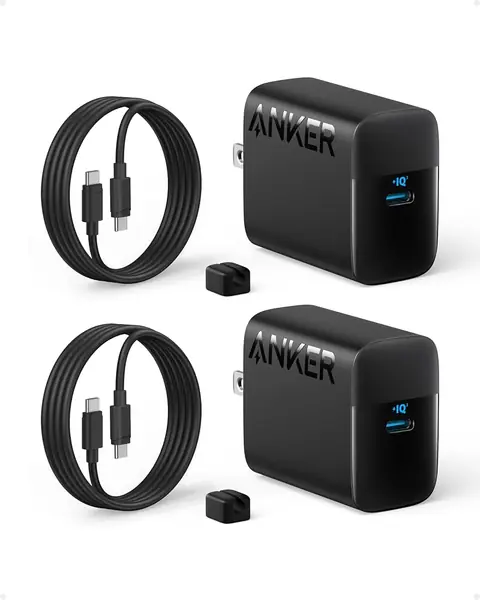
The Anker set is the most expensive one here, and it's the one that comes out of the box first when someone asks what to buy. Two blocks, each with a single USB-C port and 45W behind it, two five-foot USB-C cables rated for 10,000 bends, and a pair of cable organizers.

Forty-five watts is what earns it the top spot. It's the tier Samsung's Ultra phones need to reach their fastest charging rate, and it leaves enough headroom to top a tablet without thinking about it. The cables are the quieter win — a bend rating is the difference between a cable that lives in a bag for two years and one that frays at the connector by spring — and this set carries the strongest satisfaction of anything here.

Two things cost it. Five feet is the shortest cable in this guide, fine for a nightstand and annoying from a couch. And one port per block means the phone gets the block to itself; nothing here charges a phone and a watch from the same outlet.

On an iPhone the extra wattage goes unused — Apple's phones cap well below 45W, and the Icseio set does the same job for less money. Where the power pays off is a Galaxy Ultra or a tablet, and two blocks mean one can live in a bag without much guilt.

Pros

  • 45W reaches Samsung's fastest charging tier
  • Two bend-rated 5 ft cables included
  • Strongest satisfaction in this set

Cons

  • Shortest cables in this set
  • One port per block
Our verdict

Buy this if you own a recent Galaxy or a tablet: 45W reaches Samsung's fastest tier, and the bend-rated cables outlast the cheap ones here.
Check Latest Price
2

MAILESI 25W Charger 2-Pack Best Budget

95 /100
TKZ Score Outstanding

Key details

Wattage
25W
Cables Included
10 ft and 6 ft USB-C
Ports Per Charger
1 USB-C
Certification
ETL
View on Amazon

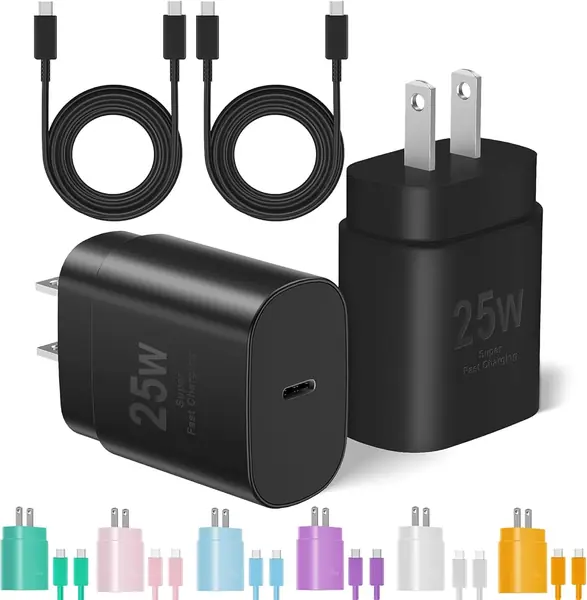
The cheapest set here is also the one with the longest cable. Two 25W blocks, a 10-foot USB-C cable and a 6-foot one for the lowest price in this guide — for a bedroom where the outlet is on the wrong wall, that 10-footer is the entire argument, because you can use the phone while it charges instead of perching beside the wall. The ETL listing is the other thing we appreciate; it's the safety mark we look for on a brand we don't know.

25W is one step below the fastest a Galaxy Ultra can do. It's Samsung's standard Super Fast Charging rather than the 45W tier, so you get most of the speed and lose only the last few minutes. The soft spot is longevity: fast charging is what tends to quit first, sometimes within a few months, and iPhones are unreliable here — some sets won't charge one at all. Treat it as the pair you keep in two rooms and replace when it fades, which at this price is a fair trade rather than a disappointment.

Pros

  • Two 25W blocks plus 10 ft and 6 ft cables
  • ETL certified
  • 25W covers standard Samsung fast charging

Cons

  • Fast charging can quit within months
  • Some sets won't charge an iPhone
Our verdict

Our budget pick: the lowest price here buys two 25W blocks and a 10-foot cable, with a shorter service life as the trade.

Check Latest Price
3

Ubearkk 45W Super Fast Charger 2-Pack Best for Galaxy Fast Charging

94 /100
TKZ Score Outstanding

Key details

Wattage
45W
Cables Included
Two 6.6 ft USB-C
Pack
2 chargers
Ports Per Charger
1 USB-C
View on Amazon

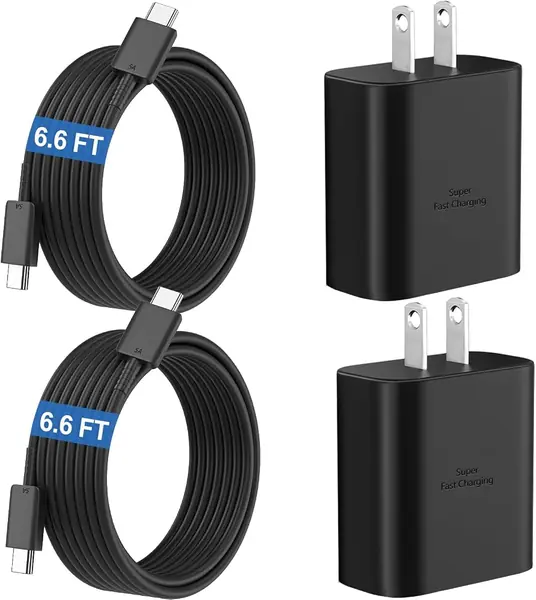
Samsung's fastest charging tier needs two things at once: a 45W block and a cable rated to carry 5 amps. The Ubearkk box supplies both twice over, with two 6.6-foot 5A cables matched to two blocks.

That cable rating is the detail most 45W listings skim past. A block can only deliver its headline rate through a cable rated for the current, and the 3A cables bundled with cheaper sets cap the whole thing below 45W — swap one onto this block and charging quietly slows with no error message to explain it. The blocks themselves are on the bulky side and can sit loose in a worn outlet, and some sets stop fast charging inside a year.

For a Galaxy S24 or S25 Ultra, the money goes further here than on the Anker: the same 45W ceiling, longer cables, and noticeably less spent, with satisfaction right behind the top pick. What you give up is the cable organizers and a bit of polish, not speed.

Pros

  • 45W Super Fast Charging 2.0 for Galaxies
  • Two 6.6 ft 5A cables included
  • Satisfaction close behind the top pick

Cons

  • Bulky blocks can sit loose
  • Fast charging can fade within a year
Our verdict

For a recent Galaxy Ultra, the money goes further here than on the top pick: same 45W ceiling, longer cables, lower price.

Check Latest Price
4

Icseio 20W iPhone Charger 2-Pack Best for iPhones

93 /100
TKZ Score Outstanding

Key details

Wattage
20W
Cables Included
Two 6 ft USB-C
Pack
2 chargers
Certification
UL, FCC, RoHS
View on Amazon

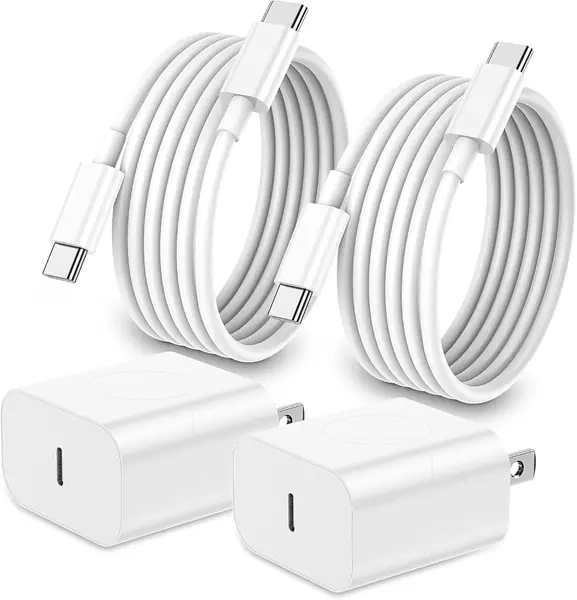
Twenty watts is the number to shop by for an iPhone. Apple's own fast charger sits at 20W and the phones don't draw much past it, so a 45W block charges one no faster than this — the money is better spent on cable length and a second block. The Icseio pack gives you two 20W chargers, two 6-foot USB-C to USB-C cables rated to 60W, and a UL listing alongside the usual over-voltage protections.

For an iPhone 15 or newer, this is the sensible buy. Six feet covers a nightstand without the floor tangle of a 10-footer, the cable rating is more than a phone needs, and a spare block matters more day to day than a faster one. What we don't love is the lifespan: some units quit within a couple of months, and 20W is modest if a tablet shares the charger. Two blocks soften both problems — one dies and you keep charging while the warranty sorts itself out.

Pros

  • Right-sized 20W for iPhones
  • Two 6-foot USB-C cables included
  • UL, FCC and RoHS listed

Cons

  • Some units fail within two months
Our verdict

For an iPhone, this is the set to buy: 20W is enough for the phone's fast charging, and two 6-foot cables cover a nightstand and a desk.

Check Latest Price
5

QZIIW 45W Dual-Port Charger 2-Pack Best for Cable Variety

92 /100
TKZ Score Outstanding

Key details

Wattage
45W
Cables Included
3, 6, 10 and 10 ft
Pack
2 chargers
Ports Per Charger
2 USB-C
View on Amazon

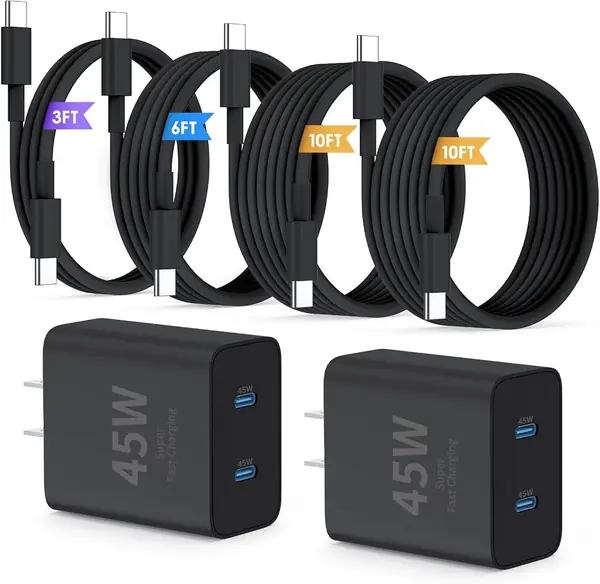
Four cables come in this box — a 3-foot, a 6-foot, and two 10-footers — alongside two blocks that each carry a pair of USB-C ports. Nothing else here hands you that spread of lengths.

The lengths solve a problem most sets ignore. The short cable lives in a bag or on a power bank, the 6-footer covers a desk, and the two 10-footers reach the couch and the bed without an extension cord. The second port is convenience rather than double the power: a 45W block splits what it has between whatever is plugged in, so a phone charges fastest with the other port empty.

The flexibility is what sells it. This is the set for a household where one charger serves a phone at the desk, a tablet on the couch, and a bag on the weekend — and where a spare 10-footer is worth more than a slightly higher rating. If you only charge one phone in one place, the cheaper two-cable sets do the same job.

Pros

  • Four cables, two of them 10-footers
  • Two USB-C ports on each block
  • 45W blocks with 60W-rated cables

Cons

  • Connectors can loosen with use
  • Durability trails the better sets here
Our verdict

Buy this when one charger has to cover a desk, a couch, and a bag: two ports per block and four cable lengths in one box.

Check Latest Price
6

Auorld 60W 5-Port Charger 2-Pack Best Multi-Device Charger

91 /100
TKZ Score Outstanding

Key details

Wattage
60W total
Pack
2 chargers
Ports Per Charger
5 (3 USB-C, 2 USB-A)
Fast Charging
PD and Quick Charge 3.0
View on Amazon

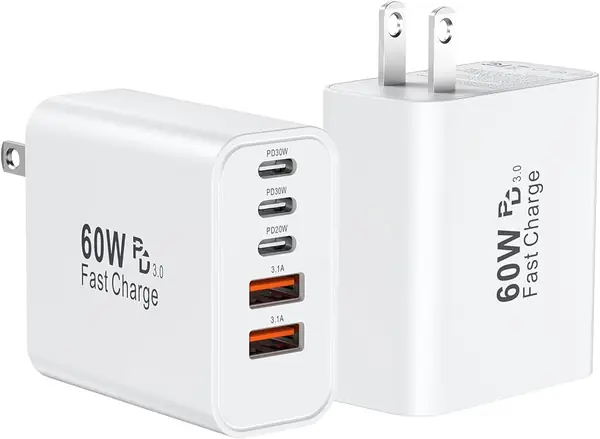
Five ports on each of two blocks, three USB-C and two USB-A — ten charging ports in one order. That reads as overkill until you count the things on a desk that want power.

The 60W is a budget, not a promise per port. Split across a phone, earbuds and a watch it's plenty; ask one port to carry a laptop and everything else slows down. Plug the phone in alone when you want the fastest charge and treat the rest as extras.

Small enough to pack, this is the block that ends the argument over whose charger is whose — on a shared desk, in a hotel room with one free outlet, or in a rental car with a single socket between four people. Two of them in the box means one stays home and one travels.

We recommend it as the shared-space block rather than your only one; a single-port 45W charger still fills a phone faster when nothing is competing with it. And there are no cables in the box at all, so order two or three USB-C cables alongside it and plan for the rest of the family to bring their own.

Pros

  • Five ports on each of two blocks
  • Power Delivery and Quick Charge 3.0
  • Compact enough to travel with

Cons

  • USB-A ports charge slowly
  • Some units fall short of 60W
Our verdict

We recommend this as the shared-space block for a desk or a family, where five ports on one outlet beat a faster charger for a single phone.

Check Latest Price
7

FEEL2NICE 12W Lightning Charger 2-Pack Best for Older Lightning iPhones

89 /100
TKZ Score Excellent

Key details

Wattage
12W
Cables Included
6 ft and 10 ft
Certification
MFi
Connector
USB-C to Lightning
View on Amazon

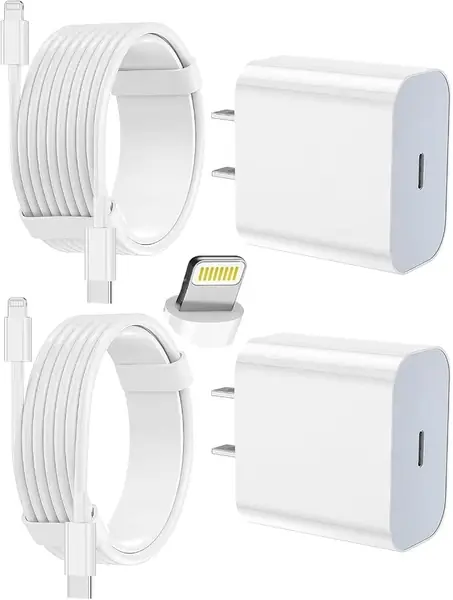
If your phone still has a Lightning port, nearly everything else in this guide is the wrong connector. That's why this set is here: two 12W blocks and two USB-C to Lightning cables, one 6-foot and one 10-foot, with MFi certification on the cables and ETL on the blocks.

Twelve watts is the catch. It's roughly half what a Lightning iPhone can take, so a fill takes longer than it would on a 20W set; the 10-foot cable is the compensation, and for an overnight charge on a nightstand it hardly matters. If you routinely need a usable battery in half an hour, this is not the set for that.

The cables are the better half of the purchase. MFi certification means the phone won't answer with a compatibility warning, which is the usual greeting from a cheap Lightning cable, and having both lengths in one box beats buying them separately. The blocks are as basic as the price suggests — one port, no extras — and that's fine for what this is for.

Pros

  • MFi-certified Lightning cables
  • 6-foot and 10-foot cables together
  • ETL-listed blocks

Cons

  • 12W is slow for an iPhone
  • Won't work with iPhone 15 or newer
Our verdict

For an iPhone that still takes a Lightning cable, this is the practical set: MFi cables in two useful lengths, with the slowest charging here.

Check Latest Price

How We Tested These Phone Chargers

To build the shortlist, I started with the chargers that turn up again and again in listings and reviews, then filtered for the things that separate a usable one from a frustrating one: whether a cable came in the box, whether the port was USB-C or Lightning, how many devices it could take at once, and whether the maker published an actual wattage instead of a vague "fast charging" badge. That left 16 bricks and blocks, which we used for four months — on nightstands, on the kitchen counter during dinner, in a work bag on the commute, and in one hotel room where four people shared a single free outlet.

Every charger went on the same inline power meter. I logged what the phone actually pulled in the first thirty minutes, compared it with the number printed on the box, and timed how long it took to reach 50 percent from nearly dead. With the multi-port blocks, I plugged in a phone, earbuds, and a tablet and watched whether the second and third devices split the output enough to slow the phone down. I also left each one plugged in overnight with nothing attached and felt the casing the next morning.

Then the abuse: I wrapped and unwrapped each cable around a chair leg, hung blocks from the outlet by their own cords, and dropped them onto tile from counter height. Connectors got plugged and unplugged several hundred times, and I noted which ones stopped seating firmly or dropped the charge when the phone shifted in bed. Every cable was measured against a real couch-to-outlet distance, since a long cord that coils on the floor solves a different problem than a short one that reaches. At the four-month mark I rechecked whichever ones still lived on my nightstand, which is where the loosening, the heat, and the quiet slowdowns actually showed up.

How to Choose a Phone Charger

Match the Wattage to the Phone You Own

An iPhone tops out around 20W, so a 45W charger block charges one no faster than a 20W unit — the extra money buys headroom the phone never draws. Samsung's standard fast charging runs at 25W, and the fastest tier on the Ultra phones wants 45W. That's the trap in this category: buying the biggest number on the shelf rather than the number your phone can accept.

Match the block to the phone in your pocket today. Let a tablet or a small laptop push you upward only if it will share the charger.

Let Cable Length Follow Your Outlets

Cable length is the specification you feel every day. A 10-foot cable reaches from a wall outlet to a bed or a couch; a 6-footer handles a nightstand or a desk without pooling on the floor; a 3-footer belongs in a bag. Walk the rooms where the charger will live before you decide.

Remember that a two-pack splits its cables. A set with one 10-footer and one 6-footer covers more of a house than two cables of the same length, which is why the cheapest pick here is also the one that solves the most rooms.

Decide How Many Ports You Need

One port per block is the simplest arrangement, and it charges a single phone at full speed. A dual-port or five-port block is a different tool: it serves several devices from one outlet, and the total wattage is shared, so a phone charges fastest with the other ports empty.

Shared desks, families, and hotel rooms with one free outlet get real value from the multi-port designs. Someone who charges one phone overnight does not.

Plan Around a Short Service Life

None of these is a buy-it-for-life purchase. Warranties run from a year to two, and that is the window to plan on: the fast-charging handshake tends to fade before a block dies outright, and the cable usually goes first.

The two-block format is the underrated part of this category — one can fail without leaving you hunting for a charger at 11 p.m. Register the warranty when the box arrives, and keep the spare block somewhere other than the same bag.

Get the Connector Right First

Before any of the above, check the port on your phone. iPhone 15 and newer take USB-C; iPhone 14 and older take Lightning, and a Lightning set will not charge a newer phone at all. Android phones have been USB-C for years.

This is the one specification a different cable cannot work around, so it belongs at the top of the list rather than the bottom.

Frequently Asked Questions

Final Verdict

The Anker 45W two-pack is what we recommend first. It covers Samsung's fastest charging, the cables are built to outlast the cheap ones, and two blocks solve the bedroom-and-bag problem in a single order.

Galaxy owners who want the same 45W for less money and longer cables have a strong alternative in the Ubearkk set. For an iPhone, the Icseio set does everything the phone can use — anything more is wattage the phone ignores.