Best Noise-Canceling Earbuds for Running of 2026

There's a certain panic around mile two, when one earbud works loose and you have to decide whether to stop or listen to it skitter across the pavement. Running earbuds have to do two things that pull against each other: stay locked in for an hour of pounding, and mute enough noise that you aren't cranking the volume to compensate.

Over six months, my team and I have run, lifted, and sweated through 12 pairs of noise-canceling earbuds, from over-ear hooks to winged buds. Two surprises. A hook isn't automatically more secure than a wing tip — it depends on how it adjusts. And playtime almost always counts the charging case, so a pair advertising 45 hours may hold seven in the buds themselves.

The setting I reached for most wasn't the deepest noise cancellation but transparency — hearing a cyclist behind you matters more on a road run than silencing a treadmill. What separated the good pairs was fit and sound: the ones that stayed put also sounded better, because a loose seal kills bass and pushes the volume up. Everything below cleared that bar.

The Best Noise-Canceling Earbuds for Running

1

Soundcore Sport X20 Best Overall
87 /100
TKZ Score Excellent

Key details

Battery
12 hrs; 48 hrs with case
Water Resistance
IP68
Controls
Touch
Bluetooth
5.2
View on Amazon

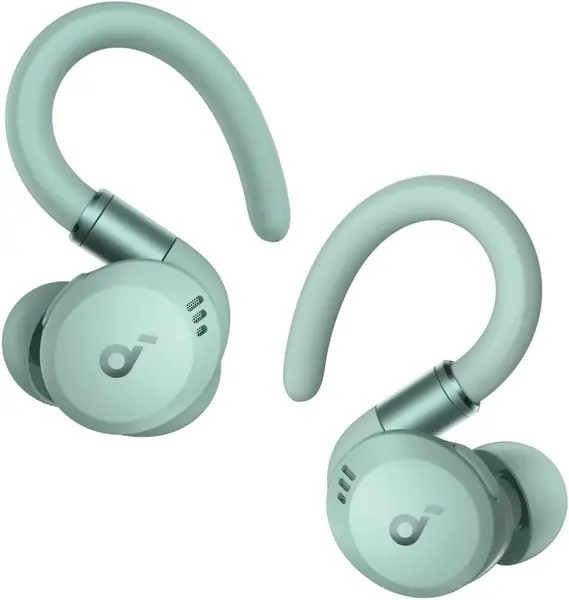
The adjustable hook is what earns the Sport X20 the top spot. It rotates up to 30 degrees and extends about 4 mm, so it settles around the back of your ear instead of pressing on one fixed point — and that range is the difference between a hook that fits your ear and one that only fits the model's ear. Behind it sits an IP68 rating, which means dust-tight and sealed against sweat, the number that matters when a pair gets worn four times a week in heat.

Noise canceling at this price is usually a token gesture. Here it does real work: switch it on in a gym and the clang of stacked weights drops back behind the music, and the 11 mm drivers give kick drums enough weight to hold a tempo. We're less taken with the controls. There's no volume adjustment on the buds themselves, so mid-run changes mean reaching for your phone, and the on/off button is awkward to find under a hat or a glove — a strange gap on a pair built to handle weather.

Battery is listed at 12 hours per charge and 48 with the case, which covers a week of training before the case needs a cable. One quirk we haven't gotten used to: the low-battery and mode-change chimes are startlingly loud, and they always seem to land two miles from home.

What keeps us coming back is the app. The HearID hearing test takes about five minutes and reshapes the EQ around your ears, and the low end cleans up noticeably on bass-heavy playlists. Spatial audio, EQ presets, and firmware updates live there too — the unglamorous support that keeps a pair current two years in.

Pros

  • Adjustable hook rotates and extends for a wider range of ears
  • IP68 sealing handles sweat, rain, and dust
  • Noise canceling strong enough for a loud gym

Cons

  • Some units stop holding a charge within a few months
Our verdict

We point most runners to the Sport X20: the adjustable hook and IP68 shell make it the most dependable fit here, and its noise canceling holds up in a loud gym.
Check Latest Price
2

Beats Powerbeats Pro 2 Best for Heart-Rate Tracking

86 /100
TKZ Score Excellent

Key details

Battery
Up to 45 hrs with case
Water Resistance
IPX4
Heart Rate
Sensors in both buds
Case Charging
Qi wireless
View on Amazon

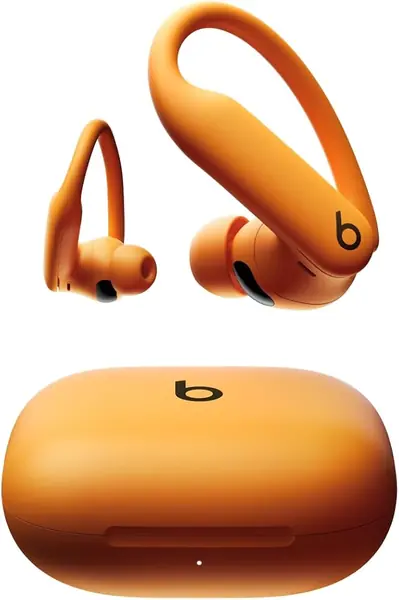
The Powerbeats Pro 2 is the only pair here with a heart-rate sensor in each earbud, and that single addition reframes what a running earbud is for. It reads your pulse from the ear rather than a chest strap or a wrist, so a zone-two session doesn't require a second device, and the numbers land in the apps you already train with. You pay for it: this is the most expensive pick in the group by a wide margin.

Fit is where our enthusiasm cools. The earhook is fixed rather than adjustable, which means it either suits the shape of your ear or it doesn't — the hook can press behind the ear on longer runs, and paired with glasses that pressure adds up over an hour. Buy from a retailer with a real return window, run a long one in them, and decide before the window closes.

What isn't in question is the noise canceling. It's tuned for training environments rather than airplanes, so it takes the edge off a treadmill belt without the plugged-up sensation cheaper ANC produces. Battery is listed at 45 hours total with the case, enough that charging becomes a weekly chore, and the case itself takes a Qi pad. Sound is bass-forward and loud, and Android users get pairing, switching, and the full feature set rather than a stripped-down version.

Pros

  • Heart-rate sensors in both buds replace a chest strap
  • 45 hours of total playback with the case
  • Full feature access on Android as well as Apple

Cons

  • The most expensive pair in this group
  • Fixed hook presses behind the ear for some wearers
Our verdict

Buy the Powerbeats Pro 2 if you want heart-rate data without wearing a watch and a hook that locks onto the ear — just test the fit while returns are still easy.

Check Latest Price
3

Beats Fit Pro Best for Apple Devices

85 /100
TKZ Score Excellent

Key details

Fit
Flexible secure-fit wingtips
Chip
Apple H1
Spatial Audio
Dynamic head tracking
Listening Modes
ANC, Transparency, Adaptive EQ
View on Amazon

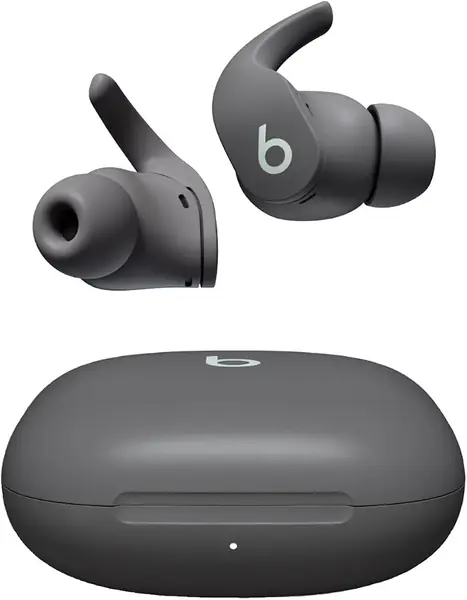
Where the Powerbeats loop over the top of your ear, the Fit Pro tucks a soft wingtip into the bowl of it. That's a smaller, less obtrusive way to stay put, and on ears that hold a wing happily it disappears in a way a hook never quite does. We think that's the better trade for most runners who don't need a hook's extra grip.

The noise canceling is the strongest part of the package — the closest thing here to flipping a switch on a loud room — and the Apple H1 chip makes everything around it frictionless on an iPhone: one-touch pairing, automatic switching between devices, hands-free Siri, and spatial audio with head tracking. On Android you still get the earbuds, minus most of that convenience.

The wingtip is also the risk. It sits where a lot of ears run narrow, and on those it works its way loose mid-run, so treat fit as a try-before-you-commit question in a way the hooked designs aren't. The electronics are the other variable: a share of pairs develop a dead earbud or start dropping their connection. Neither is universal, but both are common enough that a return window matters. Against the Powerbeats Pro 2, you give up the heart-rate sensor and get a smaller bud and a lower outlay.

Pros

  • Wingtips sit flush and stay put on the right ear shape
  • Strong noise canceling and a real transparency mode
  • Seamless switching across Apple devices via the H1 chip

Cons

  • Wingtips work loose on narrow ears
  • Some pairs develop a dead earbud or connection dropouts
Our verdict

We recommend the Fit Pro to anyone living inside Apple's ecosystem who wants a low-profile running bud — as long as their ears hold a wingtip.

Check Latest Price
4

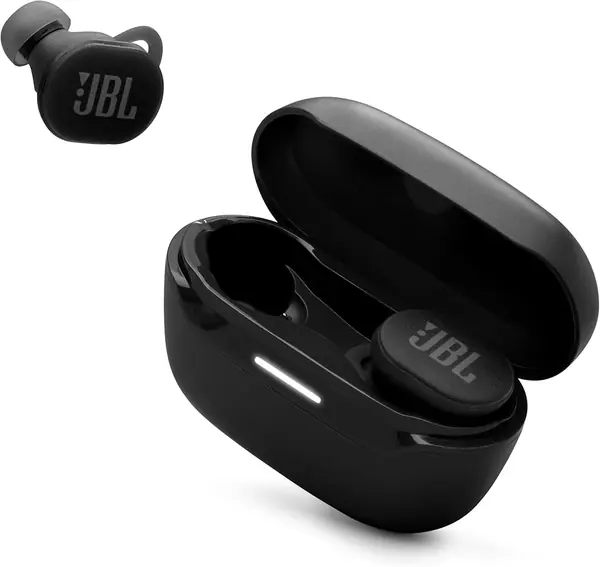
JBL Endurance Race 2 Best for Heavy Sweaters

84 /100
TKZ Score Excellent

Key details

Battery
12 hrs; 48 hrs with case
Water Resistance
IP68
Bluetooth
5.3
Fit
Twistlock wing enhancer
View on Amazon

IP68 is the toughest rating on this page, and it changes how you treat a pair of earbuds. These can be rinsed under a tap after a muddy run instead of dabbed at with a towel, and a downpour stops being an emergency. If your last pair died of sweat rather than of drops, that alone is the argument.

The fit uses JBL's Twistlock wing enhancer, which rotates into the ear for a deeper seat than a plain tip, and the box includes two sizes of enhancer to work with. Playtime is listed at 12 hours per charge and 48 with the case, so the case lives in a drawer most weeks. Noise canceling is here and it helps — enough to blunt a treadmill and a stack of dropped dumbbells, not enough to erase a busy road. A sealed shell, a wing that stays put, and a price near the bottom of this group is what makes it our budget pick.

JBL's own setup note is worth repeating: dry the buds and the case before they go back in to charge, because wet contacts are how a sealed pair ends up dead in a drawer. Make that a habit and these will outlast the price tag; skip it and a charging failure is the likeliest way they get retired.

Pros

  • IP68 lets you rinse them after a muddy run
  • Twistlock wing gives a deeper, more secure seat
  • 12 hours per charge, 48 with the case

Cons

  • Bluetooth dropouts are the weak spot
Our verdict

For sweat-heavy runners on a budget, the Endurance Race 2 is the one: IP68 protection and a wing that twists into the ear, for less than most of this group.

Check Latest Price
5

occiam T19 Best for All-Day Comfort

83 /100
TKZ Score Excellent

Key details

Battery
8 hrs; 48 hrs with case
Water Resistance
IPX7
Controls
Push button
Bluetooth
5.4
View on Amazon

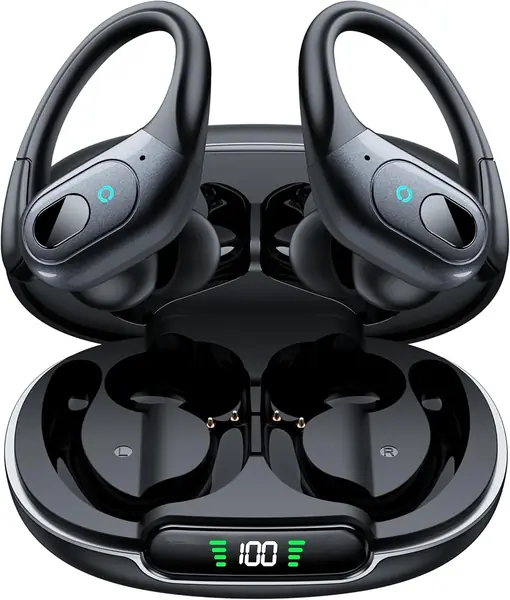
If deep-seated buds leave your ears aching an hour in, the T19 is shaped for you. Its hook curves over the ear rather than wedging into the bowl, the shell is a soft matte black that doesn't look like a gym accessory, and the fit suits smaller ears better than the stick-style buds in this group. Weight lands at 85 g for the set with the case, which is light enough to forget in a jacket pocket.

Protection is IPX7 — sweat and rain with room to spare, no swimming. Each bud is listed at 8 hours per charge with 48 hours in the case across six recharges; the 90-hour figure in the title is that case math stretched, so plan on 8 and 48. Physical buttons handle volume, tracks, and calls without a touch panel to misfire, and opening the case pairs them before you've got the second one in.

Noise canceling is rated to knock down 45 dB, a more modest claim than the premium pairs make, and in a gym it takes the edge off without silencing the room — which is roughly what we want from ANC on a run anyway. What we appreciate more is the small stuff: the case is genuinely pocket-sized at 8.4 cm long, and the LED display on the front tells you what's left before you open it.

Pros

  • Over-ear hook shape is easier on the canal over long sessions
  • Physical buttons for volume, tracks, and calls
  • Case is small enough for a pocket

Cons

  • The 90-hour headline is really 48 hours in the case
  • Noise canceling is mid-pack for the money
Our verdict

We like the T19 for long, comfortable wear: soft over-ear hooks, real buttons, and eight hours a charge suit runners whose ears ache after an hour in deep-seated buds.

Check Latest Price
6

WHYKJTEK BX30 Best for Budget Battery and Buttons

82 /100
TKZ Score Excellent

Key details

Battery
8 hrs; 90 hrs with case
Water Resistance
IPX7
Controls
Push button
Bluetooth
6.0
View on Amazon

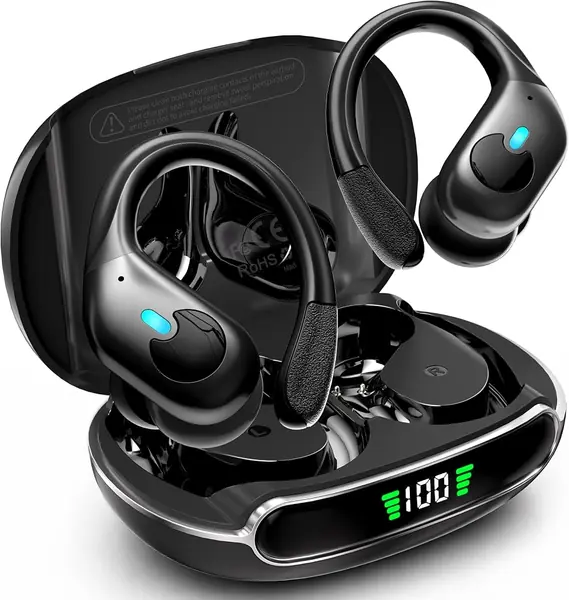
Physical push buttons, not a touch panel. That's the detail that sells the BX30 to anyone who has paused a podcast by brushing a sweaty earlobe, and it's a real advantage on a run — you can change volume through a jacket or a glove without breaking stride or looking down.

The rest of the spec sheet is generous for the money: IPX7 sealing, flexible earhooks, Bluetooth 6.0 with LE Audio, a 10 mm driver, and a case with a charge display rated for 90 hours of total playback against 8 hours per charge. The hooks cradle the ear rather than pressing into the canal, which keeps pressure off the sensitive part on longer sessions, and pairing happens as soon as the case opens.

Where we temper expectations is noise canceling. It's here and it's adjustable, but this is a pair you buy for battery, buttons, and price first and quiet second. The one-year warranty is the other thing to know — a shorter promise than the bigger brands make — so keep the order confirmation somewhere you'll find it.

Pros

  • Push-button controls work through gloves and wet hands
  • 90 hours total playback with the case
  • IPX7 sealing and earhooks that avoid the canal

Cons

  • One-year warranty only
Our verdict

If you want push buttons and a case that goes a week between charges for very little money, the BX30 is the budget buy we point people to.

Check Latest Price
7

GOLREX T59 Dry-Weather Gym Backup

77 /100
TKZ Score Very Good

Key details

Battery
8 hrs; 80 hrs with case
Water Resistance
Water resistant
Controls
Push button
Drivers
13 mm dynamic
View on Amazon

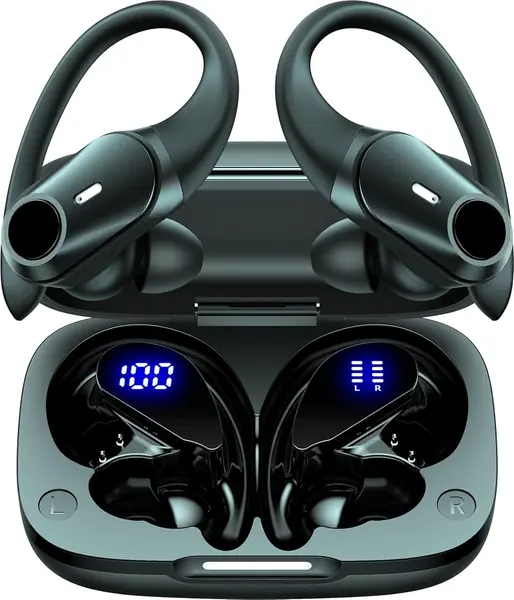
One gap matters for runners: the T59 is described as water resistant and stops short of an IP number, so we treat it as a dry-weather pair rather than one to rinse under a tap. Everything else about it reads like a considerably more expensive set of earbuds.

Thirteen-millimeter drivers give it real low end, 80 hours of total playback with the case sits behind 8 to 9 hours per charge, and there's a transparency mode for hearing traffic at a crossing. The tuning is bass-forward: satisfying for gym music and podcasts, a touch muddy on acoustic material, which is the usual trade with drivers this size at this price.

Physical buttons handle playback and volume, the case carries an LED readout of what's left, and GOLREX backs the whole thing with a five-year manufacturer warranty — a longer promise than anything else in this group.

The verdict we keep arriving at is that the T59 is a fair-weather pair with expensive habits. Add a case that charges on a wireless pad, which is unusual down here, and it's the most feature-dense cheap pair on the page. It's the one we'd keep in a gym bag rather than trust as an only pair through a wet winter.

Pros

  • 13 mm drivers deliver strong bass
  • 80 hours of total playback with the case
  • Wireless charging case with a power display

Cons

  • Water resistance is stated without an IP rating
Our verdict

For dry-weather runners who want big bass, physical buttons, and a case that lasts a week, the T59 delivers a lot for very little.

Check Latest Price

How We Chose and Tested the Best Running Earbuds

We built the shortlist from the specs runners actually compare: a water-and-dust rating that survives sweat, some kind of stabilizer — over-ear hook, wing tip, or twist-to-lock — and a playtime claim long enough to cover a week of training between charges. Then we ordered 12 pairs, from budget models with big battery numbers to premium sets with the most aggressive noise cancellation, and lived with them for six months.

Most of that time was spent where the earbuds will actually live: three- to ten-mile road runs, treadmill intervals, lifting sessions, and a few rainy commutes. Each pair was paired to both an iPhone and an Android phone before the first run; I counted the taps it took, then walked away from a parked phone to find where the signal broke. On the run I did deliberate head shakes and sprint intervals, tugged at each bud after every mile, and noted which ones needed re-seating and which I forgot I was wearing.

Sweat got tested honestly — long hot runs, an indoor cycling class, one downpour — then I dried each pair and watched the charging contacts over the following weeks. For battery, I ran each set from full to dead at a conversational volume and counted how many case recharges it really delivered. Noise cancellation was judged in a crowded gym and on a windy stretch of road, listening for wind leak and whether transparency let a cyclist's approach through. And because these get worn in public, we noted how each looked in a coffee shop and whether the price felt earned once the app, controls, and case were in the mix.

How to Choose Noise-Canceling Earbuds for Running

Start With the Fit Mechanism, Not the Brand

Three designs hold a bud in place: a hook that loops over the ear, a wing that tucks into the bowl of the ear, and a plain tip that relies on the seal alone. Hooks are the most forgiving across ear shapes — the Soundcore's adjustable version and the occiam's soft one both work this way — but they can press behind the ear on a long run. Wings sit flatter and suit ears with a defined bowl; on narrow ears they work loose.

If buds have always slid out on you, buy a hook. If hooks leave a sore spot, buy a wing.

What Water Ratings Actually Promise

IPX4 handles splashes from any direction, which covers sweat and rain. IP68 adds dust-tightness and survives a dunking — the JBL Endurance Race 2 carries it, and that's why it can be rinsed after a muddy run instead of dabbed at with a towel.

Two habits keep any of them alive: dry the buds and the case before they go back in to charge, since wet contacts are the usual cause of a pair that suddenly won't charge, and never store them wet in a gym bag.

Noise Canceling on a Run Has a Ceiling

ANC is built to cancel steady low-frequency sound, so it does its best work on a treadmill, an indoor track, or a busy gym, and its worst against wind. It's also a safety decision: beside traffic or on a shared path, transparency mode is the setting to use, and every pick here has one. We treat ANC as a gym and commute feature that happens to help on the run, not something to leave on next to the road.

Count Battery per Charge, Not the Case Total

The 48-, 80-, and 90-hour figures on these boxes are case-inclusive, and no runner needs them — a marathon is under five hours. What matters is the per-charge number, and anything at six hours or better covers the longest session you'll do.

The case total decides how often you hunt for a cable; 48 hours is roughly a week of daily runs. Noise canceling drains faster than transparency, so plan on less than the listed figure with ANC on.

Buttons Beat Touch When Your Hands Are Wet

Touch panels are sleek until sweat or rain makes them misfire, and a gloved finger does nothing at all. Physical buttons — on the occiam, the GOLREX, and the BX30 — let you change volume and skip tracks by feel. Touch isn't disqualifying, but check where volume lives: on the Soundcore it's your phone, and that's a reach mid-run.

Frequently Asked Questions

Final Verdict

For most runners, the Soundcore Sport X20 is the pair to buy. The hook adjusts, the shell is sealed to IP68, and the noise canceling is strong enough that a loud gym stops competing with your playlist. Fit is what earns it, and fit is what most running earbuds get wrong.

If you sweat hard and want to spend less, the JBL Endurance Race 2 carries the toughest water rating in this group for a budget price. And if you train by heart rate, the Powerbeats Pro 2 is the only pair here that reads it without a chest strap.