Best Lightweight Power Banks of 2026

The moment I decided I needed a better power bank came at a gate in Terminal B: phone at 6 percent, boarding group three, and every outlet claimed by someone's laptop. What I wanted was something that vanished into a jacket pocket and bought me a full charge before landing. That's the whole trick with this category — the lightest banks are the ones you'll actually carry, and the ones you carry are the ones that save you.

My team and I have spent four months with 14 of them, running them through airports, commutes, and long days out, and the differences come down to things the spec sheet skips. A built-in cable matters more than capacity, honestly; a bank with a cable you can't lose is one you'll still be carrying next year. And two banks can both claim the same fast-charging wattage and behave nothing alike when your phone is the one on the other end. Below are the ones I'd hand to a friend.

The Best Lightweight Power Banks

1

AIFENG CP2 Power Bank Best Overall
92 /100
TKZ Score Outstanding

Key details

Capacity
10,000 mAh
Output
22.5 W
Weight
7.05 oz
Built-in
Cables and foldable AC plug
View on Amazon

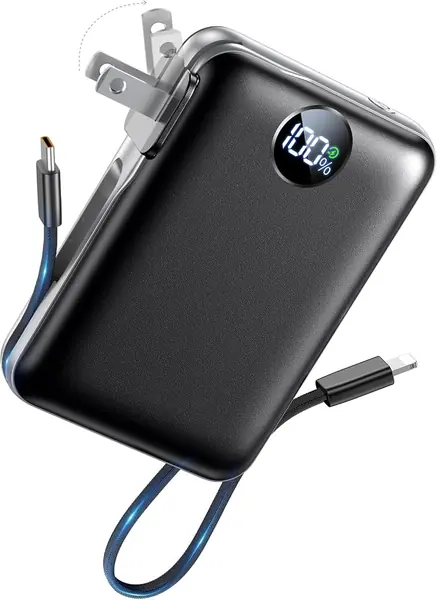
The foldable plug on the back is why this one took the top spot. Two prongs flip out, so the bank itself refills from any wall outlet with no cable and no charging brick, which means the thing you carry is one object instead of three. At 200 grams it isn't the lightest 10,000mAh bank here, but it's the only one that also replaces your charger.

The footprint is genuinely small: 3.66 by 2.36 inches is about a deck of cards, and it disappears into a jacket pocket or a tote's slip pocket. Built-in Lightning and USB-C cables cover the two phones most people carry, and between those and the spare ports it can charge up to four devices at once when a hotel room has one outlet.

22.5W is quick enough for a modern phone, with the listing quoting half a battery in 30 minutes, and the bank refills in about four hours from that same foldable plug with no fast charger required. That's the part we kept coming back to: a power bank that needs its own charger is a power bank that gets left at home.

Pros

  • Refills from a wall outlet with no cable or brick
  • Lightning and USB-C cables built in
  • Deck-of-cards footprint for 10,000 mAh

Cons

  • 1.26 inches thick, the chunkiest body here
Our verdict

We recommend it to most people: a deck-of-cards body, two built-in cables, and a foldable plug that replaces your wall charger, so the only thing you pack is one object.
Check Latest Price
2

Anker Zolo 30W Power Bank Best for Fast Charging

91 /100
TKZ Score Outstanding

Key details

Capacity
10,000 mAh
Output
30 W
Weight
7.87 oz
Built-in Cable
5.4 in USB-C
View on Amazon

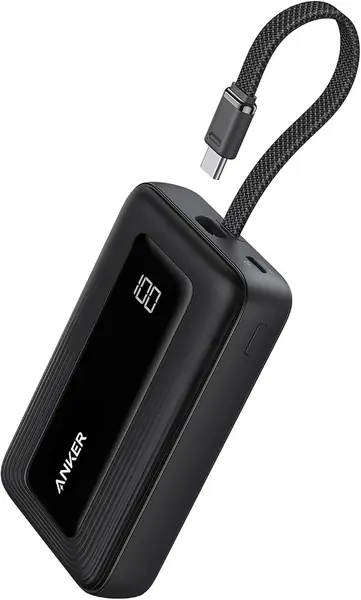
Thirty watts is the highest output in this group, and it changes what a pocket bank can do: a phone down to single digits reaches half in about 27 minutes, and a tablet accepts a real charge instead of a trickle. If the reason you carry a bank is a dead phone before a meeting, this is the one that fixes it fastest.

The built-in USB-C cable is a 5.4-inch stub that doubles as a lanyard, and Anker rates it for 10,000 bends, a spec worth having since a built-in cable that fails takes the whole bank with it. The body runs 223 grams, more than the AIFENG and the Aaoyun, and you feel it in a light jacket. That mass buys the 30W board, and we minded the weight less once speed became the reason we reached for it.

The cable is USB-C only, so anyone still on a Lightning iPhone should plan on packing a cord and giving up part of the convenience. For a phone-and-tablet traveler who wants one cable and the quickest top-up, it's still the fastest thing here that fits in a bag pocket.

Pros

  • 30W output, the highest in this set
  • Built-in USB-C cable rated for 10,000 bends
  • Fast two-way charging, 30W out and 20W in

Cons

  • Built-in cable is USB-C only, so Lightning users need a cord
  • Almost an inch thick, so it stays out of jeans pockets
Our verdict

The pick when speed is the point: 30W output and a built-in USB-C cable in a body that's still small enough for a bag pocket.

Check Latest Price
3

Aaoyun B2 Power Bank Best Budget

89 /100
TKZ Score Excellent

Key details

Capacity
10,000 mAh
Output
22.5 W
Weight
6.8 oz
Case
Aluminum alloy
View on Amazon

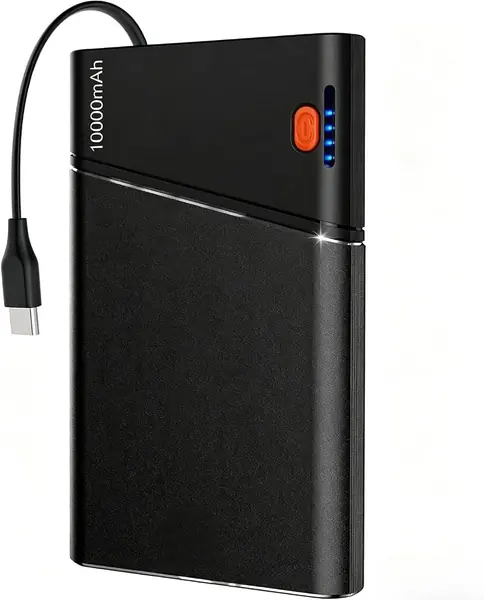
An aluminum case at this price is the surprise. The B2 is 0.6 inches thin, weighs 6.8 ounces, and costs about half what our top pick does, a combination that usually means a plastic shell and a hollow feel. It's the bank we hand to someone who wants one to vanish into a bag and be forgotten until it's needed.

22.5W over the built-in USB-C cable, plus two more outputs for three devices at once, and a claimed 63% for an iPhone 17 in half an hour. The built-in cable is the good part: nothing to lose, nothing to dig for. Anyone on a Lightning iPhone will still need their own cord.

Staying power is the caveat. Some units stop holding a charge after a few months, and the one-year warranty is the shortest here, so we treat this as the second bank, the one in a glovebox or a work bag, rather than the only one you own. At this money, replacing it in a year stings a little rather than a lot.

Pros

  • Aluminum body at a budget price
  • 6.8 oz, among the lightest banks here
  • 22.5W charging over a built-in USB-C cable

Cons

  • One-year warranty, shortest in this group
  • Some units stop holding a charge after months
Our verdict

A metal-bodied 10,000mAh bank for about half the price of our top pick, and the one we recommend when a power bank is a backup rather than a daily essential.

Check Latest Price
4

Zmmyuluo N1 Power Bank Best for Mixed Devices

88 /100
TKZ Score Excellent

Key details

Capacity
10,000 mAh
Output
3 A
Weight
6.63 oz
Built-in Cables
4
View on Amazon

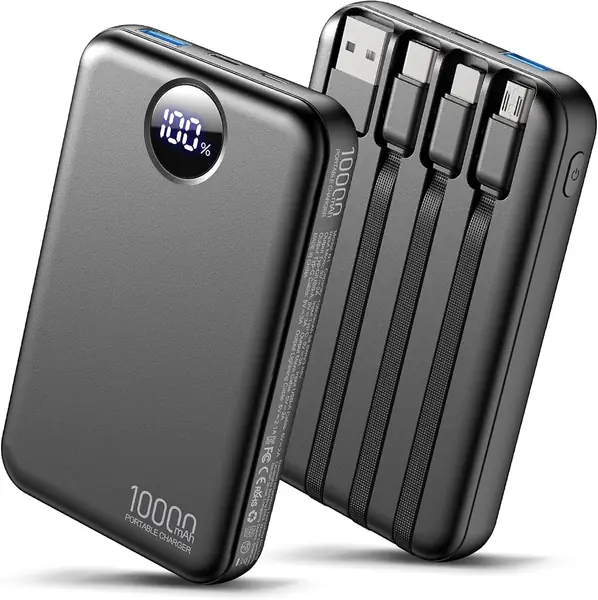
Picture the drawer: an e-reader on micro-USB, earbuds on USB-C, a work phone on Lightning. The N1 grows four cables out of its own body and covers all three standards, so the drawer stays home. That's a small thing that turns into a big one the first time you pack for a trip without a pouch of cords.

At 188 grams it's the lightest 10,000mAh bank here, and 0.77 inches thick means it lies flat in a bag pocket. The display reads out a percentage rather than four anonymous dots, a small upgrade that turns out to matter when you're deciding whether to top it up before a flight.

Speed is the compromise. The output is an ordinary 3A rather than a fast-charge standard, so a phone left at 5% will sit there a while. That's a fair trade if this lives in a bag as the household's shared backup; the cables are the reason to buy it, and nothing else here covers this many plugs without extra parts.

Pros

  • Four built-in cables cover Lightning, USB-C, and micro-USB
  • Lightest 10,000mAh bank here at 188 g
  • Percentage display instead of indicator dots

Cons

  • Ordinary 3A output rather than fast charging
Our verdict

The one to buy if your household runs on three different charging standards: four built-in cables, 188 grams, and nothing extra to pack.

Check Latest Price
5

INIU BI-B3 Power Bank Laptop-Bag Carry

87 /100
TKZ Score Excellent

Key details

Capacity
10,000 mAh
Output
20 W
Weight
9.1 oz
Thickness
0.5 in
View on Amazon

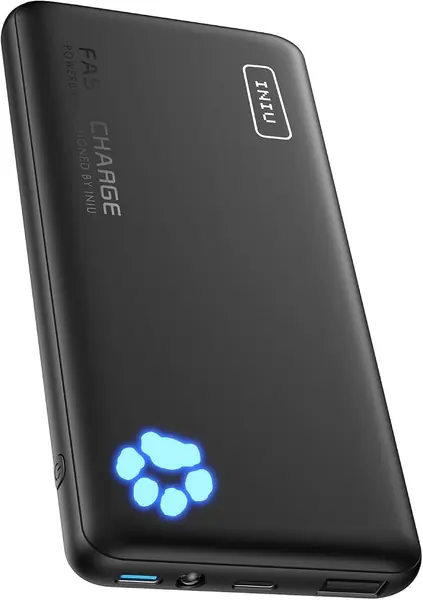
Half an inch thick is the entire argument. The BI-B3 slides into a back pocket, a slim folio, or the tablet sleeve of a backpack where thicker banks make a lump, and at 5.2 inches long it doesn't poke out of a pocket.

What that thinness costs is density: 9.1 ounces, more than the AIFENG, the Aaoyun, and the Anker. Thin isn't the same as light, and a flat but heavy bank still pulls a jacket sideways. What you get for the weight is two USB-C ports plus USB-A, a paw-shaped charge indicator that's more useful than it sounds, and a flashlight for the parking garage.

20W PD covers a phone comfortably and trails the 30W Anker on a tablet. The three-year warranty is the longest in this group, though, and if the pocket you're aiming at is a flat one, nothing else here fits it as cleanly.

Pros

  • 0.5-inch body, the thinnest in this guide
  • Two USB-C ports plus USB-A
  • Three-year warranty

Cons

  • 9.1 oz, heavier than the lighter-bodied picks here
  • 20W output trails the 30W Anker
Our verdict

Half an inch thick and built to live in a laptop bag; just know that the flattest bank here is also one of the heavier ones.

Check Latest Price
6

FancyBean M7 2-Pack Whole-Household Backup

86 /100
TKZ Score Excellent

Key details

Capacity
10,000 mAh each
Built-in Cables
Lightning and USB-C
Pack
2 units
Warranty
3 years
View on Amazon

Two 10,000mAh banks in one box is the whole idea. One lives in a backpack, the other stays plugged in by the door or in the car, and nobody in the house is left hunting for the single charger everyone shares.

Each bank is 0.63 inches thick with a Lightning cable and a USB-C cable built in, plus two USB-A ports, so four things can charge at once. That's more than most people need and exactly right for a car full of phones. A percentage display rounds out the sensible bits.

The set costs about what one mid-range bank does, and the three-year warranty covers both. If one of them dies, you're not stranded mid-trip, which two-bank households appreciate more than any spec.

The trade is on the refill side: both banks take their time topping up themselves, so plan on an overnight rather than a lunch break. As a pair of errand-and-road-trip banks that's easy to live with; as your only charger on a work trip, it isn't.

Pros

  • Two 10,000mAh banks for one mid-range price
  • Lightning and USB-C cables built into each bank
  • Three-year warranty covering both units

Cons

  • Slow to recharge the banks themselves
Our verdict

Two capable banks for the price of one mid-range pick, and the sensible buy for a household that keeps stealing each other's chargers.

Check Latest Price
7

GrnOas.E K51 Power Bank Cheap Spare Bank

85 /100
TKZ Score Excellent

Key details

Capacity
10,000 mAh
Output
22.5 W
Weight
8.4 oz
Built-in Cables
Lightning and USB-C
View on Amazon

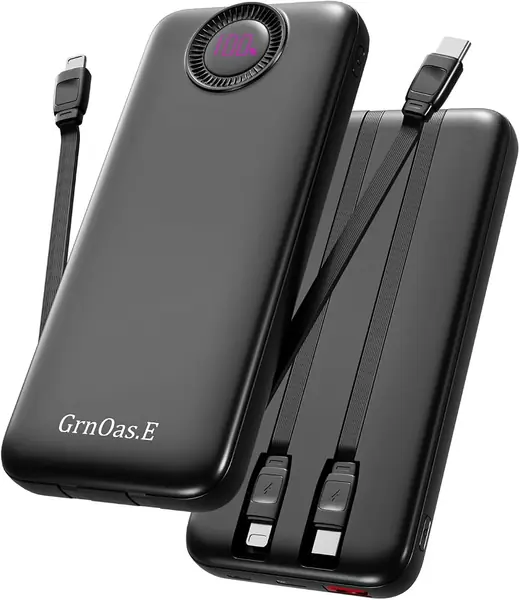
Lightning and USB-C, both built in, for the least money here. In a house where one person carries an older iPhone and another an Android, that pairing is the entire reason to look at this one.

22.5W output, four outputs and two inputs, a percentage display, and a three-year warranty. At 5.9 inches long and 8.4 ounces it's a bag bank rather than a pocket one: a tote or a backpack, not jeans.

Two things hold it back. Refilling the bank itself is slow, an overnight job rather than a lunch-break one, and some units quit after a few months. As a cheap second bank for the car or a desk drawer, that's a reasonable gamble; as the only bank you own, the Anker or the AIFENG is the safer buy.

Pros

  • Lightning and USB-C cables built in at the lowest price here
  • 22.5W output with four outputs and two inputs
  • Three-year warranty

Cons

  • Slow to recharge the bank itself
  • Some units quit after a few months
Our verdict

The cheapest way to get both Lightning and USB-C cables attached to a bank, as long as you're buying a spare rather than your only one.

Check Latest Price

How We Picked and Tested Lightweight Power Banks

We started by pulling every bank we could find that claimed roughly 10,000mAh and looked genuinely pocketable, then cut anything with a pattern of dead-on-arrival or short-lifespan complaints in its review history, or a price that didn't line up with what it delivered. That left 14 models, which we bought at retail so no brand had a reason to expect a kind word.

For four months those banks lived where a power bank actually lives: a morning commute, two cross-country flights, a long Saturday out with no outlet in sight, and one slow train home. We weighed each one on a kitchen scale out of the box, then carried it in a front jeans pocket and in a jacket pocket on separate days to see whether it read as a tool or a brick.

Charging speed got timed, not estimated. We drained each bank and ran the same phone from 10 to 50 percent, then timed how long the bank itself took to refill from a wall outlet — a couple of these needed most of a night. Capacity we measured in delivered charges rather than printed numbers, counting full phone charges in week one and again in month four to see how much had quietly gone missing. Built-in cables got the roughest handling: stuffed into bags, twisted the wrong way, and used to dangle a phone off the edge of a table while it charged.

Reliability showed up in small things — whether the button still clicked firmly at the end, whether the port had gone loose, whether anything rattled when we shook it. Value came down to what you pay per delivered charge rather than per milliamp-hour on the box.

How to Choose a Lightweight Power Bank

Weigh the Whole Kit, Not Just the Bank

Most 10,000mAh banks land between 6.5 and 9.5 ounces, and the spread between the lightest and heaviest picks here is about two and a half ounces. That's worth caring about, but the bigger difference is what else goes in the bag. A portable charger with built-in cables and a foldable plug replaces a charging brick and a cord, which is more weight and more to forget than the gap between the banks themselves. Compare the assembled kit, not the bare battery.

Size Has Two Dimensions, and Listings Only Brag About One

Compact in a listing usually means a small face, not a thin body. A bank can be the size of a deck of cards and still be 1.3 inches deep: flat in a tote, obvious in a jeans pocket. Under about 0.7 inches disappears into most pockets, and anything approaching an inch is a bag bank. Footprint matters more for a jacket or a crossbody; depth decides whether it's a pocket object at all, so check both against the pocket you actually use.

Capacity Is Where the Weight Comes From

10,000mAh is the sweet spot for daily carry, roughly two phone charges, and it's where almost every pick here lands. A 5,000mAh bank halves the weight and halves the charges, which suits a commute or a concert rather than a travel day. If you're set on a bank under six ounces, you're shopping 5,000mAh rather than hunting for an unusually light 10,000.

Output Wattage: 20W Is the Floor Now

Look for USB-C Power Delivery at 20W or more; that's what gets a modern phone to half in about half an hour. The models without a fast-charge claim are noticeably slower and fine mostly for overnight top-ups. Thirty watts is worth paying for only if you charge a tablet or a large phone that can take it, and remember that the number on the box is a ceiling shared across ports once two devices are plugged in.

How It Refills, and How Long It Lasts

A bank you can't refill quickly is a bank you leave at home. Some here top up from a wall plug in roughly four hours; others need a USB-C charger you already own and take considerably longer. Then there's the longer curve: capacity fades, and the most common complaint in this category is a bank that stops holding a charge after a few months. A three-year warranty is the best hedge available, and it's one of the few specs worth comparing before you buy.

Frequently Asked Questions

Final Verdict

The AIFENG CP2 is the lightweight power bank we recommend to most people because it's the only one here that replaces your charger as well as your battery: a deck-of-cards body, two built-in cables, and a plug that folds out of the back, so the whole kit is one object. If speed matters more than the plug, the Anker Zolo's 30W output is what changes a tablet from a trickle to a charge.

And if the goal is simply the smallest, lightest thing that still holds two charges, the Aaoyun B2 weighs a few grams less and costs about half as much, as long as you treat it as a spare rather than your only bank.