Best Headphones for Travel of 2026

The engine drone starts somewhere over the Rockies and the podcast you downloaded is suddenly not loud enough. That's usually the moment people start shopping for travel headphones — not for a spec sheet, but for a quieter six hours. What you're actually buying is a calmer flight: cancellation that swallows engine hum, earcups that don't clamp by hour three, and a battery that doesn't quit over the Atlantic.

The numbers on the box rarely tell you what a pair is like at 35,000 feet. Battery life is often quoted with cancellation switched off, and a headphone that folds flat takes up half the room in a personal item bag. Over the past six months, my team and I have flown with, commuted in, and stuffed into carry-ons 12 pairs to find the ones actually worth carrying.

Every pick below earns its place on travel grounds: it seals out a cabin, survives a bag, and stays comfortable through a long travel day for a price that makes sense. If you only ever listen at a desk, a few of these are more than you need.

The Best Headphones for Travel

1

Bose QuietComfort Headphones Best Overall
93 /100
TKZ Score Outstanding

Key details

Weight
8.4 oz
Noise Control
Active noise cancellation
Battery Life
24 hours
Wired Option
3.5 mm jack
View on Amazon

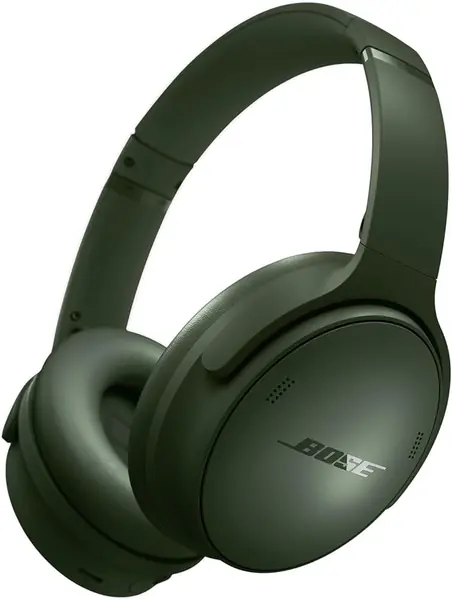
The first thing we noticed about the QuietComfort is how little it asks of you. The earcups are deep and soft, the clamp is gentle, and the 238-gram weight settles into place instead of pressing on the top of your head. On a long flight, that is worth more than a spec sheet full of features.

Bose's Quiet and Aware modes are why it earns the top spot. Quiet mode takes the low rumble out of a cabin and turns a noisy train into background hum; Aware mode lets you hear the gate announcement without pulling the headphones off. The active noise cancellation is the most convincing in this group, and the plush fit helps it work.

The 24-hour battery rating is not the biggest here, because the Tagry and Kividio go longer, but it is enough for a transatlantic round trip, and a 15-minute charge adds up to 2.5 hours. We also like the included hard case and 3.5mm cable, which let you switch to a seat-back screen or save the battery on a long layover.

The hard case is the detail that makes it feel purpose-built for travel: we can toss it in a carry-on without babying the headband, and the cable lives in the case for the seat-back screen. That is the kind of small convenience that keeps a premium pair in the bag instead of on a shelf.

Pros

  • Strong noise cancellation for flights
  • Plush fit for long wear
  • Wired backup and hard case
  • 24-hour battery with quick charge

Cons

  • Premium price
  • Bluetooth can stutter when switching devices
Our verdict

We recommend the QuietComfort for frequent flyers: its noise cancellation and plush fit make long travel days easier, and the wired cable is there when a seat-back jack calls.
Check Latest Price
2

Soundcore Q20i Best Value

92 /100
TKZ Score Outstanding

Key details

Weight
8.64 oz
Noise Control
Hybrid ANC
Battery Life
40 hours with ANC
Multi-Device
Two devices
View on Amazon

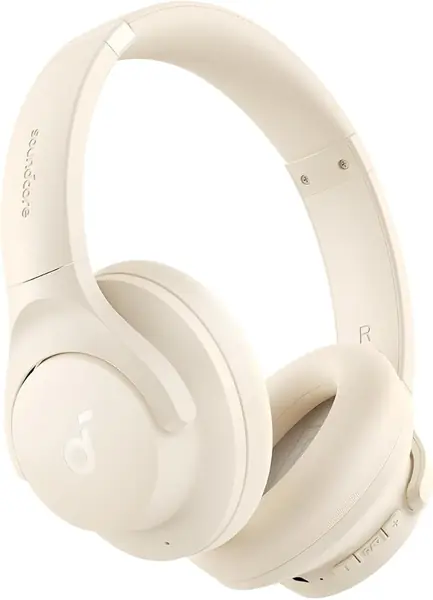
Budget travel headphones usually ask you to give up one thing: ANC, battery life, or a wired connection. The Q20i gives you all three, which is why it is the value pick here. It is the pair we leave in a bag for short trips, commutes, and the flights where losing a premium headphone would sting.

The 40-hour ANC rating is the big draw: it covers a long weekend or a week of commutes without a charger, and the included AUX cable means a dead battery does not end the trip. We also like the two-device pairing, since switching from a phone to a laptop is the kind of small convenience that matters in an airport.

The hybrid ANC is good for the money, but it is not the quietest in this group; the Bose is the one to buy if silence is the priority. Fit is the other thing to watch. On a smaller head, the headband can sit loose, so this is a better pair for sitting in a seat than for moving through a station.

The app lets you switch EQ presets or build your own, which is a small bonus on a budget pair; we used it to tame the bass for spoken-word listening. That flexibility makes the Q20i feel less like a compromise and more like a travel tool.

Pros

  • Real ANC at a budget price
  • 40 hours of ANC playtime
  • Wired cable and two-device pairing
  • Custom EQ in the app

Cons

  • No carrying case included
Our verdict

The Q20i is the pair we hand to anyone who wants real ANC and a wired backup without spending much; just check the fit if you have a smaller head.

Check Latest Price
3

Beats Studio Pro Best USB-C Audio

91 /100
TKZ Score Outstanding

Key details

Weight
9.2 oz
Noise Control
Active noise cancellation
Battery Life
40 hours
Wired Audio
USB-C and 3.5 mm
View on Amazon

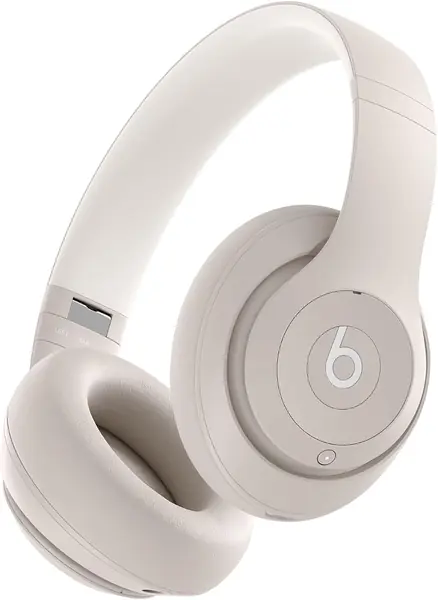
The Studio Pro's most useful travel feature is the USB-C port: it carries lossless audio from a laptop or a USB-C phone, not just charging current. If you travel with an iPad or a newer phone, that is a cleaner setup than hunting for a dongle.

We also like the 40-hour battery rating, which is the longest of the premium picks here, and the foldable design that lets it collapse into a bag. One-touch pairing works with both Apple and Android, so it is not a one-ecosystem purchase.

The fit is where the Studio Pro asks for patience. The clamp can feel firm, especially if you have a wide head or thick glasses, and the earcups sit closer than the QuietComfort's. The sound is lively and bass-forward, which suits movies and travel playlists more than neutral monitoring.

Spatial audio with head tracking is the sort of extra that sounds like a gimmick until you watch a movie in a cramped seat; it gives the soundtrack some room without making the headphones feel heavy. That, plus the USB-C audio, gives the Studio Pro a clear role for the right traveler.

Pros

  • USB-C lossless audio plus 3.5mm
  • 40-hour battery
  • One-touch Apple and Android pairing
  • Spatial audio with head tracking

Cons

  • Hinge and headband durability are watch points
Our verdict

We recommend the Studio Pro for USB-C listeners who want 40 hours and lossless audio, though its clamp is firmer than the Bose.

Check Latest Price
4

YMOO Y7Pro Best for Long-Haul Flights

90 /100
TKZ Score Outstanding

Key details

Weight
9.45 oz
Noise Control
Hybrid ANC
Battery Life
100 hours
In-Flight Adapter
Included
View on Amazon

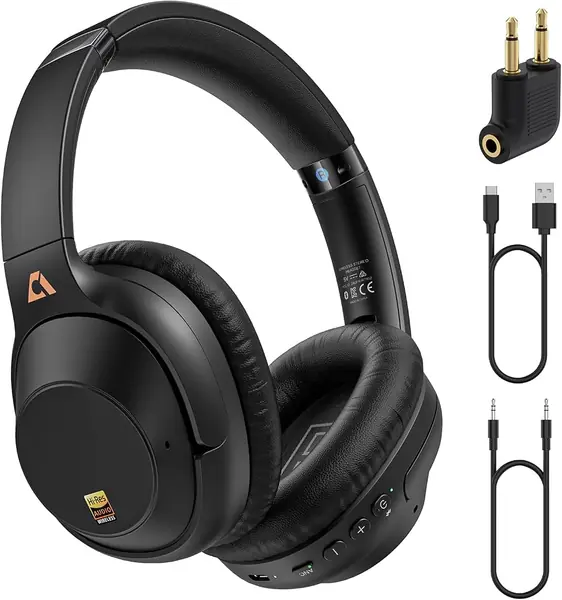
The Y7Pro comes with the accessory most travel headphones leave out: an aircraft adapter. That small plug, plus the 3.5mm cable, means you can use the seat-back screen even if the battery is flat or the plane has no Bluetooth.

The 100-hour battery rating is the second-longest in this group, behind the TAGRY A18, and it is the reason the Y7Pro belongs in a long-haul bag. LDAC support and 40mm drivers give it more audio ambition than most budget travel pairs, and the roomy earcups sit around the ear rather than on it.

The ANC is real, with four microphones and a transparency mode, and it is a genuine step up from passive isolation. At 268 grams, the Y7Pro is heavier than the QuietComfort, though the weight is spread across a padded headband.

We like the button controls for travel because you can find them by feel with a hood up or a scarf on. The Y7Pro also folds, so it takes up less room in a personal item than a fixed over-ear design.

Pros

  • Aircraft adapter included
  • 100-hour battery rating
  • LDAC hi-res audio
  • Roomy over-ear fit

Cons

  • ANC trails the Bose's
  • Pouch only, no hard case
Our verdict

We recommend the Y7Pro for long-haul trips: the included aircraft adapter and 100-hour rating make it a useful seat-back companion, provided you temper expectations on ANC.

Check Latest Price
5

KVIDIO WH201A Best No-Frills Budget

89 /100
TKZ Score Excellent

Key details

Weight
7.04 oz
Noise Control
Sound isolation
Battery Life
65 hours
Wired Option
3.5 mm jack
View on Amazon

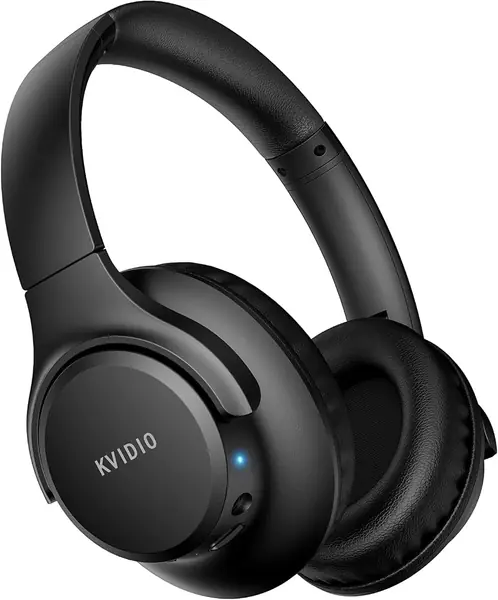
There is no active noise cancellation here, and that is the trade: KVIDIO keeps the price low and the battery long. For a backup pair or a trip where you are not chasing silence, that is a sensible bargain.

The 65-hour rating is the third-longest in this group, and the 7.04-ounce weight makes it easy to stuff into a bag. The 3.5mm cable is the real travel insurance: if the battery runs down, you can plug into a seat-back jack and keep going.

We found the memory-foam earcups comfortable for a movie, though the padding is not as plush as the Bose or Beats. The closed-back cups take the edge off engine rumble, but they do not cancel it; think of this as a quiet-ish pair, not a noise-cancelling one.

The controls are simple push buttons, which we prefer to touch controls when wearing gloves, and the foldable hinges make the headphone small enough for a backpack pocket. It is the pair you can hand to a kid or leave in a car without worrying.

Pros

  • 65-hour battery rating
  • Light 7.04-ounce body
  • Wired 3.5mm backup
  • Simple push-button controls

Cons

  • Bluetooth pairing can be fussy
  • No carrying case included
Our verdict

We recommend the KVIDIO for a cheap, long-lasting backup pair: it has no ANC and a basic fit, but 65 hours and a cable cover the travel essentials.

Check Latest Price
6

RORSOU C6 Lightweight ANC

88 /100
TKZ Score Excellent

Key details

Weight
8.11 oz
Noise Control
Active noise cancellation
Battery Life
60 hours
Carrying Case
Included
View on Amazon

At 0.23 kg, the C6 is one of the lightest ANC over-ears here, and the fold-flat cups and included protective case make it easy to live with. For a short trip or a commute, that combination is more useful than a bigger battery.

The 60-hour rating is respectable, and the 3.5mm cable gives you a fallback for a seat-back screen. Bluetooth 5.4 paired quickly in our use, and the included case means you can toss it in a tote without worrying about the earcups.

The ANC is real but modest: it lowers steady noise, and voices and announcements still come through. That is fine for a train or an office, less so for a loud cabin. The earcups are soft, but the fit is not as plush as the Bose, and we do not count on it for a ten-hour flight.

The controls are physical buttons, which we found easier to use than touch panels when wearing gloves. The C6 makes sense as a second pair, the one you leave in a bag for short trips or hand to a family member.

Pros

  • Light 0.23 kg build
  • 60-hour battery rating
  • Protective case included
  • Wired 3.5mm backup

Cons

  • Durability of hinge and cup is a question
Our verdict

We recommend the C6 as a light, affordable ANC pair for short trips, as long as you accept that its quieting and build are not Bose-grade.

Check Latest Price
7

TAGRY A18 Best for Battery Marathons

87 /100
TKZ Score Excellent

Key details

Weight
9.17 oz
Noise Control
45dB hybrid ANC
Battery Life
120 hours
Microphones
6-mic ENC
View on Amazon

The A18's 120-hour battery rating is the kind of number that changes how you pack: you can leave the charging cable at home for a weekend and still have headroom. It is the longest rating in this group, and that alone earns it a place.

The rest of the travel kit is equally practical: a 3.5mm cable, a foldable design, and a 0.26 kg body that is easy to carry. The 6-mic ENC array is aimed at calls, which makes the A18 a better airport-work headphone than the Sony or Kividio.

The hybrid ANC is tuned for steady noise like engine drone, and the transparency mode lets you hear announcements without taking the headphones off. Comfort is a strong point in the early going; the memory-foam cushions and adjustable headband keep pressure off the top of the head.

The low-latency mode is a small extra for a tablet game on a layover, even if it is not why you buy a travel headphone. The A18 is a features-first pair that happens to hit the travel essentials.

Pros

  • 120-hour battery rating
  • 6-mic ENC for calls
  • 3.5mm cable and foldable design
  • Pressure-free over-ear fit

Cons

No notable drawbacks to flag.

Our verdict

We recommend the A18 for travelers who care more about battery life than brand polish: 120 hours, a 3.5mm cable, and good comfort for the money.

Check Latest Price
8

Sony MDR-ZX110 Wired Backup

86 /100
TKZ Score Excellent

Key details

Weight
4.76 oz
Noise Control
Passive isolation
Wired Option
3.5 mm jack
Earcups
Swiveling
View on Amazon

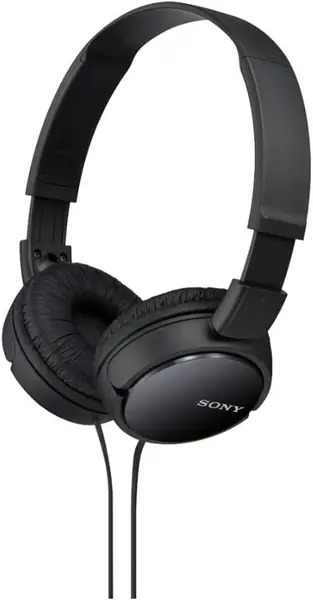
There is no battery to charge and no Bluetooth to pair, which is exactly why the MDR-ZX110 belongs in a travel bag as backup. It is a wired on-ear headphone with a 3.5mm plug, a 3.94-foot cord, and swiveling earcups that fold flat for packing.

At 135 grams, it is the lightest pair here, and the closed-back design seals in sound enough to take the edge off cabin noise. We like it for a seat-back screen, an e-reader with audio, or a trip where you do not want to think about charging.

The trade-off is on-ear pressure. The pads sit on the ears rather than around them, so a long flight can become uncomfortable, and passive isolation is modest compared with ANC. The cable is also the only connection, so a broken cord ends the trip.

The swiveling cups make it easy to hang around your neck between flights, and the L-shaped plug is less likely to snag on an armrest. That is the kind of small thing that keeps a backup pair in the bag.

Pros

  • No charging or pairing
  • Light 135 g with swiveling cups
  • L-shaped 3.5mm plug
  • Low-cost backup

Cons

  • On-ear pressure can bother after hours
  • No microphone
Our verdict

We recommend the MDR-ZX110 as a wired emergency pair: it is light, cheap, and needs no charge, though on-ear pressure limits long flights.

Check Latest Price

How We Tested Travel Headphones

We started by pulling the over-ear headphones shoppers actually buy for travel — active noise cancellation models across the price range — then filtered for what matters in transit: whether they fold, whether they can run wired when the battery dies, how much they weigh, and whether the maker's app lets you retune the sound. That left 12 pairs, which we rotated through six months of real trips: two cross-country flights, a week of subway commutes, a long train ride, and plenty of calls taken from noisy gates and coffee shops.

Battery came first, since a dead pair at the gate is the failure we hear about most. We charged each to full, ran noise cancellation at a set volume until the low-battery warning, and noted how far the real number fell short of the claim — most did, once cancellation was on. Sound got a fixed reference too: the same three tracks on every pair, listening for bass that swallowed vocals and treble that turned harsh when we nudged the volume up.

Comfort got the least glamorous test: four straight hours in one seat, with notes on clamping pressure, heat behind the ears, and how often we fidgeted with the headband. We walked each pair through a crowded terminal to see where Bluetooth dropped, bounced connections between a phone and a laptop, and took calls from a busy gate to hear how the mic handled announcements. Then we packed each one into a personal item bag, case and no case, and inspected hinges and earcup pads at the end of six months, keeping a running note of what each pair cost against how much cabin noise it actually removed.

How to Choose Travel Headphones

Noise Cancellation: Match It to the Noise

Active noise cancellation is best at steady low-frequency sound like jet engines, train rumble, and air-conditioning. It is less effective on voices, babies, and announcements, so even the strongest ANC in this group is not a mute button for a crowded gate. If you fly often, pay for strong ANC and a good seal; if you mostly need to hear a podcast on a bus, a passive closed-back pair can be enough. Transparency mode is worth having for boarding, but it should not replace taking the headphones off when you need to be aware.

Battery Life and the Cable You Hope Not to Need

Battery ratings are measured in different modes, so treat a big number as a ceiling rather than a promise. ANC, higher volume, and cold weather all shorten runtime. For a long-haul flight, look for a rating well beyond the flight time, or at least a 3.5mm cable that works with the seat-back jack. The Soundcore Q20i, KIVIO, and TAGRY A18 all include a cable; the Beats Studio Pro adds USB-C audio. A cable is the only feature that still works when the battery is empty.

Fit, Weight, and Packing

Comfort is not a single measurement. Clamping force, earcup depth, headband padding, and weight all decide whether you will still be happy three hours in. A 238-gram Bose feels different from a 268-gram YMOO, and an on-ear Sony presses differently from an over-ear Soundcore. If you wear glasses, give the temples room; if you have a smaller head, check that the headband adjusts tight enough. Folding cups and a case matter as much as grams: the Beats and RORSOU fold, while the Bose includes a hard case.

Bluetooth, Multipoint, and Durability

For travel, stable Bluetooth and multipoint pairing are more useful than the latest codec. Multipoint lets a phone and laptop stay connected, so a call does not require repairing at the gate; the Soundcore Q20i handles two devices. Check the hinge and headband, too: folding joints are convenient but are often the first thing to fail. A hard case and a simple folding mechanism are worth more than a fancy case that adds bulk. If you are rough on gear, buy for the hinge as much as the sound.

Frequently Asked Questions

Final Verdict

After comparing the set, the Bose QuietComfort is the travel headphone we recommend first. It has the strongest noise cancellation here, the most forgiving fit for long wear, and a wired cable and hard case that make it easy to live with. The premium is not small, but it buys the quietest, least fussy trip.

If you want to spend less, the Soundcore Q20i is the value pick: real ANC, 40 hours, and a cable for much less. Choose the Beats Studio Pro if USB-C audio and 40-hour battery matter more than the softest clamp, or the KVIDIO if you just want a cheap, long-lasting backup.