Best GaN Chargers of 2026

Gallium nitride is the reason a charger the size of a deck of cards can now top up a laptop. Swapping silicon for GaN inside the brick means less energy is lost as heat, so the components can sit closer together and leave room for extra ports. Two chargers with identical numbers on the box can still behave very differently once a laptop is plugged in.

My team and I spent six months with 12 of them — pocket-size blocks, multi-port wall chargers, desktop stations — to see which hold their speed, run cool, and earn their price. We timed real charges, checked case temperatures, and weighed each one before it went in a bag.

Worth knowing before you buy: the wattage on the box is a total budget, not a promise to each port. Plug a laptop, phone, and watch into a 100-watt charger and the laptop may drop to 65 so the phone can take its share. Good ones divide that budget sensibly and stay cool doing it. Below: everything from a brick that disappears into a jacket pocket to a station that replaces the power strip under your desk.

The Best GaN Chargers

1

Anker 67W GaN 3-Port Charger Best Overall
95 /100
TKZ Score Outstanding

Key details

Ports
2 USB-C + 1 USB-A
Total Output
67W
Weight
5.12 oz
Two-port Output
65W max
View on Amazon

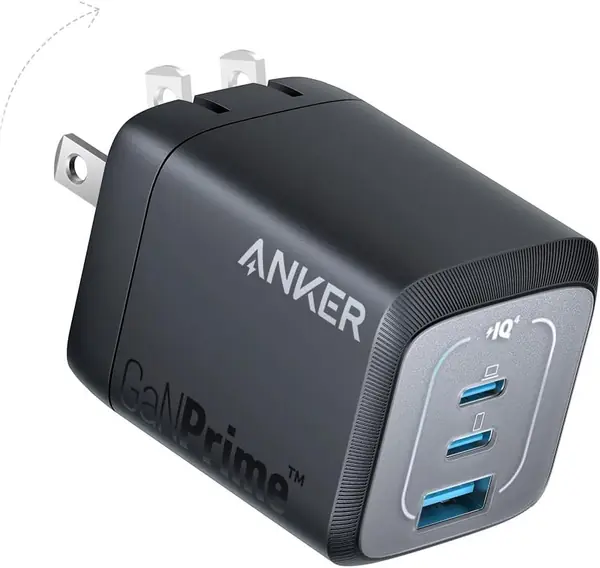
The number that settled this one for us is 65W, the output the Anker still delivers when two ports are in use at once. That is the difference between a brick that looks fast on a spec sheet and one that stays fast when your laptop and phone are both plugged in. Total output is 67W across two USB-C ports and a USB-A, in a body Anker lists at 51% smaller than the 67W MacBook charger it replaces, with prongs that fold flat.

Anker lists it at 5.12 ounces, which is a lot of charger for the footprint. It drops into a backpack pocket and the folded plug doesn't stab at a laptop sleeve. Of everything here, this is the one we reach for first: the USB-A slot keeps an older watch cable or a borrowed phone in play without an adapter, and three ports is enough that you stop rationing outlets in a hotel room.

The quieter half of why it earns the top spot is the coverage. ActiveShield 2.0 monitoring and a 24-month warranty are the longest protection on this list, and the difference shows up in year two rather than on day one. It runs warm when a laptop is pulling hard, as any brick this small will, and it never got uncomfortable to pull out of an outlet.

What it isn't is a one-device charger. A phone-only carry is paying for two ports it will never use. And the box holds the brick and a welcome guide, nothing else, so budget for a USB-C cable rated for 65W or the laptop will charge at whatever the cable allows rather than what the charger can do.

Pros

  • Holds 65W while two ports are in use
  • Three ports, including USB-A for older gear
  • Foldable plug, 51% smaller than the MacBook brick

Cons

  • No USB-C cable in the box
Our verdict

We recommend the Anker 67W to anyone who wants one brick to cover a laptop, phone, and tablet without slowing any of them down.
Check Latest Price
2

UGREEN Nexode 65W 3-Port Charger Best Budget

94 /100
TKZ Score Outstanding

Key details

Ports
2 USB-C + 1 USB-A
Total Output
65W
Weight
4.6 oz
Warranty
1 year
View on Amazon

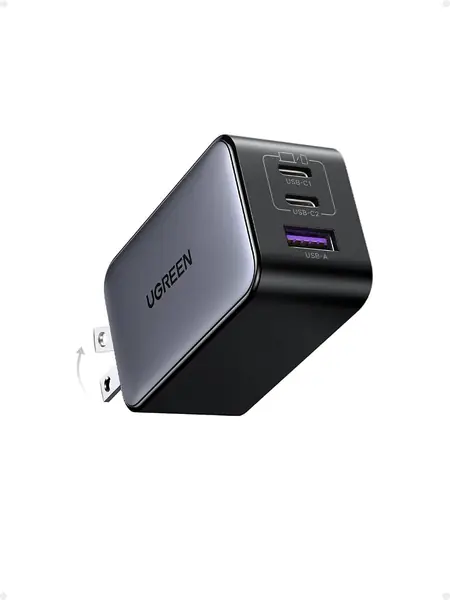
Half the size of the 61W brick it replaces and 4.6 ounces on the scale, the UGREEN Nexode 65W is the compact USB-C charger we hand to people who want the job done without paying for a screen or a fourth port. Two USB-C ports and one USB-A share 65W, the plug folds, and the whole thing vanishes into a jacket pocket between trips.

We like it best as the second charger, the one that lives in the work bag while something bigger stays home. It has been steady on phones, tablets, and a 13-inch laptop, and a full-size MacBook Air goes from empty to more than half in well under an hour on the single-port connection. The foldable plug has kept its tension through months of being opened and closed.

Heat is the thing to know. Push a full 65W into a laptop for an hour and the case gets genuinely warm, warm enough that you notice it when you pull it out. It is UL listed with the usual overheat and overcurrent circuitry, so this is normal behavior rather than a fault, but don't bury it under a cushion or leave it behind a couch while it works. Coverage is one year, the shortest of any pick here.

The step up to the Anker 67W buys longer coverage and a port that keeps its speed with two devices attached. And if your laptop is a 100W machine rather than an air-class ultraportable, this isn't the brick for it; the UGREEN Nexode Pro 160W is where that job lives.

Pros

  • Half the size of a 61W laptop brick
  • Cheapest laptop-capable charger in this group
  • Two USB-C plus USB-A at 65W total

Cons

  • Runs warm with a laptop at full draw
  • One-year warranty, shortest here
Our verdict

The UGREEN Nexode 65W is our pick for anyone who wants laptop charging on the smallest budget, as long as the laptop is not a 100W machine.

Check Latest Price
3

Anker Prime 200W Charging Station Best Desktop Station

92 /100
TKZ Score Outstanding

Key details

Ports
6
Total Output
200W
Dimensions
4.4 x 3.0 x 1.4 in
USB-C Output
100W each, two in use
View on Amazon

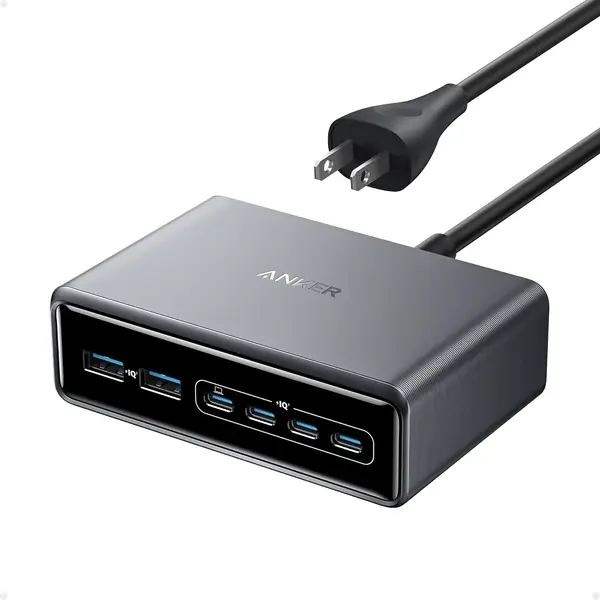
Six ports and a cord solve what no wall brick can: the desk. The Anker Prime 200W charging station measures 4.4 by 3.0 by 1.4 inches, about the width of a phone, sits flat on the surface, and claims one outlet instead of the four or five a desk usually takes.

What earns it a place here is the split. Two USB-C ports deliver 100W each when both are in use, which is enough to fast-charge a pair of 14-inch laptops at the same time, and the remaining ports absorb phones, earbuds, a watch, a tablet. We ran a laptop, a tablet, and two phones off it in a single sitting and nothing fell back to a trickle. That is the thing a 65W brick cannot do at any price.

At 1.2 pounds with a C7 cord, it does not travel, and we made that trade happily: a brick that heavy hanging out of a wall outlet is a worse idea than a cord across a desk. If you move between an office and a kitchen table, the Anker 67W is the right shape for you instead.

There is no display and no status light, so which port is live is a guess until you check the device itself; a wrap of tape around each cable end settles it in a minute. That is the only thing we minded. Otherwise it is a slab of plastic that disappears under a monitor arm until something needs charging.

Pros

  • Two USB-C ports at 100W each, together
  • Six devices from one outlet and one cord
  • Sits flat instead of hanging off a socket

Cons

  • 1.2 lb plus a cord, so it stays home
Our verdict

Buy the Anker Prime station if your charging lives on a desk and you want two laptops at full speed from one outlet; it is not a travel charger.

Check Latest Price
4

UGREEN Nexode Pro 160W Charger Best for High-Power Travel

91 /100
TKZ Score Outstanding

Key details

Ports
4 USB-C + 1 USB-A
Total Output
160W
Display
Rotatable touch screen
Single-port Output
140W
View on Amazon

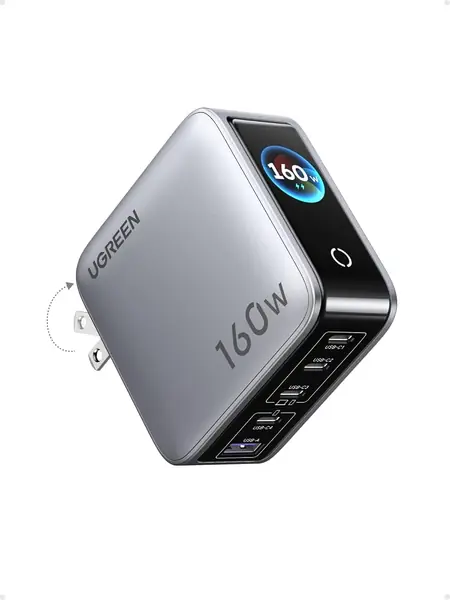
A charger with a screen invites skepticism, but the rotatable touch panel on the Nexode Pro earns its space. It cycles through total output and per-port draw, so you can see which port is doing the work, whether the laptop is actually pulling what it is rated for, and whether the cable you grabbed is the reason the number looks low.

The hardware behind the screen is the strongest single-port setup here in a wall charger: 160W total across four USB-C ports and a USB-A, with 140W available on either of the first two. That is a MacBook Pro charger, a phone charger, and a tablet charger collapsed into one block with a foldable US plug.

We noticed the size before anything else. It is compact for 160W and still noticeably fatter than a 65W brick, so it is a bag charger rather than a pocket one, and the display is the reason we reach for it over the Anker 67W when a laptop is the main event of the trip. Five ports also means the hotel outlet stops being a negotiation.

Power this high only arrives over a cable rated for it, and the display is honest about it: with a 100W cable attached, the big port sits at 100W and you can watch it happen. Pack a 240W-rated cable if the 140W number is why you are buying.

Pros

  • 140W on a single USB-C port
  • Rotatable display shows per-port output
  • Five ports with a foldable plug

Cons

  • Fatter than a 65W brick in a small bag
Our verdict

The UGREEN Nexode Pro 160W suits the traveler carrying a big laptop and a bag of smaller gear who wants to watch the power go where it should.

Check Latest Price
5

Ediliow 380W 8-Port Station Family Charging Shelf

88 /100
TKZ Score Excellent

Key details

Ports
8
Total Output
380W
Fast Ports
2 x 100W USB-C
Cables Included
4 USB-C
View on Amazon

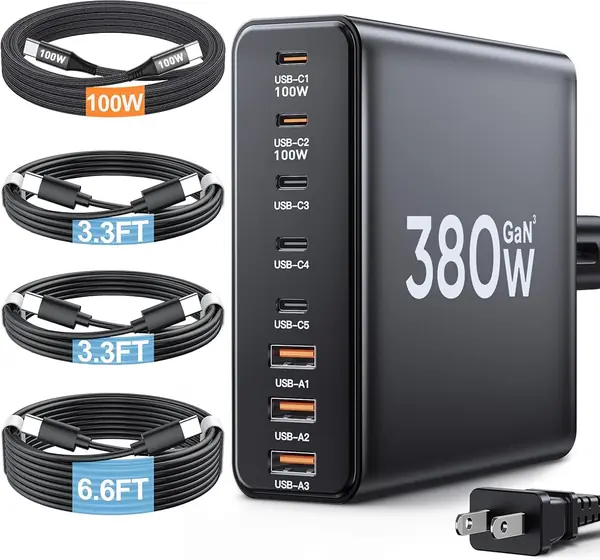
Eight ports and four cables in the box is the whole pitch, and for a shelf in a busy house it works. Two USB-C ports are rated to 100W, three more USB-C and three USB-A are rated to 30W, and a 5-foot cord means the block sits where you want it rather than dangling from an outlet behind the sofa.

Read the 380W as a ceiling, not a promise. It is the sum across all eight ports, and what a device sees is its own port's rating; a single port tops out at 100W however the arithmetic on the box reads. For phones, tablets, earbuds, a watch, and one laptop, that is plenty. Two gaming laptops is not this charger's job, and no amount of port count changes that.

The included cables are the part we appreciated most. A 100W braided USB-C cable plus three more C-to-C cables means the fast ports can be used at speed the day it arrives, which saves a separate order and a guess about which wire is holding you back.

It gets warm with several devices drawing at once, which is what the plastic case is for, and nobody is carrying this to a café anyway: the cord and the eight-port block are a fixed-location setup. Ours sits behind a monitor, invisible until a cable needs plugging in, and that is exactly the job we wanted it to do. It complements a bag charger rather than replacing one.

Pros

  • Eight ports, two of them at 100W
  • Four USB-C cables included
  • Long cord lets it sit on a shelf

Cons

  • 380W is the total across all eight ports
  • Cord and bulk make it a fixed setup
Our verdict

Choose the Ediliow station if you want one inexpensive block keeping a family's phones, tablets, and a laptop charged in one place.

Check Latest Price

How We Tested GaN Chargers

We started by reading spec sheets and pulling every listing that stated its output per port rather than just a single headline number, then filtered by port count, wattage, whether the prongs fold, and price. Anything that couldn't tell us how it splits power across ports got cut. That left 12 chargers, which we used for six months as our everyday power on desks, in kitchen outlets, and in carry-ons.

At home, we ran a 14-inch laptop from near-empty to half charge on each charger and read the wattage with a USB-C power meter rather than trusting the label, then plugged in a phone, a tablet, and a watch at the same time to watch the numbers fall and see whether the ports were labeled clearly enough to know which one deserved the laptop. We noted whether two chunky cables would sit side by side in adjacent ports and whether the brick stayed put in a loose wall outlet or sagged out of it.

For travel, we weighed every charger on a kitchen scale, packed it in a carry-on, and folded and unfolded the collapsible plugs dozens of times. After a 30-minute full-load session we took surface temperatures with an infrared thermometer and felt around the plug end, since that's where cheap internals show themselves. We also compared what the extra money bought — more ports, more headroom for a laptop, or just a nicer finish.

How to Choose a Gan Charger

What Each Port Gets When Everything Is Plugged In

In a multi-port charger the ports share a single budget, and the split is the spec that separates a satisfying brick from a disappointing one. The Anker 67W holds 65W with two ports in use, so adding a phone never slows the laptop; the UGREEN Nexode Pro 160W hands 140W to one port and divides the rest.

Add up the two biggest devices you charge at the same time and buy a total above that, with headroom. A charger claiming 120W that splits into 60W and 60W will not fast-charge a 100W laptop, whatever the badge suggests.

Wall Brick or Corded Station

Where the charger lives decides its shape. A foldable wall brick goes in the bag and takes one outlet; a station like the Anker Prime 200W sits on a desk on its own cord and feeds six devices without hanging off a socket.

Weight matters more than it looks. A heavy brick in a worn or upside-down outlet sags and loses contact, so for the outlet behind the couch or under the desk, choose the corded station. For a hotel wall you will use once, choose the brick.

Port Mix: Two USB-C and One USB-A Is the Useful Floor

Two USB-C ports cover a laptop and a phone; the third port ends the arguments. A USB-A slot keeps older cables, watch chargers, and other people's devices working without a dongle, and it is the cheapest future-proofing you can buy on a travel brick.

Above three ports you are buying for a household or a desk rather than a bag. The same USB-C charger that lives in a backpack rarely needs six outlets on its face.

Heat, and Why It Is Not Automatically a Fault

Every charger in this class warms up. A 65W brick pushing a laptop for an hour gets properly warm in the hand, and a 100W-plus charger warmer still. What matters is whether it keeps delivering or throttles down when the load stays high.

Keep chargers off soft furniture, out from under cushions, and out of a closed drawer while they work, and treat a case that is too hot to hold as a reason to unplug and check the cable. Overheat and overvoltage protection is the baseline here, not a premium feature.

Warranty Length Is the Cheapest Insurance

Chargers fail at the plug, the cable, or the port, and coverage is the difference between a replacement and a landfill. Anker covers the chargers here for 24 months; the UGREEN Nexode 65W comes with one year.

That gap is worth more than an extra port when two chargers are otherwise close. A two-year brick that dies in month 14 is a free replacement, and a one-year brick is not.

Frequently Asked Questions

Final Verdict

The Anker 67W wins for us because it keeps 65W flowing with two devices attached, folds into a pocket, and carries the longest warranty of any charger here. It is the brick that covers a laptop, a phone, and a tablet without a second thought, and it is the one most people should buy.

If the budget is tight and the laptop is an ultraportable, the UGREEN Nexode 65W does the same job for less. If the charging never leaves the desk, the Anker Prime station's six ports and paired 100W USB-C outputs are the better shape, and the 1.2 pounds stop mattering the moment it lands on the desk.