Best Fast Charging USB-C Cables of 2026

Your phone says it's charging, your laptop says it's plugged in, and an hour later the battery has barely moved — because the cable, not the brick, is usually the bottleneck. A USB-C cable is copper, shielding, and a chip or two, but the gap between a 60W cable and a 240W one is the gap between a laptop that trickles and one that's full before your coffee goes cold. My drawer is full of the free ones that came with something, and most of them are why my devices crawled for years.

My team and I have spent the past four months living with 16 of them — nightstand, backpack, car, the tangle at the bottom of my tote — and the pattern showed up fast: the cables that hold up don't skimp on the jacket or the wattage rating. Here's what first-time buyers get wrong: a cable's rating only matters up to what your charger and device can actually take, so matching beats maxing out. Length behaves the same way, which is roughly how the picks below shake out.

The Best Fast Charging USB-C Cables

1

INIU 240W USB-C Cable Best Overall
97 /100
TKZ Score Outstanding

Key details

Length
6.6 ft
Max Power
240W
Pack Size
2 cables
Cable Tip
LED-lit
View on Amazon

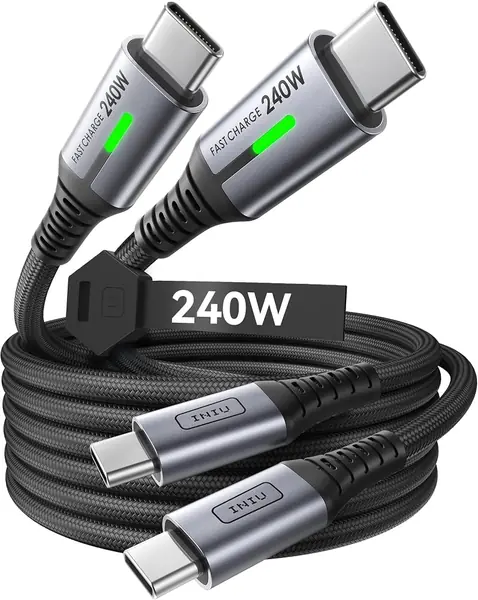
Two hundred and forty watts is the highest rating in this group, and it's why this is the cable we reach for first. A phone asks for a fraction of that; a big laptop can ask for more than a 100W cable will carry. The INIU covers both ends of that range, so the same cord can live on the desk with a laptop and still be the one you pack with a phone.

The light-up connector is the detail we didn't expect to care about. It turns finding the port under a hotel desk or behind a nightstand into a two-second job instead of a fumble with a flashlight. You get two 6.6-foot cables, each with a hook-and-loop strap, and the E-marker chip inside is what lets the cable negotiate the higher voltage bands the big bricks use.

Bulk is the price of all that. This is a thicker, less floppy cable than the 60W picks here, and it takes a wider coil in a jacket pocket — a fair trade for the rating and the light, but worth knowing if you like a cord that disappears into a small bag. If that's the priority, one of the 60W options does it better.

Pros

  • 240W rating covers laptops and phones
  • LED connectors make dark ports easy to find
  • Two 6.6-foot cables with straps

Cons

  • Chunky braid takes a wider coil
  • Data transfers cap at 480Mbps
Our verdict

If you want one cable that fast-charges a phone and a laptop without a second thought, we think this is the pair to buy.
Check Latest Price
2

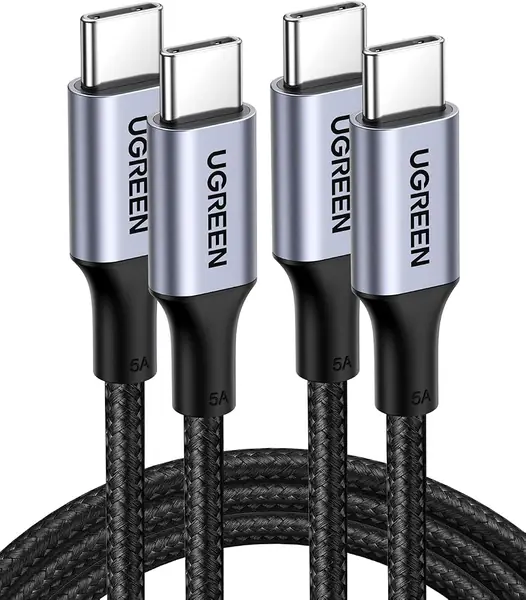
UGREEN 100W USB-C Cable Best for Desks and Travel

96 /100
TKZ Score Outstanding

Key details

Length
3.3 ft
Max Power
100W
Pack Size
2 cables
Chip
Built-in E-marker
View on Amazon

Three and a third feet is the shortest cable here, and that's the reason to buy this pair rather than a reason to skip it. On a desk, the run from a dock to a laptop is short anyway, and a short cable is less to shove aside. In a bag, it's the one that doesn't turn into a nest around a power bank. We kept reaching for these whenever the outlet was already close.

It's 100W with a built-in E-marker chip, which is more than a phone needs and exactly what a 14-inch laptop wants, and the aluminum housings feel better than anything else in the budget tier here. Our reservation is the braid: it holds a bend instead of draping, so it's lovely on a desk and mildly annoying jammed into a small pouch.

Reach is the real limit. This is not the cable for charging from a wall outlet while you're on the couch, and it's the pick here with the most question marks over in-car use, since CarPlay has been hit or miss with it. Treat the pair as desk and travel spares and keep a six-foot cable for the sofa.

Pros

  • 100W and an E-marker in a compact pair
  • Short run stays tidy on a desk or bag
  • Aluminum housings feel solid

Cons

  • 3.3 feet is too short for couch charging
  • CarPlay can be unreliable with it
Our verdict

Buy this pair for a desk, a bag, or a power bank, where a short 100W cable is an advantage rather than a compromise.

Check Latest Price
3

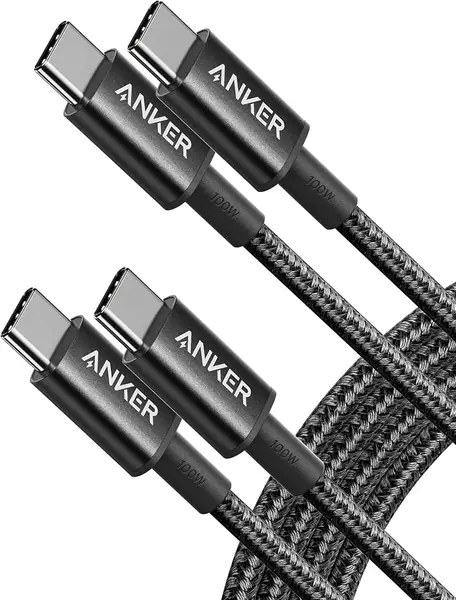
Anker 100W USB-C Cable Best 100W All-Rounder

95 /100
TKZ Score Outstanding

Key details

Length
6 ft
Max Power
100W
Pack Size
2 cables
Bend Rating
5,000 bends
View on Amazon

Where the INIU is thick and lit up, this Anker is the plain 100W pair, and for plenty of people that's the better trade. Six feet is the length that gets from a floor outlet to a nightstand without an extension cord, and the nylon jacket carries a 5,000-bend rating, the sort of number a cable earns by being handled badly for years.

Two of them come in the box with a hook-and-loop tie, and the connectors seat with a solid click rather than a vague push. It's the pair we'd hand to someone who wants a cable in the laptop bag and another one charging the phone on the nightstand, without thinking about either again.

On charging speed this one sits mid-pack in this group rather than at the top, and it's the pick where a particular charger and phone pairing is most likely to fall back to a slower rate. That's the trade for the price and the two-pack. If the fastest possible top-up is the whole point, the INIU is the one; if you want six feet of 100W you won't have to think about, this is it.

Pros

  • 100W with six feet of reach
  • 5,000-bend rated nylon jacket
  • Two cables plus a hook-and-loop tie

Cons

  • Stiff until it breaks in
Our verdict

This is the 100W pair we point laptop owners to when they want six feet of reach and don't need the top pick's extra headroom.

Check Latest Price
4

Anker 60W 5-Pack Best Multipack

94 /100
TKZ Score Outstanding

Key details

Length
6 ft
Max Power
60W
Pack Size
5 cables
Jacket
Nylon braid
View on Amazon

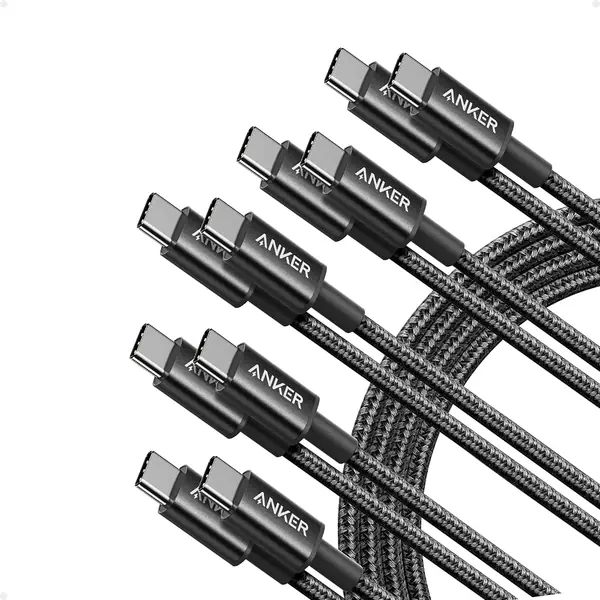
The case for this pack is arithmetic: five six-foot cables in one box, at a per-cable price none of the two-packs here can match. That's the job it does better than anything else on this list. It's what you buy when the kids' tablets, the car, the kitchen drawer, and the bedside table each want their own cord and you're tired of carrying one around the house.

Sixty watts is the ceiling, so this is a phone, tablet, and small-laptop cable rather than a cord for a 16-inch pro machine. What you get in exchange is Anker's PowerIQ handling and a nylon braid that has held up well against the rest of this group — the cable feels like it costs more than the pack does.

Longevity is the honest caveat. A five-pack is a volume play, and the failure that turns up is at the connector end after a few months of daily plugging, usually on the cable that gets yanked out by the cord instead of by the plug. Spread them across rooms with ordinary handling and they last; give one to the household's roughest charger and it won't.

Pros

  • Five 6-foot cables in one box
  • Six feet reaches most rooms
  • Nylon braid that holds up

Cons

  • 60W limits charging for larger laptops
Our verdict

Buy the five-pack if you want a charging cable in every room and don't need laptop-level wattage from any of them.

Check Latest Price
5

AINOPE Right-Angle USB-C Cable Best for Charging While You Play

93 /100
TKZ Score Outstanding

Key details

Length
6.6 ft
Max Power
60W
Pack Size
2 cables
Connector
90-degree right angle
View on Amazon

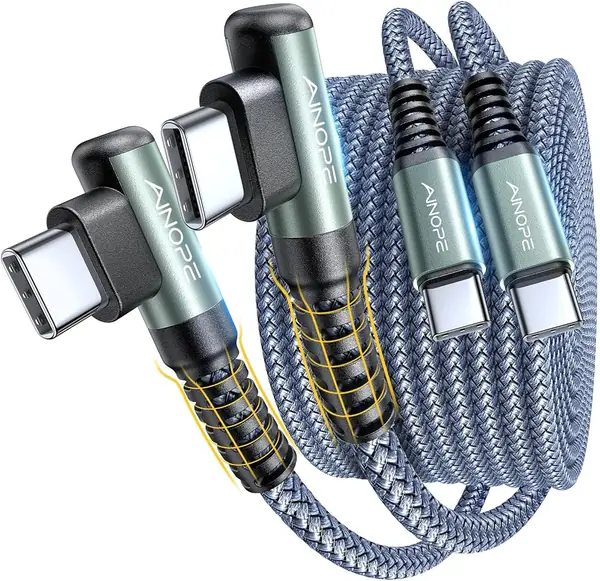
The plug on this cable turns ninety degrees, and if you've ever had a straight connector dig into your palm while you held a phone sideways, you already know why that matters. We like it for exactly that: gaming, video, scrolling in bed, the cord leaving the phone sideways instead of sticking out into your hand.

It's 60W rather than 100W, and we're comfortable with that here, because this is the phone and tablet cable in this set rather than the laptop one. The 6.6 feet gives you slack to move, the braided jacket lies flat instead of curling off the table, and a right-angle plug takes the bending stress off the joint, which is where straight cables usually fail first.

Two things to check. The angle only works the way your port faces, so a car mount or a controller clip that wants the cord to exit the other direction gains you nothing. And if a cable starts and stops charging, the plug isn't seating — try both in the first week and send them back inside the return window if either one hunts for a connection.

Pros

  • Right-angle plug stays out of your palm
  • 6.6 feet of slack while in use
  • Flat braid lies still on a table

Cons

  • 60W tops out below laptop charging
  • Right-angle plug only fits one orientation
Our verdict

If you charge while you scroll or game, the sideways plug on this pair is worth more than the extra wattage you give up.

Check Latest Price
6

JSAUX 100W USB-C Cable Budget 100W

92 /100
TKZ Score Outstanding

Key details

Length
6.6 ft
Max Power
100W
Pack Size
2 cables
Chip
Built-in E-marker
View on Amazon

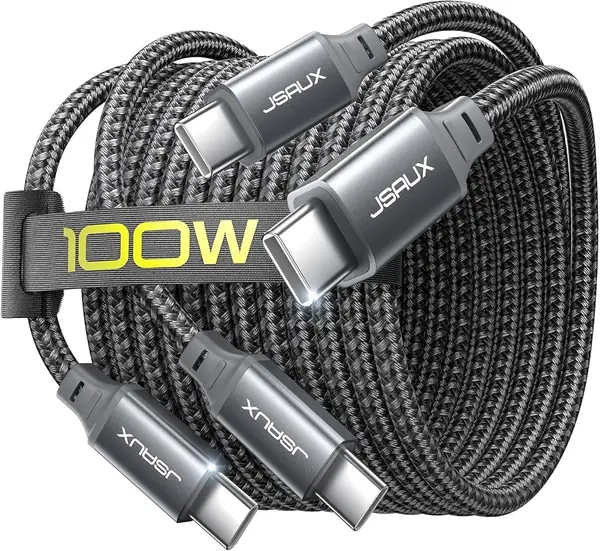
This is the least expensive 100W pair here, and on paper it does what the pricier ones do: E-marker chip, 20V/5A Power Delivery, braided jacket, two 6.6-foot cables. That's the appeal, and we understand it — the value is real, and the braid looks better than the price suggests.

Where it gives ground is staying power. Over months of daily plugging this is the 100W pick in this group with the weakest record, and the failures land at the plug rather than mid-cable, which is the usual pattern for a jacket that stiffens with use. The connectors themselves seat with a satisfying click while they last.

None of that makes it a bad buy; it makes it a two-pack to treat as consumable. Keep the second cable in a bag as the spare, buy it for a car or a kid's room, and plan on replacing it rather than passing it down. If you want one 100W pair that lasts, the Anker two-pack costs more and earns it.

Pros

  • Cheapest route to 100W and 6.6 feet
  • Braided jacket looks better than budget
  • E-marker chip for full PD output

Cons

  • Durability is the weakest among the 100W picks
Our verdict

Worth it if you want 100W for as little as possible and can live with replacing them sooner than a premium pair.

Check Latest Price

How We Tested the Best Fast-Charging USB-C Cables

We started by pulling every USB-C to USB-C cable we could find that claimed 60W or higher, then cut the field to 16 over four months based on jacket material, connector housing, wattage rating, and what the price worked out to per cable inside a multipack. Customer reviews helped us drop the ones that arrived dead or quit after a few weeks — we wanted cables that had already survived strangers before we got our hands on them.

Charging speed got measured, not eyeballed. I ran a USB-C power meter in line between the charger and the device so I could watch the actual wattage each cable pulled, then charged a drained laptop and a drained phone for 30 minutes on every cable using the same charger. That's how we caught the ones that looked identical to the fast cables but quietly capped well below their label.

Durability took the abuse. Each cable spent time coiled in a backpack, yanked out of a wall by the cord instead of the plug, flexed back and forth at the connector, and wrapped around a chair arm. We noted where the braid first started to fray, whether the connector housing worked loose, and whether the cable stayed supple in cold weather or stiffened into a wire hanger.

Length and compatibility came last. We measured each cable against its stated length, weighed it for bag-friendliness, and plugged every one into a phone, a tablet, a laptop, and a handheld game console to confirm full-speed charging across all of them rather than just the device it was marketed for. We also checked that the plug seated firmly through a phone case, since a connector that pops loose is a connectivity problem no wattage rating can fix.

How to Choose Fast-Charging Usb-C Cables

Start With the Connector, Not the Wattage

Power Delivery needs USB-C at both ends. A USB-A to USB-C cord can still charge, but it tops out around 15W, and the fast-charging claim on the package usually describes what the phone can do with the right brick rather than what the cord can pass. If your charger has a rectangular USB-A port, that port is your ceiling, and replacing the brick will do more for you than buying another cable.

Buy C-to-C for anything you want topped up quickly, and check that the cable's rating meets or beats what the device asks for. Getting this wrong is the most common reason a new cable feels no faster than the old one.

Match the Wattage to the Device

Phones draw well under 60W, which is why a 60W cable is the sensible default for a household of phones and tablets. Laptops are the reason to go higher: a 14-inch machine can pull close to 100W, and a large one can go beyond it. A Type-C cable rated above 60W carries an E-marker chip that lets it negotiate those higher bands, so the number on the box is doing real work.

Buy 60W for phones, 100W if a laptop shares the cable, and 240W only if you're charging a big laptop that came with a high-wattage brick of its own.

Pick the Length for Where It Lives

Length is a comfort decision. Three feet is right for a dock, a desk riser, or a bag; six feet is what gets from a floor outlet to a nightstand or a couch arm; past that you're managing coil rather than gaining much. Longer cables do drop a little voltage, but at charging currents that is rarely what's slowing you down.

Measure the run from the outlet to where you actually hold the phone, add a foot, and buy that length in a two-pack rather than one long cable you have to untangle every night.

The Plug End Is What Fails

Cables rarely die in the middle. The braid at the connector takes the bending, the yanking, and the weight of a phone hanging off a socket, and that is where a charge starts cutting in and out. Strain relief at the joint matters more than a big bend-test number printed on the box.

If the cable gets used in your hand, a right-angle plug moves the stress off the joint entirely, which is why the AINOPE pair earns a place on this list. Coil loosely around a strap, never around the brick.

Packs, Spares, and the Car

Think about how many cables the household actually consumes. A two-pack covers a desk and a bag; a five-pack is the right buy when four rooms and a car each need a cord, and it works out cheaper per cable than any pair here.

For the car, test the cable with CarPlay before you rely on it. A cord that charges fine can still refuse to hand over data, and that is one of the few things you cannot judge from the packaging.

Frequently Asked Questions

Final Verdict

Of the six cables here, the INIU 240W is the one we recommend without a caveat attached: it fast-charges a phone and a large laptop, the LED tips solve a small nightly annoyance, and the pair covers desk and bag. Buy the UGREEN pair instead if your cables live on a desk and you want the shortest possible run. Buy the Anker five-pack if the goal is a cable in every room rather than the fastest cable in the house.