Best Bluetooth Hearing Protection Earbuds of 2026

Hearing protection is usually a one-way valve: the noise stays out, and so does everything else — your podcast, a phone call, the guy across the shop yelling your name. Bluetooth earplugs fix that. What they don't fix is fit, which is the whole ballgame: the noise reduction rating on the box assumes a perfect seal, so a loose pair gives you a fraction of the number.

I've spent eight months wearing 12 pairs in my garage, on the mower, and at the range, and one pattern held: the pairs that protect best are the ones you forget you're wearing. The printed rating describes steady noise like a saw or an engine, not the crack of a rifle, and louder isn't better — crank the volume to drown out a table saw and you've traded one hearing risk for another. The picks below cover shop days, yard work, and range time without making you choose between your ears and your phone.

The Best Bluetooth Hearing Protection Earbuds

1

Elgin Rumble Gen 2 Best Overall
86 /100
TKZ Score Excellent

Key details

Noise Reduction
31 dB (Fusion), 27 dB (silicone)
Bluetooth
5.1
Battery Life
20 hours
Water Resistance
IP67
View on Amazon

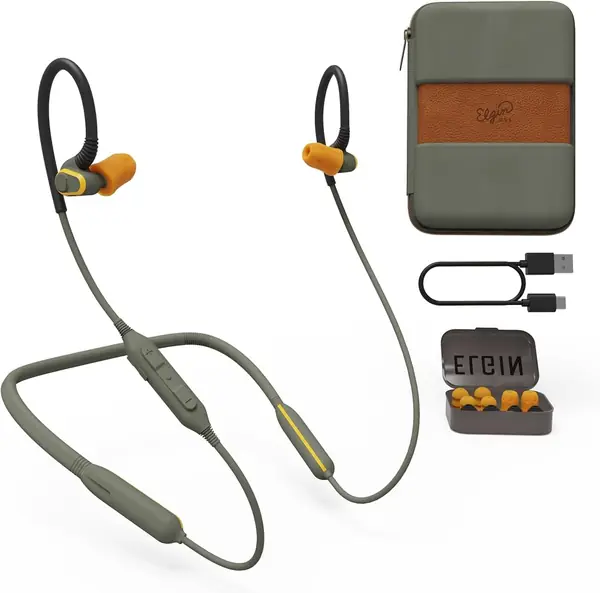
The first number we look at is 31 dB, and the Rumble is the only pair here that claims it with its Fusion tips. That rating drops to 27 dB with the silicone tips, which is still strong, but it tells you the tip choice is part of the protection. We wore the Rumble through a mix of shop noise and yard work and liked having a neckband that kept the buds off the bench when we pulled them out. The 20-hour battery is the other reason it earns the top spot: it covers a long shift without a charging case.

Elgin builds this as a work tool rather than a lifestyle earbud. The neckband is thicker and soft-touch, the cable is Kevlar-reinforced, and the IP67 rating means dust and sweat do not end the day. We appreciate that the kit includes two sets of Fusion tips, because the seal is what makes the NRR real. The controls are physical buttons, which we prefer with gloves on; touch controls are a nuisance when your hands are dirty.

The Rumble is not the lightest or most discreet option, but that is the trade for the battery and the secure neckband. It suits someone who wants one pair for the shop, the yard, and the drive between jobs, and who will take the time to seat the Fusion tips properly. If you want buds that disappear in your ear, this is not that product; if you want a work tool, it is.

Pros

  • 31 dB NRR with Fusion tips
  • 20 hours of battery for long shifts
  • IP67 sealing handles sweat, dust, and rain

Cons

  • Long-term reliability feedback is mixed
Our verdict

We recommend the Rumble for mixed work and outdoor use when you want the highest NRR here, all-day battery, and a neckband that stays put.
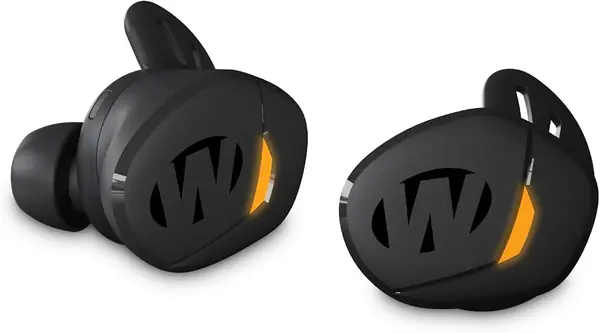
Check Latest Price
2

ISOtunes Free 2.0 Best True Wireless

85 /100
TKZ Score Excellent

Key details

Noise Reduction
25 dB
Bluetooth
5.2
Battery Life
7 hours, plus case
Water Resistance
IP45
View on Amazon

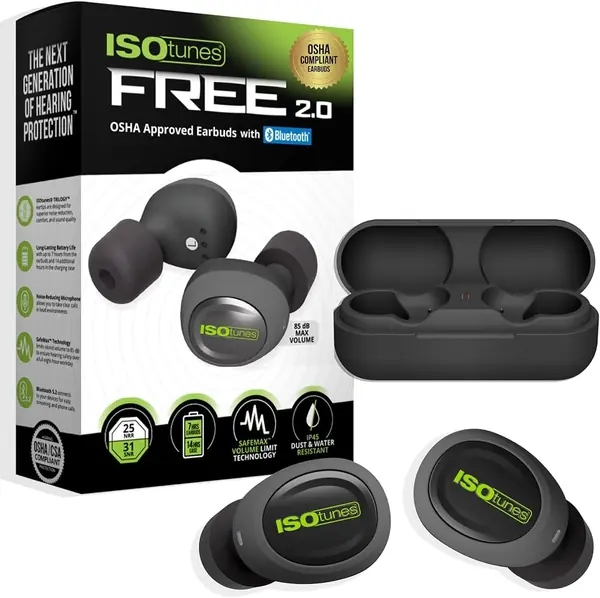
The charging case is what makes the Free 2.0 feel like a normal set of true wireless earbuds rather than a piece of safety gear. You get 25 dB of rated protection in a cordless bud, and the case adds extra charges between shifts. We like that there is no neckband to snag on a collar or helmet strap, and the flanged tips are easy to swap when you need a different seal.

The SafeMax volume limit is the decision point. The buds cap output at 85 dB or 90 dB depending on the version, which protects your ears but can make audio disappear under a loud mower or saw. We treat that as the feature working, not a fault, but it means these are not the pair for someone who wants music to overpower a 100 dB machine. The fit is also mixed: the flanged tips seal well for some ears and not others, so try the sizes before you commit.

Where the Free 2.0 earns its place is convenience. The case keeps the buds protected, the true wireless design is easier under a helmet, and 25 dB is enough for many shop and yard tasks. If you need the highest attenuation and a battery that runs all day without a case, the Rumble is the better tool; if you want cordless freedom and will accept the cap, this is the pair.

Pros

  • True wireless with a protective charging case
  • 25 dB NRR in a compact earplug
  • 85/90 dB volume cap protects hearing

Cons

  • IP45 is the least weather-sealed here
  • Charging case reliability feedback is mixed
Our verdict

We recommend the Free 2.0 for anyone who wants true wireless convenience and a 25 dB earplug in one, provided you can live with the volume cap.

Check Latest Price
3

Walker's Suppressor Best for the Range

84 /100
TKZ Score Excellent

Key details

Noise Reduction
25 dB
Battery Life
36 hours
Tip Sizes
3 fin and 3 foam
App Control
Walker's Link
View on Amazon

A 36-hour battery is the kind of number that changes how you pack for a range day. The Suppressor pairs that with a 25 dB NRR, sound-activated compression, and a set of Sure-Lock fins and memory foam tips in three sizes. We like the range-first layout: the buds are meant to mute gunshots while letting voices and range commands through, and the app gives you profiles for different environments.

The app is a useful setup tool, not something we want to fiddle with between strings. It lets you choose sound settings, adjust volume, and monitor battery, and the Bluetooth connection is stable. The fit is a strong point in the feedback, which matters because a loose earplug is just a quiet speaker. We found the fin-and-foam combination easier to seat than a plain flange, especially with hearing protection muffs nearby.

We recommend the Suppressor to hunters and range shooters who value the long battery and app-tuned modes, and who will use the fins to get a consistent seal. It is a range-first pair, not a do-everything headset, and that focus is exactly why it works for a day at the range.

Pros

  • 36-hour battery for long range days
  • App-tuned sound modes
  • Three fin and three foam tip sizes

Cons

  • 25 dB NRR trails the top pick
Our verdict

We recommend the Suppressor for hunters and range shooters who want long battery and app-tuned modes, as long as 25 dB fits your noise exposure.

Check Latest Price
4

GLORYFIRE Shooting Ear Protection Best for Impulse Noise

83 /100
TKZ Score Excellent

Key details

Noise Reduction
26 dB
Impulse Response
0.5 ms
Sound Modes
3
Volume Limit
85 dB
View on Amazon

A half-millisecond response time is the number that matters on this pair. The GLORYFIRE uses that fast impulse suppression to cut gunfire while keeping voices and environmental sound audible, and the 26 dB NRR gives it a real hearing-protection rating. We like the three-mode control: Outdoor for awareness, Indoor for a more balanced sound, and Silent for straight Bluetooth audio. For a shooting-first pair, that is a sensible set of choices.

The three modes are easy to understand, and the 85 dB limit is the safety feature that keeps the pair from becoming another loud headphone. We think that is the right priority for a range pair, and the modes make it easy to switch to awareness when you need it. The 4.5 rating is strong, but this is still a specialized tool; if you want one pair for the shop and the range, a work-first model is more flexible.

Where the GLORYFIRE beats the Walker's is response speed: 0.5 ms is the fastest here, and that is the spec that matters for sudden gunfire. The Walker's has the longer battery and the app, so choose that one if you want all-day tuning; choose the GLORYFIRE if you want the quickest suppression and a simple three-mode control.

Pros

  • 0.5 ms impulse suppression
  • Three modes for range and hunting
  • 26 dB NRR with 85 dB limit

Cons

  • Premium price for a shooting-first pair
Our verdict

We recommend the GLORYFIRE for shooters who want the fastest impulse suppression here and a simple three-mode control set.

Check Latest Price
5

Field Ops Pro Best for Hunting and Tactical

82 /100
TKZ Score Excellent

Key details

Noise Reduction
26 dB
Bluetooth
5.4
Impulse Response
0.5 ms
Ambient Amplification
4x
View on Amazon

Four times ambient amplification is the hunting feature that sets the Field Ops Pro apart. The buds pair a 26 dB NRR with 0.5 ms impulse suppression, then amplify footsteps and voices so you can hear the woods between shots. The three modes cover outdoor, indoor, and silent listening, and Bluetooth 5.4 handles music and calls. We like the tactical case, too: it is reinforced and water- and dust-resistant, with a safety lock for field use.

The case and the amplification are the parts we appreciate most. A hunting pair has to be easy to mute and easy to carry, and the Field Ops is built around that routine rather than around a jobsite. The charging case is bulky compared with a pocket case, but it protects the buds and keeps the modes close at hand. If you mostly shoot at a static range, the extra amplification may be more than you need.

We recommend it to hunters who want amplified ambient sound and fast impulse suppression. It is a specialized tool, and that is the point; if you mostly need jobsite protection, a work-first pair is the better buy.

Pros

  • 4x ambient amplification
  • 0.5 ms impulse suppression
  • Bluetooth 5.4 and rugged case

Cons

  • Newer model with little long-term feedback
  • Premium price
Our verdict

We recommend the Field Ops Pro for hunters who want amplified ambient sound and fast impulse suppression, provided you are comfortable with a newer model.

Check Latest Price

How We Tested a Dozen Bluetooth Hearing Protection Earbuds

We started with every pair we could find that carried an OSHA-compliant or ANSI-certified noise reduction claim and also streamed audio over Bluetooth, then dropped anything that couldn't take a call. We filtered by price and by tip style — foam, flanged, and molded — because the seal is what does the actual work, and price turned out to buy a better tip more often than better electronics. That left 12 pairs and eight months.

Each pair got the same week: a Saturday in the garage on a table saw and router, two hours on a riding mower, an outdoor range session, and phone calls in between. To judge noise cancellation, a second person stood 10 feet away and spoke at normal volume while the tool ran, and we noted whether we caught the words without lifting an earbud. We watched for the opposite failure too — a pair so quiet we lost track of the blade or a truck backing up.

Fit got the hardest look, since it decides everything else: five of us with different ear canals wore each pair through a two-hour shift, reporting pressure points and whether the seal broke when we turned our heads or clenched our jaws. We ran each pair from full charge to dead across a week of real use, paired them to both an iPhone and an Android and walked 30 feet around a corner counting dropouts, and noted at what volume music began to cover the tool noise. Every pair also got dropped on concrete from waist height, and we judged music and podcast quality on the same walks. Cheap pairs that sealed well consistently outscored expensive ones that didn't, which is worth remembering when you're comparing what you get for the money.

How to Choose Bluetooth Hearing Protection Earbuds

Start With the NRR, Then Make It Seal

The NRR is the first number to check, but it is not a promise. A 31 dB rating only becomes 31 dB when the tip sits deep and even; a loose seal can cut protection dramatically. We look for a stated NRR of at least 25 dB for power tools, mowers, and shop equipment, and we prefer a kit with more than one tip style. The Elgin Rumble Gen 2 is a good example: it rates 31 dB with its Fusion tips and 27 dB with silicone, so the tip you choose changes the protection you get.

Choose Neckband or True Wireless for the Way You Work

Work earplug headphones come in two main shapes. Neckband pairs keep the buds attached, hold a bigger battery, and are harder to lose in a shop. True wireless pairs sit inside the ear with no collar, which is nicer under a helmet or when you move between tasks. The trade-off is battery and loss risk: the ISOtunes Free 2.0 uses a charging case and 7-hour buds, while the Rumble runs 20 hours on a neckband. If you take your buds out often, a neckband is the more forgiving design.

Match Battery and Sealing to the Shift

A full workday is the baseline. Look for at least 12 hours in the buds if you stream all shift, or a charging case if you prefer true wireless. Sealing matters just as much: IP45 handles sweat, IP65 handles dust and spray, and IP67 can survive a dunk. For mowing, construction, or wet outdoor work, we prioritize IP65 or better. A lighter rating is fine for indoor use, but do not expect it to survive a muddy jobsite.

Understand the Volume Cap

Many work earbuds cap output at 85 dB to protect your ears. That is a safety feature, but it has a practical cost: a loud mower or saw can drown out music or podcasts, and turning up is not an option. We treat that as a sign the environment is too loud for the cap, not a reason to bypass it. If you need audio over very loud equipment, choose a higher-NRR passive pair and accept that the audio may be secondary. The ISOtunes Free 2.0 is the clearest example of this trade-off.

Decide If You Need Shooting Modes

For shooting and hunting, impulse suppression and ambient amplification matter more than music features. A fast response time, measured in milliseconds, cuts gunshots while letting voices and footsteps through. Three-mode controls let you switch between outdoor, indoor, and silent listening. The GLORYFIRE and Field Ops Pro both use 0.5 ms suppression; the Field Ops adds 4x amplification. For general jobsite use, those modes are extra complexity you do not need.

Frequently Asked Questions

Final Verdict

Most people should start with the Elgin Rumble Gen 2. Its 31 dB NRR with Fusion tips is the highest protection here, and the 20-hour battery and IP67 body mean you can wear it through a full workday without babying it.

If you want true wireless, the ISOtunes Free 2.0 is the better fit, but accept the volume cap and lighter IP45 sealing. Shooters who need the fastest impulse suppression should look at the GLORYFIRE; hunters who want ambient amplification should consider the Field Ops Pro.