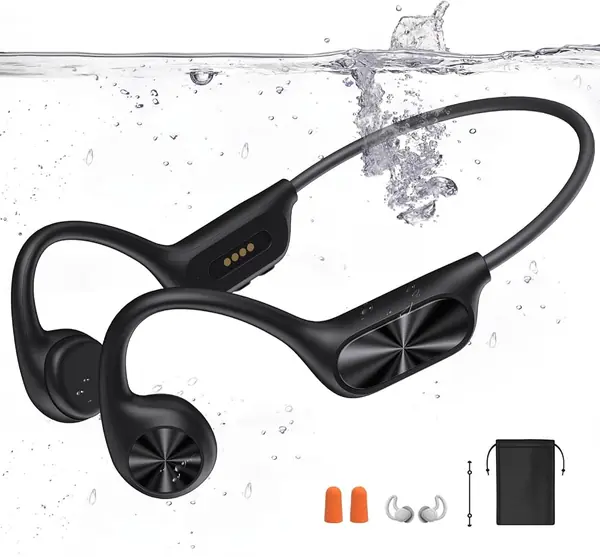
Best Wireless Headphones for Swimming of 2026

Bluetooth and swimming don't mix—literally. The signal drops the moment your head goes underwater, which is why so many waterproof headphones are only splash-proof. The real solution is onboard memory: a pair that stores your playlists and plays them without a phone. Over the past six months, I've swum with a dozen pairs that claim to solve this, and the gap between the good ones and the rest is mostly about one thing: whether they keep sounding like music once your ears are submerged.

Bone conduction sits outside your ear canal, which keeps you aware of lane traffic and lets water drain naturally—but it also means bass is a suggestion, not a punch. Fit matters more than specs: a loose band slides when you push off the wall, and a tight one leaves marks after 1,500 yards. Battery life, Bluetooth reliability above water, and value all matter too, but none of it counts if the headphones won't stay put through a flip turn. The picks below are the ones that survived repeat sessions—and the ones I'd actually pack in my swim bag.

The Best Wireless Headphones for Swimming

1

PSIER S18 Swimming Headphones Best Overall
88 /100
TKZ Score Excellent

Key details

Playtime
8 hours
Built-in Storage
32GB
Waterproof Rating
IPX8, 2 m for 1 hour
Charging
Magnetic
View on Amazon

The S18 is the pair we stopped thinking about, which is the highest compliment a swim headphone can earn. The band settles over a swim cap, the pads rest on your cheekbones, and nothing shifts when you push off the wall. IPX8 is the rating that matters for swimming, and PSIER attaches real numbers to it: two meters of water for up to an hour.

Underwater you are on the built-in player rather than Bluetooth — 32GB of it, enough for a season of laps without hearing the same song twice. Switching modes takes a moment, eight hours of playtime covers a long session, and the magnetic charger means there is no fiddly plug to line up with wet hands.

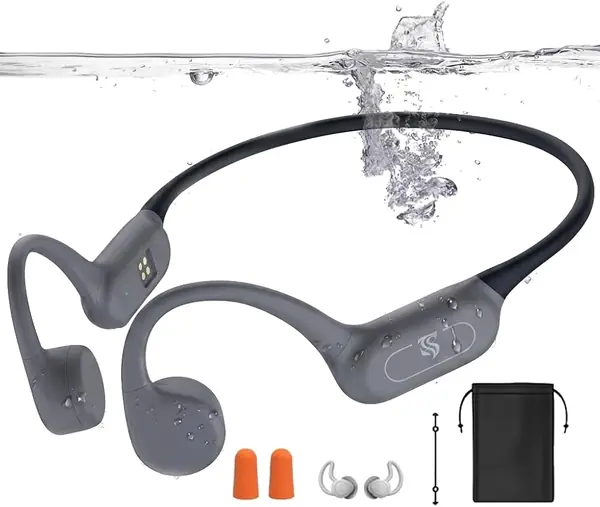
Two details from the water are worth passing on. The band runs large: fine if your head is on the bigger side, less so if it is not, and a swim cap is what pulls it into line. And bone conduction sounds thin until you plug your ears — a pair of foam earplugs does more for the low end than any equalizer, and it costs almost nothing to try.

Against the Shokz it gives up two things that matter to some swimmers: a second hour of submersion and the polish of a pair that has been through more revisions. Against everything else here it gives up very little. For most people, most weeks, this is the pair that makes swimming with music feel ordinary.

Pros

  • IPX8 seal rated to 2 meters for an hour
  • 32GB of built-in storage
  • Eight hours of playtime, magnetic charging
  • Stays put under a cap through turns

Cons

  • No carrying case in the box
Our verdict

Our pick for most swimmers: solid IPX8 sealing, a 32GB player that holds hours of laps, and a fit that survives turns — at a price that leaves room for goggles.
Check Latest Price
2

Shokz OpenSwim Pro Best Premium

87 /100
TKZ Score Excellent

Key details

Playtime
9 hours
Built-in Storage
32GB
Waterproof Rating
IP68, 2 m for 2 hours
Weight
0.96 oz
View on Amazon

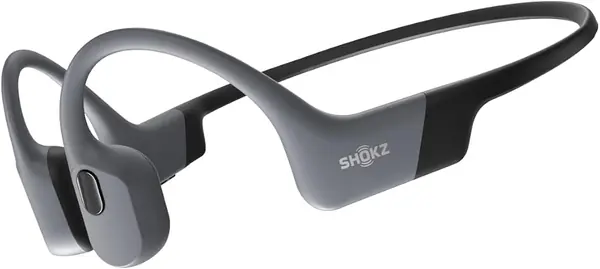
The OpenSwim Pro is several times the price of most of the picks here, and the case for it is not a longer spec sheet — it is the finish. Shokz has been building this shape for years, and it shows in the small things: a silicone case, swim earplugs and a nose clip in the box, and a nickel-titanium band that holds its curve instead of slowly widening.

Nine hours on a charge, with a ten-minute top-up buying three more, is the number that convinced us. The seal is IP68 rated to two meters for two hours — double the PSIER's window — and at 27.3 grams with a band that hugs rather than clamps, it is the pair that disappears under a cap fastest. Swim five mornings a week and that is the difference between a gadget and a piece of kit.

Two things to know before you pay for it. Bluetooth is dry-land only, and the listing is upfront about it: underwater you are on the 32GB player, like everything else here, so a pair that stops streaming the moment your head goes under is behaving exactly as designed. And the magnetic charging pins are the part that ends these early — rinse the band in fresh water after a swim, then dry the pins before it goes in the case.

What you are paying for is the app that loads music without a computer, the two-year warranty and a fit refined over several generations. If those do not earn it for you, the PSIER does the swimming half for a fraction.

Pros

  • IP68 rated to 2 meters for 2 hours
  • Nine hours, plus a 10-minute quick charge
  • Case, earplugs and nose clip included
  • 27.3 grams on a titanium band

Cons

  • Several times the price of the other picks
  • MP3 playback drains faster than the nine-hour figure
Our verdict

Worth the premium if you swim often and want the most finished pair here: app-loaded music, a nine-hour battery and a fit that vanishes under a cap.

Check Latest Price
3

Tevese X9 Swimming Headphones Best Battery Life

86 /100
TKZ Score Excellent

Key details

Playtime
10 hours
Built-in Storage
32GB
Waterproof Rating
IPX8
Warranty
2 years
View on Amazon

Ten hours is the longest playtime on this page, and it is the first thing worth knowing about the X9. Swim an hour a day and you are charging every two weeks rather than every week — the sort of difference you notice a year in, when the cable has stopped living by the sink.

The rest of the package is unfussy in the way we like. There is 32GB of storage, which Tevese puts at more than nine thousand tracks, a two-year manufacturer warranty, and real push buttons rather than the touch panels we have come to distrust on a wet deck.

Battery is the headline, but the fit is what keeps this pair in the bag: the band sits close to the head, the pads are soft enough for a full session, and the whole thing is light enough to forget between sets. It is the least dramatic pair here, and after a few swims that reads as a compliment rather than a criticism.

The gap is documentation. Tevese rates the X9 IPX8 but never says how deep or how long, while Shokz and PSIER both tell you exactly what their ratings cover. For lap swimming it is academic, since you are never more than a meter down, but it is the one number the listing leaves out.

Pros

  • Ten hours of playtime, the longest here
  • Two-year manufacturer warranty
  • Push-button controls instead of touch

Cons

  • No depth or duration published for IPX8
Our verdict

Two years of warranty cover and the longest battery in this group make the X9 the pick for anyone who wants to charge rarely and stop thinking about it.

Check Latest Price
4

VLOP VP01 Swimming Headphones Best for Land and Water

85 /100
TKZ Score Excellent

Key details

Playtime
8 hours
Built-in Storage
32GB
Waterproof Rating
IP68/IPX8 equivalent
Weight
0.92 oz
View on Amazon

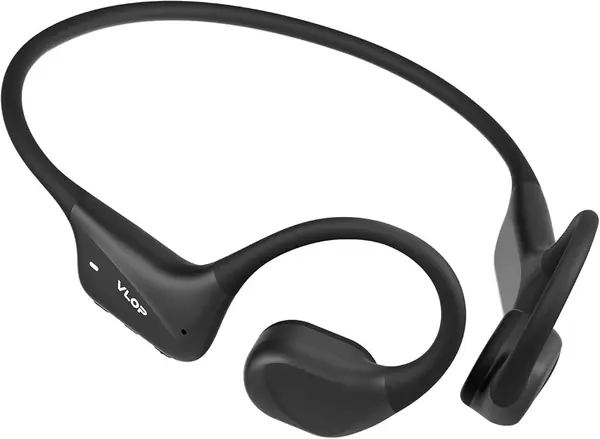
Bone conduction has an obvious weakness on dry land: no bass, no isolation, and everything sounds like a speaker two rooms away. VLOP's answer is a hybrid — a bone conduction driver for the water plus a small directional air driver for above it — and it is the only pair here we kept on after the swim.

The rest is built for the pool. Sealed to an IP68/IPX8 equivalent, 32GB of storage, Bluetooth 6.0 on land, eight hours of playtime depending on mode, and magnetic charging. At 26 grams it is the lightest thing on this page, and the titanium memory frame survives being shoved into a bag with a wet towel.

Head shape is where it divides. The rear hoop sits further back than the Shokz or the PSIER, and on some heads it stands off the neck instead of hugging it; goggles worn over the top are what pulls it into line. If you have a narrow head, that hoop is the part to look at in the photos before you order.

We are pleasantly surprised by how much the air driver adds — podcasts on a run sound like a normal pair of headphones, and switching back to bone conduction at the pool is a button press. If you want one pair for swimming and everything else, this is the one that tries hardest.

Pros

  • Hybrid driver adds bass above water
  • Lightest pick here at 26 grams
  • 32GB player with Bluetooth 6.0 on land

Cons

  • Waterproofing claimed as IP68-equivalent, not certified
Our verdict

The one pair here that sounds genuinely good on dry land: a hybrid driver gives it bass above water without giving up the underwater MP3 mode.

Check Latest Price
5

Roujune X20 Pro Swimming Headphones Best Certified Waterproofing

84 /100
TKZ Score Excellent

Key details

Playtime
8 hours
Built-in Storage
32GB
Waterproof Rating
IP68, TÜV certified
Weight
0.95 oz
View on Amazon

Roujune does something none of the other midrange pairs here bother with: it puts a certification behind the waterproofing claim. The X20 Pro carries TÜV-tested IP68, and a few swims in, that is the specification we kept coming back to — a rating somebody independent checked, on a pair that costs about the same as the ones nobody did.

The rest of the package is complete in a way that suggests a swimmer wrote the spec: 27 grams on a liquid-silicone and titanium memory neckband, 32GB, Bluetooth 5.4 for dry land, eight hours of playtime, and a box with an adjustment strap, spare eartips and a waterproof bag in it.

One thing to know: bone conduction leaks. At a moderate volume the person in the next lane can hear a thin version of your playlist, and a quiet pool makes it more obvious. It is the price of keeping your ears open, and in a busy public pool you will never notice.

What it has over the cheaper picks is the certification, a two-year warranty and a band you forget about by the second lap — which, for something that lives in a wet bag, is most of what matters. Where it gives ground is the app the Shokz has and this does not: you load music by dragging files across, which is five minutes of admin, not a reason to skip it.

Pros

  • TÜV-certified IP68 waterproofing
  • 27 grams on a titanium memory neckband
  • Two-year warranty and a full accessory kit

Cons

  • Eight-hour battery is a step behind the leaders
Our verdict

Certified rather than claimed: TÜV-tested IP68, a 27-gram titanium band and a two-year warranty make this the most reassuring buy for long, frequent sets.

Check Latest Price
6

SAMVEK X6 Swimming Headphones Best Budget

83 /100
TKZ Score Excellent

Key details

Playtime
8 hours
Built-in Storage
32GB
Waterproof Rating
IP68
Bluetooth
6.1
View on Amazon

The unglamorous part of swimming with headphones is the homework: before you get in the water you have to get music onto the thing. The X6 is the most forgiving pair we tried on that front, taking MP3, WMA, WAV, APE and FLAC, so whatever your library is in, it probably loads.

It is also the least expensive pair here, and it does not pretend otherwise — the plastic is plain and nothing about it will be mistaken for the Shokz. What you are buying is the whole checklist: IP68 sealing, 32GB, eight hours of playtime, Bluetooth 6.1 for dry land, and an adjustable strap in the box for heads the band does not quite fit.

That strap is the detail that makes the X6 work for more people than the price suggests. The band is one size, and a strap that pulls it snug against the back of the head is the difference between a secure fit and a pair you are adjusting every length. For a first pair, or a spare that lives in the pool bag, that is the whole argument.

Pros

  • 32GB of storage at the lowest price here
  • Plays MP3, WMA, WAV, APE and FLAC
  • IP68 sealing and eight hours of playtime
  • Adjustable strap improves the fit

Cons

  • No case or pouch in the box
  • IP68 claim has no depth or time attached
Our verdict

The cheapest pair worth buying here: IP68 sealing, a 32GB player and eight hours of laps without spending much at all.

Check Latest Price
7

Sanag B60S Pro Swimming Headphones Swimmers Who Take Calls on the Pool Deck

82 /100
TKZ Score Excellent

Key details

Playtime
8 hours
Built-in Storage
32GB
Waterproof Rating
IPX8, up to 2 m
Microphone
ENC call mic
View on Amazon

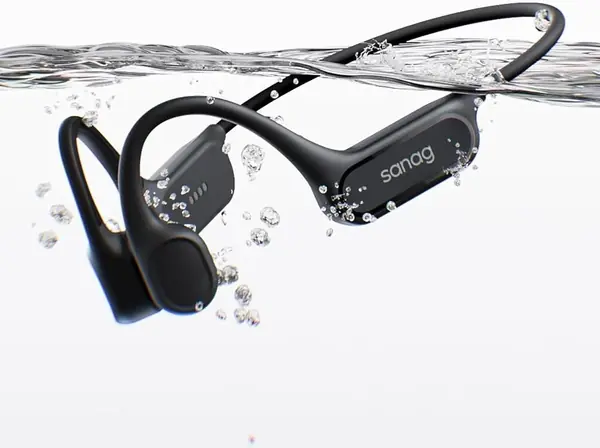
Most swim headphones treat the microphone as an afterthought, because a pool is not where people take calls. The B60S Pro is the exception: a built-in mic with ENC, the processing that pulls your voice out of the noise on the other end of the line.

The rest is a sealed one-piece shell rated IPX8 to two meters, with 32GB, eight hours of playtime and a two-hour charge. Sanag also ships it with a silicone case, which is the sort of thing you do not appreciate until your pool bag has been damp for a season.

Where we land is that it is a good pair priced above better ones. The shell feels like a single piece, with no seams to work loose, and that is worth something in chlorinated water. But the PSIER does the swimming half of this job for less, and the Shokz does the polished half for more.

So the honest summary is that you are paying for the microphone and the case. If you take calls on the deck, or you like leaving the phone in a locker and staying reachable, that is a real thing to pay for. If you do not, it is not.

Pros

  • ENC microphone for calls
  • Seamless one-piece shell rated to 2 meters
  • Silicone carrying case included

Cons

  • Priced above better midrange picks
Our verdict

The only pick here that takes calls seriously: an ENC mic, a seamless IPX8 shell and a case in the box — if you do not mind paying above the midrange.

Check Latest Price
8

Dnniakm X7P Swimming Headphones A Cheap Second Pair That Lives in the Pool Bag

79 /100
TKZ Score Very Good

Key details

Playtime
8 hours
Built-in Storage
32GB
Waterproof Rating
IP68
Bluetooth
5.4
View on Amazon

Every cheap pair of swim headphones is a bet on how long it keeps working, and the X7P is no exception. What it has going for it is that the important parts are all present: IP68 sealing, 32GB of storage that Dnniakm puts at nine thousand songs, and Bluetooth 5.4 for everything above the waterline.

The box is generous for the money — an adjustment strap, spare eartips and a waterproof bag, more than several pricier pairs include. In the water the fit is the part that impressed us: it sits close, stays put through laps, and does not need fiddling between sets.

Two things to keep in mind. Battery life is the number that shrinks in real use: a couple of hours of laps is fine, a day at the beach is not. And the MP3 player is the component with a question mark over it — it is the part that can fail, and unlike a flat battery you cannot work around it. For a pool-bag backup used twice a week, both are acceptable risks.

At this money that is a fair trade. The X7P is not the pair we reach for first, but it is the one we leave in the bag, load once, and hand to a friend who wants to try swimming with music before spending properly.

Pros

  • IP68 sealing at a budget price
  • 32GB, about nine thousand songs
  • Strap, eartips and waterproof bag included

Cons

  • Battery falls short of a full day out
Our verdict

A reasonable second pair for the pool bag: IP68, 32GB and a strap-and-bag kit, as long as you are not relying on it every day.

Check Latest Price

How We Tested Swimming Headphones

We started by narrowing the field to headphones with onboard MP3 storage—enough for several hours of music—and an IPX8 or IP68 rating, since Bluetooth alone can't carry a signal underwater. We also filtered for bone conduction or open-ear designs that leave the ear canal clear, plus a reliable Bluetooth mode for above-water use. That left us with 12 pairs, which we tested over six months.

Each pair came to the pool for twice-weekly sessions of 1,500 to 2,000 yards, and a few made it to open-water swims. I wore them under a swim cap and with goggles, noting whether the band shifted during flip turns, whether the speakers pressed into my cheekbones, and whether I could still hear the lifeguard whistle. After each session, I rinsed them in fresh water, dried them, and checked the buttons and seals for water intrusion—and logged any unit that fogged, glitched, or stopped charging.

For sound, I listened to the same three songs—one bass-heavy, one vocal-heavy, one acoustic—above water and again with my head submerged, noting whether the low end disappeared or the treble turned muddy. Battery life was measured from a full charge to shutdown over repeat swims, not just the spec sheet. For Bluetooth, I paired each pair to my phone on the pool deck and during a short run, logging dropouts and failed reconnections. Value came last: I asked whether the performance justified the price compared with the other pairs in the test.

How to Choose Wireless Headphones for Swimming

Why Swimming Means MP3, Not Bluetooth

A Bluetooth radio loses its signal within inches of water, which is why every pick here has a built-in player and a mode switch. That makes storage the specification you are really shopping for. 32GB is the standard at this price and the makers put it at roughly eight to nine thousand tracks, while the occasional 8GB pair holds a quarter of that. Check formats too: MP3 is universal, and a few pairs add WMA, WAV, APE and FLAC for larger libraries.

The trap is buying on Bluetooth version. A newer chip tells you nothing about the swim; storage and the file transfer decide whether you have music in the water at all. Work out how many hours of audio you want before you look at anything else.

Read Past the IP Rating

IPX8 and IP68 both end in an 8, which means the maker promises continuous immersion beyond one meter — but only at the depth and duration they specify. Without those numbers, the rating is close to meaningless. The pairs worth trusting publish them: two meters for two hours on the Shokz, two meters for one hour on the PSIER, and a TÜV-tested IP68 on the Roujune.

The first digit of IP68 covers dust, which matters on a trail and very little in a pool. Shop the second digit, then the figures after it. For laps in a 1.5-meter pool a two-meter rating leaves plenty of headroom; for diving or open water, get the depth in writing before you pay.

Fit Is the Whole Ballgame

An open-ear band should sit above your ears with the pads resting on your cheekbones, and it should still be there after a turn, a push off the wall and a hundred meters of freestyle. Weight is the easiest thing to compare from a listing: the picks here run 26 to 27 grams, and the lighter ones are the ones you stop noticing.

Think about what you wear with them. A swim cap pulls a wide band into line, and goggles worn over the top do the same for a hoop that stands off the neck. If you swim bareheaded and your head is on the small side, a band that runs large is the first thing to check, because there is no adjustment on most of these.

Battery, Charging and Chlorine

Eight hours is the floor in this group and ten is the ceiling, and MP3 playback is the greedy mode — that is the figure that matters, not the Bluetooth one. Magnetic charging is standard across the board, and those pins are the weakest point on any of them: chlorine and salt sit on the contacts, and a pair that stops charging usually stops there.

Rinse the band in fresh water after every swim, dry the pins with a towel rather than a hairdryer, and never charge a wet unit. That routine does more for how long the headphones last than any feature on the box.

What the Extra Money Buys

At the bottom of this group you get the whole checklist — IP68, 32GB, eight hours — in plainer plastic, with no case and a shorter warranty. The middle adds lighter frames, metal in place of plastic bands, certifications, microphones and cases. The top of the market buys an app that loads music without a computer, longer warranty cover and a fit refined enough to disappear.

Swim twice a week in a public pool and the middle is where the value sits. If you are in the water five mornings a week and the headphones live in your kit bag, the premium pair earns its price inside the first season.

Frequently Asked Questions

Final Verdict

Buy the PSIER S18. It gets the three things that decide a swim headphone right — a real IPX8 seal with a stated depth, a 32GB player and a fit that holds through turns — and it does all of that without the premium the Shokz commands.

If you are in the water often enough that a nine-hour battery and a more finished fit are worth several times the money, the OpenSwim Pro is the better long-term buy. If charging is what annoys you, the Tevese X9 goes longest between charges.