Best Anker Power Banks of 2026

The first time a power bank rescued me, it was 9 p.m. on a train platform, my phone at 4 percent, and every outlet claimed. Twenty minutes off a battery pack got me home. That's the whole job, really: turning a dead phone from a disaster into a minor inconvenience.

What's less obvious is that milliamp hours tell you less than wattage does. Wattage decides whether a laptop actually charges or merely trickles, and the built-in USB-C cables showing up on so many models now mean you're not digging through a bag for the right cord. My team has spent six months carrying 12 of these through airports, commutes, and weekend trips, and the ones that earn their place are the ones you never think about.

A 20,000mAh pack will get most phones through two full days, but it weighs around a pound, so the biggest number isn't automatically the best buy. The picks below cover every version of that tradeoff, from a slim pack that disappears into a jacket pocket to a magnetic one you never plug in.

The Best Anker Power Banks

1

Anker 20K 87W Power Bank Best Overall
94 /100
TKZ Score Outstanding

Key details

Weight
15.2 oz
Capacity
20,000mAh
Max Output
87W
Ports
Built-in USB-C, USB-C, USB-A
View on Amazon

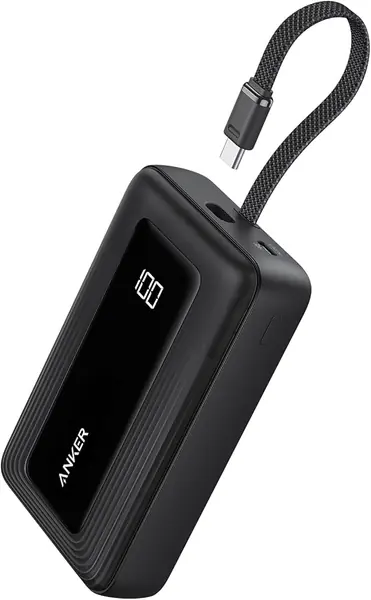
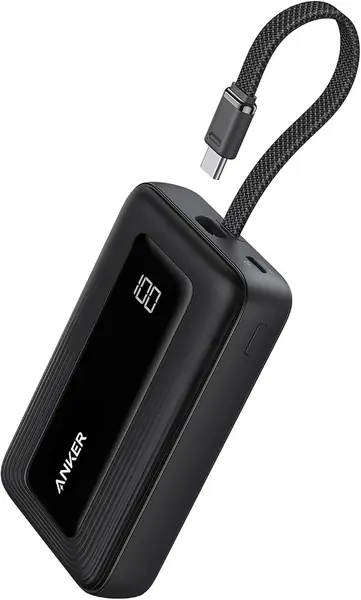
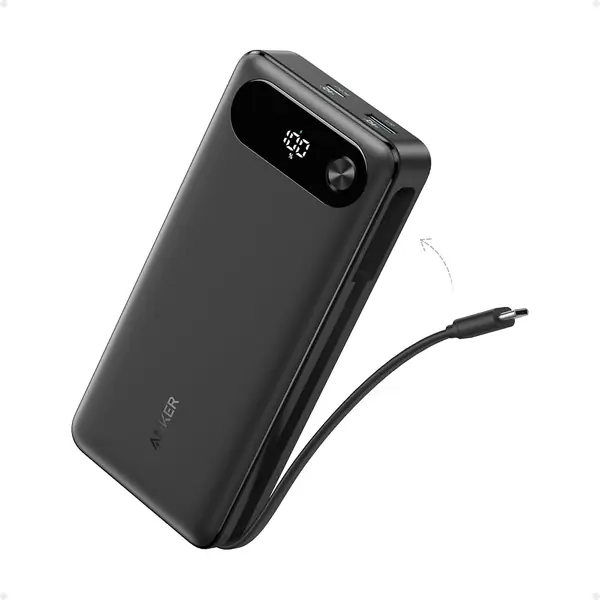
The 87W rating on this Anker looks like a laptop number until you read the split: 87W is shared across three devices, and any one device tops out at 65W. That is still enough to move a 14-inch MacBook Pro to 50% in about 30 minutes, and the built-in USB-C cable keeps a phone charge from turning into a cable hunt.

We recommend it because that balance is rare in this set. It has 20,000mAh, a built-in cable, a USB-C port, and a USB-A port, so it can carry a phone, tablet, and laptop through a travel day without making you choose one. The 1.5-hour recharge with a sufficiently powerful charger matters too; a big bank that takes all night is one you stop carrying.

At 15.2 ounces and about an inch thick, it belongs in a tote or backpack, not a jeans pocket. We did not mind that for the laptop capability, but it is the reason a smaller 10K pack still has a place. The 87W marking on the side is a small travel nicety when a gate agent wants to see the rating.

The built-in cable is the part we watch. It is convenient enough that we stopped carrying a short spare, but it is also the first thing that can fail on a pack like this. A charged battery with a dead cable can still use the USB-C port, so a spare cable in the bag is cheap insurance.

Pros

  • Laptop-ready 65W single-port output
  • Built-in USB-C cable plus two extra ports
  • Twenty-thousand milliamp-hours in a carry-on size

Cons

  • No wall charger in the box
  • At 15.2 oz, it is bag-only
Our verdict

We recommend the Anker 20K 87W to most people because it balances laptop-ready power, a built-in cable, and carry-on size better than anything else here.
Check Latest Price
2

Anker 25K 165W Laptop Power Bank Best for Laptops

93 /100
TKZ Score Outstanding

Key details

Weight
10.6 oz
Capacity
25,000mAh
Max Output
165W
Ports
4, including 2 built-in cables
View on Amazon

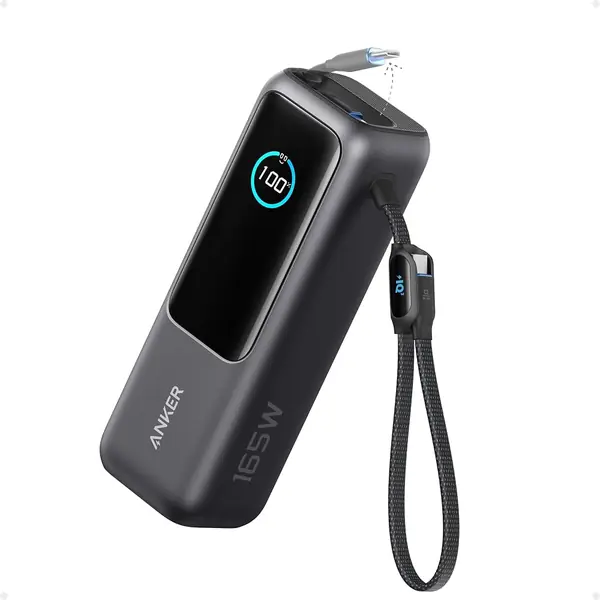
The retractable cable is the reason we keep this 25K pack in the laptop-travel conversation. It pulls out to 2.3 feet and is rated for 20,000 retractions, while a second 0.98-foot cable doubles as a carry strap. That is a lot of cable management built into a pack that also offers three 100W USB-C ports and 165W total output.

We like it for the days when a laptop, tablet, and two phones all leave the house together. With two built-in cables plus a USB-C port and a USB-A port, it can feed four devices at once, and the 25,000mAh capacity has enough headroom for a long travel day. The 2-hour recharge with a 100W charger keeps it from becoming an overnight chore.

It is a premium pack, and the retractable cable is a mechanism, not a piece of cord you can replace with any spare. We treat it as a travel convenience rather than a bombproof feature. If you mostly charge one phone, the 20K 87W is easier to justify; if your bag has a laptop and a small fleet of devices, the extra ports and cables earn their space.

Pros

  • 165W total with three 100W USB-C ports
  • Two built-in cables, one retractable
  • Charges four devices at once

Cons

  • Premium price for the cable-and-port package
  • Retractable cable is not user-replaceable
Our verdict

We keep the 25K 165W for trips where two laptops, a tablet, and a phone all need to leave the house charged.

Check Latest Price
3

Anker Prime 300W Power Bank Best High-Power

92 /100
TKZ Score Outstanding

Key details

Weight
1.32 lb
Capacity
26,250mAh
Max Output
300W
Airline Capacity
99.75Wh
View on Amazon

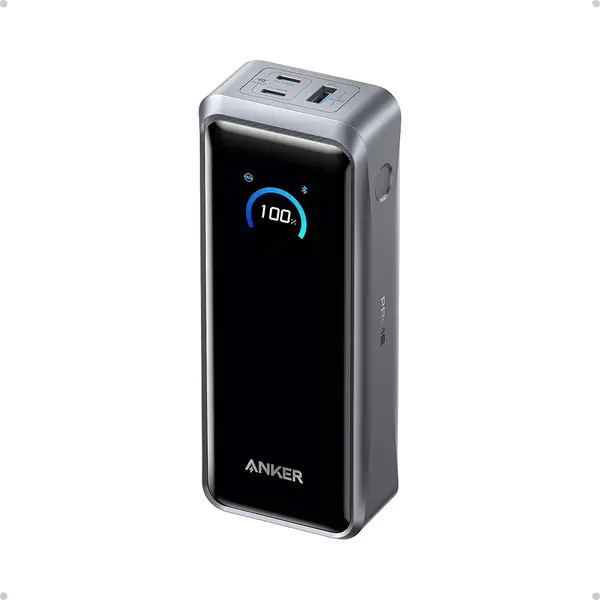
The first number we check on a laptop power bank is watt-hours, not milliamp-hours, and the Prime lands at 99.75Wh. That is just under the common 100Wh airline carry-on ceiling, which makes its 26,250mAh capacity feel less like a spec-sheet flex and more like a useful travel limit.

Output is the other reason it exists. The Prime delivers 300W total across two USB-C ports and one USB-A port, with up to 140W on a single USB-C port when you use a 5A cable. Two MacBook Pros can run at full speed from it, according to Anker, and the 250W dual-port input is absurdly quick: 50% in 13 minutes with the right charger.

We see this as the pack for someone whose laptop is the point of the trip. It is the most capable model here, and the smart display and app control make it easy to see where the power is going. But it is heavy enough to feel like a brick in a small bag, and it costs more than most people need to spend on a phone backup.

The charging base is not included, so budget for the dock separately if you want the stand-and-recharge setup. For a photographer, video editor, or consultant carrying a high-wattage laptop, the combination of 300W output and near-limit airline capacity is worth the weight. For everyone else, it is more bank than the day requires.

Pros

  • 300W total and 140W on one USB-C port
  • 99.75Wh stays under the common airline ceiling
  • 250W dual-port input recharges to 50% in 13 minutes

Cons

  • Heavy at 600 g
  • Charging base sold separately
Our verdict

We see the Prime 300W as the right buy for someone who needs desktop-class output and will accept the price and the heft.

Check Latest Price
4

Anker Zolo 20K 45W Power Bank Best Value

91 /100
TKZ Score Outstanding

Key details

Weight
12.5 oz
Capacity
20,000mAh
Max Output
45W
Ports
Built-in USB-C, USB-C, USB-A
View on Amazon

The step down in price from our top pick is the first thing that makes this Zolo worth a look, but the 45W output is what keeps it on the list. It has 20,000mAh, one built-in USB-C cable, a USB-C port, and a USB-A port, and Anker rates it for up to 3.3 iPhone 17 Pro charges or 3 Samsung S25 Ultra charges. We think it is the value pick for phone-first travel.

The built-in cable is the feature we use most. It means one less thing to unpack at a coffee shop or in an airport seat, and the 20K capacity has enough headroom for a phone and a tablet over a long day. Anker also lists a 20-minute charge to 50% for an iPhone 17 Pro, which is quick enough that a short stop can matter.

It is not a laptop bank in the way the 87W and 165W models are. At 45W it can top up a tablet or a small device, but a power-hungry laptop will want more. It is also about the size and weight of two phones, so it belongs in a bag, not a pocket. For the money, we have not found a better balance of capacity and cable convenience in this set.

Pros

  • 45W output with a built-in USB-C cable
  • 20,000mAh rated for 3.3 iPhone 17 Pro charges
  • USB-C and USB-A ports add two more connections

Cons

  • 45W is short of laptop fast charging
  • Bag-only at 12.48 oz
Our verdict

We think the Zolo 20K 45W is the value pick for phone-first travelers who occasionally need tablet power.

Check Latest Price
5

Anker Nano 10K 45W Power Bank Best Compact

90 /100
TKZ Score Outstanding

Key details

Weight
8.2 oz
Capacity
10,000mAh
Max Output
45W
Ports
Built-in USB-C, USB-C, USB-A
View on Amazon

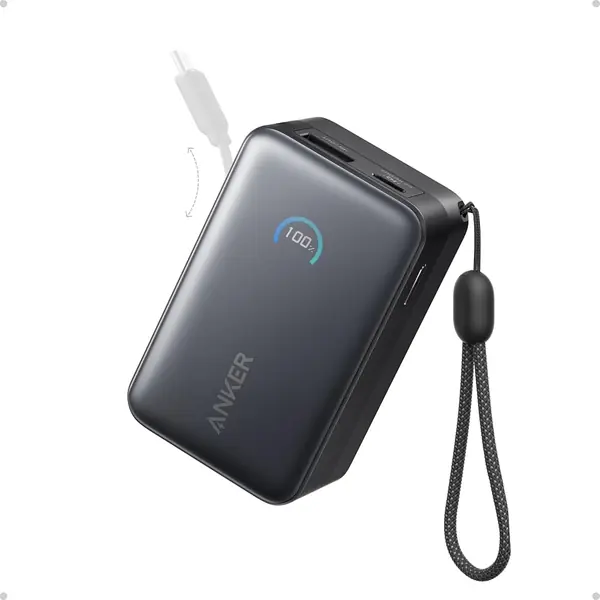
A 45W rating on a 10,000mAh pack is the kind of spec that sounds like overkill until you are topping up a tablet or a phone that has been running navigation all afternoon. The Nano puts that output through a built-in retractable USB-C cable, so there is no loose cord to lose in the bottom of a bag.

It is small even for a 10K: 3.21 by 1.99 by 1.42 inches and 8.2 ounces. We like the pull-out cable for a jacket pocket or a small sling, and the 20,000-bend rating suggests Anker expects it to be used constantly. The 30W input also means the pack itself refills at a reasonable pace, while pass-through charging lets it act as a small hub when you find an outlet.

The trade-off is capacity. Ten thousand milliamp-hours is a phone-and-tablet reserve, not a laptop day. If you are packing a MacBook, the 20K 87W or the 25K 165W is the better shape. The Nano is for the day when you want the smallest pack that still moves a phone quickly.

We also appreciate the display, which takes the guesswork out of how much is left. At this price, it is a premium small pack rather than the obvious budget choice. But for a commuter or a light traveler who wants one cable and real speed, the size-to-output ratio is the reason we keep it in the rotation.

Pros

  • 45W output from a small 10K pack
  • Retractable USB-C cable rated for 20,000 bends
  • 8.2 oz and 16% smaller than standard models

Cons

  • 10,000mAh limits it to phone and tablet top-ups
  • Premium price for a 10K pack
Our verdict

We reach for the Nano 10K when the bag is small but the day is long and the phone needs real speed.

Check Latest Price
6

Anker MagGo 2 Pro Power Bank Best Magnetic

89 /100
TKZ Score Excellent

Key details

Weight
7.76 oz
Capacity
10,000mAh
Recharge
45W
Wireless Output
25W
View on Amazon

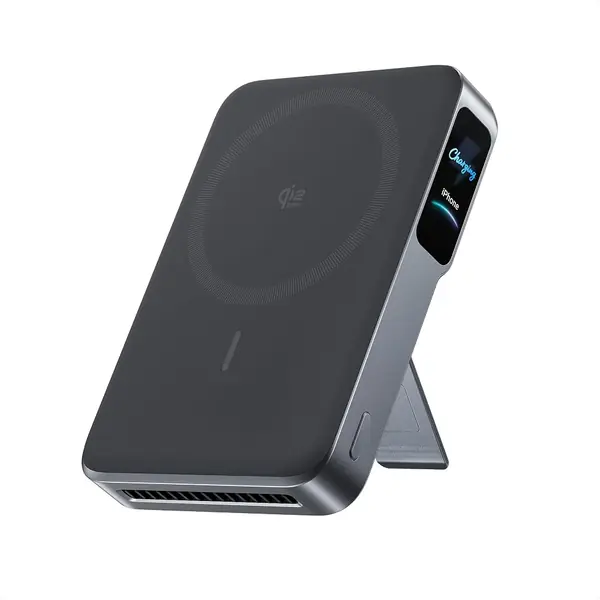
There is a small cooling fan inside this magnetic battery, and that is the detail that separates it from every other MagGo on the page. Wireless charging generates heat, and the MagGo 2 Pro uses a fan, dual air channels, and graphene to keep the pack below 96.8°F, according to Anker. That is the kind of engineering you notice when a phone is clipped to your bag for an hour.

The rest of the package is built for a phone-first day: 10,000mAh, Qi2.2 magnetic charging at up to 25W, a 45W USB-C recharge, a smart display, and a stand that folds out to 80 degrees. The stand is more useful than it sounds; it turns the pack into a bedside or desk charger instead of a lump you have to prop against something.

We like it best for iPhone owners who want magnetic convenience without the heat that makes other magnetic packs uncomfortable. It is not a wired-speed replacement for a laptop bank, and the wireless output depends heavily on the phone and case; thick cases and older phones will not see the full 25W. That is a real limit, but for a magnetic pack it is the most thoughtful one here.

It is expensive for 10,000mAh, and the fan is one more thing to trust over time. We still choose it over a cheaper magnetic pack for travel because the cooling and stand solve two daily annoyances at once. If you want maximum battery for the money, a wired 20K is the better buy.

Pros

  • Active fan keeps wireless charging cooler
  • Qi2.2 25W magnetic charging plus 45W USB-C recharge
  • Smart display and fold-out stand

Cons

  • Premium price for 10,000mAh
  • Wireless speed varies by phone and case
Our verdict

We like the MagGo 2 Pro for iPhone owners who want magnetic charging without the heat usually bundled with it.

Check Latest Price
7

Anker Zolo 10K 30W Power Bank Budget Pocket Carry

88 /100
TKZ Score Excellent

Key details

Weight
7.87 oz
Capacity
10,000mAh
Max Output
30W
Ports
Built-in USB-C, USB-C, USB-A
View on Amazon

This Zolo is about the size of two decks of cards, which is the right frame for a 10K pack that still carries a built-in USB-C cable. It measures 4.32 by 2.58 by 0.98 inches, so it slips into a small bag or a coat pocket without the brick feeling of a 20K model.

Thirty watts is enough to move a phone quickly: Anker rates it for an iPhone 16 Pro Max at 50% in 27 minutes. The built-in cable is rated for 10,000 bends, and the pack also has a USB-C port and a USB-A port for a second device. That is a useful amount of flexibility for something this small.

We treat it as a phone-and-tablet pack, not a laptop substitute. Thirty watts will not keep a demanding laptop happy, and the 10,000mAh capacity is a day reserve rather than a weekend supply. For a concert, a commute, or a purse, that is the point: it is small enough to carry all the time.

The built-in cable is short and permanently attached, so it is not the pack for someone who wants to swap cables or charge a device across a table. As a budget 10K, it earns its place by making the cable one less thing to remember. It is the one we hand to someone who wants a simple backup, not a travel power station.

Pros

  • 30W fast charging in a compact 10K body
  • Built-in USB-C cable rated for 10,000 bends
  • USB-C and USB-A ports for a second device

Cons

  • 30W is phone speed, not laptop power
  • Short built-in cable cannot be swapped
Our verdict

We see the Zolo 10K 30W as an easy budget add-on for a purse or glovebox, not a laptop bank.

Check Latest Price
8

Anker PowerCore Slim 10K Slim Everyday Backup

87 /100
TKZ Score Excellent

Key details

Weight
8.48 oz
Capacity
10,000mAh
Output
5V/3A
Thickness
0.61 in
View on Amazon

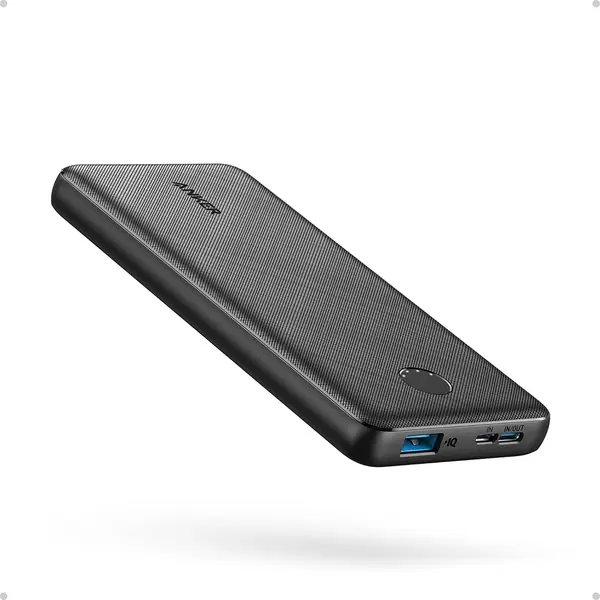
At 0.61 inches thick, this PowerCore Slim is the one that disappears into a backpack sleeve or a jacket pocket. The 10,000mAh capacity and 8.48-ounce weight put it in the same carrying class as a paperback, and the 3.2-foot drop rating means it is not a delicate desk-only object.

We like it for the days when you want a backup without thinking about it. The USB-C port handles both input and output, so one cable can recharge the pack and top up a phone, and the body is built with scratch resistance in mind. It is a simple pack, and the simplicity is the appeal.

The catch is speed. This is a 5V/3A pack, not a 30W or 45W fast charger, so a modern phone will charge more slowly than it does from the Zolo or Nano. It also uses a separate cable rather than a built-in one. If you want the slimmest possible just-in-case battery, those are fair trade-offs; if you want speed, step up to the 30W or 45W models.

Pros

  • 0.61-inch body slips into a bag sleeve
  • 3.2-foot drop rating
  • USB-C input and output from one port

Cons

  • 5V/3A output is slow by modern standards
  • No built-in cable
Our verdict

We recommend the Slim 10K to anyone who prizes a flat, light pack over fast charging.

Check Latest Price

How We Chose and Tested These Power Banks

We started by sorting the full current lineup by capacity, port count, top wattage, and price, then cut anything that duplicated another pick's job so the final group covered real differences rather than variations on the same brick. That left 12, ranging from palm-sized packs you can slip into a jeans pocket to a heavy laptop battery with app controls.

For six months these lived in bags rather than on a bench. Each one went through a run of morning commutes, two weekend trips, a couple of flights in carry-on, and long days at a desk where outlets were scarce. We timed every pack from dead to 50 percent on the same phone, then plugged in a laptop, a phone, and earbuds at once to see whether speeds held or sagged. We also counted how many full phone charges each delivered before it quit, which is where the advertised capacity and the real-world capacity tend to part ways.

Portability we judged with our shoulders: every pack was weighed, then carried in a tote, a backpack, and a jacket pocket to see which ones dragged. Durability meant riding loose in a bag with keys and taking a few waist-high drops onto pavement, then checking whether the ports still gripped a cable snugly. Reliability showed up over time — we recharged each pack weekly and noted which ones lost capacity or developed a loose port by month four, and whether they still held a charge after two weeks untouched. For the magnetic model, we checked how reliably it aligned through a thin case, how warm it got, and whether the cooling fan was audible. Value came last: what each pack cost against the charges it actually delivered.

How to Choose an Anker Power Bank

Match Capacity to the Devices in Your Bag

A 10,000mAh pack is a phone reserve: enough for a day out, a commute, or a concert, but not a weekend. A 20,000mAh pack is the better travel default if you carry a tablet or want two or three phone charges without thinking about it. Move to 24,000mAh or 25,000mAh when a laptop joins the trip. We treat the smallest pack as the one that lives in a jacket pocket and the larger ones as bag residents; buying a 25K pack for phone-only days usually means leaving it at home.

Read Output Watts, Not Just the Total

A high total wattage can be shared across ports, so the single-device number is the one that decides whether a laptop charges quickly. The Anker 20K is rated at 87W total, but one device tops out at 65W; the 25K spreads 165W across ports with up to 100W on USB-C. For phones, 30W is quick and 45W is quicker; for a laptop, look for 65W or more on a single port. A 30W pack can be a fine phone charger without being a laptop charger.

Decide Whether a Built-In Cable Is Worth It

A built-in cable is a genuine convenience for a bag you grab without checking contents. It also adds a wear point that is not as easy to replace as a loose cable. We like the retractable cables on the Nano and 25K for travel, and the fixed cable on the 20K for everyday carry. If you choose one, pack a short spare anyway; a pack with a dead cable can still charge through its USB-C port.

Pack for the Airline Limit, Not Just the Pocket

Airlines care about watt-hours, not the milliamp-hour number on the box. The Prime is rated at 99.75Wh, just under the common 100Wh carry-on ceiling, while smaller packs sit well below it. A 10K pack is the one you can slip into a personal item; a 20K or 25K pack is a backpack resident. Check your airline's limit before a long trip and keep the pack in the cabin, not checked luggage.

Treat Magnetic Charging as a Convenience, Not a Speed Upgrade

Magnetic packs are the easiest way to top up an iPhone without a cable, but wireless charging runs warmer and usually slower than wired. Qi2.2 and 25W help, and the MagGo 2 Pro's active fan is the most serious attempt at heat control here. Use a thin MagSafe-compatible case, and switch to a cable when you need the fastest charge. If you use Android, a magnetic pack is not the right default unless the phone has its own magnetic ring.

Frequently Asked Questions

Final Verdict

For most people, we point to the Anker 20K 87W. It has enough capacity for a phone and tablet day, enough output to rescue a laptop, and a built-in cable that removes one small packing decision. The 25K 165W is the better buy if your bag regularly carries a laptop and two other devices; its twin cables and four-device charging justify the extra bulk. If you want the smallest fast pack, the Nano is the one we grab.