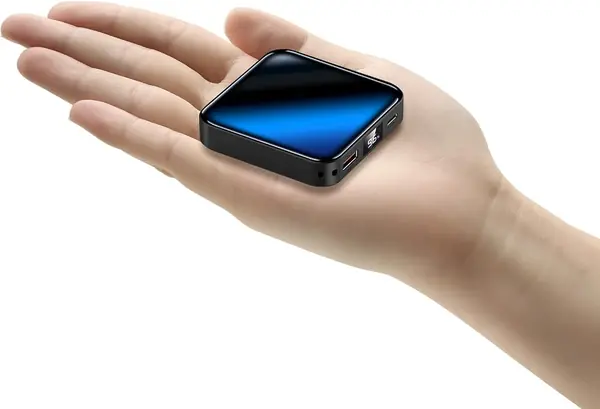
Best Small Power Banks of 2026

The best small power bank isn't the one with the biggest number printed on the label — it's the one that's still in your bag when your phone hits 4 percent at four in the afternoon. A 10,000mAh pack is the sweet spot for that job: enough for a couple of full phone charges, small enough that you stop thinking about it.

I've carried one clipped to a commuter bag for years, and the differences between models show up in the small stuff — whether the built-in cable reaches a seat-back pocket, whether the screen says 20 percent or just blinks at you. My team and I spent five months with 12 of these compact packs, timing charges, weighing them, and sending them out on weekend flights.

Built-in cables are the reason these packs stay pocketable, and on more than one model they were also the first thing to feel flimsy — worth knowing before you buy. Below, the picks sort out by what you'll actually lean on: raw charging speed, ultralight carry, or a pack that plugs straight into the wall when you get home.

The Best Small Power Banks

1

AIFENG CP2 Power Bank Best Overall
92 /100
TKZ Score Outstanding

Key details

Battery Capacity
10,000 mAh
Size
3.66 x 2.36 x 1.26 in
Max Output
22.5W
Built In
Charging cables and AC plug
View on Amazon

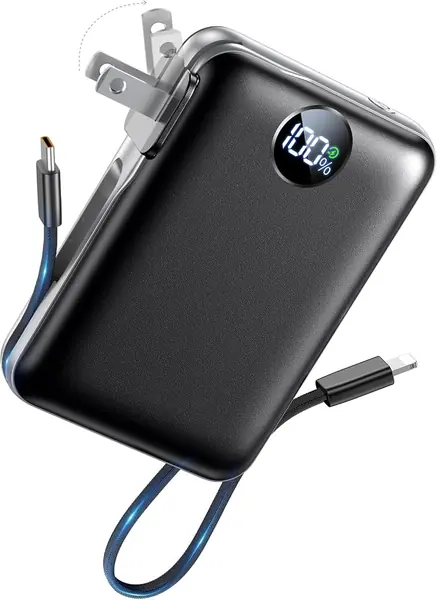
Every other pack here asks you to bring something — a cable, a wall adapter, or both. The AIFENG CP2 brings its own. Charging cables are built into the body, and the pack recharges through a foldable AC plug on the back, so one object covers a phone, a set of earbuds, and whatever your travel companion is carrying. That's why it's our top pick: it replaces the kit rather than joining it.

The numbers are sensible rather than spectacular — 10,000mAh, 22.5W output, and enough cables and ports for four devices at once. In practice that's about two charges for a current iPhone or one and a half for a large Galaxy, with roughly four hours plugged into a wall to fill the pack itself. The plug is the detail we keep coming back to. At the end of a travel day you put the bank and the phone on the same outlet side by side, instead of rationing the one adapter you packed.

Size is the honest trade. At 1.26 inches thick and about 7 ounces, it's more than twice the thickness of the INIU and the chunkiest thing in this group, which is what the plug costs you. It rides fine in a jacket, a tote, or a backpack's front pocket and is unmistakably lumpy in a jeans pocket; if pocket carry is the whole point, the Gidues M1 is the better answer.

What settled it for us is how little thought it takes. No cable to remember, no adapter to borrow, no second thing to charge overnight. For a weekend bag, a daily commute, or a trip that changes hotels every night, that's worth more than another ten watts.

Pros

  • Built-in cables cover iPhone and USB-C devices
  • Foldable AC plug recharges it from any outlet
  • Runs up to four devices at once

Cons

  • 22.5W output is modest for tablets
Our verdict

We recommend the CP2 to anyone who wants one thing to pack: built-in cables and a wall plug replace your charger kit instead of adding to it.
Check Latest Price
2

INIU P41 45W Power Bank Best for Fast Charging

91 /100
TKZ Score Outstanding

Key details

Battery Capacity
10,000 mAh
Size
5.26 x 2.7 x 0.5 in
Max Output
45W
Cable
0.4 ft detachable USB-C
View on Amazon

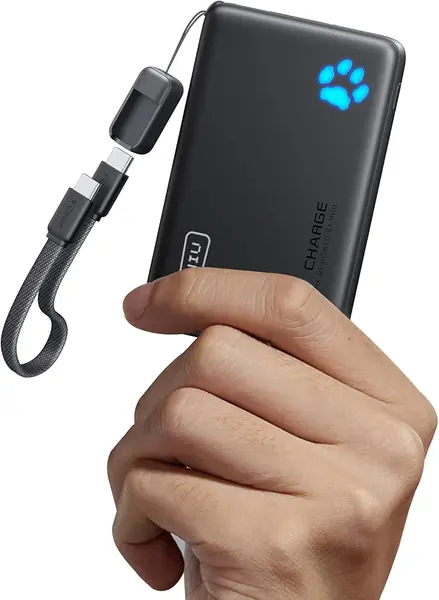
Set the INIU P41 next to our top pick and the trade is plain: the AIFENG is thicker and friendlier, this one is a half-inch slab with 45W on tap. That's double the AIFENG's output and tied for the highest here, and it's the difference between topping a phone up and actually charging a tablet at a useful rate. INIU quotes 76% on an iPhone 17 Pro Max, 84% on a Galaxy S25 Ultra, and 60% on an iPad Pro in 30 minutes starting near empty.

The cable is the smartest thing about it. It's a 0.4-foot braided USB-C cord that detaches, so when it frays — and cords always fray — you replace the cable rather than the pack. Every built-in-cable model here becomes e-waste the day its cord dies, which is why this is the one we hand to people who travel hard. Two USB-C ports and a USB-A sit alongside it for a second device, and the three-year warranty is the longest coverage in this group.

It's also 5.26 inches tall, so it's a bag pack rather than a pocket one: fine in a jacket or a backpack sleeve, awkward in jeans. At a bit over 8 ounces you'll know it's there. What you get in exchange is close to two full phone charges and the fastest refill in this set, which is a fair deal as long as a bag is never far away.

Pros

  • 45W output, tied for fastest here
  • Detachable cable is replaceable when it frays
  • Two USB-C ports plus USB-A

Cons

  • Some units stop holding a charge within months
Our verdict

We point fast-charging phones and tablet travelers here — 45W output and a replaceable cable matter more than a slimmer body.

Check Latest Price
3

Anker Nano 45W Power Bank Best Premium Pick

90 /100
TKZ Score Outstanding

Key details

Battery Capacity
10,000 mAh
Size
3.21 x 1.99 x 1.42 in
Max Output
45W
Cable
Retractable built-in USB-C
View on Amazon

The Nano is the most expensive pack here, and the first minute with it explains the gap. Pull the built-in USB-C cable out of the body, plug in, and let it retract when you're done — no loop hanging off the pack, nothing to unplug and lose at the bottom of a bag. Anker rates the mechanism at 20,000 bends, which is exactly the kind of number we want attached to a moving part.

Everything else is scaled to that idea. It measures 3.21 by 1.99 by 1.42 inches and weighs 8.2 ounces, with an exact-percentage display, 45W output, and 30W input so the bank refills itself nearly as fast as it fills a phone. If you fly often and your bag is a small study in minimalism, this is the pack that keeps it that way, and we think the premium is defensible for exactly that person.

For everyone else the math is harder. The extra money buys a nicer mechanism, not more capacity — it's still 10,000mAh and roughly two phone charges. Buy it because handling the cable well every single day is worth something to you, not because it holds more power.

Pros

  • Retractable USB-C cable stows inside the body
  • 45W out and 30W in for fast two-way charging
  • Smart display shows exact battery percentage

Cons

  • 1.42-inch body is a block in a pocket
  • Some units quit holding a charge within months
Our verdict

We think the Nano earns its premium if you want the cable to disappear; it's the neatest, fastest small pack here and you pay for the mechanism.

Check Latest Price
4

Anker Zolo 30W Power Bank Best Built-In Cable

89 /100
TKZ Score Excellent

Key details

Battery Capacity
10,000 mAh
Size
4.32 x 2.58 x 0.98 in
Max Output
30W
Cable
Built-in 5.4 in USB-C
View on Amazon

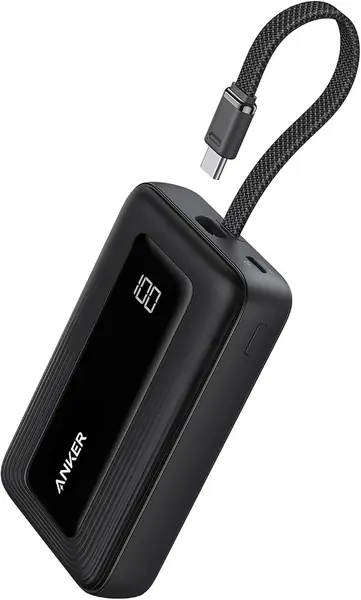
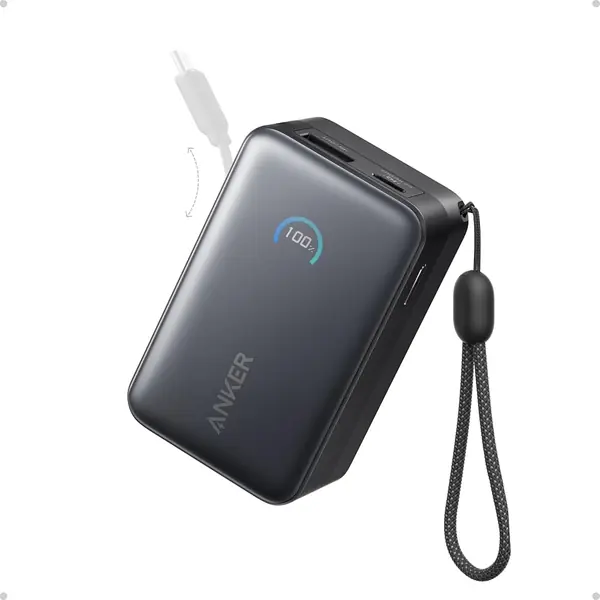
The Zolo's built-in USB-C cable doubles as a lanyard, which sounds like a gimmick until you're carrying it: loop a finger through and the pack hangs off your hand while your phone charges in the other. That, plus a 5.4-inch cable Anker rates at 10,000 bends, makes this the built-in-cable pick we're most comfortable recommending for daily carry — it's the one that feels like it will still be in a bag in two years.

The rest is sensible. You get 10,000mAh, 30W output, a digital readout of the exact percentage left, and a body of 4.32 by 2.58 by 0.98 inches that fits a coat pocket and stretches a jeans one. Anker quotes two full charges for an iPhone 15 and just under two for a Galaxy S24. A USB-C port and a USB-A port sit alongside the fixed cable, so a second device can charge while the cable handles your phone.

At 7.9 ounces it's heavier than its footprint suggests, which is the cost of a 10,000mAh cell plus a permanently attached cable, and the Gidues M1 is the alternative if weight is what you feel first. In a coat pocket or a tote we stopped noticing it; in a front jeans pocket you won't.

Pros

  • Built-in 5.4-inch cable doubles as a strap
  • 30W output delivers about two phone charges
  • Digital display reads out exact percentage

Cons

  • Refills at only 20W
Our verdict

The Zolo is the one we hand to everyday commuters: a 30W cable that doubles as a strap and enough capacity for two phone charges.

Check Latest Price
5

Gidues M1 Power Bank Best for Pockets

88 /100
TKZ Score Excellent

Key details

Battery Capacity
10,000 mAh
Size
2.74 x 2.28 x 1.14 in
Max Output
22.5W
Cable
Built-in two-way USB-C
View on Amazon

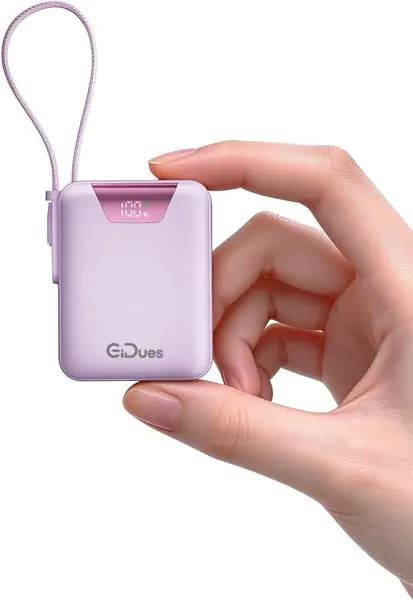
A 10,000mAh pack is usually about the size of a deck of cards. The Gidues M1 measures 2.74 by 2.28 by 1.14 inches — smaller than a deck in both width and height, thicker than a phone — a stubby little cube that drops into a trouser pocket and stays there.

It's 22.5W with a two-way USB-C cable built in: the same cable takes a charge in and gives one out, so you can refill the pack from a laptop or a wall brick without hunting for a second cord, then turn around and charge a phone from it. There's a percentage display, a second port for a friend's device, and a purple finish that's easy to spot in a bag full of black rectangles.

The cable is short, and that shapes how you use it: phone and pack end up stacked in one hand, or both on a table, rather than phone-in-pocket while it charges. That's a small annoyance in exchange for never carrying a separate cord. For a concert, a commute, or a night out where you want a full charge in a front pocket and nothing else, this is the pack that disappears most completely.

Pros

  • Smallest footprint here at 2.74 inches wide
  • Two-way built-in cable handles input and output
  • Digital display shows remaining charge

Cons

  • Heavier than its tiny footprint suggests
Our verdict

We recommend the M1 when your pocket, not your bag, is the constraint — it's the smallest 10,000mAh pack here and it charges without a cable.

Check Latest Price
6

Zmmyuluo N1 Power Bank Shared Family Bag

87 /100
TKZ Score Excellent

Key details

Battery Capacity
10,000 mAh
Size
4.4 x 2.3 x 0.77 in
Display
LED percentage
Built-in Cables
4
View on Amazon

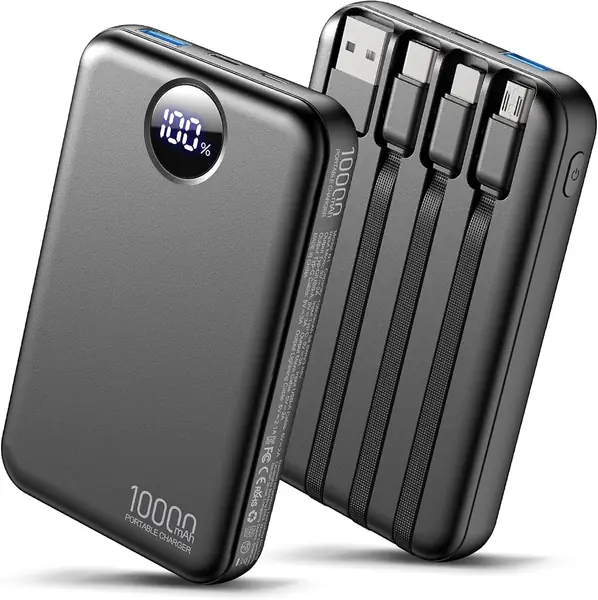
Four built-in cables sounds like a strange thing to get excited about until you're the person in the group who has the cord. The N1 carries four of them, covering iOS, USB-C, and micro-USB devices, alongside its ports — so an iPhone, an Android phone, a set of earbuds, and an old kid's tablet can all draw power from one brick without anyone digging through a bag.

The hardware is ordinary in a good way: 10,000mAh, up to 3A output, an LED display that reads out the exact percentage, and a body of 4.4 by 2.3 by 0.77 inches at 6.6 ounces. That's roughly phone-sized and slides into a bag pocket, and the pack itself refills in about four hours.

The honest gap is speed. Charging is the least consistent part of the experience here — some devices fill quickly while others crawl toward full, and a tablet will feel like it's stalling. It's the kind of unevenness that matters less when the pack is a backup in the car and more when it's the only thing between you and a dead phone at an airport.

Where it earns its place is coverage. Nothing else at this price covers every connector in the house, which makes it the pack to leave in a glovebox, a kitchen drawer, or a family travel bag where the mix of devices is unpredictable. Treat it as the shared spare rather than your daily driver and it makes a lot of sense.

Pros

  • Four built-in cables cover iOS, USB-C, and micro-USB
  • LED display reads out exact percentage
  • Charges several devices at once

Cons

  • Charging speed is uneven across devices
Our verdict

For a shared bag or a car, the N1 is the pack we hand over: four built-in cables mean nobody has to remember theirs.

Check Latest Price
7

WeeFancy WF103 Power Bank Glovebox Spare

82 /100
TKZ Score Excellent

Key details

Battery Capacity
10,000 mAh
Max Output
20W
Ports
2 USB-C + 1 USB-A
Weight
5.8 oz
View on Amazon

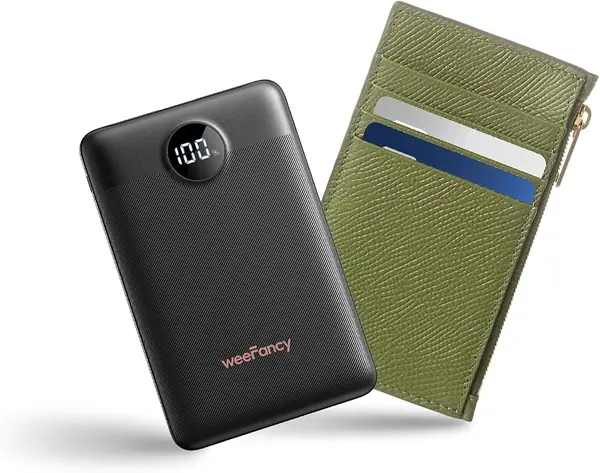
The line worth reading on a cheap power bank is the certification one. The WeeFancy WF103 lists FCC, CE, and RoHS certification and a nine-layer protection system, which is more than most anonymous packs bother to claim, and it's why we're comfortable keeping it on this list at all.

The rest is a competent 10,000mAh pack: 20W Power Delivery, two USB-C ports plus a USB-A, 5.8 ounces, and a 4.32 by 2.7 by 0.62-inch body that lies flat in a bag. WeeFancy quotes about 65% in half an hour and a three-hour refill for the pack itself. Nothing here is exotic — no built-in cable, no display — which is the point at the bottom of the range.

What you give up is consistency. Charging speed is uneven across devices, and a phone that negotiates well will fill quickly while another stalls. As a spare that lives in a glovebox or a work bag and gets checked once a month, that's tolerable — it's a portable charger for the day you forgot to charge. As your only pack on a two-week trip, the AIFENG's built-in cables and wall plug are worth the step up.

Pros

  • Three ports including two USB-C
  • 20W Power Delivery output
  • Lists FCC, CE, and RoHS certification

Cons

  • Arrives heavier than the listed 5.8 ounces
Our verdict

We keep the WF103 on the list as a certified, budget spare that does the basics and nothing more.

Check Latest Price
8

Xuniktek XF-4 Power Bank Best for Desk-Side Charging

81 /100
TKZ Score Excellent

Key details

Battery Capacity
10,000 mAh
Size
2.75 x 2.7 x 0.9 in
Ports
1 USB-A + 1 USB-C
Display
LED percentage
View on Amazon

The XF-4 is a cube: 2.75 by 2.7 by 0.9 inches, with a full-arc body and no corners to catch on a bag lining. That shape has a practical payoff — set it on a nightstand or a café table and it stays where you put it, instead of sliding around under the weight of a cable the way thinner packs do.

Inside is a 10,000mAh cell with QC 3.0 and up to 3A total across one USB-A and one USB-C port, plus an LED display that shows exactly how much is left. Xuniktek claims three phone charges; we'd treat that as an optimistic round number, and something in the region of two charges is the realistic expectation from 10,000mAh.

There's no cable in the box beyond the ports, so the cord you need is the cord you remembered. And 0.9 inches of thickness means it bulges in a front pocket even though it takes up less length than a slab — a trade that favors a bag or a desk and works against tight jeans.

The bigger question is price. It sits above packs from far better-known names at the same capacity, and when what you're buying is a battery you don't want to think about, reputation is part of the product. Choose it if the cube form and the display are what you actually want; otherwise the INIU and the AIFENG are steadier bets for the money.

Pros

  • Compact 2.75-inch cube with rounded body
  • Digital display shows battery percentage
  • QC 3.0 fast charging up to 3A

Cons

  • Priced above better-known packs of the same capacity
Our verdict

The XF-4 earns a place if you want a pack that sits on a desk and shows its charge, though you're paying proven-brand money for a newer name.

Check Latest Price

How We Tested Small Power Banks

We started with a few dozen 10,000mAh packs and narrowed by size, price, and what comes in the box — a built-in cable, a folding AC plug, a readout that shows an actual number instead of four blinking dots. Anything too chunky for a jacket pocket, or claiming a capacity the spec sheet couldn't back up, got cut before we ordered it.

Twelve made the final list, and they lived with us for five months: on commutes, on weekend flights, in coat pockets on cold walks, and on nightstands recharging overnight. Each one got the same run — a phone drained to 0 percent, then timed to 50 percent and to full, followed by a tablet on the second port to see whether the second device dragged the first charge down.

We weighed every pack on a kitchen scale and set it next to a phone and a jeans pocket, because the winner in this category is almost always the one you forget you're carrying. Then we went after the weak points: tugging and bending every built-in cable, counting how many full phone charges each pack delivered before it needed a wall outlet, and timing that recharge from dead to full.

Durability surfaced over weeks rather than minutes — a cable that went loose, a display that started lying about the percentage, a shell that scuffed in a bag full of keys. At the end we weighed cost against the number of full phone charges each pack actually delivered, and asked whether the extras were worth the bulk they added.

How to Choose a Small Power Bank

What 10,000mAh Really Buys You

Capacity is quoted at the cell, not at your phone. Every 10,000mAh pack here lands somewhere around one and a half to two full phone charges, because some energy is lost in conversion and in the cable. A 5,000mAh pack is good for a single top-up. That's the real decision in front of you: a day out needs 5,000mAh, a weekend or a tablet needs 10,000.

Don't buy capacity you'll resent carrying. A 20,000mAh brick is twice the weight for a second day you probably won't need, and a flat 10,000mAh slab like the INIU P41 is easier to live with than a fatter pack with more cells. If you routinely go two days between outlets, two small packs beat one heavy one — you can leave one charging at the hotel.

Built-In Cables, Detachable Cables, or None

A built-in cable is the single biggest convenience upgrade in this category: nothing to forget, nothing to untangle, and on the AIFENG CP2 nothing to plug into the wall either. The catch is that when a fixed cable fails, the pack usually goes with it, which is the failure we'd worry about most in a cheap pack.

A detachable cable solves that, and it's why we like the INIU P41 for heavy users — a frayed cord becomes a two-dollar problem rather than a dead battery. Whichever way you go, check whether the built-in cable also recharges the pack itself. On the Gidues M1 one two-way cable does both, which halves the number of things you have to keep track of.

Watts: Buy for Your Biggest Device

Output wattage decides whether a pack is a phone charger or a tablet charger. Anything from 20W to 30W fills a phone at or near its top speed; 45W, as on the INIU P41 and the Anker Nano, is what you need to move an iPad or a small laptop meaningfully in half an hour.

Two traps worth knowing. A 45W pack doesn't charge a phone at 45W unless the phone supports it, so the ceiling is usually your device rather than the bank. And check the input wattage, because that's your overnight refill: a bank that takes power in slowly will still be plugged in at breakfast.

The Pocket Test: Thickness Beats Capacity

Listings brag about being 40% smaller, which usually means smaller than other power banks, not small enough for your jeans. The dimension that decides pocketability is thickness. A half-inch slab like the INIU disappears; anything around 1.2 to 1.4 inches, like the AIFENG CP2 or the Anker Nano, announces itself every time you sit down.

Weight comes next, and roughly seven ounces is where a shirt pocket starts pulling. Measure the pocket you'll actually use against the listing's shortest side before you order, and if the honest answer is bag rather than pocket, stop optimizing for size and buy for capacity instead.

Frequently Asked Questions

Final Verdict

For most people the AIFENG CP2 is the pack to buy. Built-in cables and a foldable wall plug mean it's the only thing you have to remember, and 10,000mAh at 22.5W covers a phone-heavy day without a second thought.

If a tablet or a fast-charging Android shares your bag, put the same money into the INIU P41 and its 45W output and replaceable cable. And if the constraint is a pocket rather than a bag, the Gidues M1 is the smallest 10,000mAh pack here — the one that disappears.