Best Power Banks for Camping of 2026

Every camping trip has that moment. You've got the tent up, dinner is going, and you're taking photos of the light hitting the ridge — and then your phone drops to 8 percent with two days of driving directions, trail maps, and a shuttle pickup still ahead of you. A power bank is the obvious fix, but the ones that hold up outdoors are a different animal from the slim brick in your desk drawer. They have to shrug off being dropped on granite, live in a duffel that gets thrown into a trunk, and keep a phone, a headlamp, and a camera alive when there's no outlet for three days.

After six months with 14 of these — big 60,000mAh slabs, palm-sized solar units, models with built-in cables and wireless pads — I can tell you the label is the least useful thing on the box. Rated capacity is wildly optimistic, and the heaviest battery is usually the one that stays in the car. What actually matters is how many real recharges a bank delivers, how fast it refills a phone, and whether it's still working after a season of being treated like camping gear.

Below are the ones my team and I kept reaching for, sorted by how you'll actually use them — a multiday basecamp, a solo overnight, or a just-in-case backup in your pack. Every pick earned its spot on a trip, not a spec sheet.

The Best Power Banks for Camping

1

IAPOS 60,000mAh Power Bank Best Overall
91 /100
TKZ Score Outstanding

Key details

Weight
15.5 oz
Battery Capacity
60,000mAh
Max Output
22.5W
Ports And Cables
2 USB-A, 1 USB-C, 3-in-1 cable
View on Amazon

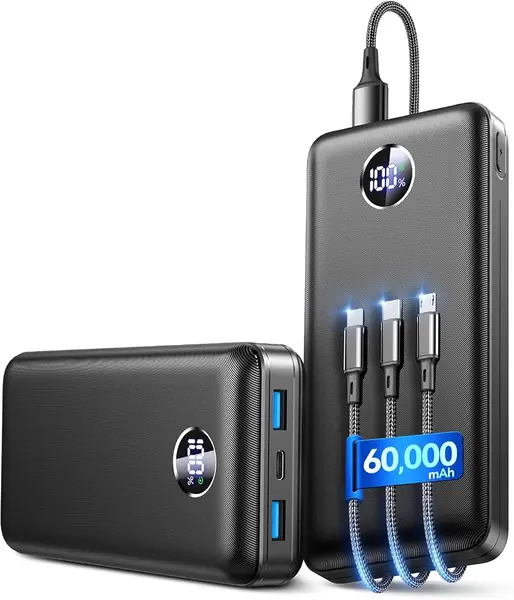
Sixty thousand milliamp-hours is a hard number to feel, so here's the translation: roughly four to five full phone charges, or two phones and a tablet kept alive across a long weekend. That reserve is why this pack takes the top spot for camping. It's the difference between rationing battery on day three and not thinking about it at all. The 22.5W USB-C port does the rest of the work, moving a phone from nearly dead to useful in about half an hour.

What makes it easy to live with is how little there is to remember. The 3-in-1 cable is built into the body and ends in USB-C, Lightning, and micro-USB tips, so the usual pre-trip hunt for the right cord simply doesn't happen. Add two USB-A ports and the USB-C port and you can run five devices at once, more than anything else in this group. The display reads in percent rather than four vague dots, and on a trip where you're deciding whether to shoot video, that specificity is worth a lot.

The detail that surprised us is weight. At 15.5 ounces it's lighter than the 50,000mAh OHOVIV, the sort of spec-sheet oddity that turns out to matter when you're deciding what goes in the pack at the trailhead. The body is a plain 5.9-inch slab with rounded corners that slides into a laptop sleeve. One quirk: the button on the side is more of a wake button than a control, since plugging in a device is what starts a charge.

There's no water-resistance rating, so ours travels in a dry bag rather than clipped to the outside of a pack, and it's a pack-panel item rather than a pocket one. The three-year warranty matches the longest in this group, which takes some of the sting out of buying the priciest pack here.

Pros

  • 60,000mAh, the largest reserve in this set
  • 22.5W USB-C PD plus two USB-A ports
  • Built-in 3-in-1 cable with three tip types

Cons

  • Too bulky for a pocket; plan on a pack pocket
Our verdict

We point most campers here: the biggest reserve in this group, fast USB-C, and a spare cable built into the body.
Check Latest Price
2

OHOVIV 50,000mAh Power Bank Best Value

87 /100
TKZ Score Excellent

Key details

Weight
1.43 lb
Battery Capacity
50,000mAh
Max Output
22.5W
Display
LED percentage
View on Amazon

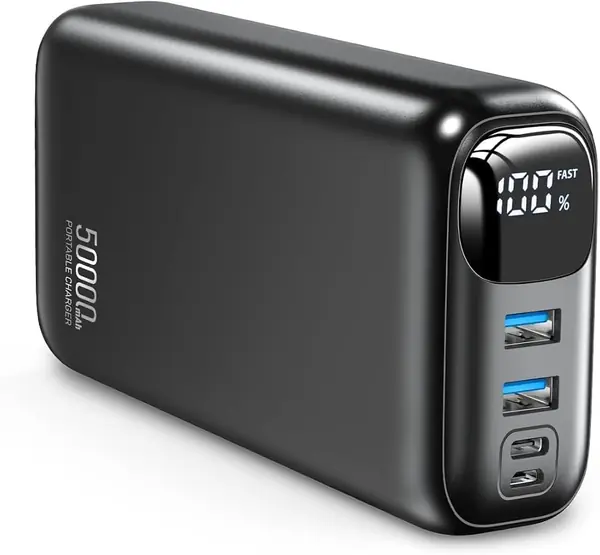
Cheaper than our top pick and only 10,000mAh behind it, this is the pack we point to when budget is the deciding vote. You give up the built-in cable set and the extra capacity; you keep the 22.5W USB-C output that makes a modern phone usable again in half an hour, which is the part most people actually feel.

Three devices charge at once from two USB-A ports and a USB-C port that works in both directions, so the same cable refills the pack overnight and tops up your phone in the morning. The LED display reads to the percentage rather than flashing at you, which makes planning the last day of a trip much easier. The 5.4-inch body fits a jacket pocket, though at 1.6 inches thick it's a chunky rectangle rather than a slim one.

Weight is where it gives ground: 0.65 kg, heavier than the bigger top pick. For a pack that lives in a tent or a canoe barrel, that's an easy trade against the savings. For something you carry up a mountain, it isn't, and the 10,000mAh BLAVOR is the better answer. The 12-month warranty also sits at the short end for this group, worth knowing if you're hard on gear.

Pros

  • 50,000mAh for less than the top pick
  • 22.5W USB-C that both charges and recharges
  • LED display shows the exact charge level

Cons

  • Heavier than the top pick despite less capacity
  • No solar panel or weatherproofing for off-grid use
Our verdict

Our value pick: nearly the capacity of the top choice, the same fast USB-C, and a percentage display for less money.

Check Latest Price
3

SOARAISE 48,000mAh Solar Power Bank Best Solar Option

85 /100
TKZ Score Excellent

Key details

Weight
1.37 lb
Battery Capacity
48,000mAh
Solar Panels
4 fold-out
Built-in Cables
4
View on Amazon

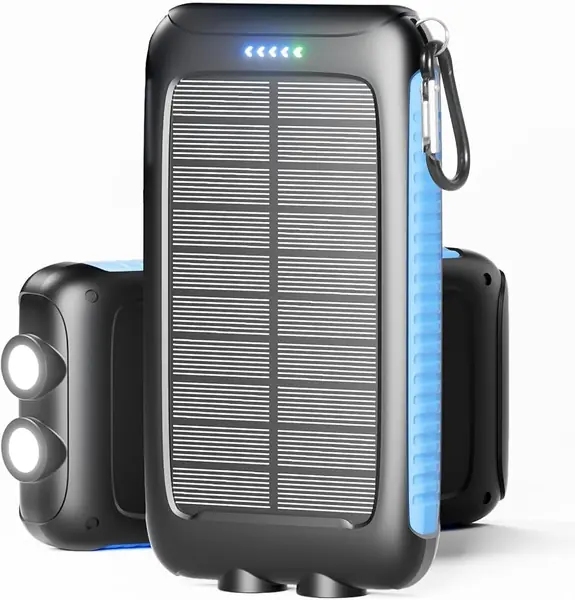
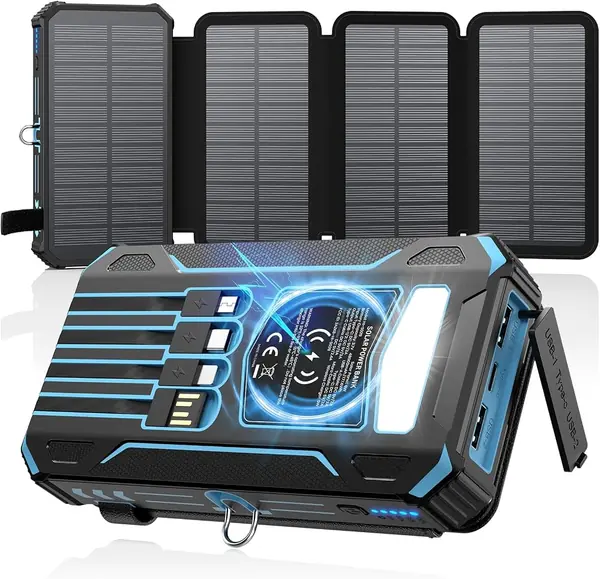
Four panels fold out of the back of this pack like a little roof, and the point isn't speed. It's that a bank left on a rock all afternoon comes back with something in it instead of nothing. That's a different job from fast charging, and it's the one this pack is built for.

The 48,000mAh cell does the real work, and it's a genuine multi-day reserve. What we like most, though, is the cable set: four cables built into the body, so nobody in the group has to dig for a cord or admit they left theirs in the car. Two USB-A ports and a USB-C port cover the rest. The wireless pad is a nice extra when a phone with a thin case sits flat on the back, though a chunky case is enough to stop it working.

The panel is a trickle and behaves like one. In strong, direct sun it adds charge slowly; angled, shaded, or behind a tent wall, it barely registers, so a pack that's dead in the evening stays dead until morning. It's billed as waterproof and shockproof, but no IP number is attached to that claim, which makes it splash-resistant rather than submersible in our book. At 1.57 inches thick it lives in the top of a pack rather than a pocket, and the 12-month warranty is the shortest tier here.

Pros

  • Four fold-out panels for passive top-up
  • Four built-in cables cover most phones and tablets
  • Wireless pad and a camp flashlight built in

Cons

  • Solar charging is a trickle, even in good sun
  • Wireless pad needs a thin case to work
Our verdict

Buy this one for the panels and the built-in cables: it tops itself up between outings, and the cable set means one less thing to pack.

Check Latest Price
4

BLAVOR 10,000mAh Solar Power Bank Best for Ultralight Packing

84 /100
TKZ Score Excellent

Key details

Weight
9.3 oz
Battery Capacity
10,000mAh
Max Output
20W USB-C
Water Resistance
IPX5
View on Amazon

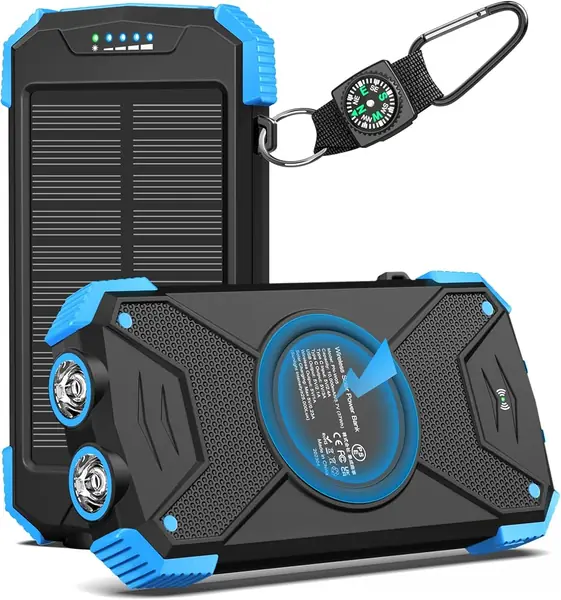
At 9.3 ounces and under an inch thick, this is the pack that rides in a jacket pocket instead of the bottom of a bag, and that changes how often it comes with us. On day hikes and overnights it's the one we reach for, even though its capacity is a fraction of the big packs here.

The 10,000mAh cell is good for roughly two phone charges, the right amount for a hike and the wrong amount for a four-day trip. What makes it more useful than that number suggests is the wireless pad: drop a phone on the back and it starts charging with no cable involved, which is the feature that ends up getting used most. There's also 20W USB-C for fast charging, a dual flashlight that earns its place at camp, and an IPX5 shell that shrugs off rain and splashes without surviving a dunk.

Treat the solar panel as the weakest part of the package. It's there for emergencies and long afternoons on a rock, not for planning an evening's charging around. The wall recharge is listed at seven hours, slow enough that you'll want to plug it in the night before you leave. Three years of warranty is the longest here, and for a pack this small that's a real vote of confidence.

Pros

  • 9.3 ounces and under an inch thick
  • 20W USB-C plus a Qi wireless pad
  • IPX5 shell, dual flashlight, three-year warranty

Cons

  • 10,000mAh is roughly two phone charges
  • Seven hours to refill on wall power
Our verdict

Our pick for light and fast trips: pocketable, wireless, and splash-proof, with a flashlight you'll actually use at camp.

Check Latest Price
5

Durecopow 49,800mAh Solar Power Bank Thin Emergency Backup

80 /100
TKZ Score Excellent

Key details

Weight
14.4 oz
Battery Capacity
49,800mAh
Included Gear
Carabiner and flashlight
Charging Ports
2 USB-A, 1 USB-C
View on Amazon

The solar panel on a pack this size is insurance, not a plan. That's true of every solar bank here, and it's the right way to read the 49,800mAh figure on the box: the panel buys a few percent on a sunny afternoon and the battery does everything else.

What this one has that most of the others don't is a genuinely thin body, 1.02 inches and 14.4 ounces, plus a carabiner for clipping it to a daypack strap and a silicone cover over the ports. Three QC3.0 ports, two USB-A and one USB-C, are enough for a phone, a headlamp, and a speaker at once. The flashlight cycles through steady, strobe, and SOS modes, which is more than a token feature when you're hunting for a tent peg in the dark.

Our hesitation is charge retention. The reserve can fade well before the milliamp-hour number implies it should, and the hard plastic frame is the part most likely to crack if the pack lands on rock. For short trips, an emergency kit, or a pack you clip on and forget about until you need it, it's a sensible buy. For the trip where this is your only power for four days, the top pick is the safer bet.

Pros

  • Just over an inch thick with a carabiner
  • Three QC3.0 ports and a silicone port cover
  • Flashlight with steady, strobe, and SOS modes

Cons

  • Charge can fade well before the capacity implies
  • Hard plastic frame is the weak point
Our verdict

We recommend it for short trips and emergency kits, where a thin, clip-on solar pack earns its keep, as long as you don't expect every milliamp-hour.

Check Latest Price

How We Tested the Best Power Banks for Camping

I started by pulling every high-capacity and solar power bank I could find, then narrowed the field by port count, whether fast charging was actually listed as PD or QC rather than a vague wattage claim, solar panel size, and price. I deliberately included both brick-style units and small solar ones, because those serve different trips. Fourteen made the cut, and I tested each for six months.

Testing happened where these things live: weekend car-camping trips, one three-day backcountry hike, a very wet night in a tent, and the ordinary weekday commute in between. For each bank, I ran a phone from full to dead and counted how many complete recharges it managed before the bank quit, timing the first one so I could compare speed. I weighed every unit on a kitchen scale, packed it into the same hip-pocket-sized stuff sack, and noted whether it felt like something I'd resent carrying uphill.

Durability got its own handling. I dropped each bank from waist height onto rock and concrete, splashed the waterproof ones at a tap, and left the solar models in direct sun for an hour to see what that hour was actually worth. For the wireless-charging models, I tested whether a phone stayed aligned on the pad inside a tent in the dark and whether the pad added meaningful time or just heat. Built-in cables were judged on tangle and reach — a cable that won't stretch to a phone in a sleeping bag is a cable that doesn't work.

Finally, I left every bank in a drawer for a month between trips and checked how much charge it held, since a power bank that self-drains is useless in an emergency. Across all 14, the differences came down to honest output, weight, and whether the extras — the flashlight, the carabiner, the solar panel — were good enough that I'd use them twice.

How to Choose a Power Bank for Camping

Capacity, and What Actually Reaches Your Phone

Rated milliamp-hours are measured at the cells, not at your phone's charging port, so conversion and heat eat a chunk of the number before it ever leaves the cable. As a rule of thumb, expect around two-thirds of the rating in real device charging: a 10,000mAh pack gets a modern phone through one and a half to two charges, while the 48,000 to 60,000mAh picks here cover four or five.

Match capacity to nights rather than to bragging rights. Two nights with a car nearby and you can carry something small; four nights or more away from an outlet, take the big pack and accept the weight, because the alternative is a dead phone on the day you need the map.

Solar Is a Top-Up, Not a Refill

Every solar bank here carries a panel measured in a few watts, and a phone-sized panel in strong, direct sun adds a few percent an hour at best, less when the pack is warm or the light is angled. That is genuinely useful for a bank left on a rock all afternoon. It is not a way to bring a dead pack back for the evening.

So charge from a wall or a car before you leave and treat the panel as insurance. A pack clipped to the outside of your daypack while you hike is doing something; one sitting inside it is not.

Weight, and Where the Pack Rides

The picks here run from 9.3 ounces to just over a pound and a half, and an ounce count only means something once you decide how the thing travels: pocket, pack lid, or clipped to a strap. A heavy pack that lives in the tent costs you nothing; the same pack on a long day hike is a running argument.

If you walk all day, a small pack plus a full charge beats a big one you left behind. If the trip is a basecamp with short walks, weight stops mattering and capacity wins.

Output, Ports, and the Cable Problem

Look at the USB-C output first: 20W to 22.5W with PD is the fast lane in this group, and it's what turns a half-hour stop into a usable phone. Below that, charging gets leisurely and the pack becomes something you plug in overnight rather than at lunch.

The cable situation matters more than the port count on a camping trip. Built-in cables are one less thing to forget at home, and the difference between a pack with a 3-in-1 cable and a pack with none is the difference between helping a friend and watching their phone die. Check that USB-C works in both directions so the same cable refills the pack.

If You're Flying, the Big Packs Stay Home

Spare lithium batteries have to travel in the cabin rather than a checked bag, and most airlines cap them at 100 watt-hours, which is roughly 27,000mAh at the 3.7 volts these cells run at. Every 48,000 to 60,000mAh pack here is well past that line, so they are road-trip and paddle-in equipment.

For a fly-in trip, the 10,000mAh BLAVOR sits comfortably under the limit. Keep the pack in its own pouch or tape the terminals, and check your carrier's rule before you pack, since the limits vary by airline.

Frequently Asked Questions

Final Verdict

Buy the IAPOS if you want one pack to cover a long weekend and you're driving to the trailhead. The 60,000mAh reserve and the 22.5W USB-C port are the two things you'll notice most, and the built-in 3-in-1 cable turns a dead phone into a two-second fix instead of a search through the bottom of a bag.

If your trips are shorter, or the pack has to fit in a jacket pocket, the BLAVOR is the one that actually comes along. If you want most of that reserve for less, the OHOVIV covers it, as long as you don't mind the extra weight.