Best Motorcycle Phone Mounts with Chargers of 2026

A phone mount fails in the worst possible place: at speed, mid-route, with your only map clipped to it. I've watched a clamp let go on a chip-sealed back road and spent the next twenty minutes walking the shoulder looking for a phone. So the bar isn't whether a mount holds a phone in a parking lot — it's whether it holds one at 70 mph with the buzz of a twin-cylinder running through the bars.

We spent six months installing 12 mounts on handlebars, mirror stalks, and 17mm ball stems, riding them through commutes, highway slogs, and washboard gravel, and scoring each on grip, build quality, charging behavior, and how miserable the install was. One thing worth knowing before you buy: the wireless wattage on the box is a ceiling, not a promise. A mount that runs cool at 10W beats one that throttles at 15W.

These are the mounts we'd leave on our own bikes, with fitment ranges spelled out clearly enough that you can measure your bar before you order. The ones that rattled loose or cooked a battery didn't make the cut.

The Best Motorcycle Phone Mounts with Chargers

1

BRCOVAN M14A Mount Best Overall
88 /100
TKZ Score Excellent

Key details

Charging
15W Qi, 20W USB-C
Phone Fit
4-7 in
Mount Fit
Handlebars 12-32 mm
Water Resistance
IP66
View on Amazon

The BRCOVAN earns the top spot because it treats charging and clamping as one system. The 15W Qi pad and 20W USB-C port can run at the same time, so a phone on the pad and a camera or second device on the cable both get power. We also like that the USB-C port can take power from a bank or USB socket, which makes the mount easier to live with on a bike that doesn't have a clean 12V lead.

The clamp is the other half of the story. A one-push lock closes the arms around the phone and a quick release frees it, and the 360-degree ball lets you angle the screen without tools. The aluminum handlebar base and stainless telescopic arm give it a planted feel; the body is IP66-rated, so rain and road spray aren't an immediate worry. In our testing it seated a phone in a normal case without a fight, though the cradle is sized for 4- to 7-inch phones and a very thick case can eat into that margin.

The detail we keep coming back to is the USB-C input. On a bike with a USB socket already installed, you can power the mount without running a new lead to the battery, and the port still works as an output when you wire it to 12V. That flexibility is a real advantage over the wired-only iMESTOU, and it makes the BRCOVAN easier to move between bikes.

Pros

  • 15W Qi and 20W USB-C run together
  • USB-C port doubles as power input
  • One-push lock with 360-degree rotation
  • Aluminum base and IP66 body

Cons

  • Bulky head on tight bars
  • Durability is less settled over months
Our verdict

Our top pick, the BRCOVAN, earns the default spot with the most consistent charging performance in this set and a clamp that holds firm.
Check Latest Price
2

Kewig M14A Mount Best for Easy Installation

87 /100
TKZ Score Excellent

Key details

Charging
15W Qi, 20W USB-C
Phone Fit
4-7 in
Mount Fit
Handlebar or mirror
Water Resistance
IP66
View on Amazon

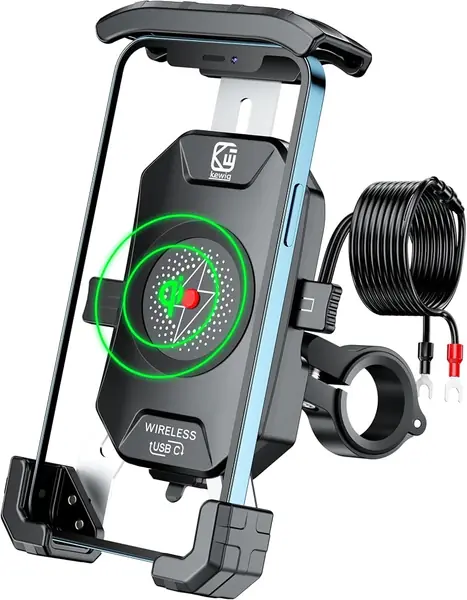
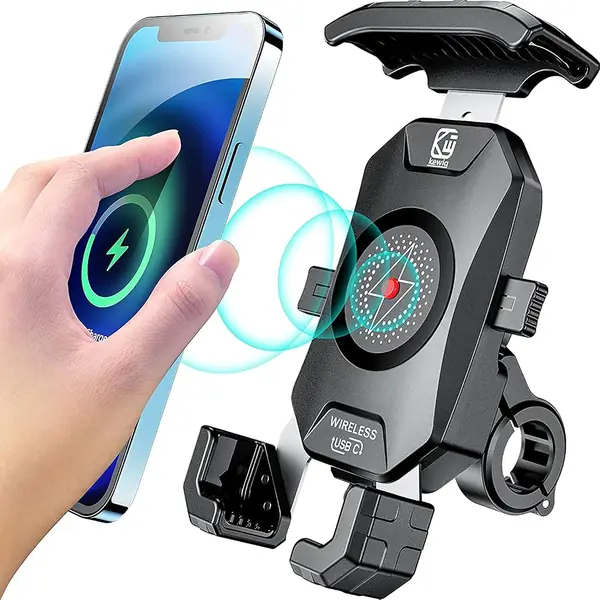
Installation is where the Kewig makes its best case. The clamp goes on with ordinary hand tools, and the mount accepts either a handlebar or a mirror post; in our testing, it went from box to bike without a fight. That matters more than it sounds, because a charging mount with a messy install tends to sit in a drawer.

We recommend the Kewig for riders who want the same dual-charging layout as our top pick with an easier setup story. The 15W Qi pad and 20W USB-C port can run together, the one-push lock is easy to work with gloves, and the 360-degree rotation lets you set the screen where you can see it. The stainless telescopic arm and aluminum base give it a solid feel, and the IP66 rating covers rain and splashes. The rubber inserts are the detail we appreciate most for a second bike, since they let the same base fit a different bar without a new mount.

The wireless pad is the part to think about before buying. It can be fussy with a thick case, and the USB-C port is the more reliable path for a phone in a heavy case. That is a reasonable trade for the easy install and secure grip, especially if you already know you'll use a cable most days.

Pros

  • Wireless and USB-C charging at the same time
  • Very easy handlebar or mirror install
  • Stainless arm and aluminum base feel solid
  • One-hand lock and 360-degree rotation

Cons

  • Bulky head on tight bars
Our verdict

For an easier install with the same dual-charging layout, the Kewig is the one we point riders toward.

Check Latest Price
3

iMESTOU Anti-Theft Mount Best Anti-Theft

86 /100
TKZ Score Excellent

Key details

Charging
15W Qi, USB-C 3A
Phone Fit
4.0-7.0 in
Weight
1.05 lb
Ball Mount
Two 1-inch balls
View on Amazon

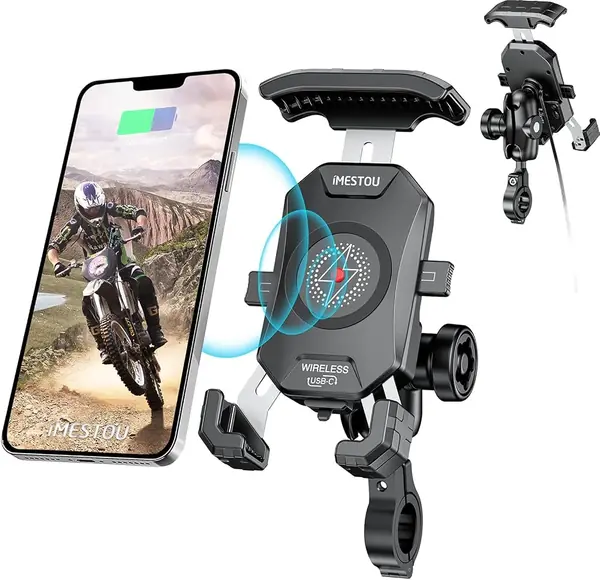
The anti-theft lock is the feature that sets this iMESTOU apart. It adds a locking step before the phone can be released, so the mount is less of a quick grab in a parking lot. That won't stop a determined thief with tools, but it changes the calculus for short stops and city parking.

We recommend it for riders who already use RAM arms or want a mount that doesn't look like an easy target. The double socket arm uses two 1-inch balls and is compatible with RAM MOUNTS, so it can slot into an existing setup. The 15W Qi pad and USB-C port can charge together, and the aluminum base and stainless arms give it a substantial feel. The locking action is positive, and the one-hand release still works once you learn the sequence.

The charging side is flexible: 15W Qi and USB-C can run together, so a phone on the pad and a camera on the cable both get power. The USB-C port can also take power from a USB socket on some installations, which is useful if you don't want to hardwire to the battery. For a rider with a RAM setup, the compatibility is the reason to choose this over the near-twins at the top of the list.

Pros

  • Anti-theft locking clamp
  • Two 1-inch balls work with RAM mounts
  • 15W Qi and USB-C charge together
  • Aluminum base and stainless arms

Cons

  • Heavy at 475 g
  • Thick cases can crowd the cradle
Our verdict

We point riders who park in risky places or already use RAM arms to the iMESTOU anti-theft mount and its locking clamp.

Check Latest Price
4

iMESTOU USB Charging Mount Best Budget

85 /100
TKZ Score Excellent

Key details

Charging
USB-A quick charge
Phone Fit
4.0-6.8 in
Mount Fit
7/8-1-1/4 in bars
USB Cover
IP66
View on Amazon

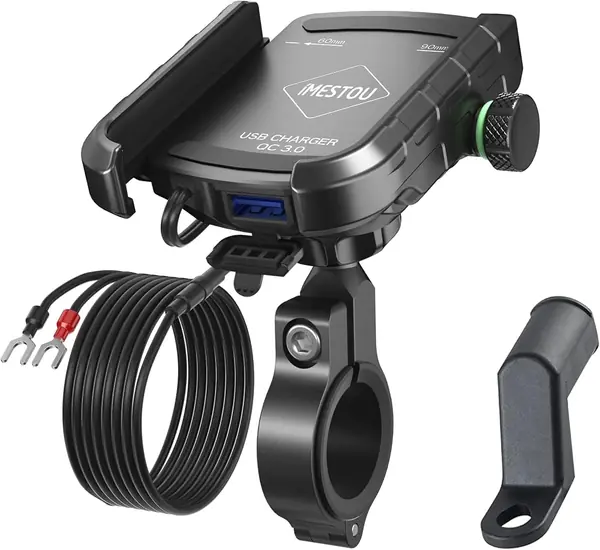
The iMESTOU USB mount is our budget pick, and it earns that spot with a clamp that feels sturdier than the rest of the package. It is a wired mount: a USB-A quick-charge port powers a phone on a cable, while the aluminum body and clamping arms hold the handset steady. For a commuter or a second bike, that is a simple, useful combination.

We recommend it for riders who already carry a cable and don't want to pay for wireless hardware. Installation is the strongest part: the mount fits 7/8-, 1-, and 1-1/4-inch handlebars or a mirror base, and the clamp goes on with ordinary hardware. The IP66 cover on the USB port is a sensible touch, and the 360-degree ball lets you angle the screen. The on/off switch also means the port isn't live when the bike is parked.

The clamp's reach is the detail we appreciate most. It holds 4.0- to 6.8-inch phones with a firm grip, and the arms close around a case without needing a special backplate. That makes it a good fit for a second bike or a commuter where the phone stays plugged in for the whole ride.

Pros

  • Lowest-cost pick in this group
  • Very easy installation
  • Secure clamp with aluminum body
  • IP66 USB cover and on/off switch

Cons

  • No wireless charging
Our verdict

The iMESTOU USB mount is our budget choice for anyone who carries a cable and values a rock-solid clamp over wireless charging.

Check Latest Price

How We Tested Motorcycle Phone Mounts With Chargers

We started with a list of roughly 40 mounts sold for motorcycles and cut anything that didn't publish a handlebar fitment range, charged only through a proprietary phone case, or couldn't be wired to a 12V or 24V circuit. That left 12 mounts, which we bought at retail and installed on our own bikes over six months.

Install came first, done in a garage with the hex keys a rider would realistically carry. We timed each one solo, then repeated the clamp-up wearing winter gloves to see whether the release tab was findable by feel and whether a fuel-stop removal could be done one-handed. On the road we ran the same loop each time — a 25-minute commute, a two-hour highway stretch, and a washboard gravel road — and after every leg we grabbed the phone and twisted it in the cradle to check for slack in the latch, then looked at the mounting bolts for signs of backing out.

Charging got its own runs. With the screen at full brightness and a navigation app running, we logged battery percentage every 15 minutes from 20 percent up, compared the wireless coil against the USB-C port, and ran both at once to see whether one starved the other. We also noted how hot the phone got — a pad that pushes its full rating and forces the phone to throttle is slower in practice than a cooler one — and whether charging held over rough pavement.

Value came last. We weighed what each mount asked for against how much of the hardware — base, arm, cradle, wiring — looked like it would survive a second season of sun, rain, and vibration.

How to Choose a Motorcycle Phone Mount with a Charger

Start With the Clamp, Then Judge the Charger

A charger is useless if the phone moves. Look for a clamp that locks, not one that relies on spring pressure alone, and check the cradle against your phone with its case on. Height, width, and depth all matter; a case can turn a listed fit into a loose grip or block the charging coil. We put secure hold first because vibration is constant on a bike, and a phone that shifts can stop charging or slip free.

Choose Wireless, Wired, or Both

Wireless charging is the convenience feature: no cable, no port wear, and a quick drop-in. It also makes heat and alignment matter more, especially with a thick case. USB-C is faster and more predictable, but you need a cable and a free port. A mount with both gives you a fallback. The BRCOVAN and Kewig pair 15W Qi with a 20W USB-C output, while the iMESTOU USB mount is wired only. If you charge a camera or second phone, both outputs running at once is the feature to check.

Measure the Bar and Plan the Power Run

Handlebar diameter is the measurement that decides whether the mount fits at all. These mounts cover common 7/8-, 1-, and 1-1/4-inch bars or a mirror post, but the clamp has to sit on a straight, clear section. Wiring is the second job: a fused lead to the bike's 12V system, a USB socket, or a power bank on mounts that accept USB-C input. Use the inline switch so the mount isn't drawing on the battery when the bike sits. Route the cable away from hot engine parts and moving controls.

Treat Weather and Vibration as Wear Items

IP66 covers rain and splashes, but the USB flap and the clamp pivot are the parts that see the most abuse. Close the flap when the port is empty, and check the clamp screw after the first few rides; a mount that loosens on the bar needs attention before it becomes a phone on the pavement. Aluminum bases and stainless arms resist flex better than all-plastic bodies, which is why the sturdier mounts here weigh more. That weight is the trade-off for less shake at speed.

Frequently Asked Questions

Final Verdict

The BRCOVAN is the one we recommend first: its 15W Qi pad, 20W USB-C port, and secure one-hand clamp cover the daily job, and its charging performance has the most consistent support in this set. If you park in high-theft areas or already use RAM arms, the iMESTOU anti-theft mount is the better buy; if you just want wired charging on a budget, the iMESTOU USB model is the simpler choice.