Best Marshall Bluetooth Speakers of 2026

A Bluetooth speaker that fills a living room and one you can drop in a tote bag are not the same machine. Push the volume on a palm-sized model and the bass thins out; buy the big cabinet and you're tied to an outlet. Pick right and the speaker disappears into the room — pick wrong and you're either lugging a brick or straining to hear a podcast.

My team and I have spent the past six months with 10 of these speakers, from strap-mounted models the size of a paperback to plug-in cabinets that anchor a living room. The detail first-time buyers underrate is the physical bass and treble knobs — an app EQ is fine, but a knob you can nudge mid-song gets used more. Sound, volume, looks, and whether the price feels earned all come back to cabinet size.

Before you scroll: the carry-friendly models trade some low-end for battery life and weatherproofing, and only the larger cabinets have the wired inputs a turntable needs. Both kinds are below, sorted by how you'd actually use them.

The Best Marshall Bluetooth Speakers

1

Marshall Acton III Best Overall
94 /100
TKZ Score Outstanding

Key details

Output
60 watts
Inputs
Bluetooth, 3.5mm aux
Woofer
4 inches
Dimensions
5.91"D x 10.24"W x 6.69"H
View on Amazon

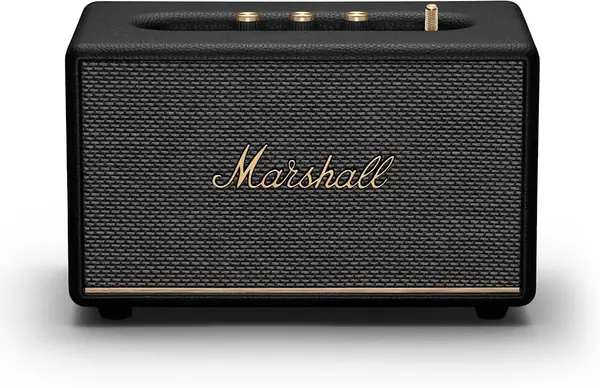
If the speaker is going to stay in one room, the Acton III is the one we recommend first. Its 4-inch woofer, 0.75-inch tweeter, and 60 watts give it a scale the portables here cannot match, while the 10.24-inch-wide cabinet still fits a bookshelf. We like the physical bass and treble controls, the 3.5mm aux input, and the fact that Marshall skipped a complicated setup: you pair it, turn the knobs, and listen.

The sound is voiced for a living room rather than a desk. The 45Hz low-end rating is not subwoofer depth, but it gives acoustic bass and kick drums enough weight at normal volumes. The stereo image is wide enough that you do not need to sit in one spot, and the cabinet avoids the hollow boom that small speakers can produce. The 70% recycled plastic build is a nice bonus, not the reason to buy it.

The trade-off is built into the design: this is a home speaker first, and it rewards a permanent spot rather than a move from room to room. If you need RCA for a turntable, the Stanmore III is the step up; if you want the Marshall look in a compact box, the Acton III is the cleanest way in.

Pros

  • Room-filling sound from a compact cabinet
  • Physical bass and treble controls
  • Aux input for turntables and phones

Cons

  • No battery; needs an outlet
Our verdict

Buy the Acton III if your speaker stays in one room and you want the fullest Marshall sound for the money; it is our home default.
Check Latest Price
2

Marshall Emberton III Best Portable

93 /100
TKZ Score Outstanding

Key details

Output
76 watts
Weight
1.48 lb
Playtime
32+ hours
Water Resistance
IP67
View on Amazon

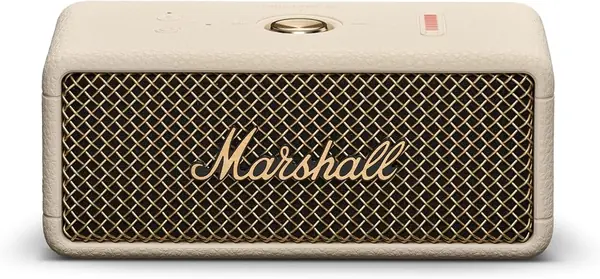
A 32-hour battery and an IP67 rating are the two numbers that make the Emberton III the portable most people should start with. It is small enough for a backpack or a kitchen counter, and the cream finish looks more like a little Marshall cabinet than a rugged travel gadget. The built-in microphone is a useful extra for calls, and the 673-gram weight keeps it from dragging a bag down.

We like the balance of size and output. The 76-watt rating is not a promise that it will fill a yard, but the stereo drivers and Dynamic Loudness give it more headroom than a 2.7-inch-tall speaker has any right to. At low volume it stays clear instead of collapsing into a muddy blob, which is what makes it a good desk and kitchen speaker as well as a travel one.

It is still a small speaker, and it will not replace a home cabinet at a party. For a dorm room, a small apartment, or a picnic, that is a fair trade. We reach for it when we do not know where the day will go, and that is the highest compliment a portable can get.

Pros

  • IP67 waterproof and dustproof
  • 32+ hours of playtime
  • 76 watts from a 673-gram frame

Cons

  • Bass depth trails larger portables
Our verdict

We recommend the Emberton III for most people who want one Marshall speaker to carry around, thanks to its IP67 shell and 32-hour battery.

Check Latest Price
3

Marshall Kilburn III Best Battery Life

92 /100
TKZ Score Outstanding

Key details

Output
36 watts
Weight
6.2 lb
Playtime
50+ hours
Water Resistance
IP54
View on Amazon

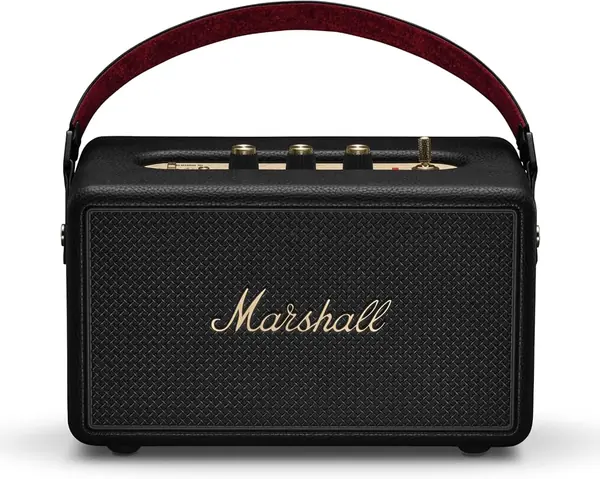
Fifty-plus hours is the reason the Kilburn III exists, but the battery is not the only thing we like. The 36-watt stereo system and 360-degree presentation give it a bigger, more relaxed sound than the Emberton III, and the metal body with the top handle feels built for a car trunk or a covered patio. The 6.2-pound weight is the cost of that scale, and the handle makes it manageable.

The playtime claim is worth treating as a range, not a guarantee. Fifty hours is realistic for moderate listening; push the volume and you will charge sooner. The built-in powerbank is a nice touch for a phone that is running low, and the top handle makes the 6.2-pound body manageable for the walk from car to picnic table.

Compared with the Middleton, the Kilburn III gives up a more rugged shell but adds playtime. Compared with the Emberton III, it buys volume and a handle at the cost of size. We keep it in the outdoor kit when the plan includes a long day and no outlet.

Pros

  • 50+ hours of portable playtime
  • 360-degree stereo sound
  • Built-in powerbank and carry handle

Cons

  • IP54 is splash-resistant, not submersible
Our verdict

Choose the Kilburn III when you need a portable that runs for days and can still fill a patio, and you don't mind carrying six pounds.

Check Latest Price
4

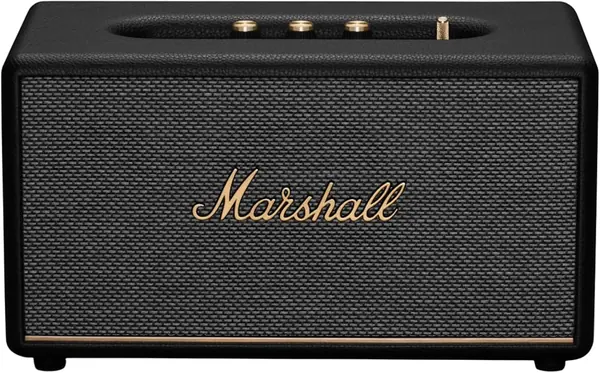
Marshall Stanmore III Best for Turntables

91 /100
TKZ Score Outstanding

Key details

Output
80 watts
Inputs
Bluetooth, RCA, 3.5mm aux
Woofer
5 inches
Dimensions
7.4"D x 13.78"W x 7.99"H
View on Amazon

The Stanmore III is the one to look at if your hi-fi has wires. It adds RCA and 3.5mm inputs to Bluetooth, so a turntable or a TV can share the same box without a switcher. The 80-watt system and 5-inch woofer give it more scale than the Acton III, and the larger cabinet helps it fill a living room without sounding strained.

We prefer it to the Acton III when the speaker has a permanent shelf and more than one source. The extra inputs are the real upgrade; the sound is richer and more spacious, but the two speakers share the same Marshall character. At 9.5 pounds, the Stanmore III is still a shelf speaker, not something you move from room to room on a whim.

The Bluetooth connection is the one place to be careful. The wired inputs are the reliable path for a turntable or TV, and Bluetooth is better for casual phone listening. If you do not need RCA, the Acton III is the better value; if you want the extra inputs and a bigger room, the Stanmore III is the one we choose.

Pros

  • RCA and 3.5mm inputs
  • 80 watts with a 5-inch woofer
  • Room-filling stereo sound

Cons

  • No battery; needs an outlet
Our verdict

The Stanmore III is the pick for a turntable or TV setup, with RCA and aux inputs that make it more flexible than the Acton III.

Check Latest Price
5

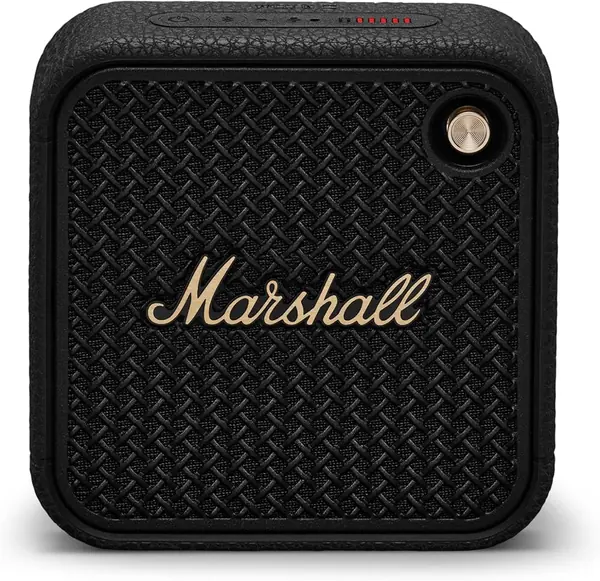
Marshall Willen II Best Tiny Speaker

90 /100
TKZ Score Outstanding

Key details

Output
10 watts
Weight
13.3 oz
Playtime
17+ hours
Water Resistance
IP67
View on Amazon

The Willen II is the size of a small sandwich and has a rubber strap that turns it into a hangable speaker. We like it for a bathroom shelf, a bike handlebar, or a tent loop because it does not need a flat surface. IP67 means it can handle a dunk, and 17+ hours is enough for a weekend of background listening.

The 10-watt output sets expectations. This is not the speaker for a backyard party; it is the one for a podcast in the shower or music while you cook. The scale is impressive for something that weighs 13.28 ounces, and the built-in microphone makes it useful for quick calls.

We end up using the strap more than any other feature. It is the difference between a tiny speaker that lives in a drawer and one that comes with you. The Emberton III is the better all-rounder if you want a desk and small-room speaker; the Willen II is the one for the smallest spaces and the roughest treatment.

Pros

  • Rubber strap hangs almost anywhere
  • IP67 waterproof and dustproof
  • 17+ hours of playtime

Cons

  • Bass is shallow at higher volumes
  • Single-channel sound limits stereo imaging
Our verdict

Get the Willen II for the smallest spaces and the roughest treatment; its strap and IP67 shell make it the easiest Marshall to take anywhere.

Check Latest Price
6

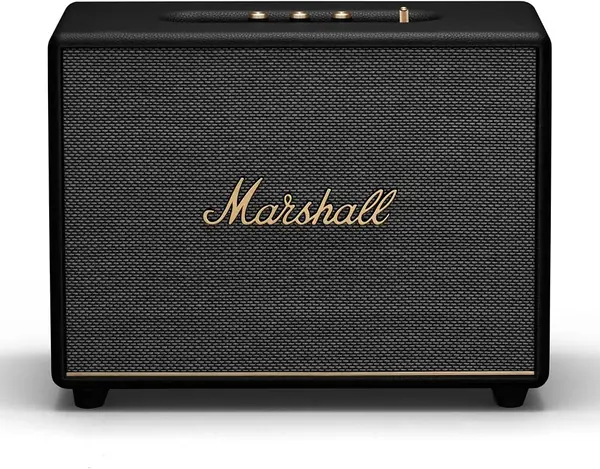
Marshall Woburn III Best for Large Rooms

89 /100
TKZ Score Excellent

Key details

Output
150 watts
Inputs
HDMI, RCA, 3.5mm aux
Woofer
6 inches
Bass
35 Hz
View on Amazon

The Woburn III is the one that makes the size argument for you. A large cabinet, a 6-inch woofer, and 150 watts are not subtle, and at 16.4 pounds it is furniture. We like it for a big living room or a dedicated listening space where the speaker can stay put and the HDMI input can pull TV audio.

What you gain over the Stanmore III is scale and low-end reach. The Woburn III goes down to 35Hz and has the power to fill a room without sounding strained; the trade-off is that it is the least flexible speaker here. The large cabinet and physical controls keep it simple once it is in place.

The HDMI input is the detail that makes it more than a music speaker. A TV, a turntable, and a phone can all live on the same box, and the sound has the authority the smaller home models cannot match. We choose it when the room is large and the speaker can stay; the Stanmore III is the smarter buy for a small apartment.

Pros

  • 150 watts and a 6-inch woofer
  • HDMI, RCA, and aux inputs
  • Deep bass down to 35Hz

Cons

  • 16.4 pounds; needs a dedicated spot
  • No battery; corded only
Our verdict

The Woburn III is for a big room and a permanent spot, where its 150 watts and HDMI input can replace a small hi-fi.

Check Latest Price
7

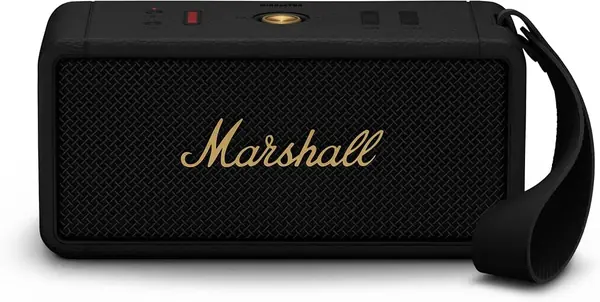
Marshall Middleton Best for Rugged Travel

88 /100
TKZ Score Excellent

Key details

Output
60 watts
Weight
4 lb
Playtime
20+ hours
Water Resistance
IP67
View on Amazon

The Middleton is the portable for people who treat a speaker like a piece of gear. The IP67 shell, 4-pound body, and carry strap are built for a beach, a tailgate, or a dusty campsite. We like that it can lie flat or stand upright, and the 60-watt stereo system gives it more authority than the Emberton III.

The 20+ hour battery and built-in powerbank are the practical reasons to pick it over the smaller portables. It also has a 3.5mm aux input, so it can take a wired source when Bluetooth is not cooperating. The sound is big and forward, with enough bass to make an outdoor movie night work.

The Middleton is not the most consistent speaker in this group. Battery and Bluetooth are less consistent than on the Kilburn III, and the 4-pound weight makes it a bag speaker rather than a pocket one. Those are the reasons it sits in Also Consider instead of the top tier.

We still keep it on the short list for messy weekends. The IP67 rating and powerbank buy real freedom, and the sound is loud enough for a small gathering. If you want the same rugged idea with fewer caveats, the Kilburn III is the safer pick; if you need a powerbank and a tougher shell, the Middleton earns its spot.

Pros

  • IP67 rugged waterproof shell
  • 20+ hours with built-in powerbank
  • 60 watts of stereo sound

Cons

  • Battery and Bluetooth can be inconsistent
Our verdict

We like the Middleton for rugged weekends when you need IP67 protection, a powerbank, and more output than the Emberton III.

Check Latest Price
8

Marshall Tufton Best for Loud Gatherings

87 /100
TKZ Score Excellent

Key details

Output
80 watts
Weight
10.8 lb
Playtime
20+ hours
Water Resistance
IPX2
View on Amazon

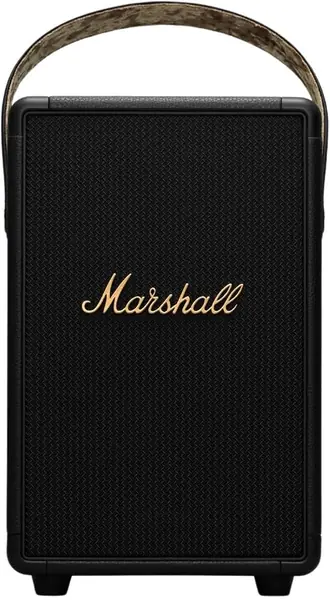
The Tufton is a portable in the same way a carry-on amp is portable: it has a strap, and you can move it, but you will know you are carrying it. The guitar-inspired handle and 10.8-pound body are the first things you notice. We like the three-knob control panel and the classic Marshall cabinet, and the 80-watt, 3-way system gives it the highest power rating of the battery-powered models here.

The sound is the reason to put up with the weight. The rear-facing driver and 360-degree presentation fill a deck or a garage with a bigger, more articulate sound than the Middleton. The 20+ hour battery is solid for a long day, and the multi-host Bluetooth lets two devices take turns without re-pairing.

The 10.8-pound carry is the cost that shows up every time you move it. This is a speaker for a deck, a garage, or a boat, not a hike or a bike ride. The guitar strap helps, but it does not make the Tufton a light carry.

We treat the Tufton as a portable hi-fi for a deck, a boat, or a garage where volume matters more than packing light. It has the highest power rating in the battery-powered group, and that is worth something. The Kilburn III is the easier carry; the Tufton is the one when the party needs more room.

Pros

  • 80 watts of 3-way sound
  • 20+ hours of playtime
  • Guitar-style carry strap

Cons

  • IPX2 handles only light splashes
Our verdict

The Tufton is the biggest battery-powered Marshall here, and the right pick if you value output over packing light.

Check Latest Price

How We Tested These Bluetooth Speakers

We started with the full current lineup, then narrowed to 10 units based on cabinet size, wired inputs, rated playtime, and whether the hardware justified the price. The shortlist deliberately mixed plug-in and battery-powered models, since that one split drives volume ceiling, bass depth, and how much the speaker weighs once it's in a bag.

Testing ran six months, in the places these speakers actually end up: a kitchen counter during dinner prep, a living room shelf, a patio table, and a bike frame for the strap-mounted ones. We ran each model at half volume and then at full for an hour straight, listening for the point where bass compressed or the tone turned harsh. A paired phone sat two rooms away to see how far the Bluetooth held before it stuttered, and we re-paired each speaker repeatedly to catch the ones that needed a second try.

Battery life was timed rather than trusted: we played at roughly 70 percent volume and logged the hours until shutoff. Waterproof models got splashed at the sink and left out overnight in the rain, and we checked how much dust and fingerprints the grille picked up over a week of normal handling. Wired inputs earned their own pass — a turntable and an aux cable, with an ear out for hum.

The knobs got more attention than you'd expect. We turned them mid-song with one hand while cooking, which is how you learn whether the resistance feels right, and noted which speakers sent you to an app for anything beyond volume. Value came down to size against price: the compact ones are judged on how close they get to a shelf speaker, the big ones on whether they could replace a soundbar.

How to Choose a Marshall Bluetooth Speaker

Home or Portable First

The biggest fork is whether the speaker ever leaves the room. A plug-in home model such as the Acton III or Stanmore III uses a larger cabinet and a dedicated woofer to create scale and bass that a battery-powered speaker cannot match at the same size. A portable such as the Emberton III or Kilburn III trades some of that scale for a battery, a handle, and weather protection. If the speaker has a permanent shelf, start with the home models; if it moves to the kitchen, patio, or car, start with the portables.

Match the Cabinet to the Room and the Carry

Measure the shelf before you fall for the look. The Acton III is about 10 inches wide, the Stanmore III about 14, and the Woburn III about 16, so a bookshelf that fits one will not fit the next. Portables have a different limit: the Willen II is a palm-sized 13.28 ounces, the Emberton III is 673 grams, and the Kilburn III is 6.2 pounds. We prioritize a speaker that fits the spot without blocking a window or a record player; if you plan to carry it often, weight matters more than a few extra watts.

Check the Inputs Before the Knobs

Bluetooth is the default, but the wired inputs decide whether a Marshall speaker can become the center of a hi-fi. The Acton III and Kilburn III have a 3.5mm aux input; the Stanmore III adds RCA, and the Woburn III adds HDMI for a TV. A turntable without a built-in phono preamp needs one before it can plug into any aux or RCA input. If you want one box for a record player and a TV, the Woburn III is the only model here with HDMI; for a turntable alone, the Stanmore III is the more sensible step.

Treat Battery and IP Ratings as Limits

Playtime ratings are measured at moderate volume. A 32-hour Emberton III or a 50-hour Kilburn III will not run that long if you keep the volume high, and cold weather can shorten a battery further. Water ratings are just as specific: IP67 means dust-tight and submersible in 1 meter of water for 30 minutes; IP54 covers dust and splashes; IPX2 handles light moisture only. Buy for the exposure you actually expect, and do not treat a splash rating as pool-proof.

Frequently Asked Questions

Final Verdict

For most listeners, the Acton III is the best Marshall Bluetooth speaker to start with: it delivers the fullest sound in this group for a home shelf, and its physical controls keep the experience simple. If the speaker needs to leave the house, the Emberton III is the better buy, with IP67 protection and 32 hours of playtime. Step up to the Kilburn III if you want a handle and more outdoor volume.