Best MagSafe Car Mounts of 2026

A phone mount only gets noticed when it fails, and it always fails at the worst moment — a merge lane, a detour, the one intersection where you actually need the map. I've had a suction cup let go on a hot afternoon and a vent clip tip my phone into the footwell mid-turn, so I'm fussier about this small piece of hardware than almost anything else in my car. What you want is simple: the phone where you can see it, stuck fast through potholes and heat, and easy to grab one-handed at a red light.

That's a taller order than the ads suggest. Magnet strength gets all the attention, but the mounting point matters just as much — a vent clip is only as steady as the vent it grips, and a dash pad is only as good as its adhesive on a 90-degree afternoon. My team has spent the past four months with 16 mounts on dashboards, windshields, and vents, and the gap between the best and the rest is real. Here's what held.

The Best MagSafe Car Mounts

1

Lamicall MagSafe Vent Mount Best Overall
91 /100
TKZ Score Outstanding

Key details

Mounting
Vent clip with metal hook
Magnets
20 N52
Weight
3.84 oz
Rotation
360° ball joint
View on Amazon

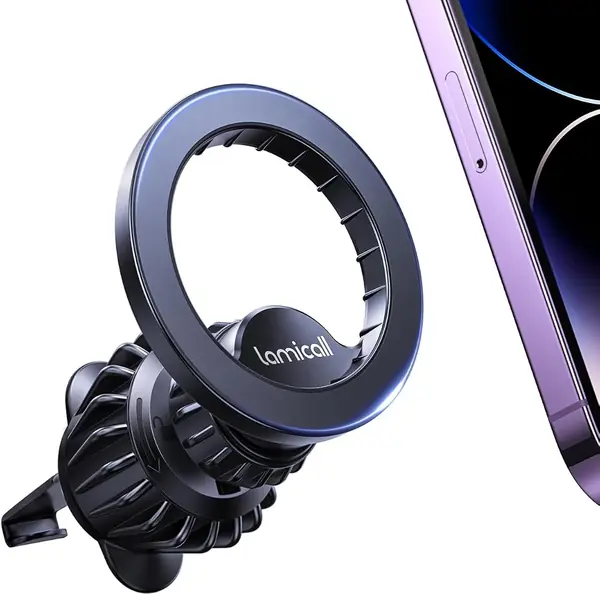
A vent mount is the least clever way to hold a phone, and that is exactly why we recommend this one to most people. The Lamicall grabs a vent blade with a metal hook instead of the plastic claws that snap on cheaper holders, and that clamp is the part that decides whether the whole mount stays where you put it.

What settles it for us is the hold at the phone end. Twenty N52 magnets look modest next to the holding-force numbers the suction mounts here advertise, but our test phone sat flush against the pad with no sag at the top edge, and the ball joint kept its angle through a week of errands and one long highway drive.

It is also the lightest thing in this guide at just under four ounces, so the vent is not carrying much and the head does not swallow the airflow the way a cradle does. A quarter turn flips the phone to landscape for maps, and one-handed placement becomes automatic after a couple of drives.

The one thing to check is your vent: the hook needs a blade it can grab and some clearance behind it, so thin, round, or recessed vents are out. Everything else about this mount is the version we want in a daily driver — nothing to stick down, nothing to cure, nothing to unpeel when you sell the car.

Pros

  • Metal hook grips a vent blade, not plastic
  • Holds a Pro Max flat without sag
  • Compact and light on the vent
  • Least expensive mount in this guide

Cons

  • No dash or windshield mounting option
Our verdict

We tell most people to start here: it holds a Pro Max without sag, clips to a vent blade in seconds, and never relies on an adhesive pad to stay put.
Check Latest Price
2

ANDERY Foldable MagSafe Car Mount Best Suction Mount

90 /100
TKZ Score Outstanding

Key details

Mounting
Rotating-lock suction
Arm
Dual-axis folding, 210°
Weight
3.88 oz
Holding Force
3900gf
View on Amazon

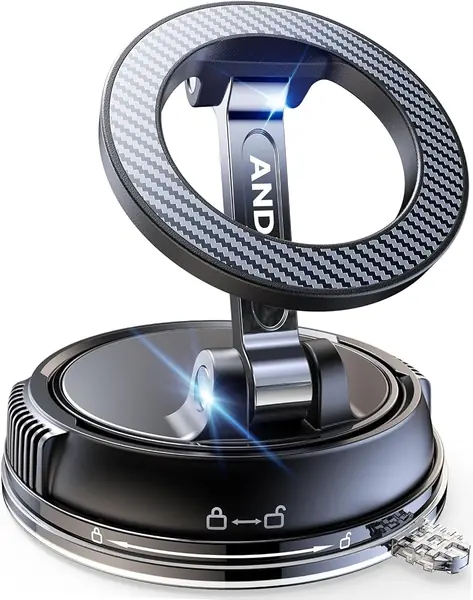
If your dash has no vent worth using, this is where we point you. The ANDERY is a suction mount: a rotating collar pulls a vacuum under the base, and dual-axis folding arms carry the magnetic head, so you choose the height and angle instead of accepting whatever your vent gives you.

The arms are what make it. Folded flat, the mount sits inside about three inches and all but disappears against the dash; opened out, the phone rides where the windshield does not throw glare across the screen. We set it on a dash pad and it held all week without the base creeping.

There is a circular cutout behind the magnet plate, which sounds like a marketing line until you are running navigation on a sunny day: the phone is not pressed flat against a solid slab, so it sheds heat instead of soaking it up. Twenty-two N55 magnets hold a heavy phone without drama, and installation is a twist rather than an overnight cure.

The arm is short, so a large phone in portrait sits close to the dash; flip to landscape and the reach stops mattering. Beyond that, it is the placement freedom that earns its price — a windshield corner, a curved dash top, a work van with nothing flat anywhere.

Pros

  • Folding arms aim the phone where you want it
  • Rotating suction lock holds without adhesive
  • Cutout behind the magnet helps heat escape

Cons

  • Folding joint loosens with daily repositioning
Our verdict

If your dash has no usable vent, start here: the suction lock stays put and the folding arms let you aim the screen where the glare is not.

Check Latest Price
3

LISEN 15W MagSafe Car Charger Best Charging Mount

89 /100
TKZ Score Excellent

Key details

Mounting
Vent hook or dash adhesive
Magnets
24 N55
Charging
15W MagSafe
Connector
USB-C
View on Amazon

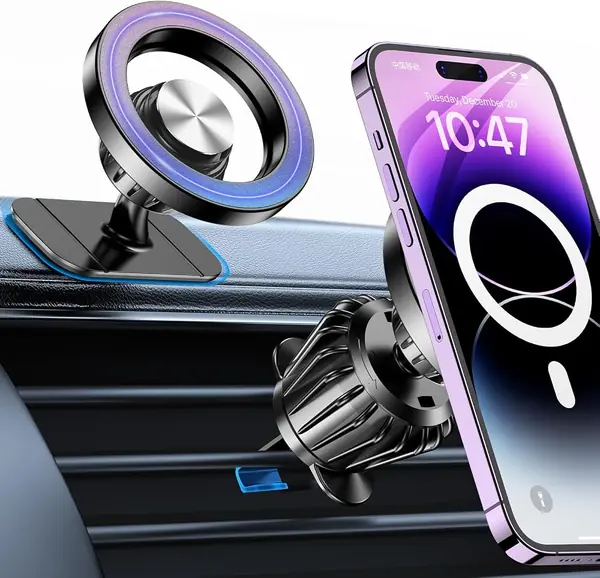
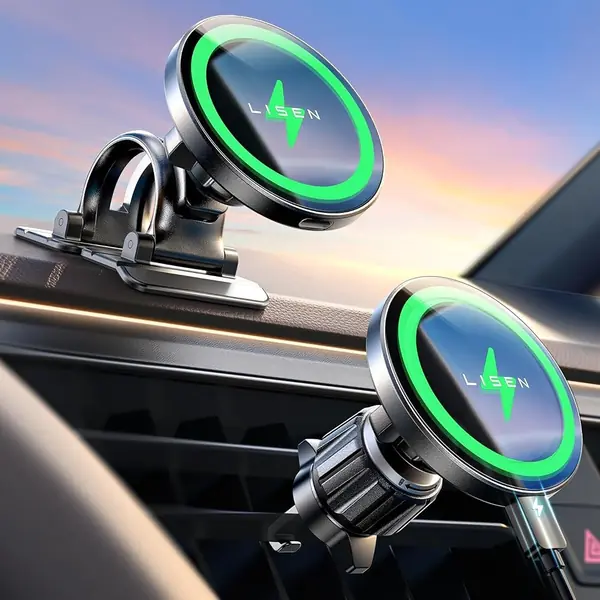
Charging is the one feature that changes how a mount gets used, and this is the least expensive way into it in this guide. Drop the phone on the pad and the magnets line it up and start pushing power at 15W, with no cable to plug in at a red light.

We like that LISEN puts both mounting options in the box: a vent hook and a 3M adhesive pad, so the same mount can live on a vent in one car and a dash in another. For a first MagSafe charging mount that is worth more than it sounds, because you find out which placement you actually want without buying twice.

Be clear about what 15W means. It is the MagSafe standard rather than a fast charge, and a phone running maps and music will gain less than the number suggests — think of it as holding the battery steady on a commute, not adding real range. If you need charge in a hurry, a cable is still faster.

The hold itself is not the compromise. Twenty-four N55 magnets kept a phone in place over potholes and hard braking, and the ring of ice-blue light is a detail we ended up liking on night drives.

Pros

  • 15W MagSafe charging built into the mount
  • Vent hook and dash pad both included
  • 24 N55 magnets hold through a MagSafe case

Cons

  • Wireless charging heats the phone on long drives
Our verdict

We recommend it if you want charging without a cable: it fits a vent or a dash, holds a phone through a MagSafe case, and tops the battery up at 15W.

Check Latest Price
4

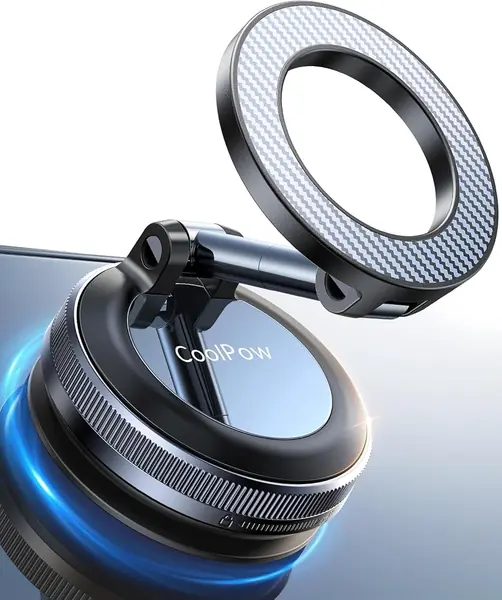
Coolpow Vacuum MagSafe Car Mount Best for Tight Spaces

88 /100
TKZ Score Excellent

Key details

Mounting
Twist-lock vacuum suction
Magnets
26 N58
Warranty
2 years
Support Rod
Zinc alloy
View on Amazon

Most mounts here announce themselves on the dash. This one disappears: the whole thing fits in a palm, and on a crowded dash that turns out to be the feature that matters.

The base is a twist-lock vacuum cup. Wipe the panel, press the base down flat, turn the collar, and the air goes out from under it — no adhesive to cure overnight and no pad to peel off later. Give it a smooth panel wide enough to cover the base and the hold is as solid as anything here.

Where it earns a place in this guide is the second vehicle. Because nothing is bonded down, we moved it between cars in the time it takes to twist and untwist, and it held a Pro Max over expansion joints without the phone creeping down the pad. Twenty-six N58 magnets do that work, and the rod behind the head is zinc alloy rather than the plastic that cracks on cheap pucks.

It is a small mount, and that is the trade: the phone sits close to whatever the base is stuck to, and you get angle from the swivel rather than reach. Fine on a dash panel you can angle toward you, less good if you want the screen out over the console.

Pros

  • Palm-sized, so it fits tight dash corners
  • 26 N58 magnets hold a heavy phone
  • Twist-lock base releases and re-seats

Cons

  • Needs a smooth, flat patch to hold
Our verdict

The pick for tight dashes and second cars: small enough to disappear, strong enough for a Pro Max, and easy to move when you change vehicles.

Check Latest Price
5

LISEN Bendable Arm MagSafe Mount Best for Curved Dashes

87 /100
TKZ Score Excellent

Key details

Mounting
Suction with 3M adhesive
Magnets
22
Arm
8.35-inch bendable aluminum
Suction Cup
Washable and reusable
View on Amazon

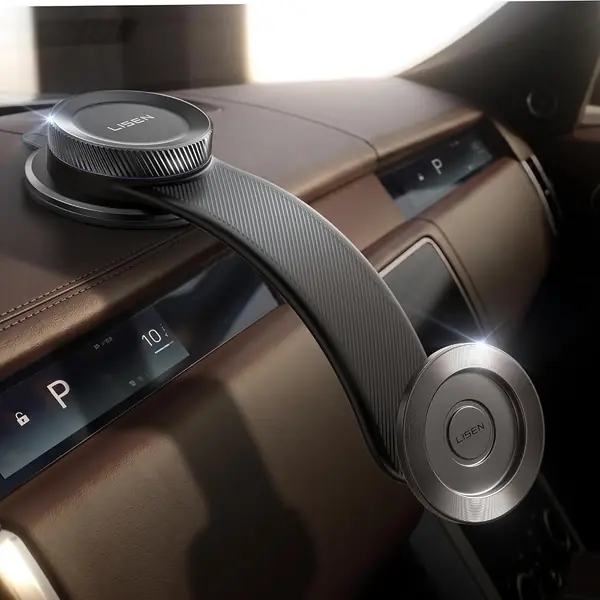
The arm is the whole idea here: 8.35 inches of aluminum that you bend by hand and that stays where you bent it. A rigid arm commits you to one angle; this one lets the dash decide nothing.

We reached for it on the cars where folding mounts fight back — a dash that slopes away from the driver, a deep console, a windshield pillar that puts the phone in your peripheral vision. Bend it once, check the angle from the driver's seat, and it holds through a drive without drifting.

Under the head, LISEN uses the same suction-and-nano-adhesive base as its other mounts, and the cup is listed as washable and reusable, which matters if you move it between cars or re-seat it after a summer. The head is set into a sunken contour so the phone sits lower than the magnet plate, keeping the top of the screen below your sight line rather than in it.

It is also the biggest piece of hardware in this guide: a long arm on a suction base needs a clear patch of dash and some air behind the phone. On a small or crowded dash, the Coolpow does the same job in a fraction of the space.

Pros

  • Bendable aluminum arm holds its shape
  • Washable, reusable suction cup
  • Sunken head keeps the phone below the sight line

Cons

  • The most expensive mount in this guide
Our verdict

For sloped or deep dashes, this is the one we reach for: bend the arm once and the phone sits where you aimed it, not where the dash points.

Check Latest Price
6

Kaistyle N21 MagSafe Dash Mount Best for Flat, Smooth Dashes

86 /100
TKZ Score Excellent

Key details

Mounting
3M VHB dash adhesive
Rotation
360° swivel ball
Warranty
2 years
Holding Capacity
6.61 lb
View on Amazon

A 3M VHB pad, a small puck, and a swivel ball — that is the entire mount, and at just under four ounces it is the least obtrusive way to put a phone on a dashboard.

The magnet is the part Kaistyle got right. Rated to 3,000 grams, it held a phone in an official MagSafe case through a week of driving without sliding down the pad, and the swivel ball gives portrait or landscape without tools.

Placement is a one-time decision, so treat it like one. The pad bonds hardest to a clean, smooth, flat panel, and it wants a day before it carries a phone; sit in the driver's seat with the phone in position, check the angle, and then leave it alone.

Where it falls short is the flat horizontal dash pad. Because the puck sits flush, the swivel tilts the phone but cannot lift it toward you, and you end up looking down at the screen instead of across at it. On a sloped section of dash, or a smooth panel that already faces the driver, it does everything the complicated mounts do.

Pros

  • Strong 3,000-gram magnet in a tiny body
  • Swivel ball for portrait or landscape
  • Barely visible on the dash

Cons

  • Won't hold on textured or curved dash surfaces
Our verdict

A good buy for a smooth, flat dash pad: the magnet is strong, the footprint is tiny, and the price is about as low as it gets here.

Check Latest Price

How We Tested MagSafe Car Mounts

We started with the mounts that come up again and again in reviews and checked them against the specs that actually change the experience: how the mount attaches, whether it charges, how far the arm reaches, and what phone and case size it's rated for. From that pool we bought 16 — vent clips, adhesive dash pads, long suction arms, and the newer vacuum-base styles — across price points, not just the expensive end.

Each was installed in one of two cars: a commuter sedan with narrow horizontal vents and a hatchback with a curved, textured dash, while the suction-arm styles went up on the glass. We wiped every surface with alcohol and waited out the maker's recommended cure time before hanging a phone on it. Then they stayed put for four months, from a stretch of 90-degree days into cooler weather, which is how we found the adhesives that sagged and the clips that loosened.

Day to day we ran navigation and music on a 40-minute commute each way, took the parking-garage speed bumps at normal speed, and spent a weekend on washboard gravel. At every stoplight we checked whether the phone had spun or crept down the mount. We also loaded the same phone in three cases — bare, a thin MagSafe case, and a bulky one — and noted which mounts let it slide and how much of a tug it took to pull the phone free one-handed.

For the charging mounts we used the same 30-watt adapter and logged battery percentage over a 30-minute drive with the screen on, along with how warm the phone got. At the end we peeled every adhesive pad off to see what it left behind and checked whether the vent clips had bent the slats they gripped. Anything that dropped a phone, blocked a vent or a hazard button, or couldn't hold a thick case came off the list.

How to Choose a Magsafe Car Mount

Choose the Attachment Before the Magnet

Three attachment styles cover almost everything. A vent clip needs no adhesive and installs in seconds, but it only works if your vent has a blade the hook can grab and the vent can carry a phone's weight. A suction base goes on glass or a smooth dash panel and can be moved, though it needs a genuinely flat patch. A 3M adhesive pad is the most permanent of the three and behaves best on a flat dash pad, but it is a one-shot decision.

Look at your interior before you look at specifications. If the vents are thin, round, or buried behind trim, a vent mount is the wrong purchase no matter how good its magnets are.

Match the Hold to the Phone You Carry

The magnets on these mounts will hold a standard iPhone and a Pro Max alike; what changes with a bigger phone is the leverage. Weight hangs off the joint rather than the magnet, so a short rigid arm leaves a heavy phone sitting low and close to the dash, while a folding or bendable arm lets you put the screen where you want it.

If you use a thick case that is not MagSafe-compatible, the phone will not grip at all without the metal ring most of these mounts include. A ring holds well but is not a MagSafe coil, so it rules out a charging mount — decide that before you buy.

Decide Whether You Want It to Charge

A charging mount adds cost, a cable, and heat. The trade is worth it for anyone whose commute plus navigation leaves the battery low, but be honest about what 15W means in a car: it holds the battery steady, it does not add meaningful range in a short drive.

If your car already has a USB-C port near the dash, a plain magnetic mount plus a cable charges faster and costs less.

Plan for Heat, Which Is What Actually Breaks Mounts

Adhesive and suction are the parts that fail, and summer is when they fail. A pad that held all winter can let go on a hot afternoon. Mount on glass or a smooth panel where you can, shade the base when the car is parked, and give a new adhesive pad time to bond before you hang a phone on it.

On folding mounts, the joint is the second wear point — the more you reposition it one-handed with a phone attached, the sooner it loosens.

Keep the Phone Visible and Nothing Else Blocked

Footprint and reach decide whether a mount is usable rather than merely attached. A palm-sized puck suits a crowded dash but sits the phone close to the surface; a folding or bendable arm buys reach at the cost of dash space.

Whichever you choose, the phone should sit below the top of the windshield and out of the airbag's path — never on the steering wheel or directly in front of the passenger seat — and it should not cover a vent you need or a control you use.

Frequently Asked Questions

Final Verdict

Buy the Lamicall if your car has a usable vent. It holds a Pro Max without sag, clips on in seconds, and there is no adhesive pad waiting to let go in August — which is why it is the mount we hand to most people.

If your vents are thin, round, or hidden, take the ANDERY instead: same secure hold, far more places to put it, and folding arms that let you aim the screen. And if arriving on a low battery is the problem you are solving, the LISEN 15W charger is the least expensive way into a charging mount here.