Best iPhone Car Chargers of 2026

Rental-car counters are where good intentions go to die. You slide in, phone at 8 percent, and find one 12-volt socket, a mystery cable from 2014, and a navigation app that eats battery faster than the highway eats miles. A car charger is a small thing to get right, but the wrong one makes you choose between music and directions. What you actually want is a plug that stays seated in the socket, moves the battery gauge instead of holding it steady, and doesn't leave a cord draped over the shifter.

Over the past four months, my team and I have run 14 of them through commutes, school pickup, and one long interstate haul, and the divide came down to retracting cables versus coiled ones, how many devices you can charge at once, and whether the plug sits flush enough to survive a passenger's knee. The wattage on the box is a ceiling, not a promise, so we paid attention to which ones actually moved the battery gauge. Here's what earned a permanent spot in the console.

The Best iPhone Car Chargers

1

Anker 40W PowerDrive III Duo Best Overall
96 /100
TKZ Score Outstanding

Key details

Max Output
40W total
Ports
2 USB-C
Warranty
18 months
View on Amazon

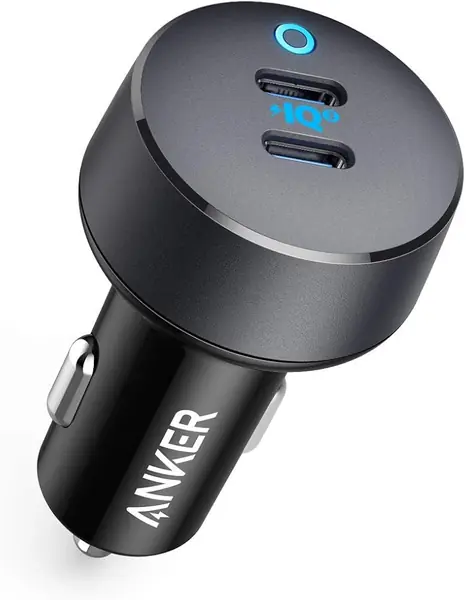
Two USB-C ports, no USB-A, no cable in the box. That looks stripped down until you count what's actually in the car: the driver's phone on a mount, maybe a passenger's phone, both of them USB-C if they were bought in the past few years. The 40 watts split across those ports comes out to roughly 20W each with both in use, which is about where an iPhone stops asking for more. That's the job done without a bundle of cable, and it's why this is the adapter we hand to most people.

It's the physical size we appreciated most. This is an ultra-compact body that sits close to flush in the socket, so a console lid still shuts over it and your knuckles clear it on the way to the climate dial. Anker's safety circuitry covers the usual over-current and overheating ground, and the 18-month warranty is the part that matters in a category where the cheap ones fail quietly and take your money with them.

Where it doesn't fit is a household still carrying a Lightning iPhone. There's no Lightning option here and no USB-A port to fall back on, so the Syncwire or the LISEN retractable does that job better. For everyone on USB-C, this is the one to put in the cart.

Pros

  • Two USB-C ports at about 20W each
  • Compact body sits nearly flush
  • 18-month Anker warranty

Cons

  • No USB-C cable in the box
  • Reliability feedback is mixed
Our verdict

For most people with an iPhone 15 or newer, this is the one to buy: two USB-C ports, each delivering about 20W, in a body small enough to disappear into the dash.
Check Latest Price
2

Anker 167.5W 3-Port Car Charger Best for Laptop and Phone

95 /100
TKZ Score Outstanding

Key details

Max Output
167.5W total
Ports
2 USB-C, 1 USB-A
Cable Included
3.3 ft USB-C
Top Port Output
100W
View on Amazon

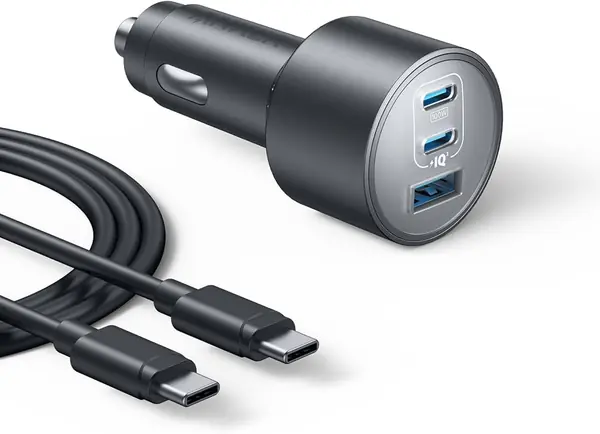
Nothing else here can run a laptop. The first USB-C port is rated at 100W, enough to take a 16-inch MacBook Pro to half charge in about 47 minutes, and the second gives 45W to a phone or tablet while a USB-A port handles the small stuff. A 3.3-foot USB-C to USB-C cable comes in the box, which is rarer in this group than it should be and instantly makes it the better travel companion of the two Ankers.

For anyone whose car doubles as an office — calls between appointments, a laptop open on the passenger seat, a tablet in the back — it replaces two adapters and a wall charger. For a driver who just wants a phone topped up, it's more charger than the job needs. The 167.5 watts is the sum of three ports, not a figure any one device ever sees; the number that matters to us is that second 45W port, which is more than double what an iPhone will take.

Durability is the open question. The feedback on early failures is mixed, which stings at this price, and the warranty is the honest answer: a unit that dies inside the coverage gets replaced, and Anker's support is the reason we're comfortable pointing you at it anyway. If you want the safest money in this category, the 40W is the safer buy. This one earns its keep only when a computer rides with you.

Pros

  • 100W first port charges a laptop
  • 45W second port for phones
  • USB-C cable included
  • Three devices at once

Cons

  • Costs the most of our picks
Our verdict

Buy this if the car doubles as an office: one 100W port runs a MacBook, a 45W port fast-charges an iPhone, and a third port mops up the rest.

Check Latest Price
3

LISEN 2-Pack Car Charger Best Budget

94 /100
TKZ Score Outstanding

Key details

Max Output
54W total
Ports
1 USB-C, 1 USB-A
Pack Size
2 chargers
USB-C Output
36W
View on Amazon

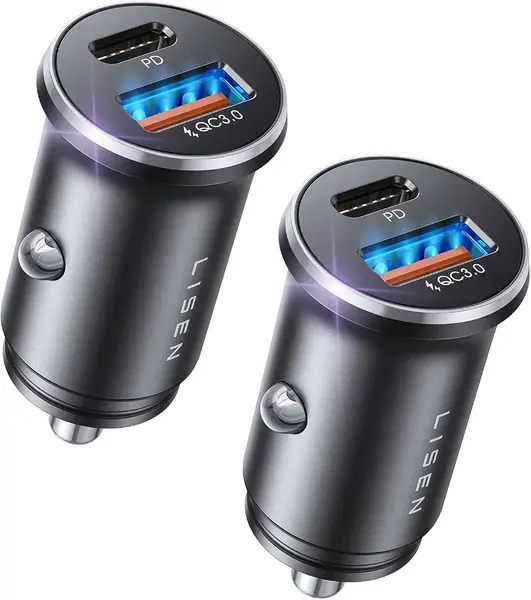
Two chargers in one box, which is the real feature. Each has a 36W USB-C port and an 18W USB-A port in an aluminum shell about the size of a thumb, and each sits deep enough in the socket to look like part of the dash. One goes in the daily driver, the other in the second car or the bag that travels with you on rental-car weeks.

It's the cheapest route into fast charging here, and you get two of them, which settles the budget question without much argument. The aluminum body is a detail we appreciate more than we expected: a 12V socket bakes in summer, and a metal shell handles that better than the molded plastic most budget chargers use. The 36W on the USB-C port also leaves headroom, so plugging in a tablet doesn't starve the phone next to it.

Pros

  • Two chargers in one purchase
  • 36W USB-C port with headroom
  • Aluminum body handles heat

Cons

  • Can sit very tight in the socket
  • Only one USB-C port per unit
Our verdict

The value pick: two small aluminum adapters with a USB-C and a USB-A port each, so both cars get fast charging without a second purchase.

Check Latest Price
4

LISEN 84W Retractable Car Charger Best for a Cable-Free Cabin

93 /100
TKZ Score Outstanding

Key details

Max Output
84W total
Warranty
2 years
Built-in Cables
USB-C and Lightning
Cable Reach
31.5 in
View on Amazon

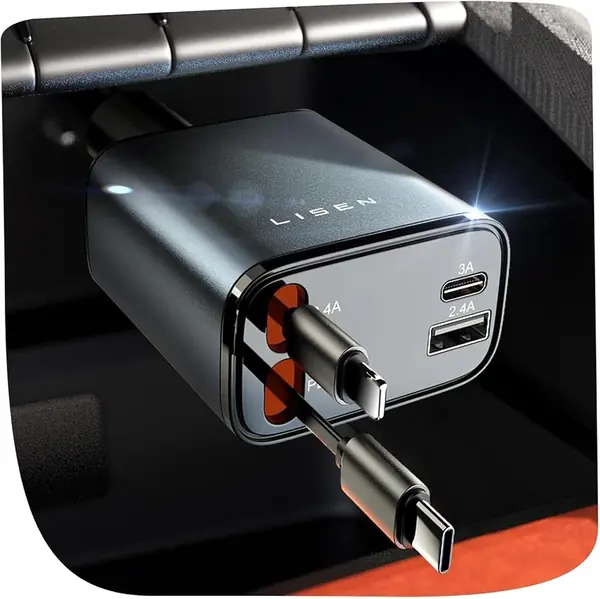
The cables are built in — one USB-C, one Lightning — and they pull out to 31.5 inches, enough to hand a phone to the back seat. Let go and they retract, and the console goes back to looking like nobody in this car owns a charger.

What we like is what it removes: the nest of cables in the cupholder, the spare Lightning cord in the glovebox, the one that always slides under the seat. There's real capacity behind the trick, too — the built-in USB-C cable does up to 45W, the two extra USB ports and the Lightning cable bring the total to 84W, and four devices can be plugged in at once. The body is heavier than a bare adapter, though, and in a worn socket it can work loose.

One thing it won't do is data. It's a power supply, so no wired CarPlay runs through those built-in cables. If CarPlay handles your maps, the phone stays on the car's own USB port and this handles everyone else. That's an easy trade for a tidier console, and it's the reason we point mixed-connector households here instead of at a plain adapter.

Pros

  • Built-in USB-C and Lightning cables
  • 31.5 inches of reach
  • Four devices at once
  • Nothing left hanging in the console

Cons

  • Spring-loaded cables can stop retracting
Our verdict

Best for a household with both a Lightning iPhone and a USB-C one: two built-in cables that reach 31.5 inches and disappear when you let go.

Check Latest Price
5

Syncwire 32W MFi Car Charger Best for Lightning iPhones

92 /100
TKZ Score Outstanding

Key details

Max Output
32W total
Certification
Apple MFi
Built-in Cable
5 ft coiled
Lightning Output
20W PD
View on Amazon

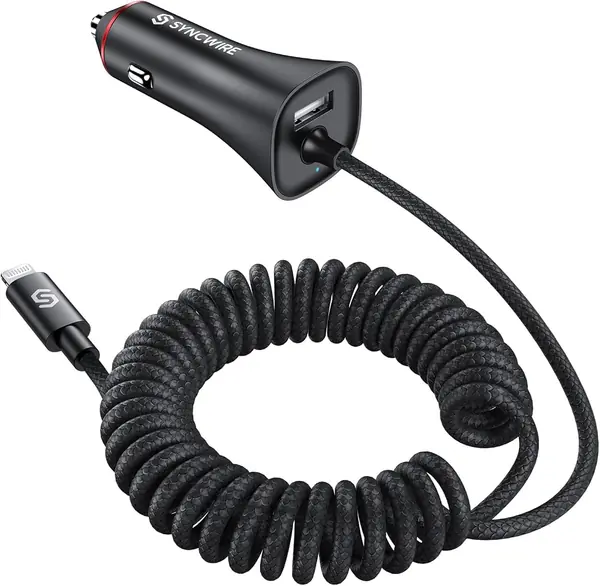
This one is for the Lightning holdouts — iPhone 14 and everything before it. The Lightning cable is built in and Apple MFi certified, so the phone treats it as a proper charger and pulls the full 20W PD rate instead of the slow trickle an uncertified cable gets you. A second USB-A port at 12W covers a passenger's phone or a pair of earbuds.

The cord is coiled: roughly 1.3 feet at rest, 5 feet if you pull it tight. That springiness cuts both ways. It reaches a windshield mount from a low socket without a loop of slack in the footwell, but it also pulls back, and a phone left lying on the seat gets dragged toward the dash. Mount the phone and the tug stops mattering.

It costs more than the budget picks here, and it only covers Lightning, so a household that has moved to USB-C should look elsewhere. For the buyer it fits, though, it's the cleanest single-cable setup on this list: nothing to remember, nothing to lose, and MFi certification doing the quiet work that separates fast charging from a phone that claims to be charging while the percentage sits still.

Pros

  • Apple MFi-certified Lightning
  • 20W PD through the built-in cable
  • Coiled cord stretches to 5 feet
  • Second USB-A port for a passenger

Cons

  • No USB-C port
Our verdict

The neatest one-cable answer for an iPhone 14 or older: MFi-certified Lightning, a full 20W of Power Delivery, and a coiled cord that stays out of the shift lever.

Check Latest Price
6

SUPERONE 99W Retractable Car Charger Best for Filling Every Seat

91 /100
TKZ Score Outstanding

Key details

Max Output
99W total
Ports
3 USB-C, 1 USB-A
Built-in Cables
USB-C and Lightning
Plug
180° swivel
View on Amazon

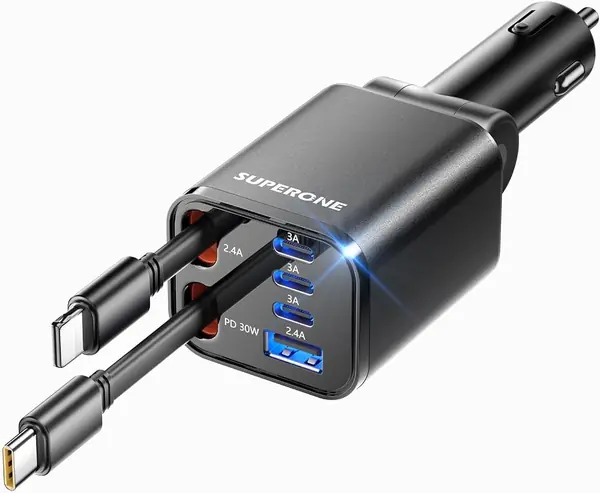
The plug swivels 180 degrees, which is the small design decision we appreciate most here: angled one way it clears a console lid, angled the other it drops the body out of the path of a shifter or a cupholder. If you've ever shut a lid on a charger and heard plastic complain, this is the fix.

Behind that plug is more charging than anything else in this group — two built-in retractable cables at 80 cm each, one USB-C and one Lightning, plus three USB-C ports and a USB-A, for 99W across the lot. A back seat with three phones and a tablet can all be plugged in at once, which is the actual use case for a charger this size.

Size is the price. This is the chunkiest pick here, and in a shallow console or a socket under a closed lid it can sit proud enough to be in the way. If your 12V socket is out in the open, that costs you nothing.

For a family car with mixed iPhones and a couple of screens in the back, nothing else here covers this many devices with this little cable clutter. If you drive alone, the bulk buys you nothing the LISEN two-pack doesn't already do.

Pros

  • Six charging points for a full car
  • Swiveling plug clears a console lid
  • Two built-in 80 cm cables

Cons

  • Cables can stop retracting properly
Our verdict

For a car full of people and devices, this covers more of them than anything else here, and the swiveling plug lets it fit where the others won't.

Check Latest Price
7

Amazon Basics 12W Lightning Car Charger Best for Older Lightning iPhones

90 /100
TKZ Score Outstanding

Key details

Max Output
12W
Certification
Apple MFi
Cable
1.5 ft coiled, 5 ft extended
Connector
Lightning
View on Amazon

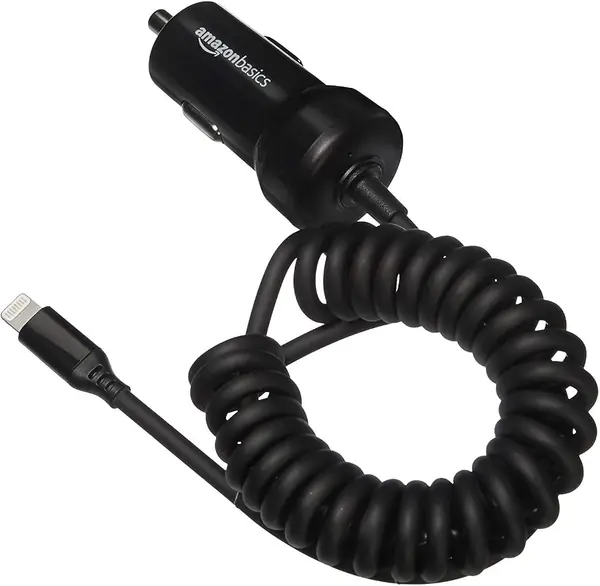
The cable is the product here: a coiled Lightning cord molded into the plug, about 1.5 feet at rest and 5 feet pulled tight, MFi certified so an older iPhone takes it without an unsupported-accessory warning.

The coil is shorter in practice than its five-foot maximum suggests, since you only get the full length by pulling it taut. From a low console socket it reaches the front seats comfortably and stops there, and it keeps the footwell clear rather than pooling a cable around your ankles.

As the charger that lives in the car and never gets thought about, it earns its place, and it does so for less money than anything else on this list. Buy it for the glovebox or a second vehicle where an iPhone 14 or older gets charged now and then. If you want real speed, one of the PD picks is worth the step up.

Pros

  • Apple MFi-certified Lightning
  • Coiled cord stays out of the way
  • Least expensive pick here

Cons

  • 12W output rules out fast charging
Our verdict

An MFi-certified Lightning charger with a coiled cord built into the plug, and the least expensive way to keep an older iPhone topped up in the car.

Check Latest Price

How We Tested iPhone Car Chargers

We built the shortlist from the chargers that keep surfacing in owner threads and repeat-buyer reviews, then cut anything with missing or vague certification and anything that advertised an amperage without naming the fast-charging standard it supported. That left 14 units: flush dual-port plugs, three-port bricks, retractable-cable adapters, and coiled-cable models. We also weighed what each one costs against how many ports and how much cable you get for it.

Every charger spent time in a daily-driver sedan on a 40-minute commute, in a second car used mostly for errands, and on a 900-mile interstate run with two phones and a pair of earbuds fighting over ports. They got plugged in on cold mornings, in summer heat with the dash in full sun, and after dark when you're hunting for the socket by feel.

For charging speed, we started a phone at 5 percent with the screen off and timed how much it gained in 30 minutes, then checked whether the phone showed its fast-charging indicator or quietly fell back to standard. We drove over speed bumps and washboard gravel to see if the plug worked loose, and measured how far each one protruded from the socket, since a plug that sits proud gets clipped by a knee or a coffee cup.

Retractable and coiled models had their cables pulled out and reeled back in over and over; we noted where the cable snagged, how much usable length we actually got from socket to phone mount, and whether the cord dragged across the shift lever. Each unit also got a yank test at the connector and a heat check after an hour of charging. By month three, a couple of the retracting mechanisms were already reeling back more weakly than they did on day one.

How to Choose an Iphone Car Charger

Start With Your iPhone's Connector

An iPhone 15 or newer takes USB-C; an iPhone 14 or older takes Lightning. That one fact decides which half of this list you're shopping in. If everyone in the car has moved to USB-C, buy an adapter with USB-C ports and keep a cable in the car — the Anker 40W is the plain version of that. If a Lightning phone still rides with you, a built-in Lightning cable saves you carrying one, and it should be Apple MFi certified. The Syncwire and the Amazon Basics both are.

The Big Number on the Box Is a Total

Eighty-four, ninety-nine, 167.5 — those figures are the sum of every port, not what any single phone receives. An iPhone draws around 20W at its peak, so a 20W USB-C PD port fills it as fast as a 45W port does. What matters is whether the port you'll actually use still delivers 20W once a passenger plugs in. The Anker 40W splits its 40 watts into roughly 20W per port, which is why it's enough. The big adapters buy you laptop charging, not a faster phone.

Built-In Cable or Your Own

A built-in cable means nothing to lose and nothing dangling. Retractable and coiled versions go further — the LISEN and SUPERONE cables reach about 31 inches, the Syncwire's coil stretches to 5 feet — but the cable becomes the part that wears out, and it can't be swapped. An adapter that takes your own cable ages better, since the cable is replaceable, at the cost of one more thing rattling around the cupholder. Decide how much loose cable you can live with, then pick the connector.

Fit, Heat, and How Long It Lasts

Two fit problems run through this category. An adapter that sits proud can foul a console lid or a button; one that seats too tightly is a fight to pull out, so leave it where it is. Heat is what finishes these off — a thin cord flexing at the plug, and a cigarette-lighter adapter left live in a socket that stays powered with the ignition off. Check whether your socket is always-on, unplug anything hot to the touch, and favor a maker that warranties the thing for a year or more.

Frequently Asked Questions

Final Verdict

Start with the Anker 40W PowerDrive III Duo. Two USB-C ports at roughly 20W each cover the driver and a passenger, it sits nearly flush so the console still closes, and the 18-month warranty is what separates it from the no-name adapters that die in a hot socket.

If a Lightning iPhone still rides with you, the Syncwire's MFi cable is the tidier one-cable answer. And if the goal is simply to stop moving a charger between two vehicles, the LISEN two-pack is the sensible spend.