Best Fast Charging Power Banks of 2026

A power bank's capacity rating is a claim, not a measurement. The number on the box says what the battery holds on paper; it says nothing about how many times it will actually refill your phone, or whether it still holds a charge after a year in a backpack. I've had a 20,000mAh brick quit at 30 percent, and I've had a cheap puck run a phone for two days.

Over the past seven months, my team and I have tested 12 of them, from slim 10,000mAh packs that vanish into a pocket to 20,000mAh travel units and a couple of enormous batteries you'd only carry on purpose. We ran each through airports, road trips, and long days away from an outlet, watching for what separates them: built-in cables, how many devices they charge at once, and whether the weight earns its place in your bag.

One thing first-time buyers rarely hear: speed and capacity pull against each other, and a pack that's quick with one phone can trickle on another. The picks below held up on both, and on portability and price.

The Best Fast Charging Power Banks

1

CUKTECH 45W Power Bank Best Overall
94 /100
TKZ Score Outstanding

Key details

Capacity
20,000 mAh
Max Output
45W
Size
6.38 x 2.83 x 1.17 in
Recharge Input
40W
View on Amazon

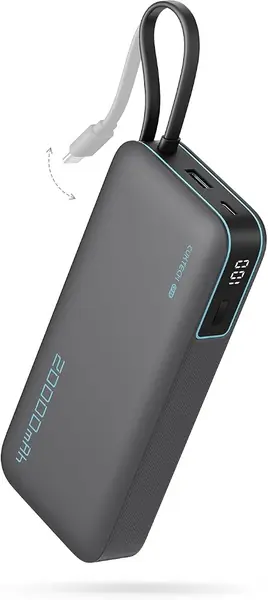
The number we keep coming back to on the CUKTECH is 40W, and it's the input, not the output. A 20,000mAh bank that trickles back to full overnight is a bank that's flat when you grab it on the way out; 40W input means a shower and a cup of coffee put a usable charge back in. The 45W output is the part printed on the box, and it's enough to run a phone at full speed, top up a tablet, and even nudge a MacBook Air.

That pairing is why this is the one we point most people to. Twenty thousand milliamp-hours, three outputs, a braided USB-C cable rated to 10,000 bends, and a percentage readout that tells you whether you're leaving with one charge or four. The cable doubles as a loop for hanging the pack off a bag strap, which sounds like a gimmick until you're topping up on a train with no table. Two phones and a set of earbuds can share it at once.

What it won't do is the heavy laptop job. Forty-five watts is plenty for a MacBook Air and thin for a 14-inch Pro, which is the one place the Anker below pulls ahead. Everything else it handles without fuss, and at about the price of the 22.5W INIU it's the easier recommendation to make.

Pros

  • 45W output covers phones, tablets, and a MacBook Air
  • 40W input refills the pack itself quickly
  • Built-in USB-C cable doubles as a strap

Cons

  • Bag-sized at 498 g, not pocketable
Our verdict

We recommend it as the default because 45W out and 40W in cover phones, tablets, and a light laptop without a premium price, and the built-in cable means you never hunt for one.
Check Latest Price
2

Anker 87W Power Bank Best for Laptops

93 /100
TKZ Score Outstanding

Key details

Capacity
20,000 mAh
Max Output
87W total, 65W single port
Weight
15.2 oz
Recharge Time
1.5 hours
View on Amazon

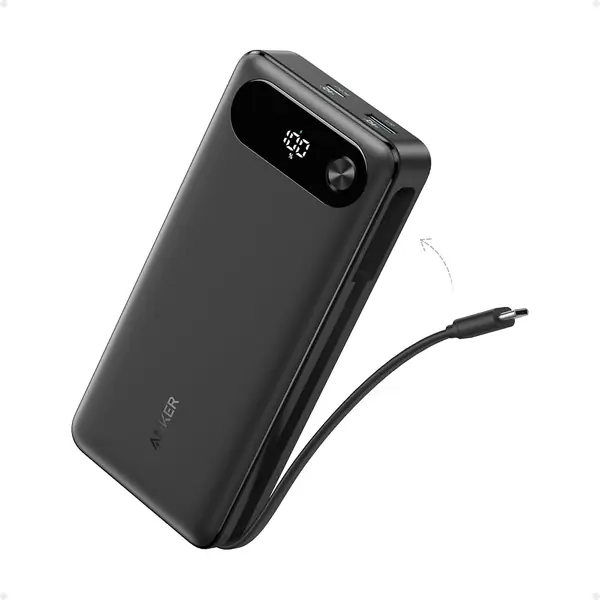
Eighty-seven watts split across three ports, up to 65W to a single device, and a built-in USB-C cable: the Anker is the only pack in this group that will meaningfully charge a laptop. Anker rates a 14-inch MacBook Pro to 50% in half an hour, and the pack itself refills in about 1.5 hours, which is quick for 20,000mAh.

The cable is what makes it a travel piece rather than a brick. It's rated to 10,000 bends, stows flat against the body, and means the thing you packed for your phone also covers your laptop. Alongside it there's a USB-C port and a USB-A port, so a phone, a tablet, and the computer can share the 87W between them.

We put it second because of price, not capability: it carries a real premium over our top pick, and if every device you own is a phone you'll never draw the watts you're paying for. For a work trip with a laptop in the bag, the extra buys a serious top-up on that laptop, and nothing else here does it.

Pros

  • 87W shared, 65W to a single device
  • Refills in about an hour and a half
  • Built-in USB-C cable survives 10,000 bends

Cons

  • About 15.2 ounces, heavy for a bag
  • Built-in cable can fail before the battery does
Our verdict

Buy it if a laptop is part of your charging load: it's the only pack here with the wattage for one, and the built-in cable keeps it a one-piece travel kit.

Check Latest Price
3

INIU 22.5W Power Bank Best Value 20,000mAh

92 /100
TKZ Score Outstanding

Key details

Capacity
20,000 mAh
Max Output
22.5W
Size
4.1 x 2.8 x 1.2 in
Recharge Time
5.4 hours
View on Amazon

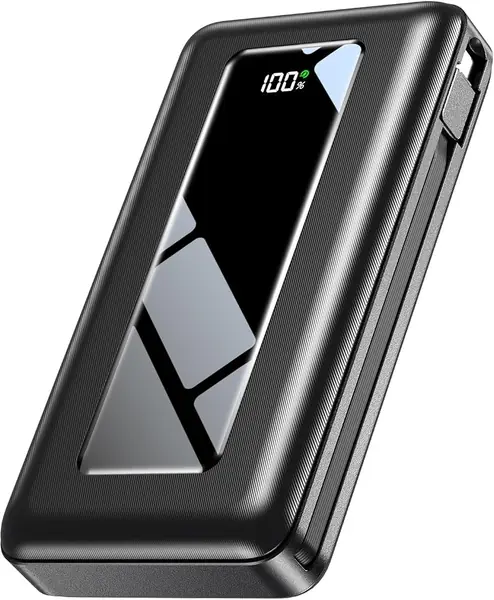
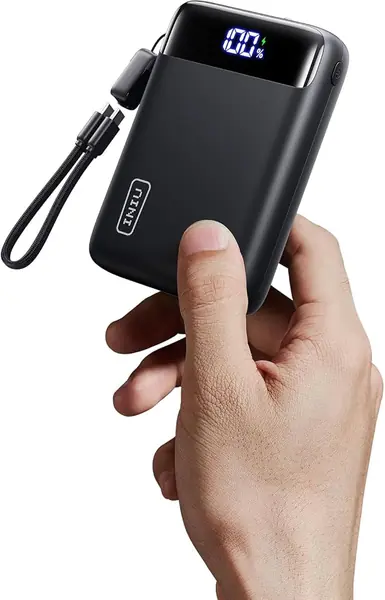
For a phone-only carry, this is the 20,000mAh pack we reach for. It measures 4.1 inches long and weighs about 11 ounces — the shortest 20,000mAh unit in this group — and the built-in USB-C cable doubles as a woven nylon lanyard, so there's no loose cord rolling around the bottom of your bag.

The 22.5W ceiling is the trade. INIU rates it at 70% on a Galaxy S25 or 60% on an iPhone 16 in 25 minutes, which is quick for a phone, but tablets charge at a crawl and a laptop is out of the question. Where it keeps up is the small stuff: a percentage display instead of four dots, a flashlight that's genuinely useful in a blackout, three ports, and a three-year warranty.

Against the CUKTECH it gives up 20W of output and gains a body you can actually pocket. That's the whole decision — pocketable and phone-only, or bag-sized and tablet-ready — and the price gap between them is small enough that the answer is about how you carry, not what you spend.

Pros

  • Shortest 20,000mAh pack in this group
  • Built-in USB-C cable works as a lanyard
  • Three-year warranty at a midrange price

Cons

  • 22.5W output slows tablets and rules out laptops
  • 5.4 hours to refill the pack
Our verdict

Get it if you want the shortest 20,000mAh pack here and don't need laptop wattage; the three-year warranty makes it an easy one to live with.

Check Latest Price
4

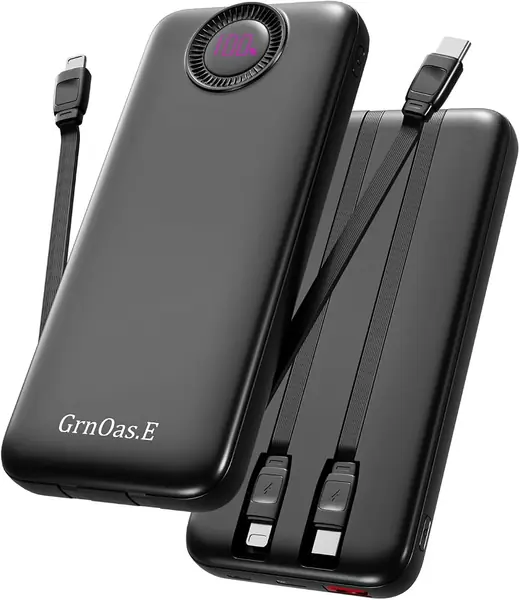
GrnOas.E 10,000mAh Power Bank Best Budget

91 /100
TKZ Score Outstanding

Key details

Capacity
10,000 mAh
Max Output
22.5W
Weight
8.4 oz
Built-in Cables
USB-C and Lightning
View on Amazon

Two built-in cables — one USB-C, one Lightning — plus a USB-C port and a USB-A port, so four things can charge at once from a pack that weighs 8.4 ounces and is about the size of a phone. If your household runs an iPhone and an Android side by side, that's the whole pitch: no dongle, no borrowed cable, no arguing over the good one.

It earns the budget slot because nothing else in this group is close on price, and for an evening out it justifies its place in a small bag. What it isn't is a weekend workhorse: 10,000mAh is roughly a charge and a half for a modern phone, so it's the pack you take to dinner, not the one you take camping.

The rest is sensible. A percentage display, a slim 0.75-inch body that slides into a front pocket, and a three-year warranty that's generous at this end of the market. It's the pack that lives quietly in the bag you carry most days, until the afternoon the phone dies at four.

Pros

  • Two built-in cables cover iPhone and Android
  • Four outputs let several devices share it
  • 8.4 ounces and a slim 0.75-inch body

Cons

  • Built-in cables fail first and can't be swapped
  • Slow to refill; it's an overnight job
Our verdict

Pick it as a second charger for a bag: two built-in cables cover iPhone and Android, and nothing else here comes close on price.

Check Latest Price
5

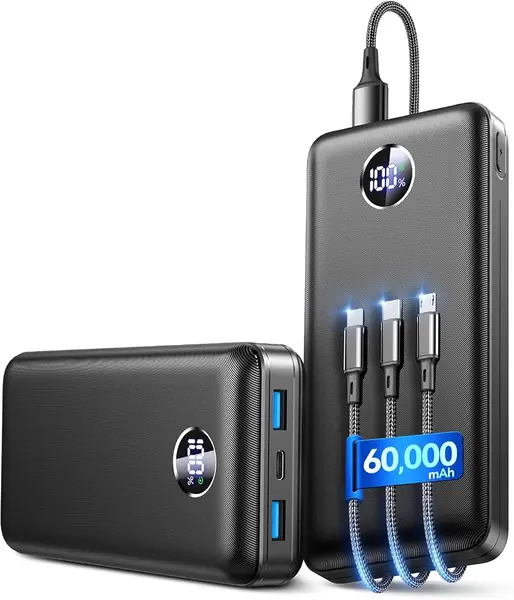
IAPOS 60,000mAh Power Bank Best for Multi-Day Trips

90 /100
TKZ Score Outstanding

Key details

Capacity
60,000 mAh
Max Output
22.5W
Weight
15.5 oz
Devices At Once
5
View on Amazon

Sixty thousand milliamp-hours works out to roughly 222 watt-hours, and that number matters more than the capacity headline: U.S. carriers cap carry-on lithium at 160Wh even with approval, so this one stays home when you fly. It's a trunk, campsite, and power-outage pack, and it's excellent at exactly that.

Two USB-A ports, a USB-C port, and a built-in 3-in-1 cable with USB-C, Lightning, and micro-USB ends let five devices charge at once, which is the real luxury here — nobody waits their turn. The 22.5W output supports PD, QC, SCP, FCP, and AFC, covering most Android fast-charge standards as well as iPhones, and the display reads in percent rather than bars.

Where it earns its place is the last pack standing on a long weekend: four people, one cabin with no outlets, everyone's phone still alive on day three. The port count and the cable bundle are what we value there, well ahead of charging speed. If your trips start at an airport gate, this isn't the one.

Pros

  • Five devices charge at the same time
  • Built-in 3-in-1 cable covers USB-C, Lightning, and micro-USB
  • Enough capacity for days away from outlets

Cons

  • 15.5 ounces and too big for a pocket
Our verdict

It's the pack for a campsite or a blackout rather than a boarding pass: enormous capacity and enough ports for everyone in the car.

Check Latest Price
6

Moihosso 50,000mAh Power Bank Mixed-Phone Households That Need Days of Power

89 /100
TKZ Score Excellent

Key details

Capacity
50,000 mAh
Max Output
22.5W
Built-in Cables
USB-C and Lightning
Warranty
3 years
View on Amazon

The feature we appreciate most here is the pair of built-in cables: one USB-C and one Lightning, both tucked into channels on the side of the pack when they're not in use. For a household with mixed phones, that's the end of the cable-drawer argument and one less thing to forget on the way out.

Fifty thousand milliamp-hours buys days rather than hours — enough for several full phone charges, a flashlight for the fuse box, and a percentage display so you're never guessing at what's left. The three-year replacement pledge is the kind of thing that matters on a pack this size, where the battery is most of what you paid for.

Where it comes up short is speed. 22.5W is fine for phones, slow for a tablet, and there's no laptop charging at all, so this is a capacity purchase first and a speed purchase second — the opposite of how our top pick earns its place. For a camper or a storm-season household, that's the right trade to make.

Pros

  • USB-C and Lightning cables built in
  • Days of capacity for several phone charges
  • Three-year replacement pledge

Cons

  • About 185Wh, over the airline carry-on limit
  • Bulky at 6.5 by 3.5 inches
Our verdict

Worth it if you want one pack covering an iPhone and an Android household for days — just know it can't board a plane.

Check Latest Price
7

Miady 2-Pack 20,000mAh Best for One Pack for the Car and One for the House

88 /100
TKZ Score Excellent

Key details

Capacity
20,000 mAh each
Max Output
22.5W
Weight
1.6 lb (pair)
Packs
2
View on Amazon

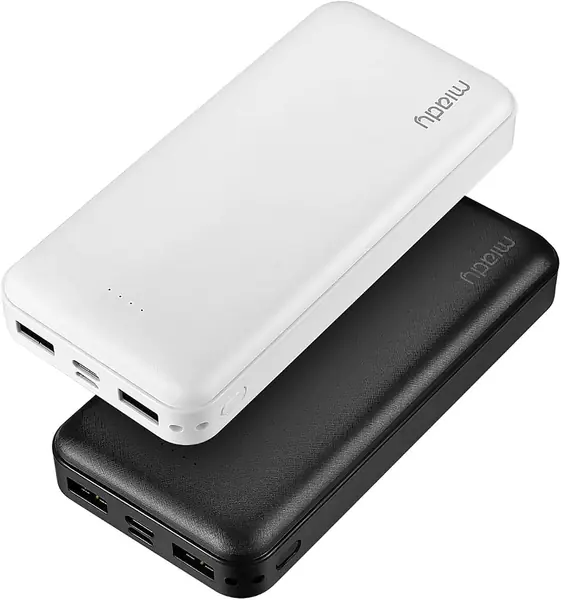
Two 20,000mAh packs, two USB-C cables, and a price that lands near what one midrange bank costs: that's the argument, and it holds up for the right buyer. One lives in the glovebox, one lives by the front door, and neither has to be remembered every morning on the way out.

Each pack is 74Wh, comfortably under the 100Wh carry-on threshold, with a 22.5W USB-C output and two USB-A ports alongside, so three devices can share one. They're plain: LED indicator lights instead of a percentage readout, a 5.5-by-2.6-by-1-inch body that's ordinary for the capacity, and no Lightning cable in the box, so iPhone owners bring their own.

What we like about the pair is the way it changes the habit. A pack that already lives in the car is a pack you actually have when the phone dies at a trailhead, and that beats a better pack sitting on a desk at home. What it doesn't give you is the percentage display, the built-in cable, or the quick refill of the picks above.

The caveat is longevity — the record on holding charge over months is the most mixed in this group — and that's tolerable for a car kit that gets used twice a month. Buy the pair for convenience, not for a decade of service.

Pros

  • Two full packs for the price of one
  • 74Wh each, so both can fly
  • Spreads power across car and house

Cons

  • 1.6 pounds for the pair, and each is bag-sized
Our verdict

Buy the pair if you want one pack for the car and one for the house for roughly the price of a single midrange bank.

Check Latest Price
8

AsperX 45W Power Bank Best for Earbuds, Watches, and Everyday Phone Charging

87 /100
TKZ Score Excellent

Key details

Capacity
20,000 mAh
Max Output
45W
Size
5.9 x 2.7 x 1.14 in
Recharge Time
4 hours
View on Amazon

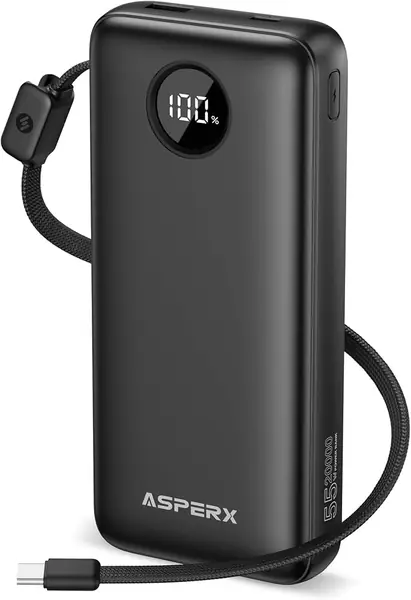
Forty-five watts in and out, a built-in braided USB-C cable, 20,000mAh, and a percentage display — the AsperX covers everything we ask of a daily pack, and the integrated cable is rated to 10,000 bends like the best of them. On paper it reads like our top pick wearing a different logo.

The one thing it does that the CUKTECH doesn't is the low-current mode: a long press on the power button switches the output down for earbuds, a smartwatch, or anything too small to trigger a normal fast-charge handshake. If you've ever had a pair of earbuds sit there refusing to charge from a power bank, that's the fix, and this is the only pack here that offers it.

The 45W input is the quiet win: it refills the pack in about four hours, which is the difference between charging it while you get ready and charging it all night. Three outputs share the load, and the 24-month warranty is standard for this group.

It lands in the also-consider tier because it costs more than our top pick for the same 45W and the same 20,000mAh, and nothing on the spec sheet explains the difference. If the low-current mode solves a real problem for you, pay it. Otherwise put the difference toward the CUKTECH.

Pros

  • 45W in and out for quick top-ups and refills
  • Low-current mode for earbuds and watches
  • Built-in braided USB-C cable

Cons

  • Costs more than our top pick for the same 45W
Our verdict

A solid 45W alternative with a low-current mode for earbuds and watches; it sits behind the CUKTECH mainly on price.

Check Latest Price

How We Tested These Power Banks

We started with the power banks that show up most often in reviews and spec sheets, then filtered for USB-C Power Delivery, a stated wattage, and a size that would plausibly live in a bag. That left 12 packs, from slim 10,000mAh models to 20,000mAh travel units and a few high-capacity bricks built for camping weekends, and we spent seven months with them.

Every pack went into a bag and stayed there. We used them on commutes, on flights, through a two-day camping trip with no outlet, and on weeknights when the couch is far from the charger. To gauge speed, we drained a phone to zero and timed how long it took to reach 50 percent and then full, repeating with a tablet and, where wattage allowed, a laptop. To gauge real capacity, we counted how many full refills each pack delivered before it quit, which is the number that matters and the one that rarely matches the label. We also plugged phones, earbuds, and tablets in together to see how the output split across ports.

Weight went on a kitchen scale with the cables included, then each pack rode in a jacket pocket for a week to see whether the difference was noticeable by mile three. We opened and closed every built-in cable several hundred times and bent it at an angle inside a bag to check whether charging dropped out. Durability got a waist-high drop onto concrete and a week rattling around with keys. We recharged each pack repeatedly over the months to see whether it still took a full charge, compared what each delivers per dollar of usable power rather than per milliamp-hour on the box, and noted which ones needed a separate cable purchase to hit their advertised speed.

How to Choose a Fast-Charging Power Bank

Match the Wattage to What You Charge

Twenty to 22.5W is a phone number: fast charging for most iPhones and Galaxies, and a slow top-up for a tablet. Step to 45W if a tablet or a MacBook Air is in the mix, and 65W or more if a laptop is the point. One trap: the headline wattage is often the total across all ports, not what any single device receives. The Anker's 87W is shared three ways with 65W to one device, which is still the most capable pack here — but read the single-port figure, not the big one.

Work Out What Capacity Buys You

Rated milliamp-hours never all reach your phone. Assume roughly two-thirds after voltage conversion and cable loss: 10,000mAh is about a charge and a half, 20,000mAh is three to four, and 50,000mAh and up is several days of light use.

Weight follows capacity. A 10,000mAh pack runs around 8 to 11 ounces and disappears into a jacket; 20,000mAh lands between 11 and 17 ounces and wants a bag; the 50,000mAh and 60,000mAh packs here are trunk and campsite equipment.

Check How Fast the Pack Itself Refills

Output gets the marketing; input decides whether the pack is ready when you leave. The picks here run from 5.4 hours for a full refill down to about 1.5 hours, and that gap is not marginal — a five-hour pack is an overnight commitment, while a 40W or 45W input is a shower and a cup of coffee. If you own one pack, prioritize input over output. You will notice refill time far more often than peak wattage.

Decide About a Built-In Cable

Most portable chargers now ship with a cable attached, and it is genuinely one less thing to pack: on the INIU and the CUKTECH it doubles as a lanyard or a strap. The catch is that the cable is usually the first part to fail and it cannot be replaced. The GrnOas.E is the most exposed, since both its cables are built in. If a dead cable shouldn't take the whole pack out of service, buy one with standard ports and keep a spare cord in the bag.

Frequently Asked Questions

Final Verdict

If we're buying one pack this month, it's the CUKTECH: 45W out, 40W in, a built-in cable, and a percentage display at about what a 22.5W pack costs. The exception is a laptop, which is the Anker's job, and its premium only makes sense if a computer travels with you.

If nothing bigger than a phone ever needs charging, the INIU is the pocketable version of the same idea, and the GrnOas.E covers an evening for the least money here.