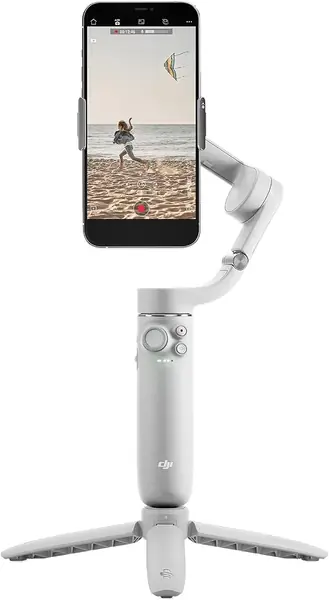
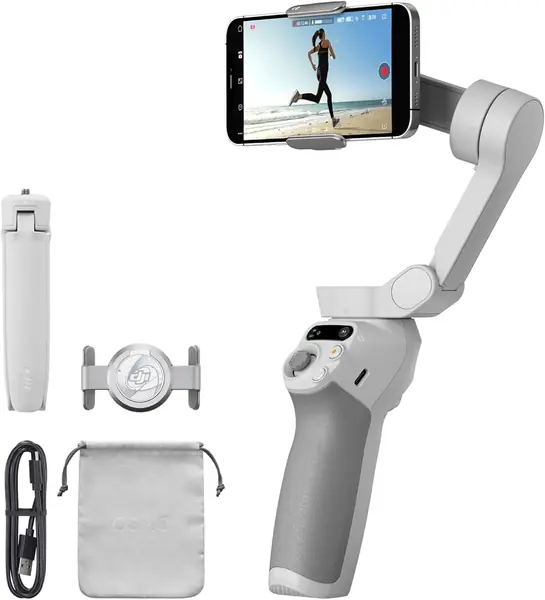
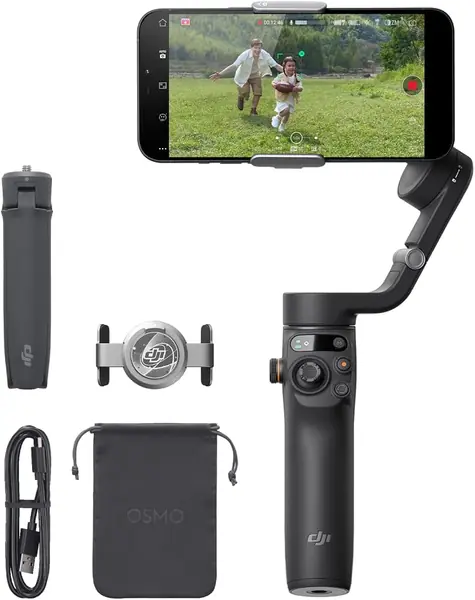
Best DJI Phone Gimbals of 2026

Shaky phone footage is the quickest way to make a great moment look amateur. A gimbal fixes that by keeping your phone level and smooth while you move, and the latest models do it without adding bulk to your bag. But not every stabilizer is equally steady, easy to set up, or worth the money—some fight you with clumsy apps, while others make filming feel almost automatic.

Over the past seven months, I’ve tested 10 phone gimbals in real life—walking city streets, chasing kids at the park, and filming travel vlogs—and the gap in quality, video smoothness, and user-friendliness is real. A good gimbal should feel like an extension of your arm: it folds small, balances your phone quickly, and tracks a moving subject without losing the shot. The best ones also last through a full day of shooting and don’t cost more than they’re worth. The picks below are the ones that earned a permanent spot in my camera bag.

The Best DJI Phone Gimbals

1

Osmo Mobile 7 Best Overall
94 /100
TKZ Score Outstanding

Key details

Weight
10.6 oz
Folded Size
179 x 95 x 39 mm
Stabilization
3-axis, ActiveTrack 7.0
Battery
10 hrs, charges phone
View on Amazon

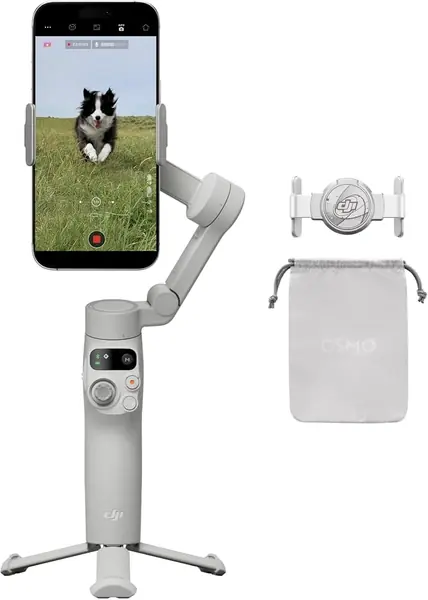
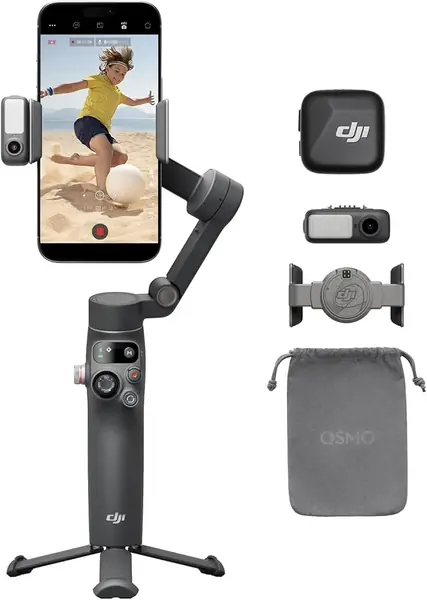
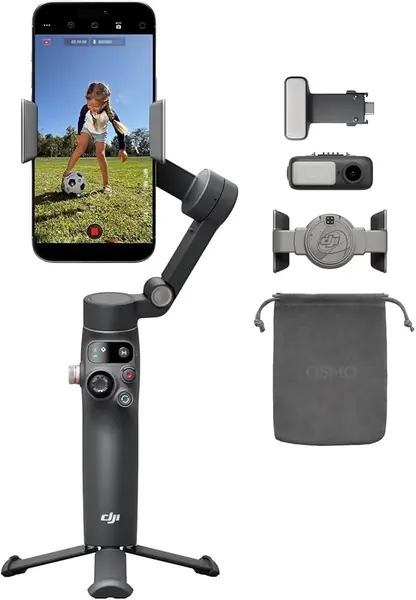
The Osmo Mobile 7 is the least expensive way into DJI's current generation, and that is most of why it is our pick. For less than either older model in this guide you get the newest tracking, the Mimo app with ShotGuides and One-Tap Edit, a body that folds in on itself, and tripod legs built into the handle — no separate accessory to buy and nothing to leave at home.

At 300 grams it is the lightest of the three current DJI models, and it folds to 179 by 95 by 39 millimeters, which is daypack-pocket size rather than camera-bag size. The handle is textured so it does not slide in a warm hand, and the rig hangs comfortably from one arm — the difference between filming the whole soccer game and handing the phone to someone else at halftime.

What you give up is reach. There is no extension rod, so overhead angles and group selfies stop at the end of your arm, and the built-in tripod only helps when there is a table or ledge at the right height. If either of those shots is the reason you are shopping, pay for the 7P or the 8.

Two practical notes. DJI rates it at 10 hours of use and it can pass charge through to your phone, which rescues a long day away from an outlet. And balance the handset in the clamp before you switch on — a heavy phone sitting off-center is what makes these motors fight, and the slow drift that follows is what makes people think the gimbal is broken.

Pros

  • Current DJI tracking at the lowest price here
  • Lightest of the current models at 300 g
  • Built-in tripod means hands-free without extra gear

Cons

  • No extension rod for overhead or group shots
Our verdict

We tell most people to start here: DJI's current tracking, the lightest body of the current models, and tripod legs built in, for the least money in this group.
Check Latest Price
2

Osmo Mobile 7P + Mic Mini Best for Vloggers

93 /100
TKZ Score Outstanding

Key details

Weight
13 oz
Built-in
Extension rod, tripod
Module
Tracking, audio, lighting
Includes
Mic Mini transmitter
View on Amazon

There is a DJI Mic Mini transmitter in the box with the Osmo Mobile 7P, and that one addition changes the kind of video you can make. Clipped to a collar, it feeds audio through the gimbal's multifunctional module and into the Mimo app, so the voice you record is the one at the collar rather than the one at the end of a selfie stick.

We like this bundle for a specific buyer: the person who talks to camera. Vloggers, tour guides, teachers, anyone narrating their own footage. The module handles tracking, a small light, and mic reception, the rod and tripod are built in, and one folded object in your bag replaces a gimbal, a selfie stick, a tripod, and a wireless mic kit.

The trade is weight and money. At 368 grams it is heavier than the Mobile 7, and folded it measures 190 by 95 by 46 millimeters — packable, but you notice it in a jacket pocket. You are paying for the rod, the module, and the microphone rather than better stabilization; the motors do the same three-axis work as the cheaper gimbal's.

One setup note. The module is where the tracking and the audio live, and it needs pairing with the app and with the transmitter. Do that at home with the app open and a test clip recorded, rather than in a crowd with a subject waiting for you.

Pros

  • Mic Mini transmitter included for clean voice audio
  • Extension rod and tripod built into the gimbal
  • One module covers tracking, lighting, and audio

Cons

  • Heavier and more expensive than the Mobile 7
Our verdict

If you talk to camera, this is the one we hand people — a rod, a tripod, a light, and a wireless mic in a single foldable kit.

Check Latest Price
3

Osmo Mobile 8 Best for Low Light

92 /100
TKZ Score Outstanding

Key details

Weight
13.4 oz
Built-in
Extension rod, tripod
Pan Range
360 degrees
In The Box
Fill light, multifunctional module
View on Amazon

Between the Osmo Mobile 8 and the 7P there is little to separate them on paper: same three-axis stabilization, same multifunctional module, same built-in rod and tripod. The decision comes down to light and range. The 8's combo adds DJI's OM Fill Light and full 360-degree pan, which is why we send anyone shooting indoors or after dark here rather than to the cheaper bundle.

The fill light clips above the phone clamp and runs off the gimbal, so a dim restaurant table or a dark hallway becomes usable without carrying a panel light. The pan is the other half: send the gimbal around your subject while tracking holds them centered, and you get an orbit shot that otherwise needs a second person walking a circle around you.

It is the heaviest gimbal we recommend at 380 grams, and folded it measures 7.5 by 3.7 by 1.8 inches, which wants the storage pouch rather than a pocket. It is also the most expensive pick here. Neither matters if the light and the orbit shot are the reason you are buying, and DJI backs it with a two-year warranty. Shoot outdoors at noon and never touch the module, and you are carrying weight for features you will not use.

Pros

  • Fill light makes dim rooms usable footage
  • Full 360-degree pan for orbit shots
  • Rod, tripod, and module all included

Cons

  • Heaviest of the current models at 380 g
Our verdict

We reach for the 8 when the shoot is indoors or after dark, where the fill light and the full-circle pan do what the cheaper bundles cannot.

Check Latest Price
4

DJI OM 5 Best Ultralight

91 /100
TKZ Score Outstanding

Key details

Weight
10.2 oz
Built-in
Extension rod, grip tripod
Tracking
ActiveTrack 4.0
Color
Athens Gray
View on Amazon

Two hundred and ninety grams is the number that keeps the OM 5 on this list. It is the lightest gimbal we recommend — lighter than every current model — and it still folds down with an extension rod built into the handle and a grip tripod in the box, so a long afternoon of walking and filming does not leave your wrist complaining.

We kept it for travel, and for anyone who wants a rod without paying current-model money. It is also the only pick here with a real color choice: DJI calls this one Athens Gray, a pale finish that reads less like camera equipment hanging off your hand. The rod extends for group shots and high angles, and the grip tripod screws on when you want to plant it.

The catch is age. The OM 5 runs ActiveTrack 4.0, several generations behind the tracking in the 7-series, and older motors work harder to hold a big phone steady. The clamp is snug on a cased handset — a thin case is fine, a thick one or a clip-on lens is where balance starts to fight you. DJI lists a 614-gram phone payload, generous for a gimbal this light.

Pros

  • Lightest gimbal in this guide at 290 g
  • Extension rod and grip tripod in the box
  • Generous 614 g listed phone payload

Cons

  • Older ActiveTrack 4.0 than the 7-series
  • Clamp is a snug fit on thick cases
Our verdict

The OM 5 is the one for a light travel kit: 290 grams, a built-in rod, and a grip tripod, with tracking that is a few generations behind.

Check Latest Price
5

Osmo Mobile SE Best for Simple Solo Setups

90 /100
TKZ Score Outstanding

Key details

Weight
12.4 oz
Folded Size
6.57 x 4.29 x 1.85 in
Tracking
ActiveTrack 6.0
Phone Weight Limit
10.2 oz
View on Amazon

A remote control you wear on your wrist is the feature that is easy to miss on the Osmo Mobile SE. Put DJI Mimo on an Apple Watch and the watch becomes a remote: you can watch the camera feed, adjust the gimbal's angle, and start recording while the SE stands on its tripod across the room.

That combination — tripod, selfie stick, wrist remote — solves the solo-shot problem properly. Plant it, walk into frame, and run the take without jogging back to press a button. For family photos where nobody wants to be the photographer, and for anyone filming themselves, it is the most useful trick in this group.

We placed the SE below the top picks for two reasons. Its kit stops at the magnetic clamp and the grip tripod — no fill light in the box, no wireless microphone — and its listed phone ceiling of 290 grams is the lowest here, which is where a big handset with a case and a clip-on lens starts to push the limit. For a standard-size phone in daylight, neither matters, and ActiveTrack 6.0 is a generation newer than the OM 5's.

Pros

  • Apple Watch remote control for solo shots
  • ActiveTrack 6.0 tracking built in
  • Tripod and selfie stick included with the clamp

Cons

  • 290 g phone limit is the lowest here
  • No fill light or mic in the box
Our verdict

For a standard-size phone and daylight shooting, the SE gives you DJI tracking, a tripod, and a wrist remote in one of the simplest kits here.

Check Latest Price
6

Osmo Mobile 6 Best for Group Shots

89 /100
TKZ Score Excellent

Key details

Built-in
Extension rod
Folded Size
189 x 84.5 x 44 mm
Stabilization
3-axis
Shooting Modes
Nine, including SpinShot
View on Amazon

Older than everything else we recommend, the Osmo Mobile 6 still earns a place because it extends. The built-in rod slides out for group shots and overhead angles, and the gimbal folds to 189 by 84.5 by 44 millimeters — jacket-pocket size rather than camera-bag size.

The rest of the appeal is software. Nine shooting modes, including SpinShot for a rotating push-in, plus ShotGuides, which suggests a sequence and walks you through it instead of leaving you to invent one. For a first gimbal, that scaffolding is worth more than another line on a spec sheet.

Pairing is the recurring friction here, and Android handsets are where it bites hardest, which is why this sits below the newer picks rather than beside them. It also costs more than the Mobile 7 while carrying an older design and none of the module extras. The case for it is narrow but real: a built-in rod, a foldable body, and a set of guided modes that hold a beginner's hand.

Pros

  • Built-in extension rod for group shots
  • Nine shooting modes, including SpinShot
  • ShotGuides suggests shot sequences for beginners

Cons

  • Costs more than the newer Mobile 7
  • Pairing can be stubborn on some Android phones
Our verdict

A foldable gimbal with a built-in rod and nine guided shooting modes; it still makes sense if you want the rod without buying the 7P bundle.

Check Latest Price

How We Tested the Best Phone Gimbals

We started by researching the current market and narrowing the field to models with strong specs, positive user reviews, and broad compatibility with both iPhones and Androids. From there, we selected 10 units that represent a range of prices and features, from compact foldable designs to models with built-in tripods and extension rods. Over seven months, we used each gimbal as our daily carry, filming everything from neighborhood walks to family soccer games and weekend trips.

To judge stability and video quality, we shot the same sequences with every gimbal: walking briskly down a sidewalk, following a subject through a crowd, and panning across a landscape. We reviewed the footage on a large monitor, looking for micro-jitters, horizon drift, and how smoothly the motors responded to movement. We also exercised each gimbal’s shooting modes—tracking a moving subject, shooting a timelapse, and switching between portrait and landscape—to see which features were genuinely useful. Ease of use got equal attention: we timed how long it took to unfold, balance, and start recording, and we noted whether the companion app connected quickly and stayed connected.

We tested durability by repeatedly folding and unfolding each gimbal and tossing it into a padded bag, then checking for loose hinges or motor noise. Compatibility was assessed with several phone sizes and cases, since a gimbal that can’t grip your phone is useless. Finally, we weighed each model’s features against its price to determine value, and we ran battery tests to see how many hours of filming we could get on a charge. The gimbals that rose to the top delivered smooth footage without making us fight the hardware.

How to Choose a Dji Phone Gimbal

Fit Comes Before Features

These gimbals hold a bare phone far more securely than a cased one, and a thick case, a magnetic wallet, or a clip-on lens moves the phone's weight away from the motors that have to balance it. Mount your own phone the way you actually shoot and check that it hangs level with the motors off. If it flops to one side, the gimbal will fight it all day.

Ceilings vary by model — the Osmo Mobile SE lists a 290-gram phone limit, the DJI OM 5 lists 614 grams — so a large handset is worth checking against the spec before you order rather than after the first shoot.

The Extras Are the Real Price Ladder

Across DJI's current models, stabilization is the same three-axis design; what changes is what's attached to it. The extension rod buys overhead angles and group selfies. Built-in tripod legs let you walk away from the shot. The multifunctional module adds subject tracking, a small light, and wireless mic reception.

So the Mobile 7 gets you the tripod, the 7P adds the rod, the module, and a Mic Mini transmitter, and the 8 adds the fill light and full-circle pan. Pay for the extras you'll genuinely use — a module on a gimbal that only ever shoots outdoors is money sitting in a drawer.

Weight and Folded Size Decide Whether It Leaves the House

The spread here is real: the OM 5 is 290 grams, the Mobile 7 is 300, the SE is 352, the 7P is 368, and the 8 is 380. Ninety grams held at the end of a straight arm for twenty minutes is a different afternoon from the lightest one.

Folded size matters just as much. The Mobile 7 packs into 179 by 95 by 39 millimeters and disappears into a daypack, while the 8's folded 7.5-inch length wants its pouch. If the gimbal lives in a bag, size wins; if it lives in your hand, weight does.

Plan for the Warranty and the Return Window

A gimbal that quits after a few weeks is the failure worth planning around with this lineup, on older models and new ones alike, and nothing on the box predicts it. Buy from a seller with a straightforward return window, shoot something real in the first week, and register the warranty the day it arrives.

Only one pick states a term: the Osmo Mobile 8 carries two years. The rest list DJI's warranty without a period, which is worth confirming before you count on it.

Frequently Asked Questions

Final Verdict

The Osmo Mobile 7 is the gimbal we point most people toward. It is the least expensive way into DJI's current tracking, it is the lightest of the current models, and the built-in tripod means hands-free shots without extra gear.

Step up to the 7P if you talk to camera — the rod, the module, and the Mic Mini transmitter earn the difference — and to the 8 if you shoot indoors or after dark, where the fill light and full-circle pan do things the other two cannot.