Best Boombox Bluetooth Speakers of 2026

A boombox is the one thing at a cookout that everybody notices and nobody thinks to charge. It gets going around noon, and by four the bass has gone soft and the whole thing sounds like it's playing through a bath towel. I have crouched over a fading speaker on a lawn chair, and I would rather not do it again. A good one stays loud without turning harsh, survives a splash and a drop off the tailgate, and still has battery when the sun goes down.

Here's what first-time buyers get wrong: almost every wattage printed on the box is a peak figure, and a 100-watt badge can sound thinner than a well-built 60-watt unit. Over the past eight months, my team and I have run 10 of these speakers through cookouts, pool decks, campsites, and one very patient garage, weighing battery life, volume, connectivity, and how much speaker you actually get for your money.

Some of these are two-hand party machines that live in a trunk; others fit behind the seat of a bike. The ones below held up either way — none hissed at low volume, none rattled apart at full tilt, and none died mid-playlist.

The Best Boombox Bluetooth Speakers

1

JBL Boombox 3 Best Overall
95 /100
TKZ Score Outstanding

Key details

Weather Rating
IP67
Battery
24 hours
Weight
14.7 lb
Power
80W
View on Amazon

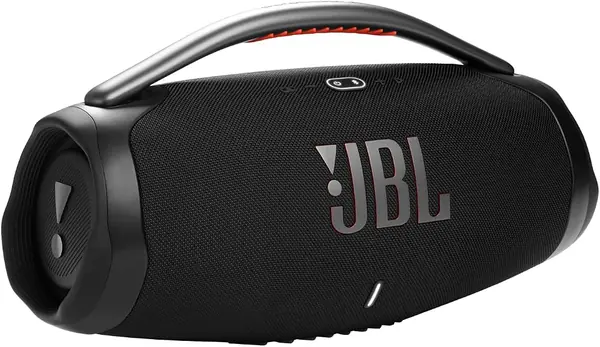
At 19 inches wide and 14.7 pounds, the Boombox 3 makes its case before the music starts. The metal handle with an orange grip tells you this is meant to be carried with two hands, and we like that it does not pretend to be a pocket speaker. The size is what buys the three-way driver array and the low end that makes a deck feel like a small venue.

The sound is the reason to pay up. We found the Boombox 3 keeps vocals clear and the bass separate even when the volume climbs, which is the difference between a loud speaker and a good one. The 24-hour battery is a moderate-volume figure; at party volume, plan on charging sooner. IP67 sealing means dust and rain are not the concern, and the JBL app adds EQ control if you want to tune the bass.

The 14.7-pound carry is the price of full-size sound, and the metal handle is comfortable enough that the walk from the car is manageable. We also appreciate that the controls are physical buttons, not a touch panel that disappears in sunlight. If it lives on a deck, the weight matters less; if it goes to the beach, you will feel it. Compared with the smaller Soundcore Boom 2, it gives up one-hand carry and gains a wider, heavier sound.

Pros

  • Full-size three-way sound with deep bass
  • IP67 sealing and 24-hour battery
  • Metal handle makes the weight manageable

Cons

  • Premium price compared with the rest
Our verdict

If you want a true full-size boombox that can carry deep bass outdoors all day, the JBL Boombox 3 is the one we reach for first.
Check Latest Price
2

Soundcore Boom 2 Best Value

94 /100
TKZ Score Outstanding

Key details

Weather Rating
IPX7
Battery
24 hours
Weight
3.7 lb
Power
80W
View on Amazon

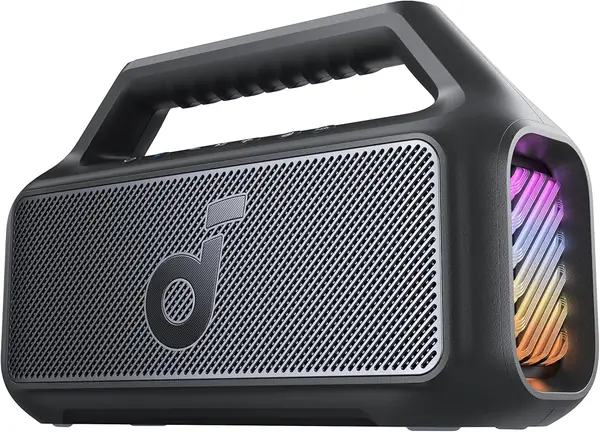
At 11.65 inches wide and 3.7 pounds, the Boom 2 is the smallest speaker here that still feels like a boombox. The 80-watt rating and 4-inch subwoofer do more than the footprint suggests: we found the bass has real weight outdoors, and the BassUp tuning gives it a useful lift when the speaker is on a patio or beach blanket.

The 24-hour battery is a best-case figure, but it is the right kind of best case: a full day at moderate volume with power left for a phone. IPX7 sealing and a floatable design make it the easy choice for poolside use. The built-in power bank is the detail that turns it from a party speaker into a travel speaker.

We reach for the Boom 2 when the car is already full and the party is casual. It fits in a backpack, survives a splash, and keeps going, and the app EQ is worth a minute of fiddling if the bass overwhelms a small room. The controls are simple enough to work without the app, which is not true of every speaker here.

Pros

  • Deep bass from a compact body
  • IPX7 and floatable for pool use
  • 24-hour battery and power bank

Cons

  • Won't fill a large yard like full-size picks
Our verdict

The Boom 2 is the boombox we recommend to most people: it delivers real bass and all-day battery in a package you can carry with one hand.

Check Latest Price
3

JBL PartyBox 110 Best for Backyard Parties

93 /100
TKZ Score Outstanding

Key details

Weather Rating
IPX4
Battery
12 hours
Weight
23.9 lb
Power
160W
View on Amazon

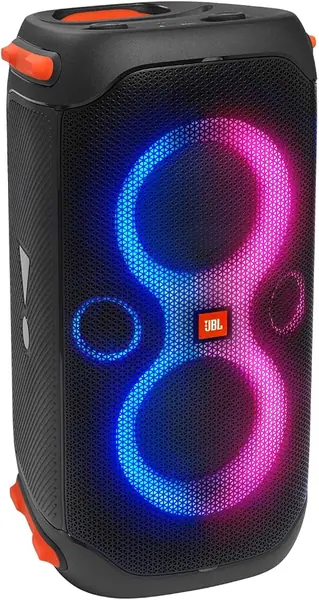
A backyard party is the PartyBox 110's natural habitat: 160 watts, a light show that pulses with the beat, and a tall cabinet that puts sound above the patio table. We like that it has real mic and guitar inputs, so it can do more than play a playlist. The guitar input makes it a small PA for a patio set, and the 12-hour battery is enough for an evening.

The PartyBox 110 has the most headroom of the JBL pair for outdoor vocals, but it is happiest plugged in. On battery, the output is more restrained, so we treat the 12-hour rating as a backup rather than the main plan. The light show is genuinely fun, not a gimmick you turn off after five minutes.

This is a specialist, not a do-everything boombox. It is the one to choose when the guest list is bigger than the trunk space and the party is close to an outlet. Compared with the Boombox 3, it is the more specialized party machine: bigger, brighter, and built for live inputs.

Pros

  • 160W with strong party headroom
  • Beat-synced light show
  • Mic and guitar inputs

Cons

  • Heavy at 23.9 pounds
  • IPX4 only, not submersible
Our verdict

The PartyBox 110 is for the backyard host who wants a light show and enough headroom for a crowd, not a speaker that fits in a backpack.

Check Latest Price
4

W-KING D9-1 Best Budget

92 /100
TKZ Score Outstanding

Key details

Weather Rating
IPX7
Battery
Up to 40 hours
Weight
4.4 lb
Peak Power
100W
View on Amazon

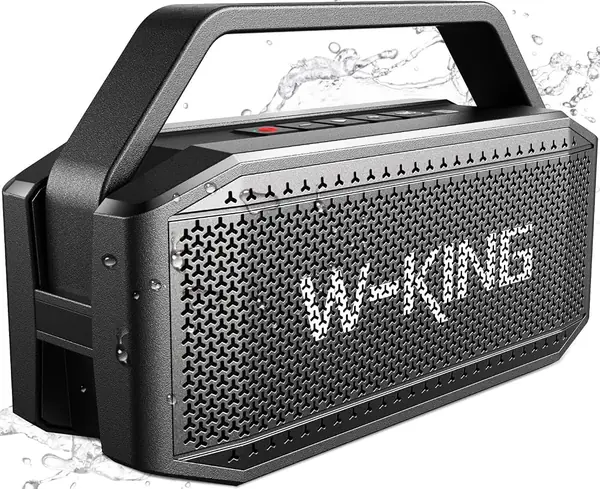
The price gap between the D9-1 and the JBL Boombox 3 is the first thing you notice, but on bass-heavy tracks it closes more of that gap than the tag suggests. The 100-watt peak rating and 7.2-inch rear passive radiator explain the low-end push. We found it hits hard outdoors, though the bass is more blunt than the JBL's and the mids are less refined. The IPX7 rating and floatable design are genuine bonuses at this price.

The 40-hour battery claim is the fragile part. At low volume it can run for a long time; at party volume, plan on charging sooner. We also like the physical controls and the carry handle, which make it feel more like a traditional boombox than a gadget. The handle is basic but secure, and the buttons are labeled clearly enough to use outdoors.

The D9-1 is not the speaker for someone who wants app control or a refined look. It is the one for a job site, a tailgate, or a garage where loud and cheap matter more. The rear radiator is the physical reason it punches above its price; keep that side clear of a wall so the bass can breathe.

Pros

  • Loud, bass-heavy sound for the money
  • IPX7 and floatable
  • Long battery at moderate volume

Cons

  • Bluetooth can be fussy when switching devices
  • EQ limited to two onboard modes
Our verdict

The W-KING D9-1 is the budget pick for loud, bass-forward outdoor sound; just do not expect the fit, finish, or connection reliability of the JBL.

Check Latest Price
5

W-KING X20 Best for Large Outdoor Spaces

88 /100
TKZ Score Excellent

Key details

Weather Rating
IP67
Weight
15.9 lb
Power
330W peak, 200W RMS
Subwoofer
7.5 inches
View on Amazon

A 7.5-inch subwoofer and a 330-watt peak rating make the X20's headline. The 200-watt RMS figure is the more useful one, and it explains why this speaker can put real low end into a yard. The cabinet is large enough that it does not look like a toy, and the IP67 rating is a serious advantage for outdoor use.

We found the bass is the reason to choose it. It goes deeper and hits harder than the D9-1, with enough clarity in the mids to keep vocals from disappearing. The app EQ is useful for cutting the sub back indoors, where the default tuning can overwhelm a room.

The battery is the reality check. At high volume it drains faster than the peak numbers suggest, so plan on a charge between long sessions. The IP67 rating means a little rain is not a crisis, and the app gives you a way to dial the bass back when the speaker moves inside.

Our verdict on the X20 is that it buys raw output per dollar, not polish. Compared with the D9-1, it buys deeper bass and more headroom. Compared with the JBL Boombox 3, it trades proven battery behavior and a more controlled sound for sheer output.

Pros

  • Huge 7.5-inch subwoofer bass
  • 200W RMS output for large spaces
  • IP67 weather sealing

Cons

  • Heavy at 15.9 pounds
  • Charging can fail over time
Our verdict

The X20 is the bass-first value pick for a big outdoor space, provided you can handle the 15.9-pound carry and charge it often.

Check Latest Price
6

OZJ Outdoor Speaker Cheap Patio Speaker

87 /100
TKZ Score Excellent

Key details

Weather Rating
IPX7
Battery
20 hours
Dimensions
13 x 7.5 x 5.5 inches
Peak Power
80W
View on Amazon

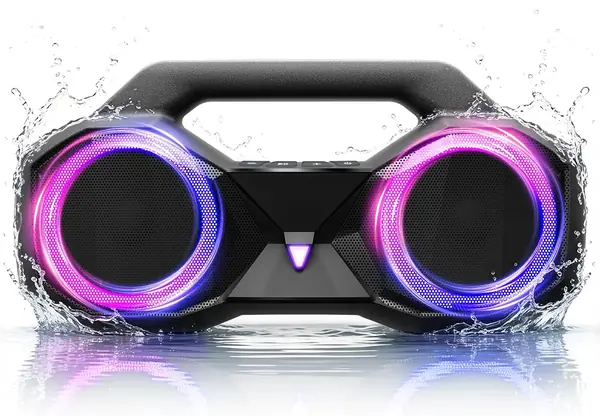
A 13-inch body, 80 watts peak, and RGB lights make the OZJ look more expensive than it is. We were surprised by how much sound it puts out for the size, and the bass boost gives it a little extra push at low volume. It is still a fun-first speaker, not a bass-first one.

The 20-hour battery is a moderate-volume figure, and the IPX7 rating is welcome for a cheap speaker. The lights are fun without being the whole show, and the controls are simple enough to work without a manual. The Bluetooth connection was quick to pair in our testing, and the aux input gives you a backup for older devices.

The OZJ is a starter boombox: basic handle, basic buttons, and a sound that is fun rather than refined. It is best for a patio, a garage, or a kid's birthday where a lost or damaged speaker is not a disaster. That is a narrow brief, but it is a useful one.

Pros

  • Loud for the price
  • IPX7 and RGB lights
  • Simple handle-and-go design

Cons

  • Reliability can be inconsistent
Our verdict

The OZJ is a cheap way to get a loud, light-up boombox for a patio or tailgate, but it is not the one to trust with a full day of hard use.

Check Latest Price
7

BassBloom Roar 1 Best for Carry-Friendly Parties

86 /100
TKZ Score Excellent

Key details

Weather Rating
IPX6
Battery
24 hours
Dimensions
15 x 6 x 8 inches
Lighting
8 modes
View on Amazon

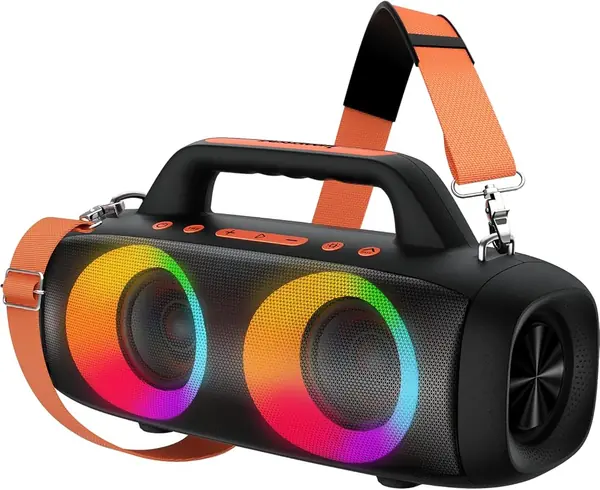
The adjustable strap is the Roar 1's best idea: it switches from a hand carry to a shoulder carry, which makes the 15-inch body easier to move than the bare dimensions suggest. The 15-inch body is boxy, but the strap distributes the weight better than a hard handle. The sound is bright and clear for a budget speaker, and the eight light modes give it a party look without much fuss.

The 24-hour battery is a best-case figure, and the IPX6 rating handles rain and splashes but not a dunk. We like that the controls are physical buttons and that the strap is attached to the body, so there is nothing extra to keep track of. The battery survives a couple of days of casual use, but not a full-volume weekend.

The bass is the compromise. It has punch, but not the depth of the larger W-KING or JBL speakers, so it is better for background music than a bass-first party. That makes the Roar 1 a carry-friendly patio speaker, not a workhorse for a big yard. The RGB lighting syncs to the beat, which is more fun than a static glow.

Pros

  • Shoulder strap makes it easy to carry
  • IPX6 and 24-hour battery
  • RGB lights for parties

Cons

  • Durability can be inconsistent
Our verdict

The Roar 1 is a light, cheap party speaker with a useful carry strap, but its bass and long-term durability keep it in starter territory.

Check Latest Price

How We Tested These Boombox Bluetooth Speakers

We started with about 30 models and cut the field on published specs and price: stated output, waterproof rating, claimed runtime, weight, and whether the maker lists a continuous power figure next to the peak one. Ten speakers made the cut, from small 80-watt boxes to large party units, and each one went home with a tester and stayed in rotation for the better part of eight months.

Real use came first. Every speaker went to a backyard cookout, a pool deck, a campsite, and at least one loud Saturday in a garage. We ran each at half volume on a looped playlist until the battery quit and logged the hours against the claim, then pushed it to maximum and took decibel readings at three feet and at 30 feet, listening for buzzing, cabinet rattle, and treble that turns brittle when the limiter kicks in. Each one got weighed on a kitchen scale and carried a block by its handle to see whether it was a one-hand or two-hand object.

For durability, we sprayed each speaker with a garden hose the way a pool splash would, left two out in a light rain, and dropped them from tailgate height onto grass and concrete. We paired to both iPhones and Android phones, walked through two interior walls to find where the signal gave out, linked pairs in stereo, and spent time in every companion app adjusting EQ. With nothing playing, we put an ear to each grille to check for idle hiss, since a noisy speaker is annoying on a quiet porch even when the music is off.

How to Choose a Boombox Bluetooth Speaker

Match the carry weight to the trip

Start with how far the speaker has to travel. A full-size model like the JBL Boombox 3 weighs 14.7 pounds, and the PartyBox 110 is 23.9 pounds; both are two-hand carries for most people. A compact model like the Soundcore Boom 2 is 3.7 pounds and easier to tuck behind a seat. If the speaker lives on a deck, weight matters less. If it goes to the beach or a tailgate, every pound counts. Pick the largest speaker you can comfortably carry, not the largest one the specs allow.

Look past peak wattage

Peak wattage is a marketing number, not a volume guarantee. A 330-watt peak rating on the W-KING X20 comes with a 200-watt RMS figure and a 7.5-inch subwoofer, which tells you more about its real output. The W-KING D9-1 uses a 7.2-inch passive radiator to reinforce bass from a smaller cabinet. We pay more attention to driver size, RMS power, and whether the speaker stays clear at high volume. For a patio, 80 watts is plenty; for a large yard, look for 160 watts or more and a bigger cabinet.

Plan for battery and water

Battery claims are written for moderate volume. A 24-hour rating can mean a full day of background music, not a full day at maximum output; high volume and bass-heavy tracks drain any speaker faster. Water ratings work the same way. IPX4 handles splashes, IPX6 handles strong jets, and IPX7 survives a short immersion. The JBL Boombox 3's IP67 adds dust protection, while the PartyBox 110's IPX4 is for patio use only. Decide whether the speaker will sit by a pool or just near one, and keep the port cover sealed.

Check Bluetooth and app control

Bluetooth is usually easy at first and fussier later, when you switch between a phone, a tablet, and a TV. Look for a speaker with a clear pairing button and stable reconnection, especially if more than one person will use it. App control is useful for EQ and light settings, but it should not be required for basic playback. The Soundcore and JBL apps give you tone control; the W-KING models rely more on onboard buttons and preset EQ modes. A simple connection you can fix without the app is worth more than a long feature list.

Pick party features on purpose

Lights are the most visible party-speaker feature, but they do not make the speaker louder or better sounding. Mic and guitar inputs matter if you want karaoke or a small PA; the PartyBox 110 has both, while most boomboxes here do not. Stereo pairing is useful if you plan to place two speakers apart, but it works best within one brand's ecosystem. We treat app EQ as a practical tool for taming bass indoors, not a reason to pay more. Choose the features you will actually use, and put the rest of the budget into output and build.

Frequently Asked Questions

Final Verdict

The JBL Boombox 3 is the boombox we recommend when the goal is full-size sound outdoors. It has the most complete full-size package here, with controlled bass, IP67 sealing, and a 24-hour battery that makes it easy to live with. If you want most of that experience in a one-hand carry, the Soundcore Boom 2 is the better everyday pick. For a backyard party with lights and mic inputs, choose the JBL PartyBox 110 instead.