Best Basic Running Watches of 2026

Basic running watches come with a tradeoff nothing in the category erases: the ones that run for years on one battery are the ones that won't tell you your pace per mile, and the ones that will want a charging cable every week. Either way they fix the same annoyance — your phone stops bouncing in your hand at mile three and your splits stop being guesswork. I've run with a watch for a decade, and my team just spent six months wearing 14 of them, from bare-bones digitals to an entry-level GPS model.

The details that separate a watch you keep from one that lands in a drawer rarely show up in a spec list. Can you read a split in direct sun at mile six? Does the alarm actually wake you at 5 a.m. without your phone? Does the stopwatch still match the clock months later, and does a large case look reasonable on a thinner wrist? The picks below cover racers chasing splits, people who want a durable timekeeper and nothing more, and the ground in between.

The Best Basic Running Watches

1

Timex Ironman Classic 30 Best Overall
93 /100
TKZ Score Outstanding

Key details

Water Resistance
100 m
Weight
0.8 oz
Lap Memory
30 laps
Countdown Timer
24 hours
View on Amazon

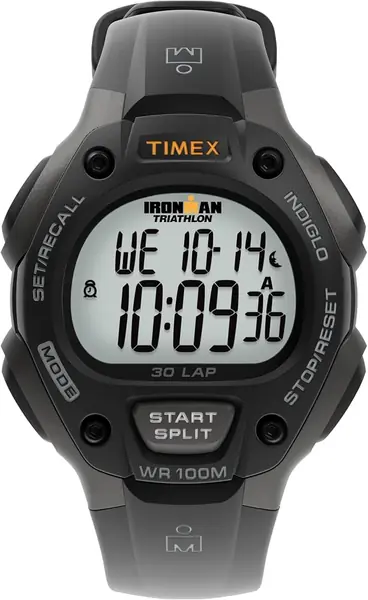
The chronograph is why this watch is our top pick, and the lap memory is why it's the chronograph. Thirty laps is enough for a full track session, and you can scroll back through the splits afterwards instead of trying to hold them in your head while your heart rate is still coming down. The countdown timer runs to 24 hours, so the same watch handles a 90-second repeat and a long day on your feet.

INDIGLO is the light that makes the difference on a dark morning. The whole dial glows a soft green rather than a single bulb throwing a spot at the numbers, and it stays readable at arm's length without wiping out your night vision. At 0.8 ounces the watch disappears on the wrist, which is the other half of why we keep coming back to it.

What it doesn't do is measure anything. There's no GPS and no heart rate here, so the watch assumes you already know your route. If you want distance and pace logged for you, the Garmin below is the one to read; the rest of this group is a timer in one shape or another.

Pros

  • Thirty-lap memory keeps every split
  • INDIGLO lights the full dial in the dark
  • Under an ounce on the wrist

Cons

  • Resin strap is the first part to fail
  • Small dial on a large wrist
Our verdict

For timed runs this is the watch we point people to: thirty laps of memory, an INDIGLO dial that reads at dawn, and under an ounce on the wrist.
Check Latest Price
2

Garmin Forerunner 55 Best with GPS

92 /100
TKZ Score Outstanding

Key details

Water Resistance
50 m
Weight
1.31 oz
GPS Battery Life
20 hours
Activity Profiles
17
View on Amazon

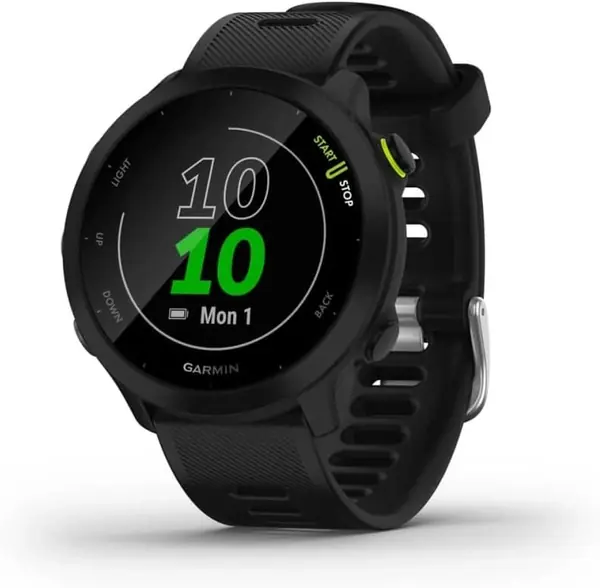
The extra money buys measurement. Built-in GPS logs distance, pace and a map of where you went, wrist heart rate comes along for the ride, and 17 activity profiles cover the days you swim or ride instead of run. At 37 grams with a 1.04-inch screen it wears like a running watch rather than a smartwatch, and we count that as the point.

The button controls are the part we appreciate most. Cold, wet fingers don't work a touchscreen, and the transflective display is brightest in direct sun, which is where you'll be using it. The free 5K, 10K and half-marathon plans plus Garmin's suggested daily workouts are the reason to pay for this over a plain lap timer: the watch hands you a session instead of an empty clock.

Two things to know before you commit. The menus run deep, and the first week is spent learning where everything lives. GPS is also worth checking against a route you already know the mileage of before you trust the splits. Battery is rated at 20 hours with GPS running, comfortably longer than a marathon, and it recharges rather than taking a coin cell.

Pros

  • Distance, pace and heart rate without a phone
  • Rated 20 hours of battery with GPS on
  • Free 5K to half-marathon training plans

Cons

  • Pace splits can wander from a measured route
Our verdict

Spend more only if you want distance, pace and heart rate recorded; this is the easiest way into GPS running in this group.

Check Latest Price
3

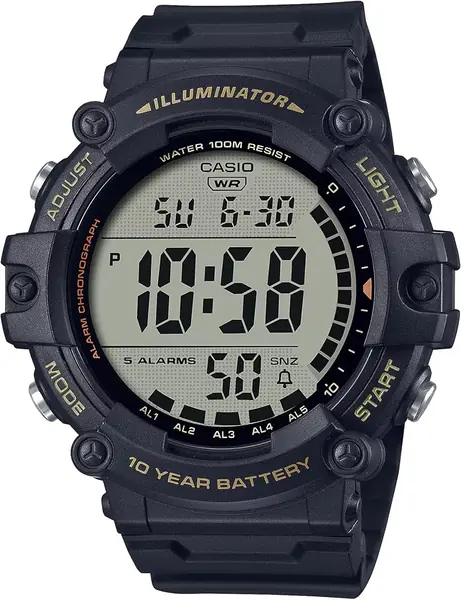
Casio AE1500WH Best Easy-Read Display

91 /100
TKZ Score Outstanding

Key details

Battery
10 years
Backlight
LED
Stopwatch
1/100 second
Alarms
5
View on Amazon

The display is the whole argument. These numerals are tall enough to read from a couple of arm's lengths away while you're moving, and the LED backlight keeps them legible once the light goes. If small watch faces have turned telling the time into a squint, start here.

The rest is standard Casio, and standard Casio is exactly what we want in a running watch: a 1/100-second stopwatch, a countdown timer, five alarms and a battery rated at ten years. Nothing to charge, nothing to pair, nothing to think about between runs.

Size is the trade. A big case is how you get digits that large, and on a narrow wrist it reads as oversized, though the watch itself isn't heavy. For steady runs, tempos and reading the clock from across the kitchen, it does the job with less fuss than anything else here.

Pros

  • Digits readable from a couple of arm's lengths
  • Ten-year battery and nothing to charge
  • Five alarms and a 1/100-second stopwatch

Cons

  • No lap memory, so splits are noted by hand
Our verdict

Our pick for anyone who wants to read the time mid-run without breaking stride: big digits, no charging and a very small outlay.

Check Latest Price
4

Casio W735H Best with Silent Alarm

90 /100
TKZ Score Outstanding

Key details

Water Resistance
100 m
Battery
10 years
Stopwatch
1/100 second
Light
Super Illuminator LED
View on Amazon

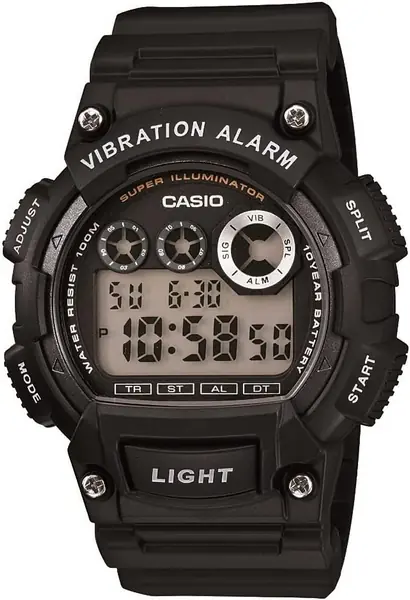
A 5:40 alarm that only you can hear is the reason to choose this watch. Set the daily alarm and it buzzes against your wrist instead of beeping, and the vibration runs off the countdown timer too, so you can program an interval session and feel each rep end rather than hear it. In a shared room or a house full of light sleepers, that's worth more than any extra feature on this list.

What we like most after the vibration is the light: a Super Illuminator LED that genuinely lights the dial rather than hinting at it. Around that sit 100 m of water resistance, a 1/100-second stopwatch, dual time and a battery rated at ten years. It wears bigger and more G-Shock than the flat digitals here, and the case has shrugged off knocks without a mark that matters.

The vibration is on the gentle side, and a heavy sleeper can sleep straight through it, so set a phone alarm for the sessions you can't miss. That's the one compromise in a watch that otherwise suits dark, quiet, wet mornings better than anything else here.

Pros

  • Silent vibration alarm for early starts
  • Countdown timer vibrates at each interval
  • Super Illuminator light and 100 m water resistance

Cons

  • Vibration is gentle enough to sleep through
Our verdict

Set it and the alarm buzzes quietly on your wrist - this is the watch we choose for early runs in a sleeping house.

Check Latest Price
5

CakCity Digital Sport Watch Big-Face Visibility

89 /100
TKZ Score Excellent

Key details

Water Resistance
50 m
Backlight
EL
Face Width
50 mm
View on Amazon

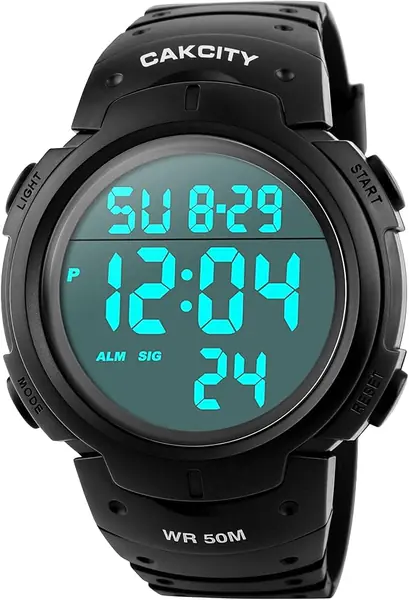
This is the least expensive watch in the group, and the one with the biggest face. A 50 mm case puts up numerals you can read from across a room, the EL backlight lights them for a night run, and 50 m of water resistance covers sweat, rain and a shower afterwards.

We kept it on the list because reading the time shouldn't require slowing down. At a glance, which is how you'll use it mid-run, the display does what you need, and the stopwatch and alarm are simple enough to set without instructions. What you give up is fit and finish: this reads as a beater rather than a keeper.

One quirk worth knowing: the backlight is brightest from a slight angle and washes out when you look straight down at it. Tilt your wrist as you lift it and the numbers come up fine. For a watch that will get knocked against fences and thrown in a gym bag, that's a fair trade.

Pros

  • 50 mm face is readable at a distance
  • Bright EL backlight for night runs
  • Least expensive watch in this roundup

Cons

  • Band is the part that fails first
Our verdict

The least expensive way to get a big, readable running timer on your wrist - we treat it as the one that can get knocked around.

Check Latest Price

How We Tested Basic Running Watches

We built the shortlist by pulling digital watches that listed a stopwatch, a backlight, and at least 50 meters of water resistance, then cross-checked the specs against what owners actually complain about — dim displays, alarms too quiet to wake anyone, straps that crack within a year. From that group we ordered 14 watches and tested them for six months.

Each one went on the same four-mile road loop, a high school track for intervals, and a treadmill when it rained, and each spent at least a week as my everyday watch — at a desk, in the shower, overnight on a nightstand. I started and stopped the stopwatch mid-run without breaking stride to see whether the buttons were findable by feel, counted how many presses it took to get from the home screen to a running timer, and read each display outdoors at noon to judge glare and contrast.

For accuracy, I ran the stopwatch alongside a phone timer over the same measured route and checked for drift at the end. Durability got the unglamorous treatment: every watch was soaked, dropped onto tile from waist height, and worn through sweaty long runs so I could watch the strap, bezel, and case for wear. I rated alarms by whether they woke me from across the room, tried each case size on wrists from about 6 to 8 inches, and logged battery drain monthly, because the value question comes down to real lifespan rather than what the box promises.

How to Choose a Basic Running Watch

Decide What the Watch Should Count

Every watch here times a run; the difference is what happens at each split. A plain stopwatch counts up and stops, which is fine for a steady three miles and close to useless for eight 400s unless you write the numbers down as you go.

Lap memory does the bookkeeping for you - the Timex Ironman holds 30 laps, so a whole track session is still there afterwards. If you run intervals, pay for the laps. If you run steady, skip them and use the countdown timer instead, restarting it at the top of each rep.

Check the Light Before the Feature List

The backlight is the spec most buyers skip and the one they notice at 6 a.m. in November. What you want is a light that covers the digits rather than a small bulb throwing a spot at one corner of the dial; a wash of even light is readable at arm's length mid-stride, while a weak one leaves you tilting your wrist to find the numbers.

Among the picks here, the Casio AE1500WH and W735H both illuminate the whole face, and the Timex's INDIGLO panel is the easiest of the lot to read at speed. If you run in daylight only, this matters far less than lap memory.

Weigh the Wrist Load: Size, Weight and Strap

An ounce on your wrist sounds irrelevant until mile six. The Timex at 0.8 ounces disappears; the 50 mm CakCity is light for its size but still a big object on a small arm, and a wide case can catch on a jacket cuff or a glove.

Case size cuts both ways - a compact face is neat on a slim wrist and skimpy if you like big numerals - so try the diameter against a watch you already wear. Then look at the strap, because on resin watches it is the part that gives out first.

Buy GPS Only If You Want the Numbers

GPS changes the job. A satellite watch logs distance, pace and a map, pairs with an app so the run still exists tomorrow, and in the Forerunner 55's case adds heart rate and training plans. That is a different purchase from a chronograph, and it costs more.

The trade is charging: 20 hours of GPS running covers a marathon several times over, but it is not the decade a coin-cell Casio manages. If you already know your routes and just want splits, a basic chronograph does the job and never asks for a cable.

Frequently Asked Questions

Final Verdict

Our default is the Timex Ironman Classic 30. It is the only watch here that remembers your laps, INDIGLO makes a dark morning readable, and at 0.8 ounces you forget you put it on. For timed running, that combination ends the search.

One requirement changes the answer: if you want distance, pace and heart rate recorded without carrying a phone, stretch to the Garmin Forerunner 55 and check its GPS against a route you already know. If you only want the clock legible mid-run and nothing to charge, the Casio AE1500WH is the quieter buy.