Best Backpacking Tripods of 2026

The best light of the day shows up somewhere you had to hike to, which is why so many of us carry a couple of pounds of metal up a mountain for one photograph. A good backpacking tripod has to disappear on the climb and then hold dead still when the wind picks up. Over the past six months, my team and I have hauled 12 of them up trails, from palm-sized carbon minis to full-height aluminum models.

Two things matter more than any line on a spec sheet. Five-section legs fold shorter, which is what you want strapped to a pack, but every extra joint is a place to flex. And if a tripod only reaches eye level with the center column cranked all the way up, you have effectively built a monopod.

Check the head before the legs, too. A ball head that takes a standard Arca-type plate will hold a phone clamp one day and a camera the next. Keep going for the ones that survived — including a couple of bargains.

The Best Backpacking Tripods

1

K&F Concept 64-Inch Tripod Best Overall
93 /100
TKZ Score Outstanding

Key details

Weight
2.54 lb (1.15 kg)
Max Height
64.1 in
Folded Size
15.5 in
Load Capacity
17.6 lb
View on Amazon

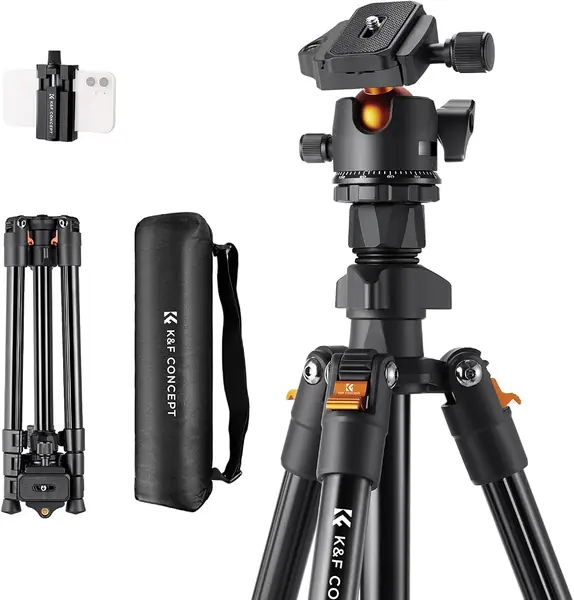
A 15.5-inch folded tripod that stands 64 inches tall is the combination most backpackers are chasing, and the K&F Concept 64-inch delivers it without carbon-fiber pricing. The four-section legs use flip locks rather than twist collars, so height changes happen in seconds, and the 36mm ball head carries a 17.6-pound rating. We like that the head uses an Arca-style plate and the kit includes a phone holder; it turns one support into a camera and phone tool.

What earns it the top spot is the ratio, not one headline number. The folded package fits a pack's side pocket, the legs reach eye level for most adults, and the 17.6-pound load rating leaves room for a mirrorless body and a modest zoom. At full height the legs are close to their limit, so we treat 64 inches as a calm-day height and drop the center column when the wind picks up. That is a fair compromise for a tripod that still feels planted at chest height.

The ball head is the detail that makes it feel more expensive than it is. It pans smoothly, holds a camera without drooping, and swaps to the phone holder without tools. The reversible center column is the feature we use most, though: it drops the camera low for ground-level shots without making us lie in the dirt, and it goes back up without tools.

Pros

  • Folds to 15.5 inches yet reaches 64.1 inches
  • 17.6-pound load rating suits a real camera kit
  • Flip locks and Arca-style plate speed setup

Cons

  • 2.54-pound carry is heavy for long hikes
Our verdict

Buy it if you want one compact tripod that reaches full height and carries a real camera kit without carbon-fiber pricing.
Check Latest Price
2

Cayer CH35 Travel Tripod Best Ultralight Full-Height

90 /100
TKZ Score Outstanding

Key details

Weight
1.54 lb (0.7 kg)
Max Height
53.6 in
Folded Size
17.7 in
Load Capacity
11 lb
View on Amazon

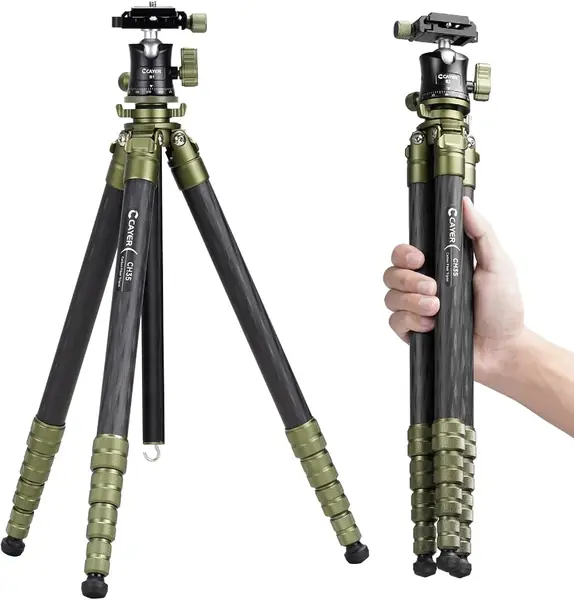
The Cayer CH35 is the lightest full-height tripod in this group, with a 53.6-inch top height and a listed 1.54-pound carry. That is the number that matters when the tripod rides on a pack for miles. It uses five-section carbon legs, a 42mm ball head, and an Arca-type plate, and the folded length is 17.7 inches. Cayer also includes a short center column, a phone clamp, and a carry case.

The 42mm ball head is the surprise. It is larger than the tripod's weight suggests, and it holds a small mirrorless kit without the creeping that plagues tiny heads. The short column drops the camera to 6.1 inches for ground-level shots, and the phone clamp means one support covers stills and video. Those are the details that make the CH35 feel like a travel tripod rather than a weight-saving exercise.

What we appreciate most is that Cayer did not shrink the head to hit the low weight. That choice is why the CH35 feels like a travel tripod rather than a weight-saving exercise. The trade-off is the low weight itself in exposed wind; we hang a pack from the center column or drop the height when the wind is up. For a hiker who counts ounces, that is a fair exchange.

Pros

  • 1.54-pound carbon build reaches 53.6 inches
  • Large 42mm ball head and Arca-type plate
  • Short column drops to 6.1 inches for low angles

Cons

  • Five-section legs take longer to set up
Our verdict

Buy it if you want the lightest full-height tripod here and will trade a little setup time for the carry weight.

Check Latest Price
3

AOKA CMP163CL Mini Tripod Best Minimal Pack Size

89 /100
TKZ Score Excellent

Key details

Weight
1.14 lb (520 g)
Max Height
27.9 in
Folded Size
14.6 in
Load Capacity
6.6 lb
View on Amazon

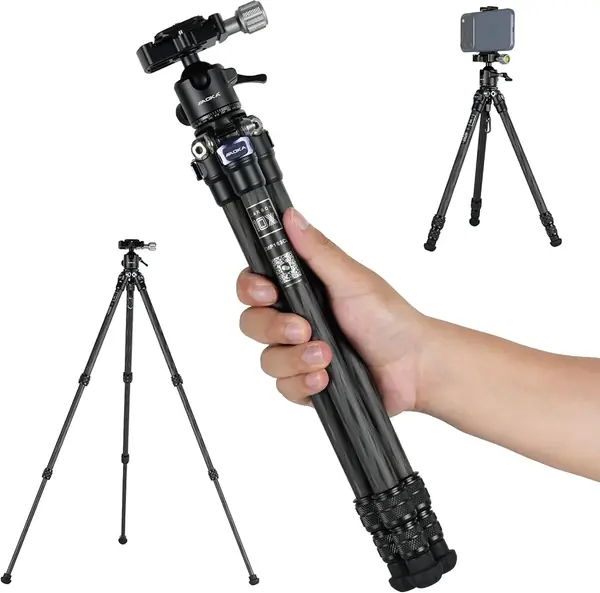
The AOKA CMP163CL is the tripod that disappears into a daypack: 1.14 pounds, 14.6 inches folded, and only 2 inches around. The carbon legs and 360-degree ball head are built for low-angle work, and the 6.6-pound load rating covers a phone, action cam, or small mirrorless body. We like it for trips where the camera gear has to share space with water, layers, and lunch.

At full extension with a camera aboard, the little legs can feel wobbly; we keep the column down and use it close to the ground. The ball head is smooth enough for precise framing, and the phone holder means it can switch from landscape stills to a quick video without extra hardware. It is not a tripod for a full DSLR or a long lens, and that is fine for the job it is built to do.

We kept coming back to the packed size: it slides into a bottle pocket and does not force a choice between water and camera gear. The low height is not a defect for that shot; it is the reason the tripod fits at all.

Pros

  • Folds to 14.6 inches and 2 inches around
  • 1.14-pound carbon build slips into a daypack
  • 360-degree ball head with phone holder

Cons

  • 27.9-inch top height is too low for eye-level shots
Our verdict

Buy it if your pack space is the hard limit and your shots are low, close, or phone-first.

Check Latest Price
4

SIRUI Traveler X Best Premium Video Kit

88 /100
TKZ Score Excellent

Key details

Weight
2.09 lb (0.95 kg)
Max Height
59.8 in
Folded Size
13.9 in
Load Capacity
11 lb
View on Amazon

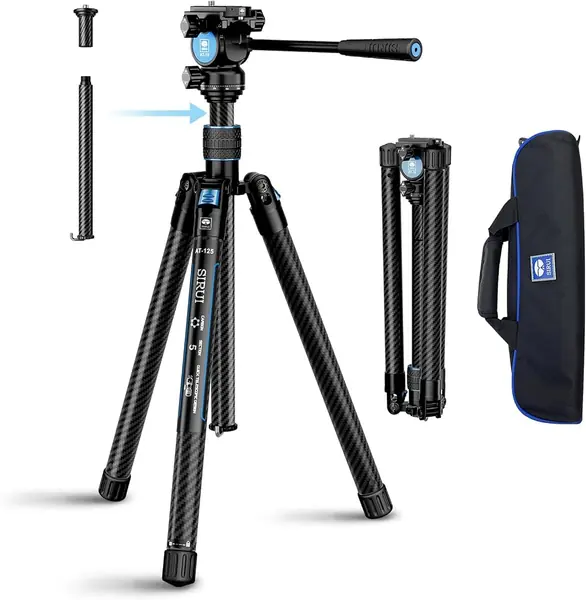
At 13.9 inches folded and just over two pounds, the SIRUI Traveler X packs like a carbon tripod should, but the AT-10 fluid head is what makes it different. The 3K carbon legs use a single twist lock to extend each section, the center column reverses for low-angle work, and the kit is rated to 11 pounds. SIRUI backs it with a six-year warranty, the longest here.

We like the fast leg release: one twist extends a leg, which is quicker than working five separate collars. The head is the compromise. It pans smoothly for video, but vertical framing is limited compared with a ball head, and the twist locks need a firm hand. For stills, the ball-head picks are more flexible; for a backpacking film project, its weight and folded size are the reason to choose it.

The reverse-folding legs protect the head in transit, and the 13.9-inch package fits inside a pack rather than strapped to the outside. At 59.8 inches it is tall enough for most standing shots, though we keep it below full height in a strong wind. The six-year warranty is the detail that makes the premium easier to justify.

Pros

  • 2.09-pound carbon build folds to 13.9 inches
  • Single-twist leg release is very fast
  • Fluid head pans smoothly for video

Cons

  • Premium price for the weight savings
Our verdict

Buy it if you want a sub-2.5-pound carbon tripod with a fluid head and fast legs, and you can live with limited tilt.

Check Latest Price
5

Amazon Basics 50-Inch Tripod Best Budget

87 /100
TKZ Score Excellent

Key details

Weight
1.23 lb (640 g)
Max Height
50 in
Folded Size
16.9 in
Load Capacity
4.4 lb
View on Amazon

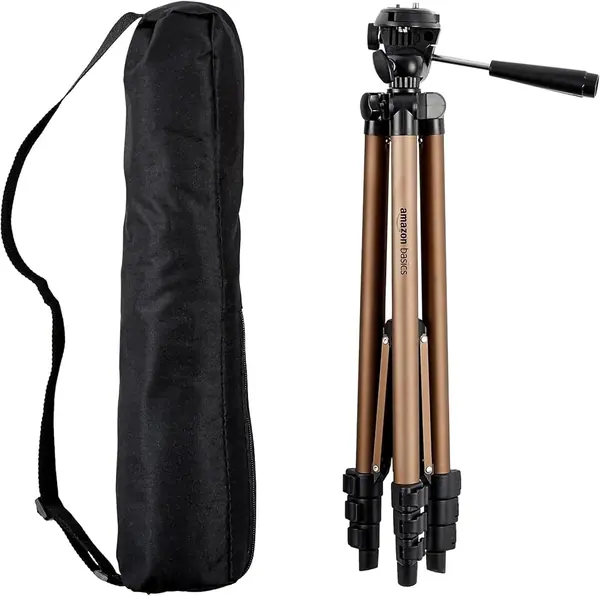
The Amazon Basics 50-inch is the tripod we hand to a first-time backpacker who is carrying a phone or a small camera. It weighs 1.23 pounds, folds to 16.9 inches, and extends from 16.1 to 50 inches with three-section lever-lock legs. The three-way head has a bubble level and a quick-release plate, and the kit includes a carry bag.

The 4.4-pound load rating is the line in the sand: a phone, action cam, or entry DSLR with a kit lens is fine, but a telephoto lens is not. The three-way head is simple to aim, though the pan movement can be a little jerky. At full height the tripod can feel light in a breeze, so we keep a hand on it or shorten the legs when the wind picks up.

What we appreciate is the simple math: light enough to carry, tall enough for a sunset, and cheap enough to leave in the pack without worry. The quick-release plate is the detail we use most, because it lets us move from tripod to handheld without unscrewing the camera. For a phone and a few sunrise shots, it does the job without making you baby the pack weight.

Pros

  • 1.23-pound carry and 16.9-inch fold
  • 50-inch height with a bubble level
  • Quick-release plate and three-way head

Cons

  • Legs and plastic fittings can fail after a knock
Our verdict

Buy it if you need a light, cheap tripod for a phone or small camera and will keep it out of rough handling.

Check Latest Price
6

SmallRig AP-30 Travel Tripod Best Budget Tall

85 /100
TKZ Score Excellent

Key details

Weight
2.55 lb (1,155 g)
Max Height
67.7 in
Folded Size
21.2 in
Load Capacity
11 lb
View on Amazon

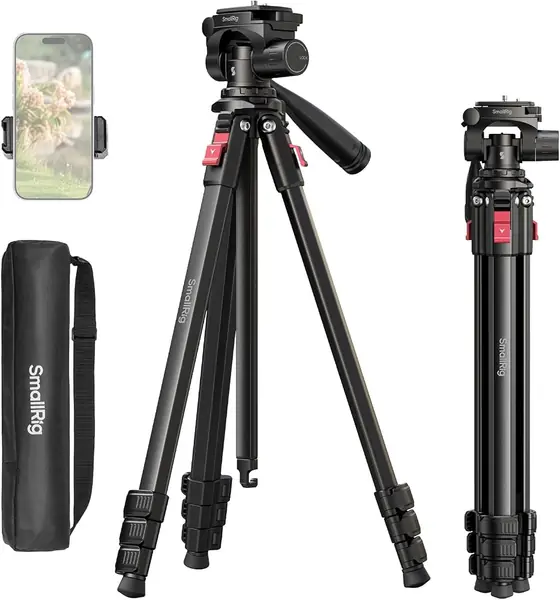
The SmallRig AP-30 is a tall tripod at a budget price: 67.7 inches of height, an 11-pound load rating, and a folded length of 21.2 inches. We see it as a camp tripod rather than a fastpacking one. The fixed center axis is meant to make the legs more stable, and the foldable hook gives you a place to hang a pack for ballast. The quick-flip locks are easy to work with cold hands, and the kit includes a phone clamp and a storage bag.

The height is the reason to choose it. It stands eye level for most adults, which makes it useful for group photos, camp time-lapses, and phone video. The quick-flip locks and fixed center axis keep setup simple, and the phone clamp is a useful extra for a trip where the camera stays in the bag. The 3/8-inch thread on the legs means you can swap the head later, which is more flexibility than most budget tripods offer. At camp, the height is what you notice; on the trail, the folded length is what you feel.

Pros

  • 67.7-inch height for camp and group shots
  • Hook accepts a pack for ballast
  • Quick-flip locks and phone clamp

Cons

  • 2.55 pounds and 21.2-inch fold limit packability
  • Avoid lenses over 70mm
Our verdict

Buy it if you want a tall, cheap camp tripod and do not need to carry it inside a small pack.

Check Latest Price
7

K&F Concept 60-Inch Carbon Tripod Best for Compact Carbon Features

84 /100
TKZ Score Excellent

Key details

Weight
2.2 lb (1 kg)
Max Height
60 in
Folded Size
13.7 in
Load Capacity
17 lb
View on Amazon

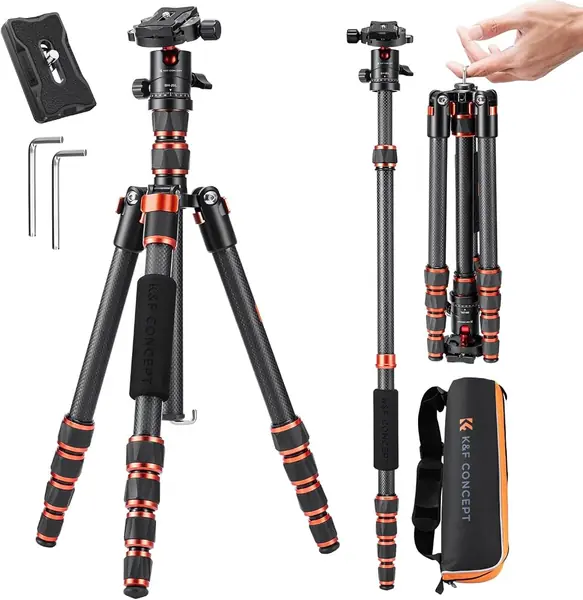
The K&F Concept 60-inch carbon tripod folds to 13.7 inches and converts one leg into a monopod, which is the kind of feature that makes a backpacker look twice. The carbon body weighs 2.2 pounds, the 25mm ball head is rated to 17 pounds, and the five-section legs use twist locks. The center column reverses for low-angle work, and the kit includes a quick-release plate.

The folded size is the real draw: 13.7 inches is short enough to live inside a daypack, and the monopod conversion gives you a second tool without a second pole. At 60 inches it is tall enough for standing shots, though the five-section legs are not as planted as the aluminum K&F 64-inch when fully extended. We shorten it in wind and use the lower height.

The leg locks are the part to watch. They can work loose with use, so we check each collar before a trip and tighten as needed. That maintenance is the difference between a tripod that lasts and one that surprises you on a ridge.

What keeps it on the list is the feature set: 60 inches of height, a 13.7-inch fold, and a monopod conversion at 2.2 pounds. The 17-pound load rating is more than a mirrorless kit needs, which leaves room for a small video head without pushing the legs.

Pros

  • Folds to 13.7 inches with a monopod leg
  • 2.2-pound carbon build at 60 inches
  • 17-pound load rating and reversible column

Cons

  • Five-section legs take longer to extend
Our verdict

Consider it if you want a compact carbon tripod with a monopod leg and will stay on top of the leg locks.

Check Latest Price

How We Tested Backpacking Tripods

I started with every tripod I could find that folded short enough to ride a pack's side pocket and weighed under three pounds with the head attached, then narrowed by head type, plate standard, and price until I had 12 worth carrying. Testing ran six months: day hikes, a handful of overnights, and a lot of dusk sessions on ridgelines where the light goes fast.

Portability got measured, not guessed. I weighed each one on a kitchen scale with head and plate on and checked its folded length against the actual side pocket of my pack. For ease of use, I set each up and broke it down in the dark, wearing gloves, timing it and noting where I fumbled — flip locks versus twist collars, how far the legs splay, whether the center column reversed without a fight.

Adjustability and stability went together. I loaded each tripod with a camera and lens close to its rated capacity, raised it to eye level, and tapped the center column with a fingernail to watch how far the frame shook, then shot a horizon line in a crosswind and checked the viewfinder for drift. Durability came from use: rock, gravel, wet sand, legs yanked to full extension and collapsed again hundreds of times, then a look for grit in the locks and play at the joints.

Compatibility surprised me. I clamped a phone in a case to see whether it slipped, and swapped plates between tripods to see what fit standard Arca-type clamps. Appearance I judged honestly, by checking paint and anodizing after months in a pack. And I kept price in view the whole way, because one that costs less and holds steady beats a nicer one that shivers.

How to Choose a Backpacking Tripod

Start With Packed Size, Not Maximum Height

A tripod that folds to 15 inches is easier to live with than one that folds to 21 inches, even if the longer one stands taller. Check both folded length and diameter: a slim 14.6-inch tripod can slide into a bottle pocket, while a thicker 17.7-inch model may need a side strap. For most backpackers, 14 to 18 inches folded is the sweet spot; below that you are usually giving up height, and above it the tripod starts to dictate how you pack. We prioritize a compact fold and a head that stays protected.

Match the Head to the Way You Shoot

Ball heads are the better default for stills: one knob loosens the camera for quick framing, and the Arca-style plates on several picks here swap between camera and phone. A fluid head pans smoothly for video, but it can limit vertical framing for stills, so choose one only if moving footage is the priority. If you shoot both, a ball head with a separate phone clamp is the more flexible kit. Check the plate type before you buy; a proprietary plate can lock you into one system.

Stability Comes From the Legs and How You Use Them

Stability is not a single specification. Leg diameter, lock quality, foot shape, and the center column all matter, and a light tripod can be steady at chest height and nervous at full extension. We treat maximum height as a calm-day number: drop the column, spread the legs, and hang a pack from a hook when the wind picks up. A 2-pound carbon tripod can outperform a heavier aluminum one if the legs are stiffer and the locks hold. Buy for the height you will actually use, not the tallest number in the listing.

Read Load Ratings and Leg Locks Together

A 17-pound load rating sounds generous until you put a long lens on a small ball head. The rating tells you what the head and legs can hold, not how comfortably they will hold it; small tripods are happiest with mirrorless cameras, phones, and short lenses. Leg locks are the other long-term question. Flip locks are fast, twist locks pack smaller, and five-section legs have more collars to check. Before a trip, extend every section and make sure each lock holds; a leg that slips on a ridge is worse than a few extra ounces.

Decide How Much Setup Fuss You Will Tolerate

Setup speed matters more on a backpacking trip than in a studio. A three-section flip-lock tripod is quick; a five-section twist-lock tripod packs shorter but takes longer to raise. If you shoot often, pay for the faster system. If the tripod comes out once a day for a sunset, the slower one is fine. We also look for a hook or a way to add ballast, because the lightest tripods are the ones most likely to need it.

Frequently Asked Questions

Final Verdict

For most backpackers, start with the K&F Concept 64-Inch Tripod. It is the best balance of folded size, height, and load in this group. Choose the Cayer CH35 if you will pay for the lightest full-height package, or the AOKA CMP163CL if your pack has more room for water than for a tripod. The SIRUI Traveler X is the video-first exception.