Best Wireless Earbuds for Running of 2026

The earbuds I liked best on the couch were the first to betray me on a run. One dropped onto the sidewalk around mile three, and I finished the loop with a bud in my fist. Fit is the whole job: sound, battery, and noise canceling only count if the thing stays put while you sweat. We've spent six months running in 13 pairs to find the ones that do.

Open-ear clips and hooks make real sense in this category. Sealed buds with active noise cancellation give you the fullest sound, but they also shut out the cyclist calling his pass; open designs trade some bass for hearing the world. And ignore the playtime on the box until you check whether it includes the case — on plenty of these, the buds alone deliver a fraction of the advertised number.

The picks below earned their spots on stay-put fit, comfort past the hour mark, and connections that didn't stutter. Whether you want to disappear into a treadmill run or hear traffic on the road, there's one here for how you train.

The Best Wireless Earbuds for Running

1

Soundcore Sport X20 Best Overall
88 /100
TKZ Score Excellent

Key details

Fit
Rotatable, extendable ear hooks
Battery Life
12 hrs buds; 48 hrs case
Water Resistance
IP68
Noise Control
Active noise cancellation
View on Amazon

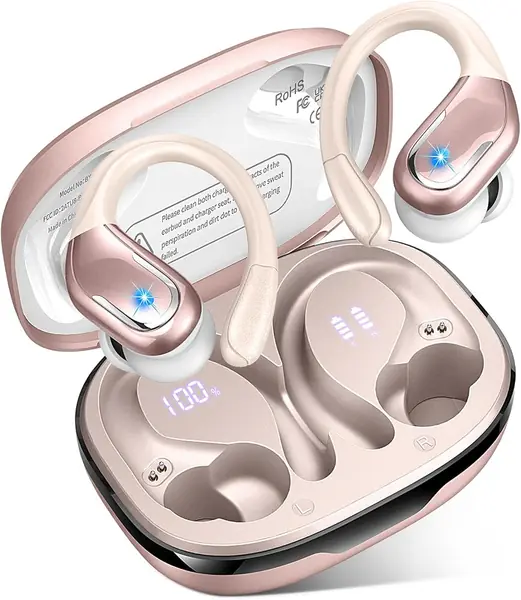
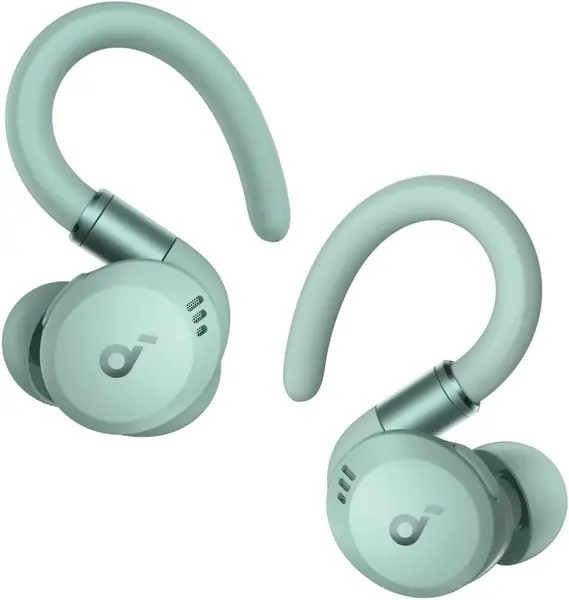
The Sport X20 starts with the two things a running earbud needs most: a hook that can be adjusted and a shell that can take a soaking. The ear hooks rotate up to 30 degrees and extend 4mm, so you can move the bud closer to the canal or away from a pressure point. The IP68 rating covers dust and water, which is a step above the sweat-resistant claims on most open-ear designs. That combination is why it sits at the top of this list.

We rank it as the best overall because it is the rare sport earbud that works for both a loud gym and a road run. The in-ear seal gives you bass and isolation, active noise cancellation quiets the treadmill, and transparency mode lets traffic back in. We like having that switch on the earbud rather than digging for the phone. The 11mm drivers and BassUp tuning give it more low-end than the open-ear picks, which matters if your running playlist needs momentum.

Battery life is rated at 12 hours in the buds and 48 hours with the case, so the case can carry you through a week of short runs without a charge. The case charges over USB-C. The touch controls are responsive, and the app adds EQ and HearID tuning if you want to adjust the sound. The fit is the main reason to choose it over the open-ear options: it seals, so you give up some natural awareness unless you switch to transparency.

The hook design is the detail that tips it for us. A fixed hook can feel either tight or loose; this one gives you a range to work with. That adjustability, plus the IP68 shell, is what makes the Sport X20 the safest default for a runner who wants one pair to handle sweat, rain, and focused training. The open-ear picks are better if you refuse to give up traffic noise, but they cannot match this level of isolation.

Pros

  • IP68 protection is the strongest here
  • Hooks rotate and extend for a dialed fit
  • ANC and transparency cover gym and road

Cons

  • Charging faults can appear after months of use
Our verdict

The Sport X20 is our top pick for most runners: IP68 protection, adjustable hooks, and noise cancellation make it the most complete sport earbud here.
Check Latest Price
2

Soundcore V20i Best Budget Open-Ear

87 /100
TKZ Score Excellent

Key details

Fit
Four-position adjustable hooks
Battery Life
8 hrs buds; 36 hrs case
Water Resistance
IP55
Driver
16mm dynamic
View on Amazon

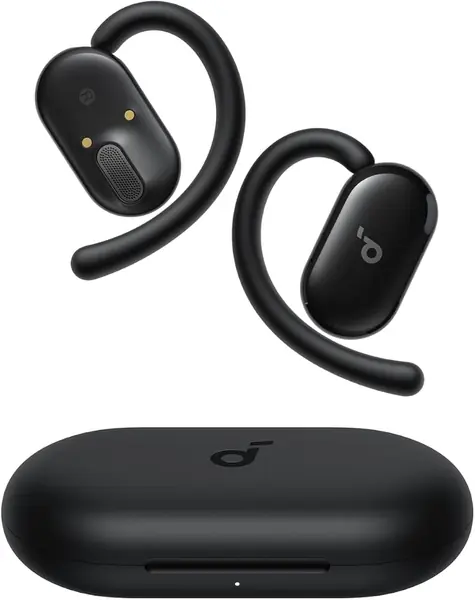
The V20i is the open-ear pair we recommend when the budget is tight but you still want a running-specific fit. The hook has four adjustable positions, so you can rotate the bud to sit closer to the ear or farther out. That sounds like a small thing until you have worn a fixed hook that pinches at the top of the ear. The open-ear shape leaves the canal clear, so traffic and footsteps stay audible.

At 8 hours in the buds and 36 hours with the case, the battery is sized for daily runs rather than a multi-day trip. The 16mm drivers give it more body than the tiny open-ear designs, and the four mics with AI call processing are useful for quick check-ins. We like the touch controls for volume and track changes, though the open-ear fit means you will not get the bass or isolation of a sealed bud. That is the trade-off, and it is the right one for a road runner who wants awareness.

The fit is the reason this one earns a spot. The hook is light, the four positions cover a range of ear shapes, and the IP55 rating handles sweat and light rain. We noticed that the open-ear design is more comfortable for long wear than a sealed bud, especially if you do not like the feeling of a tip inside your ear. The case is small enough to drop in a pocket, and the battery readout is easy to see.

This is not the pair for a loud gym or a flight; the Sport X20 is the better choice there. The case is small enough for a shorts pocket, and the four-position hook is the detail that makes it work on a run.

Pros

  • Four hook positions dial in the fit
  • IP55 handles sweat and light rain
  • Open-ear design keeps traffic audible

Cons

  • Battery life is uneven in longer use
  • Long-term reliability is a question mark
Our verdict

The V20i is our budget open-ear pick: four hook positions, IP55 sweat protection, and a comfortable fit that lets you hear the run around you.

Check Latest Price
3

TOZO OpenEarRing Best for Situational Awareness

86 /100
TKZ Score Excellent

Key details

Fit
Clip-on ear hooks
Battery Life
10 hrs buds; 40 hrs case
Water Resistance
Water resistant
Connectivity
Bluetooth 5.4
View on Amazon

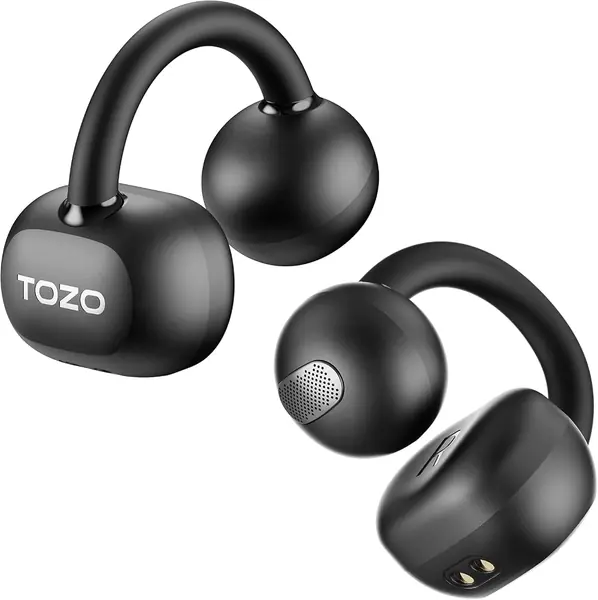
The OpenEarRing is built around a clip-on shape that sits outside the ear canal, and that is the whole reason to consider it. If in-ear tips make your ears ache or you have piercings that get in the way, the clip leaves the canal completely clear. The 10mm driver and open-ear design put sound at the edge of your ear rather than inside it, so you hear your playlist and the street at the same time. It is a different feel from a hook that wraps over the top of the ear.

The clip is light and the case is small enough to carry, and the 40-hour total playtime is enough for a week of runs. The case has a digital display that shows the charge, which is a small convenience we appreciate when you are heading out the door. The touch controls are on the earbud, and the app adds 32 EQ presets if you want to tune the sound. The fit is secure for most ears, but the clip needs to sit in the right spot; if it feels loose, adjust it before you start moving.

We rank it as the awareness-first pick because it keeps the road audible without the pressure of a sealed bud. The open-ear design is also easier to wear for long stretches, and the clip does not interfere with a hat or sunglasses as much as a full hook can. The trade-off is bass and isolation: this is not the pair for a noisy gym or a treadmill session where you want to disappear into the music. The Sport X20 is the better choice for that.

The clip is the one design here that leaves both the canal and the top of the ear clear. If that sounds like the pressure point you want to avoid, it is the pair to try.

Pros

  • Clip-on shape avoids ear-canal pressure
  • 40-hour total battery with display
  • Open-ear awareness for road runs

Cons

  • No published IP rating for sweat and rain
Our verdict

The OpenEarRing is the comfort-first pick for runners who dislike in-ear pressure, with a secure clip and a 40-hour case.

Check Latest Price
4

JBL Endurance Zone Best Rugged Open-Ear

85 /100
TKZ Score Excellent

Key details

Fit
Silicone earhook, memory wire
Battery Life
8 hrs buds; 32 hrs case
Water Resistance
IP68
Connectivity
Bluetooth 5.3
View on Amazon

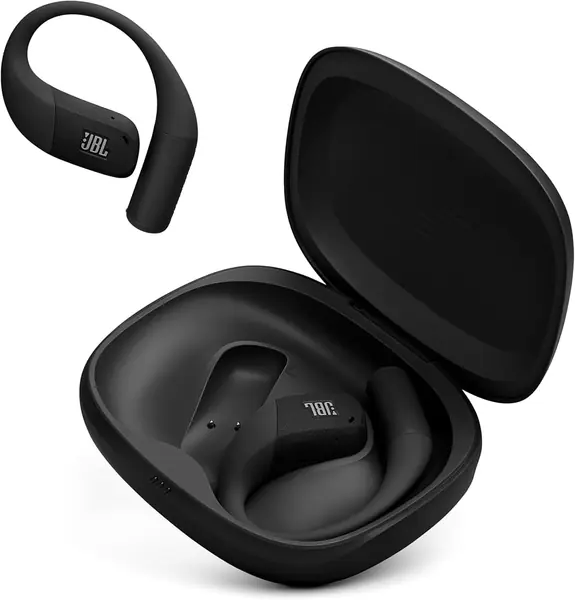
The Endurance Zone and the Sport X20 share the same IP68 rating, but they solve different problems. The Sport X20 seals the canal for isolation and noise cancellation; the Endurance Zone stays open so you can hear a trail, a car, or a running partner. The hook is a high-grade liquid silicone piece with an adaptable memory wire, so you can bend it to sit around your ear rather than forcing a fixed shape. The 18x11mm driver is sized to give open-ear sound a little more weight.

We rank it as the rugged open-ear pick because IP68 is rare in this shape. The rating covers sweat, rain, salt water, and sand, and the case is made from a scratch-resistant material that is easy to grip with sweaty hands. That makes it a better match for trail runs, beach paths, and wet commutes than the open-ear pairs with IP55 or no rating.

Battery life is rated at 8 hours in the buds and 32 hours with the case, and the four mics with beamforming are set up for calls. The touch controls work through the JBL Headphones app, where you can adjust EQ and the ambient sound settings. We like the case for a gym bag because it is designed to take a knock. The buds are light enough for long wear, and the open-ear shape keeps the canal clear.

The case is the part that makes it a trail pick: it is built to be knocked around and still close. If your runs involve rain, mud, or salt air, this is the open-ear pick we trust.

Pros

  • IP68 handles sweat, rain, sand, and salt water
  • Memory-wire hook stays stable on rough runs
  • Open-ear design keeps surroundings audible

Cons

  • Less fit adjustment than the Sport X20
Our verdict

The Endurance Zone is the rugged open-ear choice: IP68 protection, a stable memory-wire hook, and clear awareness for wet, gritty runs.

Check Latest Price
5

Ltinist BX27 Best Battery Life

84 /100
TKZ Score Excellent

Key details

Fit
Flexible ear hooks
Battery Life
15 hrs buds; 75 hrs case
Water Resistance
IP7
Driver
14.2mm dynamic
View on Amazon

The BX27 leads with playtime: 15 hours in the buds and 75 hours with the case. That is enough to get through a week of runs and a few commutes without hunting for a cable, and it is the reason we rank it as the endurance pick. The case has a charge display, so you can see where you stand before you leave. The 14.2mm drivers and touch controls cover the basics, and the flexible ear hooks are built for movement.

We like the hook fit for running because it wraps around the ear instead of relying on tip pressure. The IP7 rating gives you protection from sweat and rain, and the lightweight build keeps the bud from tugging at your ear on a longer effort. The sound is tuned for bass, which suits running playlists, though the open, airy detail of the pricier picks is not the point here. This is a pair for getting the run done with a charge to spare.

The touch controls take a little practice, but the layout is simple. What keeps it behind the Soundcore options is the lack of noise cancellation and a more polished app, not the battery. If you want the longest interval between charges, it is the clear budget answer.

The BX27 is the pair we leave by the door for a week of runs, and the case is why. It is not the most refined earbud here, but it makes the longest stretch between charges feel effortless.

Pros

  • 75-hour total playtime with case
  • IP7 protection for sweat and rain
  • Flexible ear hooks stay put

Cons

  • Charging faults can appear after months
Our verdict

The BX27 is the long-battery budget pick: a 75-hour case, IP7 protection, and ear hooks that stay put on everyday runs.

Check Latest Price
6

TRAUSI T6 Open-Ear Value Open-Ear

83 /100
TKZ Score Excellent

Key details

Fit
Open-ear hooks
Battery Life
80 hrs with case
Water Resistance
IPX7
Connectivity
Bluetooth 5.4
View on Amazon

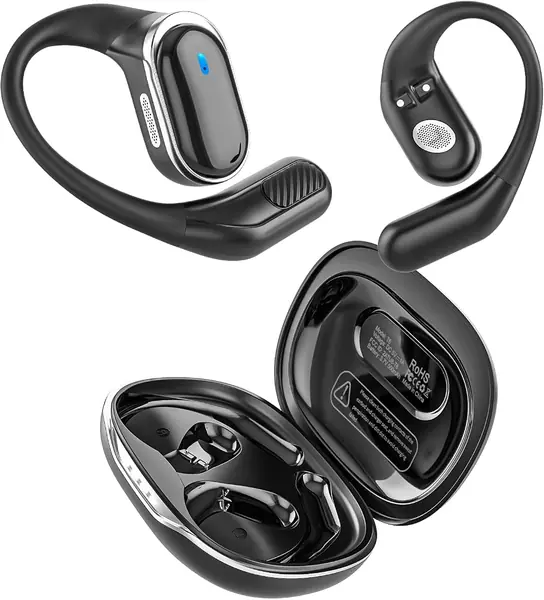
The T6 is an open-ear hook design with a fixed shape, and that is the first thing to check. If the hook sits close to your ear and does not press on glasses, it is a comfortable, lightweight pair for daily runs. If it floats too far out, no amount of battery life will fix the fit. The 80-hour case and IPX7 protection are the headline features, but the shape is the deciding detail.

We like the open-ear approach for runners who want traffic awareness, and the T6 keeps the canal clear without the pressure of an in-ear tip. The 80-hour total playtime means the case can go a long time between charges, and the IPX7 rating covers sweat and rain. The sound is clear enough for podcasts and everyday music, though the bass is not as full as a sealed design. The touch controls are simple once you learn the taps.

We put the T6 in also-consider rather than a top tier because it is a simpler open-ear design. The Soundcore V20i gives you four positions for a similar open-ear feel, and the Sport X20 gives you a sealed fit with noise cancellation. The T6 is the right choice when the fixed hook happens to match your ear and you want the longest battery in a budget open-ear.

The charging case is the part that earns its keep: it turns a budget open-ear into a pair you can forget to charge. If the T6 shape works for you, it is a lot of open-ear runtime for the money.

Pros

  • 80-hour total playtime with case
  • IPX7 protection for sweat and rain
  • Open-ear comfort with lightweight hooks

Cons

  • Fixed hook is not adjustable
Our verdict

The TRAUSI T6 is a budget open-ear with huge playtime and comfortable hooks, as long as its fixed shape suits your ears.

Check Latest Price
7

JBL Soundgear Clips Style-Led Awareness

80 /100
TKZ Score Excellent

Key details

Fit
Memory wire hooks
Battery Life
8 hrs buds; 32 hrs case
Water Resistance
IP54
Driver
11mm dynamic
View on Amazon

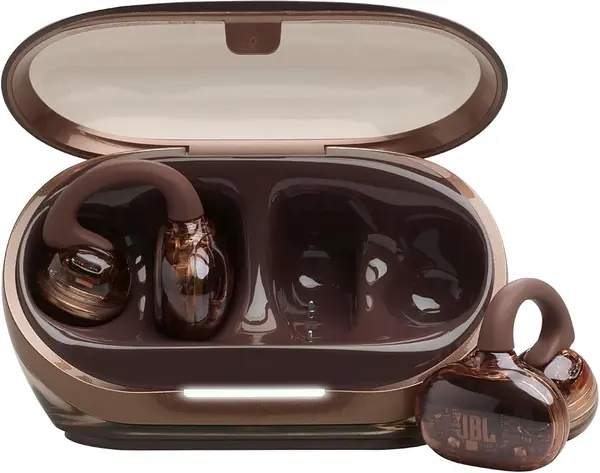
Most running earbuds look like gym equipment. The Soundgear Clips do not. The copper finish and jewelry-like clip shape are the first things you notice, and they are the reason this pair earns a place in a roundup that otherwise leans on waterproofing and battery numbers. The open-ear design keeps the canal clear, and the memory-wire hook is covered in a soft, flexible material that is meant to sit on the ear for hours.

The 11mm driver with Adaptive Bass Boost gives the Soundgear Clips more low-end than you might expect from an open-ear design, and the four mics with AI-trained noise reduction are set up for calls. Battery life is rated at 8 hours in the buds and 32 hours with the case, which is enough for daily runs and a few commutes. The touch controls and JBL Headphones app let you adjust EQ and the ambient sound.

We like the clip for everyday wear because it does not push into the ear canal and it stays put during a run. The IP54 rating covers sweat and dust, and the copper finish is the detail that sets it apart. The case is compact enough for a bag, and the open-ear shape keeps you aware of your surroundings.

We rank it as an also-consider because it is a style-first open-ear. If you want a pair that looks good away from the gym and keeps you aware on easy runs, it is a comfortable, distinctive choice. The copper finish is the detail that makes it feel less like gym gear and more like something you leave in.

Pros

  • Distinctive copper finish
  • Comfortable memory-wire hook
  • Open-ear awareness with 32-hour case

Cons

  • IP54 protection is the lowest here
Our verdict

The Soundgear Clips are the style-led open-ear pair: comfortable, distinctive, and fine for sweaty runs, though IP54 protection is the limit.

Check Latest Price

How We Tested Running Earbuds

We started by pulling every pair marketed for running and gym use, then filtered on three things: a hook, clip, or wing that shares the job of staying put; a water-resistance rating of IPX5 or better; and Bluetooth 5.3 or newer with multipoint so a pair could hold a phone and a watch at once. That left 13 pairs, from open-ear clips to sealed buds with rotatable hooks, which we ran in for six months across treadmill intervals, outdoor tempo runs, a rainy 10-miler, and plenty of sweaty gym sessions.

On the first run in each pair, I counted every time I touched the bud — a push, a wiggle, a full re-seat — and anything that needed adjusting more than twice in five miles got pulled from hard workouts. Comfort was judged at hour two, not minute ten: I wore each pair through a full workday and noted pressure behind the ear or soreness inside the canal.

For sound, we played the same bass-heavy playlist and listened for whether the low end held together at high volume and whether wind noise crept in on fast downhills. Noise cancellation got checked on a busy road and next to a running lawnmower, with a colleague talking at normal volume to see what still got through.

Battery came from a log rather than a claim: we started each pair at full charge, ran them down at a realistic volume, and counted how many charges the case delivered before it quit. We paired each set to both a phone and a watch, then left the phone in a locker room to see how far we could walk before the signal broke, and kept notes over the months on hinges, buttons, and whether sweat had worked its way into anything.

How to Choose Wireless Earbuds for Running

Start With Fit and Stability

Fit is the first spec we judge, because a loose earbud ruins a run faster than average sound does. Ear hooks wrap over the ear, clip-on designs pinch the outer ear, and sealed in-ear buds rely on tip pressure. Adjustable hooks are the safer choice if you sit between sizes; a fixed hook either fits or it does not. Look for a shape that stays put when you turn your head and does not press on a hat or sunglasses. The best fit is the one you forget about by mile one.

Match Water Protection to Your Sweat

Water protection is not binary. An IPX4 rating handles light sweat and splashes; IP55 adds dust protection and stronger water resistance; IPX7 and IP68 tolerate more sweat, rain, and rinsing, though not swimming unless the maker says so. Heavy sweaters and humid-climate runners should prioritize IPX7 or IP68. We treat an unrated water-resistant claim as a fair-weather feature, not a guarantee for a rainy long run. Dry the buds before they go back in the case.

Choose Open-Ear or Sealed

Open-ear designs leave the canal clear, so you hear traffic, footsteps, and a running partner. Sealed in-ear buds block more noise and can add active noise cancellation or transparency modes. We recommend open-ear for road and trail runners who need awareness, and sealed buds for treadmill or gym sessions where focus matters. If you choose sealed, make sure transparency mode sounds natural enough that you can use it at a curb. The wrong choice here is the one that makes you nervous to cross a street.

Look Beyond the Single-Charge Number

Battery claims usually combine the buds and the case. A single-charge figure of around eight hours covers most runs and a few commutes; the case total is what matters for a week of workouts. Connection stability is the other long-run issue: Bluetooth 5.3 or newer is the baseline we look for, and multipoint pairing helps if you switch between a phone and a watch. Button controls are easier to use with sweaty hands than touch surfaces, though touch gives you more app control.

Frequently Asked Questions

Final Verdict

For most runners, the Soundcore Sport X20 is the pair we recommend. It has the strongest weatherproofing here, hooks that adjust in two directions, and both noise cancellation and transparency for gym days and road days. If you want open-ear awareness for less, the Soundcore V20i is the budget answer. If you want open-ear awareness with IP68 protection, choose the JBL Endurance Zone. The deciding question is simple: do you want to shut the world out, or hear it coming?