Best Tactical Smartwatches of 2026

A tactical watch is a small promise that the rest of your gear can fail and you'll still know where you are. The catch is built into the category: a battery that runs for weeks and a screen you can read in direct sun rarely come from the same design, and the spec sheet won't tell you which one a watch gave up. What actually separates a good one is quieter — whether the GPS holds its line under tree cover, whether the case survives a doorframe, whether the menus still make sense when your hands are cold.

I've worn a watch over my jacket sleeve for years and assumed the bulk was just the price of durability. Six months with 12 of these changed my mind about which specs matter. Most of that time was spent on trails, in the yard, in the shower, and on a jobsite — not at a desk. The feature I dismissed as a gimmick, the built-in flashlight, is now the one I reach for every night.

Here's what nobody tells a first-time buyer: battery ratings are usually measured with GPS off and the screen dim, so a watch rated in weeks may give you days once you start tracking routes. The picks below survived the honest version of that math.

The Best Tactical Smartwatches

1

Garmin Instinct 3 Tactical Best Overall
89 /100
TKZ Score Excellent

Key details

GPS
Built-in GPS
Battery Life
Up to 40 days
Water Resistance
100 m
Weight
2.05 oz
View on Amazon

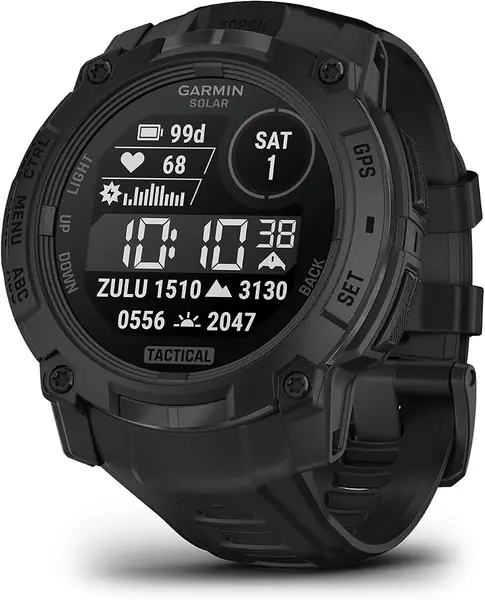
Stealth mode is the clearest line between a tactical watch and a rugged one. Switch it on and the Instinct 3 Tactical stops logging and sharing position, which is the entire point when where you are is the sensitive part of the job. Around it sits the rest of the kit you cannot get elsewhere in this group: a kill switch that wipes the device, jumpmaster and waypoint projection, a dual-position GPS format, and an Applied Ballistics solver that needs a one-time in-app purchase before it does anything.

That combination is why it is our top pick. We wore it as a daily watch and then left the phone in a pack to see whether the navigation could carry a day on its own, and it is the only watch here that made the phone feel irrelevant. Solar is the quiet advantage: a few hours outdoors most days and the 40-day rating stops being a planning number, so a two-week trip does not need a cable. At 58 grams on a 50 mm case, it also wears lighter than the size suggests.

The screen is where the money went elsewhere. A 1.1-inch LCD is the smallest and plainest display among these picks, with no AMOLED punch and no always-on color, but it is readable in direct sun, it sits recessed under the bezel, and the fiber-reinforced case with a metal-reinforced bezel brushes off knocks that would mark steel. We stopped thinking about the screen within a week.

Pros

  • Stealth mode, kill switch, and jumpmaster tools
  • Solar charging with a 40-day battery rating
  • Built-in flashlight and 100 m water resistance

Cons

  • Bluetooth link drops when the phone is away
  • Smallest display of the picks here
Our verdict

If your work can put you out of signal, this is the one to buy: the only watch here that goes dark, navigates by satellite, and runs for weeks on sunlight.
Check Latest Price
2

CARBINOX Edge Best Value

84 /100
TKZ Score Excellent

Key details

GPS
Dual-frequency L1+L5
Display
1.96 in. AMOLED, 1000 nits
Battery Life
Up to 25 days
Rugged Rating
MIL-STD-810H, IP69K, 5ATM
View on Amazon

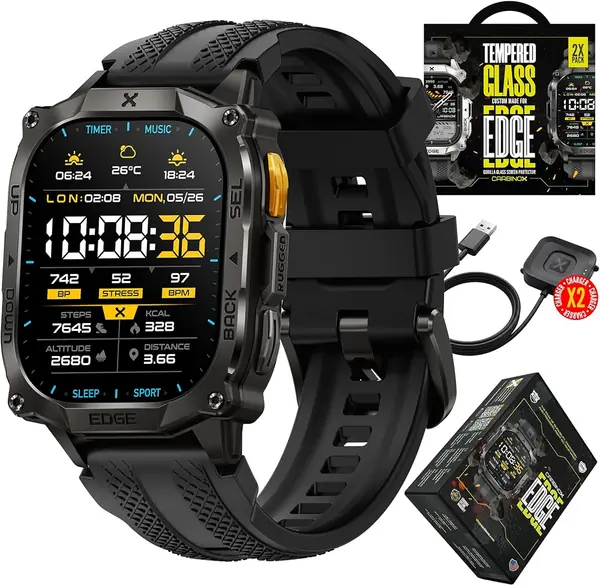
Dual-frequency L1+L5 GPS, a MIL-STD-810H test standard, Corning Gorilla Glass, and IP69K sealing are the specifications you expect to pay a great deal more for. The Edge is the only watch here that pairs phone-free navigation with a genuinely hard case, and it does it for considerably less than the Garmin.

We came to it expecting a spec sheet and found the details better than that. The 1.96-inch AMOLED at 1,000 nits is bright enough that sun stops being a factor, the 22 mm quick-release band is a two-second swap, and the case has real mass, which we like in a work watch and smaller wrists may not. Twenty-five days is the quoted basic-watch figure; run GPS and a bright screen and you will charge it far more often, as with every watch here.

Two practical notes. The hiking profile is worth a trial before a trip, because as delivered it does not log a GPS track, so choose a different activity when you want the route saved. The sensors are ordinary as well: heart rate and sleep are trend material rather than training data. What stands out is the backing, since a limited lifetime warranty is the most generous coverage in this group, and that plus dual-band navigation in a case this tough is why we call it the value pick.

Pros

  • Dual-frequency L1+L5 GPS across six systems
  • MIL-STD-810H build with Gorilla Glass and IP69K
  • 1.96-inch AMOLED rated at 1,000 nits

Cons

  • Large, heavy case on smaller wrists
  • Some units stop working early
Our verdict

We recommend the Edge to anyone who wants a hard-wearing tactical watch with genuine dual-band navigation and does not need Garmin's tactical software.

Check Latest Price
3

Tiwain ZK67 Best Budget Field Watch

83 /100
TKZ Score Excellent

Key details

GPS
Built-in, six systems
Display
1.43 in. AMOLED
Battery Life
Up to 10 days
Water Resistance
IP68, 1.5 m
View on Amazon

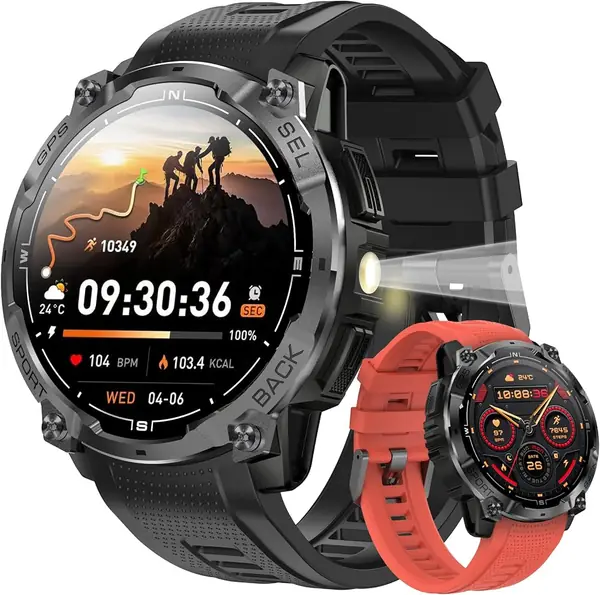
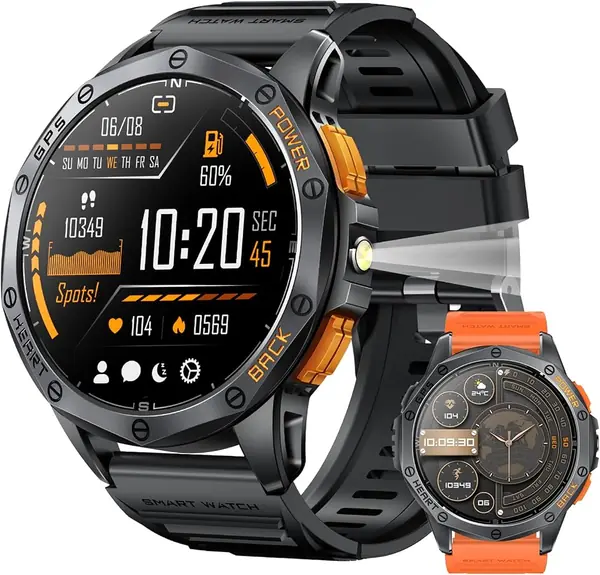
The flashlight is the tactical feature you will actually use, and it is the reason we reach for the Tiwain before the two watches that cost less. It fires from a side button and throws usable light out to about 20 meters, enough to find a trail marker, read a page, or sort a pack in a tent without waking anyone. A compass, six-constellation GPS, and a 1.43-inch AMOLED sit behind it.

The parts that matter on a trip are all present rather than promised. The AMOLED is sharp at 360 by 360, the 530 mAh cell is rated to about 10 days, and two bands, black silicone and orange, come in the box on 22 mm lugs. For someone buying a first field watch, that is a better use of money than spending less and giving up the light.

The other caution is the phone side. Pairing and syncing are where budget watches come unstuck, so set it up at home on Wi-Fi before you need it in the field, and check that the app you already use will accept the data before you commit.

Pros

  • Built-in flashlight rated to about 20 meters
  • Six-satellite GPS with a compass
  • 1.43-inch AMOLED and a 10-day rating

Cons

  • Not rated for swimming (IP68, 1.5 m)
  • Durability is inconsistent over the first year
Our verdict

For a first field watch we point people here: a usable flashlight, a compass, and satellite GPS at the low end of the budget.

Check Latest Price
4

DEKELIFE C32PRO First Tactical Watch

82 /100
TKZ Score Excellent

Key details

GPS
Built-in GPS
Display
2.02 in. AMOLED
Battery Life
Up to 15 days
Water Resistance
2 ATM
View on Amazon

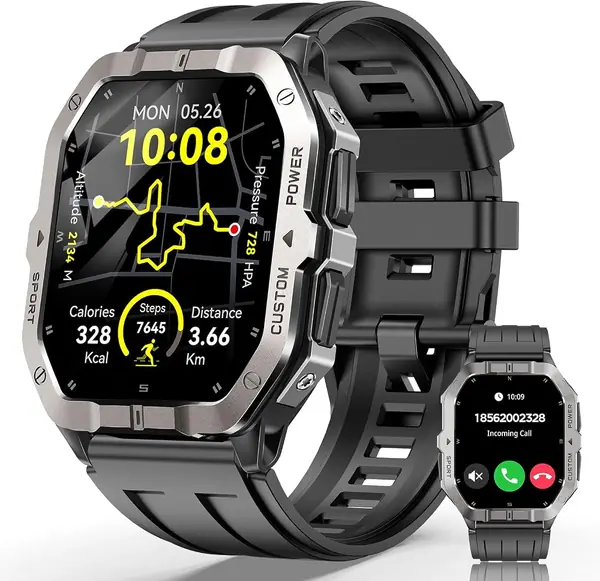
The C32PRO is the least expensive route into a watch with real built-in GPS and a screen you can read outdoors, and that combination is why it is on this list at all. The 2.02-inch AMOLED is the biggest panel in the group by a wide margin, nearly double the Garmin's diagonal, and the aluminum bezel over a composite body gives it a heft that reads as costing more than it does.

What we appreciate about it is how little it asks of you. Setup is quick, the 450 mAh cell is rated to about 15 days, calls come through the built-in speaker and microphone, and the watch faces are the loud, readable kind that suit a work glove. As a first tactical watch, or as a second one for a job where a Garmin would be a liability, it makes sense.

The risk is longevity, and it is the pick most likely to quit on you: buy it somewhere with a straightforward return window and put it through a hard first month. The health numbers are a rough guide too, since steps and heart rate drift from what a chest strap tells you, which is normal at this end of the market but worth knowing before you train by them.

Pros

  • 2.02-inch AMOLED, the largest screen here
  • Built-in GPS rather than phone-tethered
  • Bluetooth calling through speaker and microphone

Cons

  • 2 ATM, so rain and splashes only
Our verdict

The biggest screen and the lowest outlay here, with genuinely built-in GPS: a fine first tactical watch or a spare to knock around.

Check Latest Price
5

RUXINGX C32 Big-Screen Basics

81 /100
TKZ Score Excellent

Key details

GPS
Built-in, six systems
Display
2.02 in. touchscreen
Battery Life
Up to 30 days
Water Resistance
2 ATM
View on Amazon

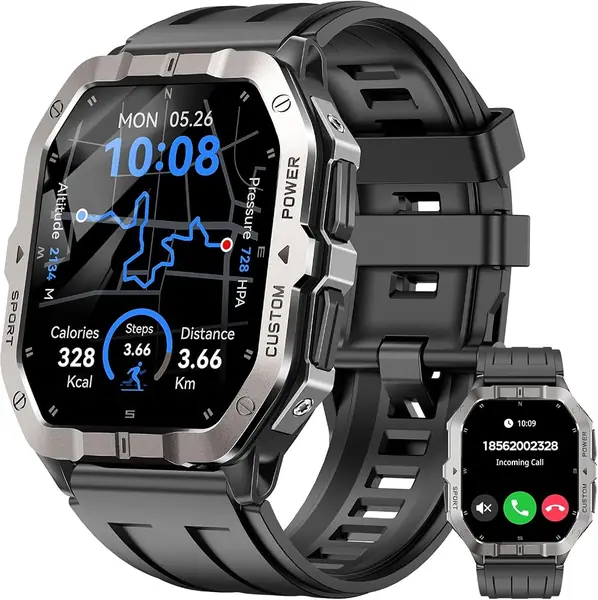
On paper the C32 is the most complete inexpensive watch here: built-in GPS across six satellite systems, a 2.02-inch touchscreen, military-grade testing claims, Bluetooth calling, and a 450 mAh battery rated to 30 days. Read down a product listing and this one wins the column comparison.

Where we are more cautious is everything the spec line cannot show. Six constellations are only as good as the antenna behind them, and this is the newest name in the group, so buying one means accepting some risk on software updates and support down the road.

Buy it with a plan: load a known route in the first week, walk it with the phone left at home, and keep the box until the track matches the ground you know. Do that and we think the RUXINGX is a sensible way to find out whether a big-screen tactical watch suits you at all.

Pros

  • Built-in GPS with six satellite systems
  • 2.02-inch touchscreen with large type
  • 30-day battery rating from a 450 mAh cell

Cons

  • 2 ATM, so keep it out of the water
  • Big square case on a small wrist
Our verdict

A complete hardware list for very little money, and a reasonable gamble if you want a big screen and satellite GPS without a premium brand.

Check Latest Price
6

FESMEY Rugged GPS Smartwatch Best for Trail and Everyday

80 /100
TKZ Score Excellent

Key details

GPS
Built-in GPS
Display
1.43 in. AMOLED, 466 x 466
Water Resistance
3 ATM
Sensors
Compass, altimeter, barometer
View on Amazon

A 466-by-466 AMOLED is the sharpest display in this roundup, and at 1.43 inches it is dense enough that map contours and small type hold together. It is always-on as well, so a glance gives you the time without the wrist-flick gesture that gives away a position after dark. Add a compass, altimeter, and barometer and the FESMEY carries the fullest sensor stack of the budget picks.

We like it best as a hiking and everyday watch. The barometer gives you a pressure trend you can act on before weather arrives, the compass settles which fork to take without digging a phone out of a pack, and built-in GPS across four constellations does the tracking. It is also the least conspicuous of these on the wrist, which matters under a cuff or a glove.

Choosing between this and the Tiwain comes down to what you look at most: the FESMEY has the sharper, always-on screen and the barometer, the Tiwain has the brighter flashlight. For us the display wins, because it is the part you check a hundred times a day and the part that has to work in gloves and glare.

Pros

  • 466 x 466 AMOLED, sharpest display here
  • Compass, altimeter, and barometer built in
  • Built-in GPS across four constellations

Cons

  • 3 ATM, so rain and handwashing only
Our verdict

Buy it for the screen and the barometer: no budget pick here gives you a better view of a map, and none packs a fuller sensor set.

Check Latest Price

How We Chose and Tested These Tactical Watches

We started with every watch sold as tactical or military-grade that had built-in GPS, then filtered out anything missing a compass and altimeter, a stated water-resistance rating, or a case that looked like it could take a hit. That left a shortlist ranging from budget imports to a premium outdoor model, and we bought 12 of them at retail.

Testing ran six months, spring into fall. Each watch got at least two weeks of daily wear, and a rotating pair came with me on a four-day backcountry trip where I left GPS running all day and logged the battery percentage morning and night. The rest of the time they lived the way these watches actually live: mowing, splitting wood, washing the truck, showering, and one long afternoon of pressure-washing a deck.

Durability got the least gentle treatment — dropped from waist height onto concrete, banged against doorframes, bezels scraped along brick, with notes on scratches, rattles, and whether the buttons still clicked. Each one also sat under a running faucet for five minutes while I checked for fogging behind the glass. For connectivity I paired every watch to both an iPhone and an Android phone, walked out of Bluetooth range, and timed the reconnect; a few needed a manual trip back into the settings menu. Calls were placed from a windy parking lot to hear how the mic handled background noise.

Accuracy meant running each GPS track against a loop I know to the tenth of a mile, checking the compass against a baseplate compass and the altimeter against a surveyed trail marker, then matching heart rate to a chest strap during intervals. I read the screens in noon sun and worked the menus with gloves on. Last, we weighed what each watch asked of you against the features that genuinely worked, and whether it looked like a tool or a costume.

How to Choose a Tactical Smartwatch

Start With GPS That Lives in the Watch

Plenty of watches in this aisle advertise GPS and mean the phone's. A watch that only mirrors your phone is a display strapped to your wrist: it stops navigating the moment the phone is dead, wet, or left in a vehicle. Look for the word built-in, then count the satellite systems, because a fix in a canyon or under heavy tree cover depends on how many constellations the watch can hear at once.

Dual-frequency L1+L5, which the Carbinox Edge and the Garmin both carry, is the step up worth paying for if you spend time among buildings or rock walls where signals bounce. Before you trust any of them, walk a route you already know with the phone in airplane mode.

Decode the Rugged Ratings

Three different ratings get sold as toughness and they measure different things. MIL-STD-810H is a test standard covering drops, vibration, dust, and temperature. IP68 and IP69K describe dust and water ingress, the second adding high-pressure spray. ATM is water pressure: 2 and 3 ATM mean splashes, 5 ATM means you can swim, and 10 ATM means you can dive.

The trap is a military smartwatch title with no standard named behind it sitting next to a 2 ATM rating that rules out a river crossing. Match the rating to what you will actually do, and if you swim, make 5 ATM the floor.

Read Battery Claims as a Range

Every figure quoted on these watches assumes the GPS is off. Turn on tracking, a bright screen, and the flashlight and the number falls hard, so shop from the longest figure and halve it for a trip where you will track a route daily. If what is left still covers the time between outlets, the battery is big enough.

Solar is a top-up, not a charger. On the Garmin it stretches standby for weeks and will not carry a day of tracking; treat it as insurance against forgetting the cable rather than a replacement for one.

Pick a Screen for the Light You Are In

The AMOLED panels here, from 1.43 to 2.02 inches, are vivid, sharp, and easy to read in direct sun at high brightness, and they draw more power. The Garmin's smaller LCD is the opposite trade: less impressive on a spec sheet, easier to read in harsh sun, and cheaper to run for a month.

If you work under night vision, check for a low-light or night-vision display mode before you buy, because a bright color panel is the wrong tool under tubes. For everyone else, daylight brightness matters more than resolution.

The Tactical Tools That Change a Task

Stealth mode and a kill switch are the two features that change behavior rather than styling: one stops the watch logging and sharing position, the other wipes the device. A ballistics solver matters if you shoot long range, and on the Garmin it costs extra to unlock. Jumpmaster and waypoint projection serve a narrow set of users.

For most buyers the built-in flashlight is the tactical feature that earns its keep, because you will use it weekly. Then check the case against a watch you wear around the clock: a 58-gram polymer case and a big stainless one are different commitments by the end of a shift.

Frequently Asked Questions

Final Verdict

The Garmin Instinct 3 Tactical is the watch we recommend to anyone whose job or trips can put them out of signal: stealth mode, satellite navigation, a flashlight, and solar charging that turns the battery into an afterthought. Pay the premium if the tactical tools are the reason you are buying in the first place.

If they are not, the Carbinox Edge delivers dual-band GPS and a MIL-STD-810H case for a great deal less, and the Tiwain covers a flashlight, a compass, and six-system GPS at the bottom of the budget. Choose the one whose compromise you can live with.