Best-Sounding Wireless Earbuds of 2026, Tested and Ranked

Earbuds are the most demanding piece of tech I own. Mine have to survive a commute, a run, a string of work calls, and the bottom of a tote bag without the sound thinning out or a bud dropping the connection at a crosswalk. The trouble is that the thing you care about most, how they actually sound, is the one thing a spec sheet can't tell you.

Over six months my team and I lived with 14 pairs, and the app EQ turned out to matter as much as the price tag: presets are rarely right for your ears, but a real custom EQ can rescue a set that's too bass-heavy out of the box. These picks also got the seal, the noise cancellation, the connection, and the battery right, which are the parts that decide whether you still reach for a pair in month six.

Build quality and value are where cheap pairs give themselves away, and comfort is the thing you can't judge from a photo. Everything below earned its spot on sound first.

Our Full Reviews

1

Samsung Galaxy Buds 4 Pro Best Overall
91 /100
TKZ Score Outstanding

Key details

Noise Canceling
Adaptive ANC 2.0
Water Resistance
IP57
Audio Codec
24-bit hi-res
Driver Design
Two-way speaker with tweeter and woofer
View on Amazon

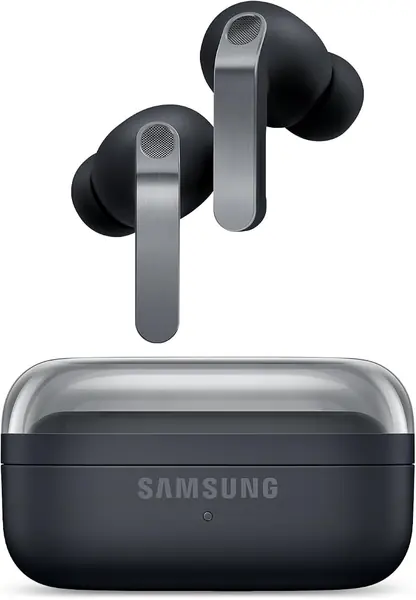
Two speakers sit in each bud: a tweeter for the highs and a woofer for the lows. Nothing else in this guide splits the job that way — every other pair runs a single full-range driver — and the effect is easiest to hear on busy recordings, where cymbals and acoustic guitar stay separate instead of smearing into the bass line.

That design is why we name these the best-sounding pair here, and it is the one physical advantage in this group that money buys outright. Above the drivers, a 24-bit hi-res codec carries the detail and Adaptive ANC 2.0 re-tunes itself as the noise around you shifts. The catch sits on your end: the hi-res codec is a Samsung ecosystem feature, so a Pixel or an iPhone cannot feed these the same signal, and off a Galaxy phone you are paying for tuning rather than bitrate.

Comfort held up for us over long sessions. The buds are shaped to hug the ear instead of pressing into it, and the tips swap out if the pre-fitted size runs small. IP57 covers sweat and rain, so a workout or a drizzle will not end them. Playtime is the one figure Samsung does not quote, which is a gap worth knowing about; charge these after a day of use until you learn your own rhythm.

Pros

  • Two-way speaker keeps highs and lows apart
  • 24-bit hi-res audio codec
  • Adaptive ANC 2.0 adjusts in real time
  • IP57 shrugs off sweat and rain

Cons

  • Costs far more than any other pick here
Our verdict

We recommend these to anyone whose first question is how the music sounds, as long as the phone in your pocket can feed them a hi-res signal.
Check Latest Price
2

Soundcore P20i Best Value

90 /100
TKZ Score Outstanding

Key details

Drivers
10mm dynamic
Bluetooth
5.3
Battery With Case
30 hrs
EQ Presets
22 in the app
View on Amazon

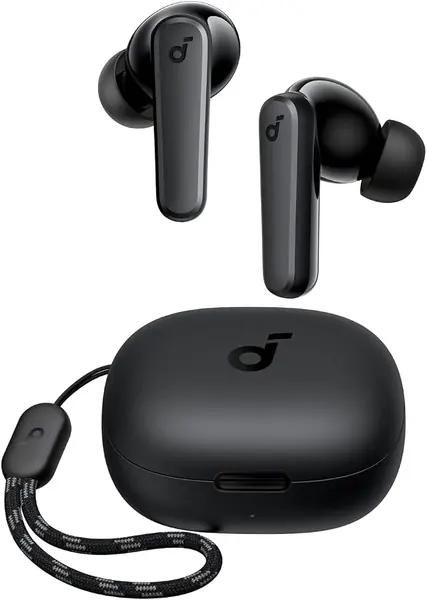
The P20i costs a fraction of our top pick, and it closes more of that gap than the price suggests. Two things carry it: 10mm drivers with the bass pushed up hard, and an app that lets you push it back down. That combination is why we call these the value pick — out of the box they are a party pair, and two minutes with the 22 EQ presets turns them into something you can listen to an audiobook on.

The app earns its place beyond EQ. You can remap the touch controls, and Find My Earbuds makes a lost bud emit a tone until you locate it wedged under a couch cushion. We got more use out of that than we expected from a pair this small and this inexpensive.

Playtime stretches to 30 hours with the case, and the case carries a lanyard for a bag strap. Splash resistance covers a sweaty commute. Two caveats: there is no active noise canceling, so engine drone comes straight through, and the fit is the real question — the round shells do not lock in, and they work loose for some ears whatever tip goes on.

Pros

  • Big bass from oversized 10mm drivers
  • 22 EQ presets plus Find My Earbuds
  • 30 hours total with a lanyard case

Cons

  • No active noise canceling
  • Bass-forward tuning out of the box
Our verdict

Our value pick: we point bass lovers here first, and the 22-preset EQ app means you can tame the boom if it turns out to be too much.

Check Latest Price
3

TOZO T10 Best for Bass

89 /100
TKZ Score Excellent

Key details

Drivers
8mm dynamic
Water Resistance
IPX8
Playtime
55 hrs total
Case Charging
Wireless
View on Amazon

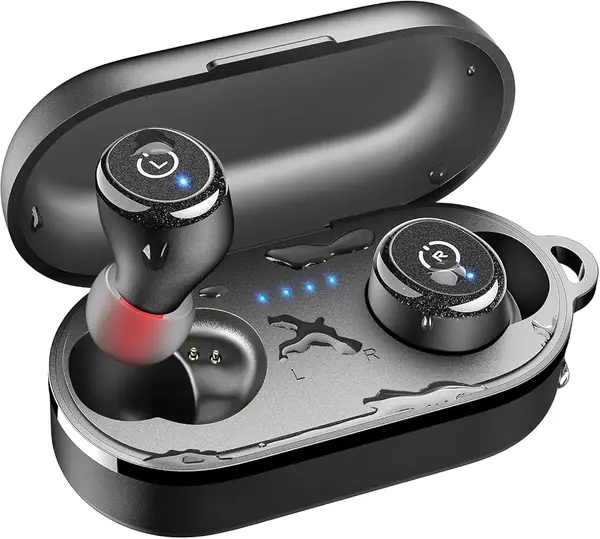
Set the T10's case on a wireless charging pad and it simply tops up — no cable, no flap, no hunting for the short USB-C cord at the bottom of a bag. It is a small convenience that ended up mattering more to us than any single feature, and it is the only case in this guide that charges without a wire.

The sound is why it made the list. The 8mm driver is tuned for deep bass, and 32 EQ modes in the TOZO app let you shift the balance when the low end overwhelms a podcast. There is weight down there that the smaller budget pairs cannot match, and the sealed in-ear fit blocks surrounding noise without any active circuitry. No canceling mode, though — that is the honest trade against the NC3 further down this list.

Playtime is 9 hours a charge and 55 with the case, and IPX8 means sweat and rain are non-issues. That endurance is the number we keep coming back to; it is the difference between a pair you charge nightly and one that lives in a bag for a week. The shells are chunky, though, and chunky shells in small ears work loose, so the seal producing all that bass is the first thing to check.

Pros

  • Deep bass with 32 EQ modes to tune it
  • 55 hours total, 9 per charge
  • Wireless charging case
  • IPX8 waterproofing

Cons

  • Chunky shells can work loose in small ears
  • No active noise canceling
Our verdict

If your library lives in the low end, this is the pair we recommend: deep bass, 55 hours of playtime, and a case that charges without a cable.

Check Latest Price
4

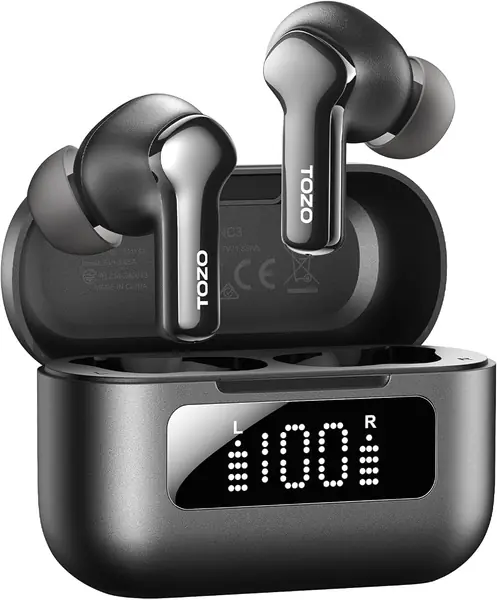
TOZO NC3 Best Noise Canceling

88 /100
TKZ Score Excellent

Key details

Noise Canceling
Hybrid ANC, up to 45dB
Playtime
68 hrs, 40 with ANC
Ear Tips
6 pairs, XS to XXL
Microphones
6 with ENC for calls
View on Amazon

Up to 45 decibels of hybrid noise canceling is the headline, and the practical effect is what matters: with a train's rumble pushed down, you can listen at a volume that leaves the detail intact. That is a sound-quality benefit even though it is not a sound-quality specification.

It is the pair we carry when the listening happens around other people. Hybrid canceling rated to 45dB, six pairs of ear tips from XS to XXL, six microphones with ENC for calls, and transparency a tap away when a platform announcement matters. Playtime runs 68 hours with canceling off and 40 with it on, and that gap is worth knowing before a long flight.

Two things to accept. The touch controls sometimes register a beat after your finger does, so pause between taps instead of double-tapping fast. And the seal is only ever as good as the tip you chose — six sizes give you a real chance at it, but small canals can still let these work loose mid-workout.

Pros

  • Hybrid canceling rated up to 45dB
  • Six tip sizes, XS through XXL
  • 68 hours total, 40 with canceling on
  • Six mics with ENC for calls

Cons

  • Touch controls respond a beat late
  • Can work loose during bending workouts
Our verdict

If you listen on trains, planes, or in a shared office, this is the pick: the strongest canceling here, plus six tip sizes that make a real seal achievable.

Check Latest Price
5

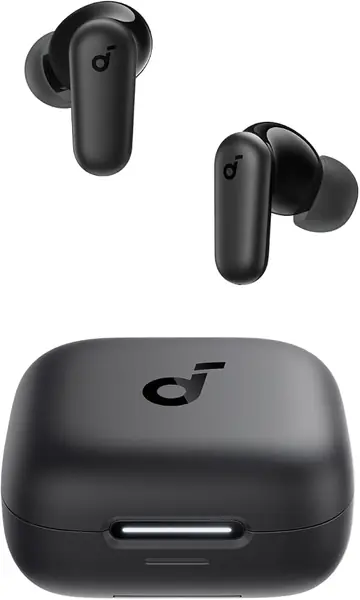
Soundcore P30i Best for Travel

87 /100
TKZ Score Excellent

Key details

Bluetooth
5.4
Noise Canceling
Adaptive ANC, up to 42dB
Case
Doubles as phone stand
Battery With Case
45 hrs, 25 with ANC
View on Amazon

Open the back panel of the charging case, stand your phone in the slot, and you have a kickstand for a tray table or a desk. It sounds like a listing gimmick and turns out to be the reason this case goes in the bag instead of another one.

The audio holds up. 10mm drivers with BassUp lifting the low end, adaptive canceling rated to 42dB that re-reads the room, transparency when a barista asks a question, and Bluetooth 5.4 — the newest version in this group. IP54 covers splashes rather than submersion, so rain is fine and a pool is not.

Playtime is 10 hours a charge and 45 with the case, dropping to 6 and 25 with canceling on. That is a flight and a layover, not a transatlantic round trip.

Where it gives ground to the NC3 is the quiet: wind noise gets through the canceling, which we noticed on walks far more than indoors. Three tip sizes is the other limitation. What you get in exchange is the stand and a set of features aimed at video and travel rather than at silencing a commute.

Pros

  • Case doubles as a phone stand
  • Adaptive canceling rated to 42dB
  • 45 hours total, 25 with canceling on
  • Bluetooth 5.4, the newest here

Cons

  • Wind noise gets through the canceling
  • Only three ear-tip sizes in the box
Our verdict

The pick for watching video on the move: the case props your phone, and the adaptive canceling and 45-hour battery make it a natural travel companion.

Check Latest Price
6

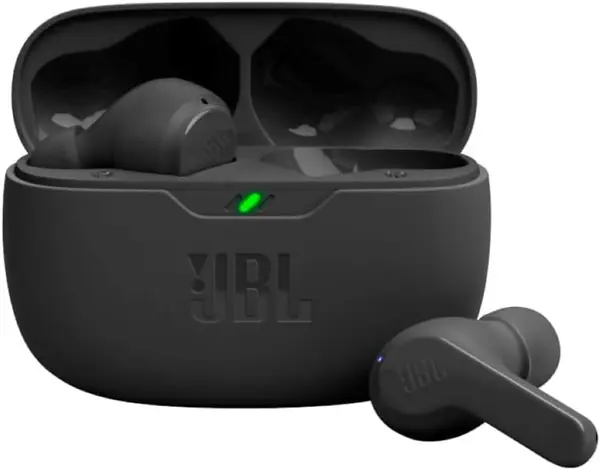
JBL Vibe Beam Best for Casual Everyday Listening

86 /100
TKZ Score Excellent

Key details

Drivers
8mm dynamic
Water Resistance
Splash and dust resistant
Battery
32 hrs total
Ambient Mode
Smart Ambient and TalkThru
View on Amazon

In a guide about sound, the first thing to say about the Vibe Beam is about fit, because a loose seal takes the bass with it. The closed, stick-shaped design does not lock in for every ear, and of everything here this is the pair most likely to work loose on a run.

That is a shame, because the tuning is fun. 8mm drivers on JBL's Deep Bass curve, a closed design that shuts out some surrounding noise on its own, and 32 hours total between the buds and the case, with speed charging for the mornings you forget. TalkThru is the sleeper feature: it drops the music and pipes your own voice back so you can order a coffee without pulling a bud out, and VoiceAware sets how much of yourself you hear on a call.

Detail is the trade-off. This tuning leans on the low end, and we wish JBL gave its app the EQ depth Anker and TOZO do, because that would be the fix. Splash and dust resistance handles weather, and the price sits in the middle of this group rather than at the bottom.

Pros

  • JBL Deep Bass tuning with real punch
  • TalkThru for quick conversations
  • 32 hours total with speed charging

Cons

  • Works loose during runs and workouts
  • Bass-first tuning gives up detail
Our verdict

A bass-forward pair with a genuinely useful TalkThru mode — we recommend it if stem-style buds have held in your ears before.

Check Latest Price
7

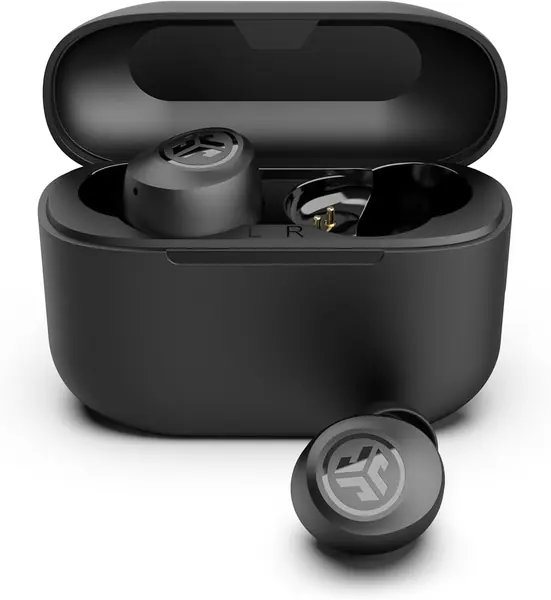
JLab Go Air Pop+ Small-Case Portability

85 /100
TKZ Score Excellent

Key details

Bluetooth
5.3
Case
Smaller than a credit card
Battery
35 hrs total
EQ
EQ3 via app
View on Amazon

Smaller than a credit card: that is the case, and it is the reason the Go Air Pop+ is the pair we recommend to anyone whose last set died at the bottom of a bag. The buds are 15% smaller and 40% lighter than the previous generation, so the whole thing vanishes in a jeans pocket.

The features do the rest of the arguing. EQ3 in the JLab app lets you pick a sound signature and adjust it, Be Aware mode lets the room back in, Google Fast Pair handles Android setup, and Bluetooth 5.3 keeps the connection current. Playtime is 9 hours in each bud with another 26 in the case, and the warranty runs two years — longer than the JBL pair and longer than Anker's coverage.

What you trade away is the top of the sound. The tuning is pleasant and the app gives you somewhere to go with it, but the low end does not carry the weight of the T10 and the separation is not close to the Samsung pair. As a first set, a spare in a bag, or a pair for a kid, we think the arithmetic is hard to argue with.

Pros

  • Case smaller than a credit card
  • EQ3 app with adjustable sound
  • Two-year warranty
  • 35 hours total playtime

Cons

  • No active noise canceling
Our verdict

Our budget pick: the smallest case here, an app you can actually tune, and two years of warranty coverage.

Check Latest Price

How We Tested 14 Pairs of Wireless Earbuds

We built the shortlist by reading spec sheets and cross-checking them against what buyers actually complained about, then narrowed to 14 pairs that covered the range: budget buds, noise-canceling models, and a few flagships. Every pair that made it had a companion app, because we wanted to see whether custom EQ could close the gap between a cheap set and an expensive one. Then we used them for six months the way people actually use earbuds: on commutes, in an open-plan office, on runs, on flights, and on calls that ran long.

Listening was the core of it. We built a reference playlist that swung from orchestral to hip-hop to spoken-word podcasts, played pairs back to back at matched volume, and wrote down what we heard: whether the bass blurred the mids, whether cymbals turned harsh when we pushed the volume, whether a voice sounded like a voice. We also opened the app on every pair, timed how long pairing took, and worked through the presets and any custom EQ to see how much control we actually had.

The rest was living with them. We timed playtime from a full charge with noise cancellation on and off, and noted how far off the claimed number each pair landed. We swapped tips until we got a seal, then wore each pair for a three-hour stretch and logged where they started to ache. We walked a block from the phone to see where the signal dropped, tossed pairs loose into bags, and checked hinges, nozzles, and case lids for wobble after the first month. Noise cancellation got the train platform and a loud café. At the end we asked one question of each: would we buy it again with our own money?

How to Choose Wireless Earbuds for Sound

Driver design: one speaker or two

Most wireless earbuds run a single full-range dynamic driver that handles bass and treble with one diaphragm. A two-way design splits the work between a tweeter and a woofer, and in this group only the Samsung pair does it. That separation is the one physical advantage a buyer can pay for directly, and it shows up as detail rather than volume.

Driver size is a rougher guide. Ten- and 12-millimeter drivers generally move more air and produce more bass, while a well-tuned 8mm driver can still sound full. We weight design and tuning over the number on the box.

The seal matters more than the driver

An earbud that does not seal loses its bass first and its detail next, and no driver size makes up for it. That is why the number of ear tips in the box is a real specification: the TOZO NC3 ships six pairs from XS to XXL, while the Soundcore P30i ships three.

Here is the trap. A large driver in a leaking ear sounds thinner than a small driver seated properly, so work up to the largest tip that stays comfortable before judging any pair. If stem-style buds have never held in your ears, do not start with one.

Codecs and Bluetooth: match the pair to your phone

Bluetooth pairs with anything; high-resolution audio does not. A 24-bit hi-res codec needs a source device that supports the same codec, which is why the Samsung pair's biggest audio claim pays off mainly on a matching Galaxy phone. The rest of us get the tuning and not the bitrate.

For everyone else the checklist is simple: Bluetooth 5.3 or newer for a stable link — 5.4 on the P30i is the newest here — and the maker's app available on your phone for EQ. Decide which of those you will actually use before you pay extra for a codec.

Noise canceling changes how much detail you hear

Active noise canceling is not a sound-quality feature on paper, but it works like one: cut the rumble of a train and you can drop the volume, and low volume is where detail survives. The cost is playtime — the NC3 runs 68 hours total with canceling off and 40 with it on, and the P30i drops from 45 to 25.

Transparency modes matter just as much day to day. If you listen mostly at a desk, passive isolation plus a good seal does the job without the battery penalty.

Playtime, the case, and the second year

Compare per-charge time separately from total time. Nine hours in the buds plus 55 in the case covers a trip differently than ten plus 45, and canceling shortens both numbers. Then look past the first year: warranties here run from one year on the JBL Vibe Beam to two on the JLab and the Samsung pair, with Anker at 18 months.

Battery capacity fades with every charge cycle no matter the brand, so on a pair you plan to keep, coverage is worth more than a slightly larger case.

Frequently Asked Questions

Final Verdict

For pure sound, the Samsung Galaxy Buds 4 Pro is the pair we recommend. A tweeter and a woofer in each bud is a real advantage in this group, and nothing else here separates instruments the same way. The requirement sits on your side of the pairing: if your phone cannot feed it the hi-res codec, the premium is harder to justify.

On a budget, the Soundcore P20i delivers the bass and a 22-preset EQ app for a fraction of the money. And if most of your listening happens on transit, the TOZO NC3's canceling buys you more usable quiet — and therefore more detail at a safe volume — than any tuning on this page.